


 Fleet Management
 Route optimization
 Shuttle Transportation
 Delivery Management
 School Bus Transportation
 Ride Sharing Management
 Airport Transfer Booking
  Vehicle inspection
 Car Rental Management
 Trucking & Logistics
 Food & Beverage
 E-Commerce
 Passenger Transit
 Delivery
 School & Corporate
Cloud-Based Fleet Management Software Cost in 2026: Pricing, Features & Hidden Fees Explained
How much does cloud-based fleet management software cost in 2026? Most cloud-based fleet management software is priced per vehicle, per month — and across the market that ranges from roughly $3 to $50+ per vehicle monthly, depending on features, fleet size, and vendor, according to 2026 industry pricing roundups. Capterra data puts a typical entry-level plan near $128 per month and premium plans around $856 per month. But the subscription is only part of the picture: hardware, onboarding, integrations, and contract terms can quietly add as much to your bill as the software itself.
That gap between the advertised price and the true cost is exactly why fleet operators get surprised at renewal. This guide breaks down what cloud-based fleet management software actually costs in 2026 — the pricing models, the features that drive the number up or down, and the hidden fees most vendors don’t put on the pricing page.
How Much Does Cloud-Based Fleet Management Software Cost in 2026?
There’s no single sticker price, because cost scales with what you need. That said, the market sorts fairly cleanly into tiers. The ranges below reflect 2026 third-party pricing roundups and review aggregators; treat them as directional, since most vendors quote based on fleet size and feature mix.
| Tier | Typical range (per vehicle / month) | What you generally get |
|---|---|---|
| Budget / entry | ~$3–$15 | Core GPS tracking, basic maintenance scheduling, simple reporting |
| Mid-market | ~$20–$35 | Advanced telematics, compliance tools, driver behavior, dispatch |
| Enterprise / AI | ~$35–$50+ (some $50–$100+) | Video telematics, predictive maintenance, route optimization, AI analytics |
Source: 2026 fleet-software pricing roundups and review aggregators (e.g., Capterra).
Two things to take from this. First, the cloud-based fleet management software cost you see advertised is almost always the per-vehicle software fee alone. Second, many capable platforms — including more customizable, enterprise-grade ones — don’t publish a list price at all; they quote based on your fleet, which is why “request a quote” is so common in this category.
How Cloud-based Fleet Management Software Cost
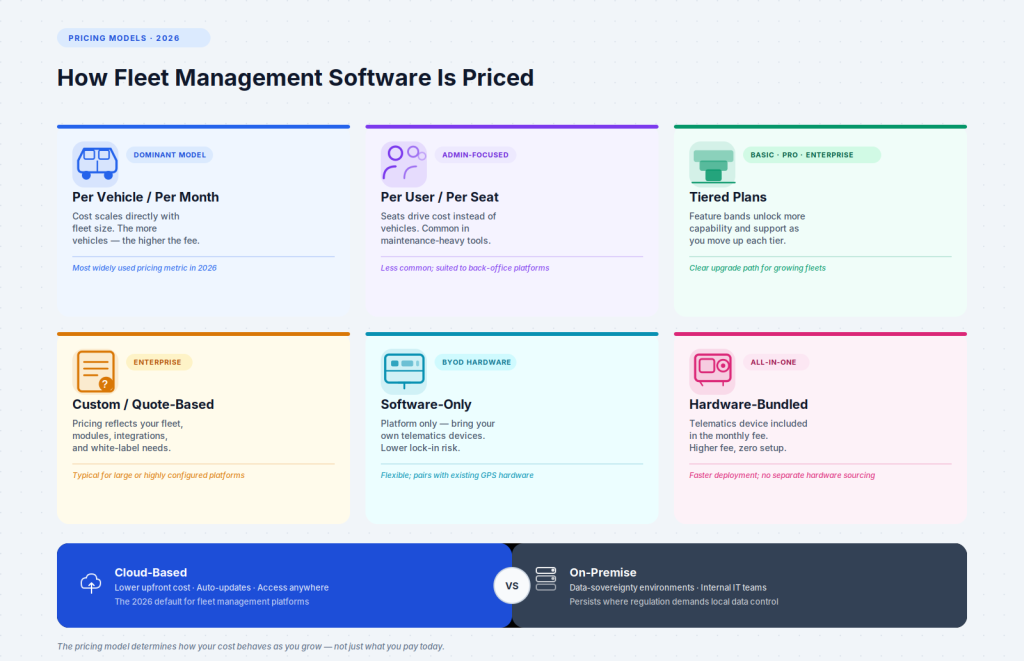
Understanding the pricing model matters as much as the number, because it determines how your cost behaves as you grow. Common fleet management software pricing models in 2026 include:
- Per vehicle, per month — the dominant model. The “value metric” is the number of vehicles managed, so cost scales directly with fleet size.
- Per user — less common, used by some maintenance- or admin-focused tools where seats matter more than vehicles.
- Tiered plans — Basic / Pro / Enterprise bands, each unlocking more features and support.
- Custom / quote-based — typical for enterprise, white-label, and highly customizable platforms, where pricing reflects your specific fleet, modules, and integrations.
- Software-only vs. hardware-bundled — some platforms include telematics hardware in the monthly fee; others are software-only and let you bring your own devices.
Cloud delivery is now the default. In 2026, cloud-based platforms dominate because they carry lower upfront cost, update automatically, and are accessible anywhere — versus on-premise systems, which mainly persist where data-sovereignty rules require them.
What Drives the Cost
Two fleets of the same size can pay very different amounts. These are the factors that move cloud fleet management software pricing up or down:
- Fleet size. Per-vehicle pricing means cost rises with vehicle count — though many vendors offer volume discounts at scale.
- Feature depth. Core GPS tracking is cheap; AI route optimization, predictive maintenance, video telematics, and advanced analytics sit at the top of the range.
- Hardware and telematics. Trackers and devices commonly run $50–$300 per vehicle, with installation often $50–$200 per vehicle, per 2026 roundups. [Verify.]
- Integrations. Connecting ERP, accounting, HR, or TMS systems frequently needs custom API work — development time plus ongoing support.
- Support and onboarding. Higher support tiers, training, and white-glove onboarding add cost (and value).
- Contract length. Longer commitments often lower the monthly rate but reduce flexibility.
- Usage at scale. Data storage, map usage, and API calls can grow with fleet activity on some platforms.
The Hidden Fees to Watch For
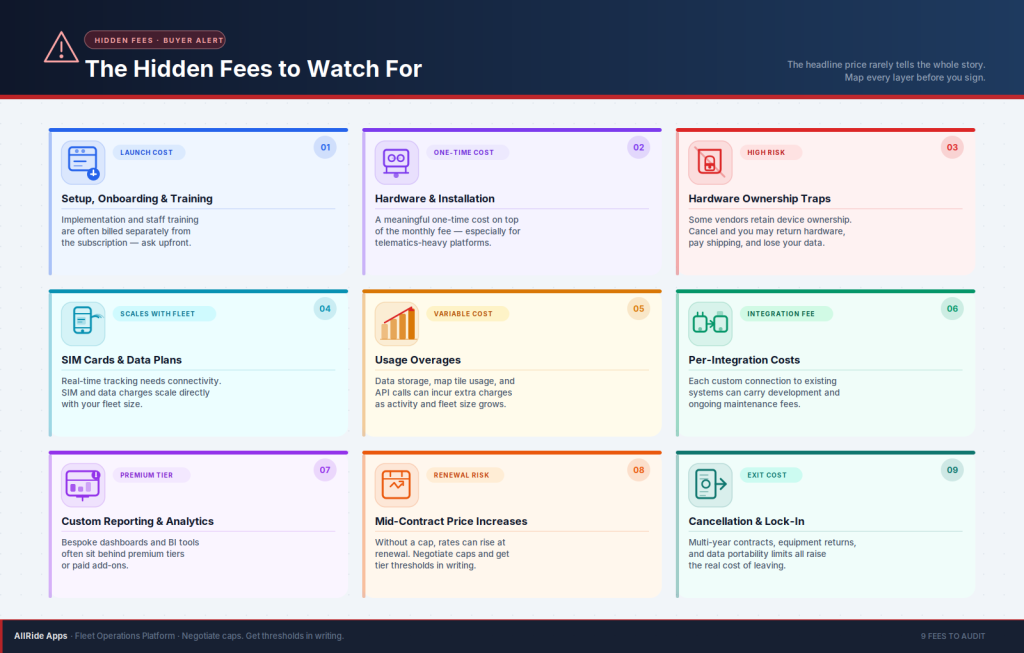
This is where the real cost lives — and where buyers get caught. The headline per-vehicle price rarely tells the whole story. Watch for:
- Setup, onboarding, and training fees. Implementation and staff training can be billed separately from the subscription.
- Hardware and installation. Often a meaningful one-time cost on top of the monthly fee, especially for telematics-heavy platforms.
- Hardware ownership traps. Some vendors retain ownership of the devices — you pay monthly but never own them, and canceling can mean returning equipment, paying shipping, and even losing historical data.
- SIM cards and data plans. Real-time tracking needs connectivity, and those charges scale with fleet size.
- Usage overages. Data storage, map usage, and API calls can incur extra charges as activity grows.
- Per-integration costs. Each custom connection to your existing systems can carry development and maintenance fees.
- Custom reporting and analytics. Bespoke dashboards and BI often sit behind premium tiers or add-ons.
- Mid-contract price increases. Without a cap, rates can rise at renewal. Negotiate caps and get tier thresholds in writing.
- Cancellation and lock-in. Multi-year contracts, equipment returns, and data portability limits all raise the cost of leaving.
A simple rule: ask every vendor what’s not in the quoted price. The answer is where your real budget goes.
Cloud vs. On-Premise: Why Cloud Usually Wins on Cost
For most operators in 2026, cloud-based is the cost-efficient choice. It carries lower upfront investment, includes automatic updates, and is accessible from anywhere — which reduces both IT burden and total cost of ownership. On-premise deployments still make sense for organizations with strict data-sovereignty or security requirements, but they typically cost more to stand up and maintain. The broader market has voted: cloud is the dominant model precisely because it spreads cost over a subscription instead of a large capital outlay.
How to Evaluate a Cloud-based Fleet Management Software Cost Right Way
The smartest buyers don’t shop for the lowest per-vehicle price — they shop for the lowest total cost of ownership against the value delivered.
Calculate true TCO. Add the subscription, hardware and installation, onboarding and training, integration work, and support over the full contract term — not just the monthly software line.
Match features to your operation, not the demo. A 15-vehicle operator paying enterprise rates for AI features they’ll never use is overpaying; a growing fleet on a bare-bones tool that can’t dispatch is underpaying and creating operational gaps. The right fit is the one that maps to how you actually run.
Weigh the return, not just the spend. Industry analyses attribute meaningful savings to fleet software — fuel optimization, fewer breakdowns, higher utilization, and lower admin overhead — with many operators reporting payback within months. [Treat ROI figures as attributed/directional and verify before publish.] The point isn’t a guaranteed number; it’s that cost should be judged against value, not in isolation.
Where AllRide Fits in Cloud-based fleet management software cost
AllRide offers cloud-based, AI-powered fleet management software for transport, logistics, and delivery businesses — covering real-time GPS tracking, route optimization, maintenance scheduling, fuel monitoring, integrations, and reporting on one platform. Its fleet management solution is built to scale from a handful of vehicles to large operations, and lets operators select the features they actually need.
On cost, AllRide follows a custom, quote-based pricing model rather than a fixed list price — pricing reflects your fleet size, the modules you choose, and any integrations or customization. That’s typical for enterprise-grade and white-label platforms, where a tailored quote fits the operation better than a one-size number. The practical takeaway: get a scoped quote against your specific fleet rather than estimating from generic per-vehicle averages. Explore the broader AllRide platform to see how the pieces fit together.
The Bottom Line
The honest answer to “what does cloud-based fleet management software cost in 2026?” is: it depends — but you can pin it down. Expect a per-vehicle monthly subscription in a broad range, then add hardware, onboarding, integrations, and support to find your true total cost of ownership. The operators who budget well are the ones who look past the advertised price, account for the hidden fees, and weigh cost against the value the software returns.
The fastest way to replace a generic estimate with a real number is to get a quote scoped to your fleet.
See what cloud-based fleet management would cost — and do — for your operation. Book a demo.
Frequently Asked Questions
How much does cloud-based fleet management software cost in 2026?
Most cloud-based fleet management software is priced per vehicle per month, ranging from roughly $3 to $50+ depending on features and fleet size, per 2026 industry roundups. Capterra puts typical entry-level plans near $128/month and premium plans around $856/month. Many enterprise platforms quote custom pricing.
How is fleet management software priced?
The dominant model is per vehicle, per month, often in tiered plans (Basic, Pro, Enterprise). Some vendors price per user or offer custom, quote-based pricing for larger or customized deployments. Software-only options let you bring your own telematics hardware.
What hidden fees should I watch for?
Common extras include setup, onboarding, and training; hardware and installation; SIM/data plans; usage overages on data, maps, and API calls; per-integration costs; custom reporting; mid-contract price increases; and cancellation or equipment-return charges. Always ask what isn’t in the quoted price.
Is cloud fleet management software cheaper than on-premise?
Usually, yes. Cloud-based platforms have lower upfront cost, include automatic updates, and require less IT overhead, lowering total cost of ownership. On-premise mainly suits organizations with strict data-sovereignty requirements and typically costs more to deploy and maintain.
Does AllRide publish fixed pricing?
AllRide uses a custom, quote-based pricing model rather than a fixed list price, scoped to your fleet size, chosen modules, and integrations. The best way to get an accurate figure is to request a quote or book a demo.