

 Fleet Management
 Route optimization
 Shuttle Transportation
 Delivery Management
 School Bus Transportation
 Ride Sharing Management
 Airport Transfer Booking
  Vehicle inspection
 Car Rental Management
 Trucking & Logistics
 Food & Beverage
 E-Commerce
 Passenger Transit
 Delivery
 School & Corporate
Best Fleet Tracking Software in 2026: Top Platforms Compared
Choosing the best fleet tracking software in 2026 is no longer just about seeing vehicles on a map. For some operators, GPS location is enough. For others, tracking has to connect with dispatch, bookings, routes, drivers, vehicles, passengers, delivery tasks, reports, and customer communication.
That’s why the market for real-time fleet tracking has become so segmented. A trucking company may need ELD compliance, dashcams, fuel data, and driver-behavior analytics. A delivery business may need task tracking, proof of delivery, and live customer updates. A shuttle operator may need recurring routes, passenger records, driver assignment, and route-based visibility. An airport transfer company may need trip mode, pickup/drop-off detail, passenger count, luggage, stops, tickets, and scheduled dispatch context.
So the real question isn’t “What is the best fleet tracking softwarein 2026?” It’s “Which fleet tracking platform fits the way my fleet actually operates?” This guide compares the top tracking platforms in 2026 and shows where AllRide fits for operators who need tracking tied to real operational workflows — not just GPS dots.
What Is Real-Time Fleet Tracking?
Real-time fleet tracking means live or near-live visibility into vehicles, trips, tasks, drivers, or assets. At a basic level, it tells fleet managers where vehicles are. At a more advanced level, it supports route progress, dispatch decisions, delay handling, task monitoring, reporting, customer visibility, driver safety, compliance, and operational planning.
But not every platform is built for the same buyer. Some are telematics-first, some delivery-first, some route-first, some maintenance-first — and some are built for scheduled transport, where bookings, passengers, tickets, routes, shared transfers, recurring trips, and dispatch context are the point. That difference matters before you choose.
Fleet Tracking vs GPS Tracking vs Dispatch Tracking
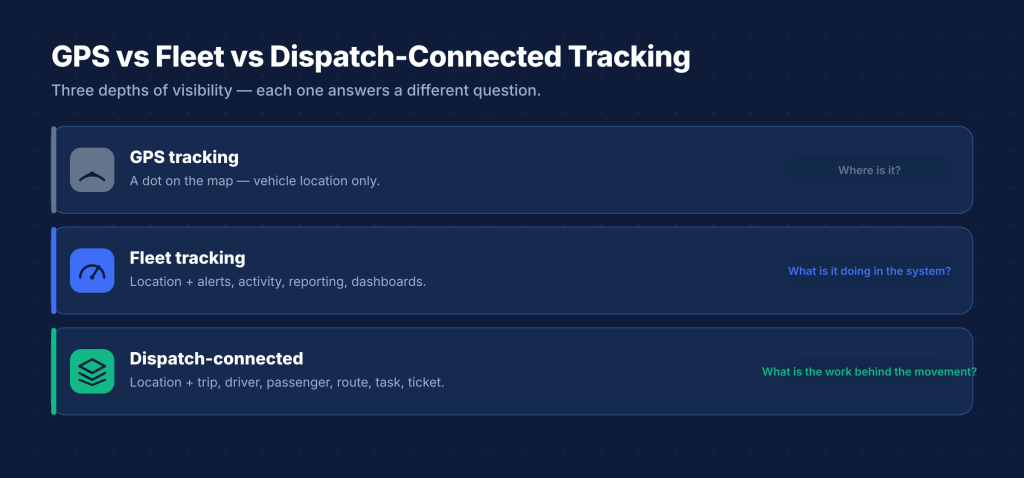
These three terms get used interchangeably, but they describe different depths of visibility:
- GPS tracking shows vehicle location — a dot on a map.
- Fleet tracking adds alerts, vehicle activity, driver movement, reporting, asset visibility, and operational dashboards around that location.
- Dispatch tracking goes one step further and connects location to the work behind the movement: the trip, driver, vehicle, customer, passenger, task, route, stop, ticket, reservation, or delivery order.
A dot on the map doesn’t tell the full story. A school transport dispatcher needs to know the route, vehicle, driver, and passenger group. An airport transfer team needs trip time, pickup and drop-off points, passenger details, luggage, and transfer type. A delivery team needs the task, order, sender, recipient, agent, vehicle, and delivery status. That’s why the best fleet tracking software in 2026 comes down to workflow fit.
Best Fleet Tracking Software in 2026: Top Platforms Compared
| Platform | Best for | Strength | Limitation |
| AllRide | Scheduled transport — shuttle, airport/hotel transfer, school/campus, event, HOHO, delivery, and multi-operator workflows | Tracking connected with reservations, trips, routes, drivers, vehicles, delivery tasks, reports, tickets, and passenger/customer context | Not positioned as an ELD, dashcam, fuel-analytics, or advanced telematics-first platform |
| Geotab | Data-heavy fleets needing analytics and extensibility | Near-real-time tracking, trip history, and an open platform ecosystem | More telematics/data-focused than passenger-workflow-focused |
| Verizon Connect | Large fleets needing GPS, compliance, analytics, and productivity tools | Deep enterprise fleet tracking and management | Pricing and contract structure may not suit every small or mid-size fleet |
| Motive | Trucking, logistics, safety, and compliance-led operations | Strong GPS, ELD, AI dashcams, telematics, and driver coaching | Less suited to passenger reservation, ticketing, and shared-transport workflows |
| Fleetio | Maintenance-first and asset lifecycle management | Strong preventive maintenance, inspections, cost tracking, integrations | Not a native GPS-first tracker; relies on telematics integrations |
| Onfleet | Last-mile delivery tracking | Live delivery tracking pages, proof of delivery, customer updates, driver chat | Not built for broad passenger transport, ELD, fuel, or maintenance |
| Route4Me | Multi-stop route planning and route progress | Strong route planning, dispatch, optimization, and driver workflows | Route-first rather than passenger-reservation- or ticket-first |
| GPS Trackit | SMB GPS tracking, alerts, scorecards, asset monitoring | Practical GPS tracking and fleet alerts | Less focused on scheduled passenger-transport workflows |
| Samsara | Enterprise fleets needing telematics, ELD, dashcams, GPS, and safety tools | Strong all-in-one GPS, safety, compliance, and telematics | Can be heavy or contract-heavy for smaller scheduled-transport operators |
How to Read the List: Match the Platform to Your Workflow
There’s no single “best” platform for every fleet — there’s a best platform for your workflow:
- Telematics-heavy fleets (GPS, compliance, dashcams, driver-behavior data, fuel visibility, regulatory support) → Samsara, Geotab, Verizon Connect, Motive.
- Last-mile delivery (live customer tracking, proof of delivery, driver chat, recipient communication) → Onfleet.
- Route-first teams (multi-stop optimization, dispatch, route progress) → Route4Me.
- Maintenance-first (inspections, work orders, asset lifecycle, cost tracking over native GPS) → Fleetio.
- Scheduled transport (reservations, trips, routes, stops, passengers, tickets, recurring schedules, shared transfers, delivery tasks, reports, operator oversight) → AllRide.
That last point is the gap AllRide is built for: workflow context, not just vehicle location.
Why GPS Dots Aren’t Enough for Scheduled Transport
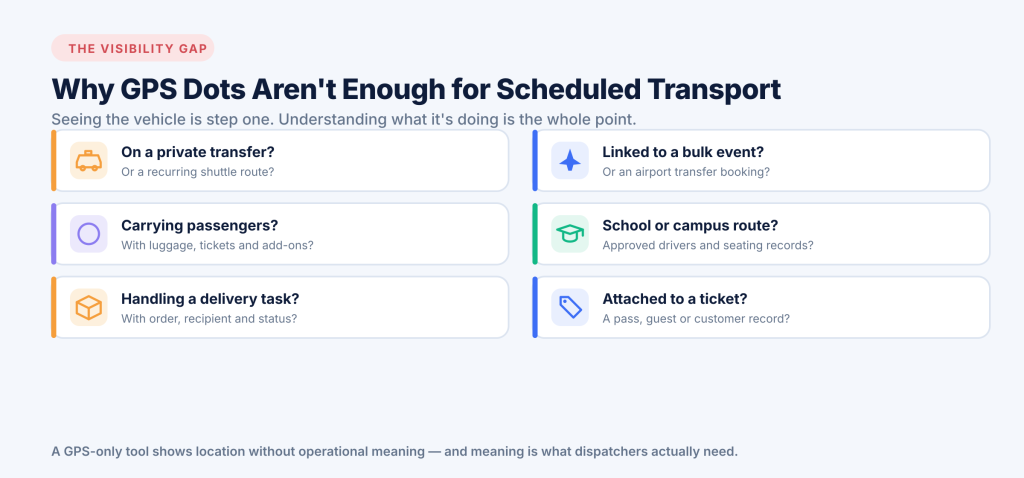
For many transport operators, seeing the vehicle is only step one. The value comes from understanding what that vehicle is doing — questions a GPS-only tool often can’t answer:
- Is it assigned to a private transfer, or serving a recurring shuttle route?
- Is it linked to a bulk event booking?
- Is it carrying passengers with luggage?
- Is it running a school or campus route?
- Is it handling a delivery task?
- Is it attached to a ticket, pass, guest, or customer record?
This is where scheduled transport diverges from generic fleet tracking. A GPS-only tool may show location without showing operational meaning — which is exactly why the top tracking platforms should be compared by use case, not feature count alone.
Where AllRide Fits: Real-Time Visibility Built Into the Workflow
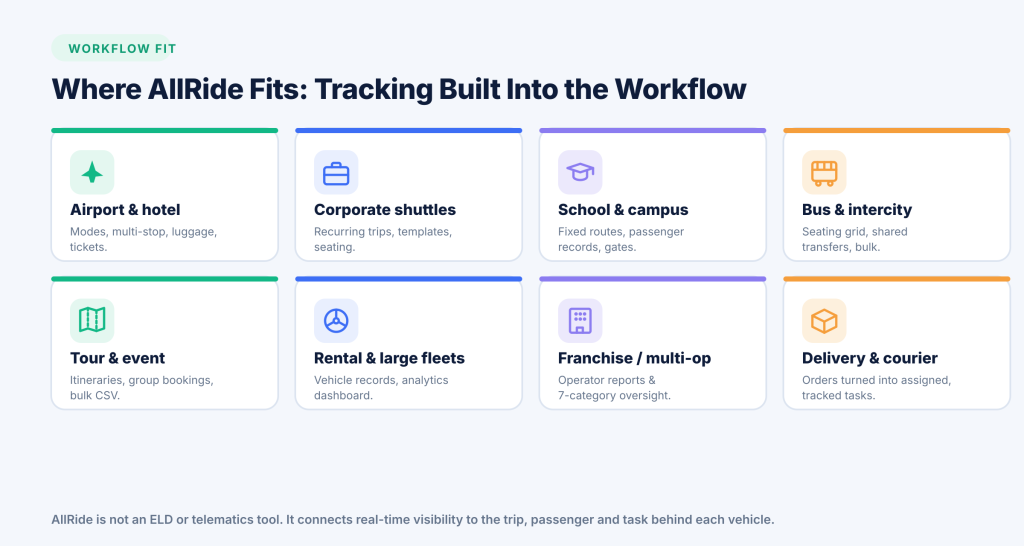
AllRide isn’t a telematics, ELD, or dashcam platform, and it doesn’t pretend to be. Its strength is connecting real-time operational visibility to the booking, trip, route, passenger, and task that produced the movement — so dispatchers and managers see meaning, not just position. Here’s where that fit is strongest, by operator type:
- Airport & hotel transfers — one-way, round-trip, and hourly modes, multi-stop routing, per-passenger and luggage capture, add-ons, and PDF tickets for detail-heavy, pre-scheduled work.
- Employee & corporate shuttles — recurring trips and templates (weekly-repeat rules, excluded dates, buffer days), route- and trip-based shared transfers, and a seating-layout builder; set a daily office route once and let it run on schedule.
- School & campus transport — recurring shared reservations on fixed routes, per-passenger records (names, ages), seating layouts, and driver assignment with approval gates for managed, safety-conscious routes.
- Bus & intercity services — a seating-layout grid builder, route/trip configuration, shared-transfer booking, and bulk reservation upload.
- Tour & travel operators — hourly and round-trip transfers, multi-stop itineraries, add-ons (water, WiFi, child seat), bulk group bookings via CSV/Excel, and branded ticket PDFs for guests.
- Car rental services — hourly and round-trip booking modes, detailed vehicle records (registration, ownership, insurance, warranty, tags), categories and add-ons with pricing, and availability filters.
- Large fleet owners & leasing operators — deep vehicle records (registration, ownership, VIN, insurance, warranty, tags), a fleet analytics dashboard (utilization, mileage, availability), and custom fields for assets and compliance.
- Franchise & multi-operator businesses — operator assignment on vehicles, operator-specific reports, customer and guest lifecycle management, and seven report categories for distributed oversight.
- Bulk & event transport — CSV/Excel bulk reservation upload with a field-override toggle, built for large one-time batches like conferences, weddings, and corporate events.
- Hop-on hop-off (HOHO) services — route- and stop-based shared transfers with recurring trips, a customer Pass record that tracks a rider’s entitlement over a set period, seating layouts, and PDF tickets for boarding.
The throughline is context: tracking is more useful when it already knows the reservation, route, and ticket behind every vehicle. If that’s the kind of visibility your operation needs, the fastest way to judge fit is on your own routes. Book a demo and see your workflow in it — and if you’re weighing a switch, the migration and pricing pages lay out what moving over actually looks like.
Telematics-First vs Dispatch-Connected: The Real Buying Decision
The core buying distinction is simple:
- If your main need is ELD, dashcams, fuel analytics, driver-behavior scoring, vehicle diagnostics, and compliance reporting, a telematics-first platform — Samsara, Geotab, Verizon Connect, or Motive — is likely the better fit.
- If your main need is delivery customer tracking, Onfleet may be stronger.
- If your main need is route optimization, Route4Me may be stronger.
- If your operation depends on scheduled passenger movement, shared routes, recurring trips, airport transfers, school routes, shuttle loops, bulk bookings, tickets, guest/customer records, delivery task tracking, and reports, AllRide becomes the stronger workflow fit.
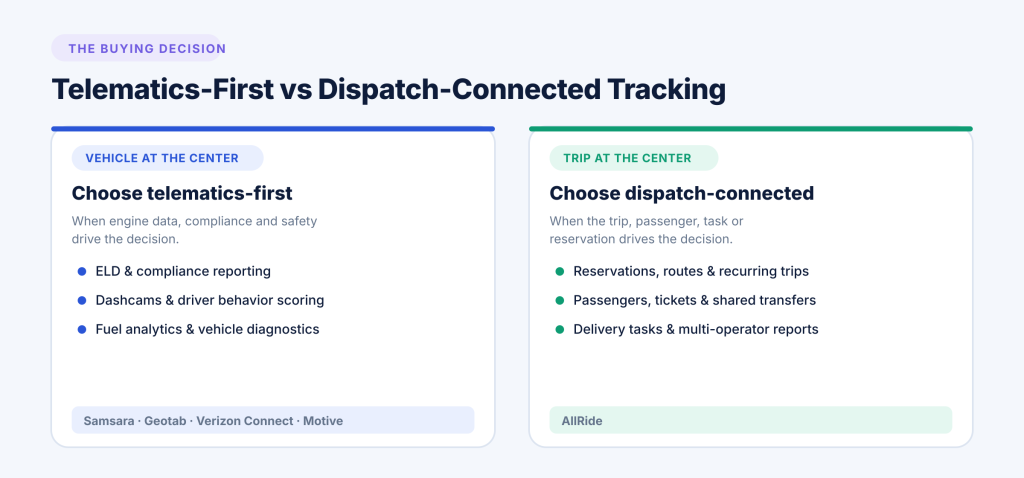
Put another way: choose telematics-first software when the vehicle is the center of the workflow; choose dispatch-connected tracking when the trip, passenger, task, route, or reservation is the center of the workflow.
Buyer Checklist: What to Compare Before Choosing
Before choosing the best fleet tracking software, ask whether the platform:
- Tracks only vehicles, or also trips and tasks?
- Connects tracking with reservations, bookings, routes, tickets, and passengers?
- Supports driver and vehicle assignment?
- Supports recurring routes or recurring trips?
- Supports route- and stop-based shared transport?
- Supports bulk booking uploads for events and group transport?
- Supports delivery task tracking?
- Provides reports after the trip or task is completed?
- Supports operator-level oversight for distributed fleets?
- Includes ELD, dashcams, fuel analytics, or telematics — if those are required?
- Fits your exact fleet type: airport transfer, shuttle, school, bus, delivery, tour, event, HOHO, logistics, or mixed?
- Comes with clear pricing, onboarding, training, and migration?
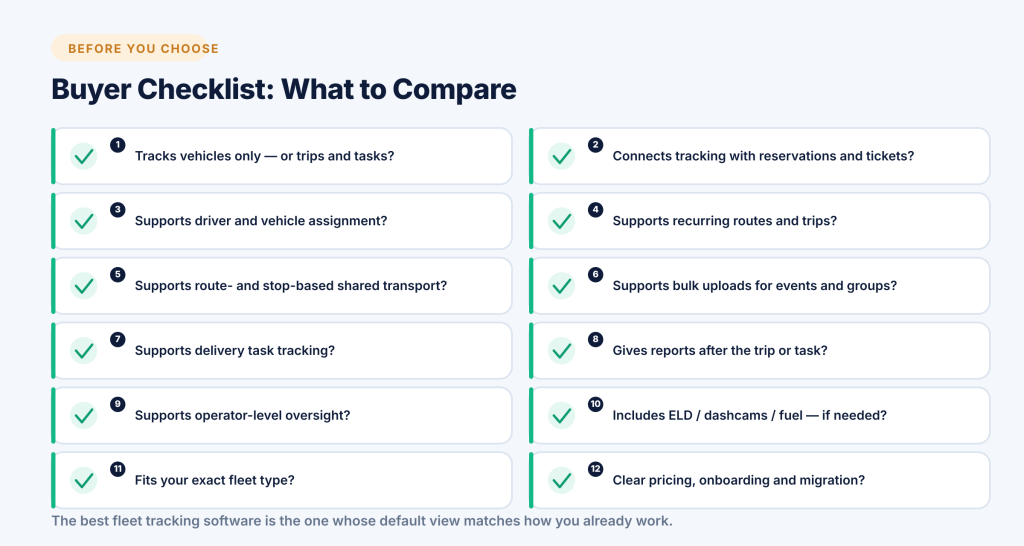
The right answer depends on your workflow — a platform that’s excellent for trucking may not fit passenger transport, a delivery platform may not fit school transport, and a route planner may not fit airport transfers. That’s why generic “top tracking platforms” lists are often incomplete.
Final Recommendation
The best fleet tracking software in 2026 depends on how your fleet operates:
- AllRide — scheduled transport visibility connected with reservations, routes, recurring trips, passengers, tickets, delivery tasks, driver/vehicle assignments, reports, and multi-operator workflows.
- Samsara, Geotab, Verizon Connect, or Motive — telematics, ELD, dashcams, driver-behavior analytics, fuel tracking, and compliance-heavy visibility.
- Onfleet — last-mile delivery visibility and customer-facing tracking.
- Route4Me — route planning and multi-stop dispatch.
- Fleetio — maintenance, inspections, asset lifecycle, and cost control.
For airport and hotel transfer, shuttle, school/campus, bus, event, HOHO, tour, delivery, and mixed transport businesses, tracking shouldn’t stop at coordinates — it should connect every vehicle movement with the operational context behind it.
Track every trip with context — not just coordinates. Book a demo with AllRide workflow today.
FAQs
What is the best fleet tracking software in 2026?
It depends on your fleet type. Samsara, Geotab, Verizon Connect, and Motive are strong for telematics-heavy fleets; Onfleet for delivery; Route4Me for route-first operations; and AllRide for scheduled transport workflows.
What are the top tracking platforms?
The top tracking platforms include Samsara, Geotab, Verizon Connect, Motive, Fleetio, GPS Trackit, One Step GPS, Onfleet, Route4Me, and AllRide — the right one depends on the use case.
What is real-time fleet tracking?
Real-time fleet tracking gives live or near-live visibility into vehicles, drivers, tasks, trips, or assets, so operators can monitor field activity and respond faster.
What is the difference between GPS tracking and dispatch tracking?
GPS tracking shows where a vehicle is. Dispatch tracking connects that location with the trip, reservation, passenger, task, driver, vehicle, ticket, route, or report behind it.
What is the best fleet tracking software for delivery fleets?
Onfleet and Route4Me are strong for delivery-focused fleets. AllRide fits operators that need delivery task tracking alongside passenger-transport workflows.
What is the best tracking software for shuttle operators?
Shuttle operators should compare platforms that support recurring trips, shared routes, driver and vehicle assignment, passenger context, reports, and live fleet visibility.
Does fleet tracking software include reports?
Many platforms do, but depth varies. Compare driver, vehicle, trip, task, operator, and transaction reporting before choosing.
Is AllRide a telematics platform?
No — AllRide shouldn’t be positioned as an advanced telematics, ELD, dashcam, or fuel-analytics platform. It’s built for operators who need tracking connected with dispatch, reservations, trips, tasks, passengers, tickets, and reports.