

 Fleet Management
 Route optimization
 Shuttle Transportation
 Delivery Management
 School Bus Transportation
 Ride Sharing Management
 Airport Transfer Booking
  Vehicle inspection
 Car Rental Management
 Trucking & Logistics
 Food & Beverage
 E-Commerce
 Passenger Transit
 Delivery
 School & Corporate
Auto-Dispatch vs Manual Dispatch: Costs, Speed & Control
With modern automated dispatch systems you don’t trade control for speed — you get both, because the software makes the same routing and assignment calls a great dispatcher would, just faster and with a live audit trail behind every decision. Manual dispatch still wins on gut-feel flexibility for a handful of vehicles, but it leaks money the moment volume rises: idle assets, empty miles, slow assignment, and human error all scale with the phone calls. Auto-dispatch closes those gaps by matching the nearest qualified driver to each job in seconds, optimizing routes against live traffic, and surfacing exceptions before they become failures. Across three levers, cost is utilization and fuel, speed is assignment time, and control is real-time GPS visibility plus a single source of truth.
The key insight: the real choice in the auto dispatch vs manual debate isn’t speed versus control — it’s whether your dispatch decisions get made by one overloaded human under pressure, or by smart dispatch software that frees that human to handle the judgment calls only a person can make.
The pressure to answer this question is rising fast. Operating margins are thin, customers expect Amazon-grade ETAs, and the spreadsheet-and-phone workflow that ran a 15-vehicle operation simply buckles at 50, 100, or 500. Every minute a dispatcher spends dialing a driver is a minute they’re not booking the next high-value trip.
What’s at stake is more than convenience. Slow, manual assignment quietly burns fuel, strands scarce capacity, and frays customer trust. The operators pulling ahead aren’t the ones with the most trucks — they’re the ones whose dispatch turns demand into completed trips with the least waste.
This guide breaks down where manual dispatch actually costs you, why the cheap shortcut is usually a false economy, and the five moves that let you cut cost and speed up assignment without losing an ounce of control — with dispatch software with GPS doing the heavy lifting.
The Manual Dispatch Problem
Manual dispatch rarely fails in one dramatic moment. It bleeds margin through four channels at once — empty miles, idle assets, slow assignment, and error rework — and the numbers are sobering.
First, the cost floor keeps climbing. The marginal cost to operate a truck reached roughly $2.26 per mile, with a record $1.78 of every mile going to non-fuel costs like labor, insurance, and equipment, according to the American Transportation Research Institute (ATRI) 2025 Operational Costs of Trucking report.
Second, too many of those miles carry nothing. ATRI’s data puts average empty (deadhead) miles at 16.7% of all miles driven — wheels turning, fuel and labor burning, revenue at zero. Manual dispatch, blind to live positions, can’t easily pair backhauls to trim it.
Third, the capacity you waste is hard to replace. The American Trucking Associations estimates the industry is short roughly 78,000 drivers, so every idle vehicle or misrouted trip squanders a resource that’s already scarce.
Fourth, the market has already voted on the fix. Per Verizon Connect’s 2026 Fleet Technology Trends Report, 80% of fleet professionals now use GPS fleet tracking — an 11-point jump in a single year — and 66% name efficiency and productivity their top priority for the next 12–18 months.
The forces driving the manual-dispatch squeeze:
- Rising fixed costs — labor, insurance, and equipment make every wasted mile and idle hour more expensive.
- Volume and complexity — more stops, tighter delivery windows, and multi-service operations overwhelm phone-and-spreadsheet workflows.
- Customer ETA expectations — riders and shippers now treat accurate, real-time tracking as the baseline, not a perk.
- Thin dispatcher bandwidth — a proficient dispatcher can juggle only so many vehicles before judgment work gets crowded out by busywork.
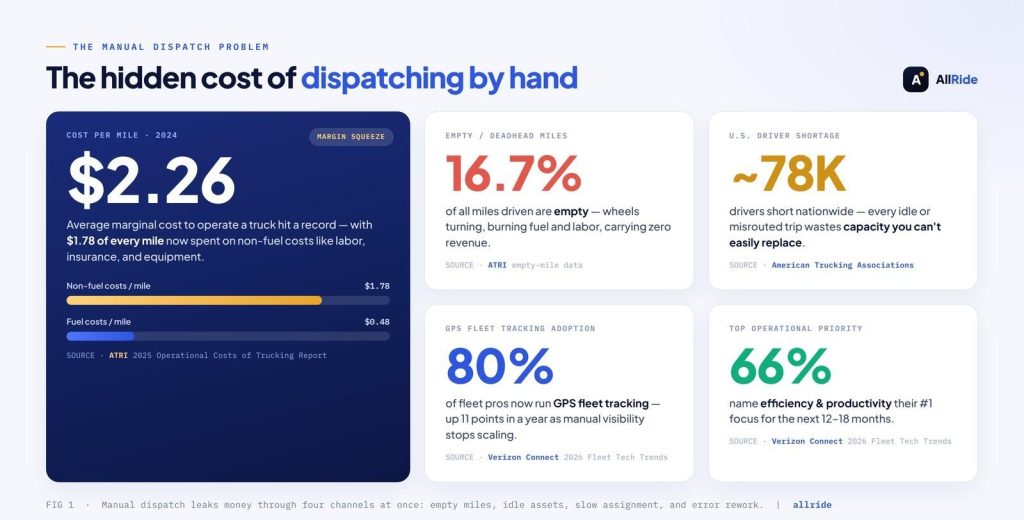
Fig 1 — The hidden cost of dispatching by hand, with sources (ATRI, American Trucking Associations, Verizon Connect).
Why “Stick With Manual” Is a False Economy
Picture a regional operator — call it Summit Transfers — running 40 vehicles across airport runs, a corporate shuttle contract, and a growing same-day delivery side. The owner prices out automation, balks at the subscription, and decides the team will “push through” another quarter on whiteboards, group texts, and a basic GPS dot-on-a-map tracker. It feels thrifty.
Then a key client issues an ultimatum over late arrivals. Mornings burn 90 minutes on manual route-building. A driver calls in sick and the reassignment ripples all day because no one can see who’s closest. Two high-margin delivery requests land while the dispatcher is mid-call — both go to a faster competitor. The “savings” evaporated weeks ago; they were just invisible.
That’s the trap. The sticker price you avoid is tiny next to the costs you can’t see on an invoice:
- Missed trips, not just slow ones — revenue that quietly walks to whoever confirmed first.
- Deadhead and detour miles — fuel and labor spent on movement that earns nothing.
- Overtime and burnout — last-minute scrambles inflate labor cost and churn your best dispatchers.
- Error rework — mismatched confirmations, billing discrepancies, and missed compliance flags that surface as penalties later.
- A GPS tracker is not a dispatch system — seeing a dot on a map tells you where a vehicle is, not who to assign, which route to run, or what just went wrong.
Cheap manual dispatch doesn’t lower your cost — it relocates it into line items you only notice when a contract is already at risk.
How to Cut Cost and Speed Up Dispatch Without Losing Control
Here’s what most “manual vs automated dispatch” debates miss: every win below is a cost win and a control win at once. You don’t pick a column — you build a system where speed and safety come from the same decision.
1. Auto-assign every trip with automated dispatch systems
Automated dispatch systems take the slowest, most error-prone step — deciding who gets the job — and make it instant and rule-based.
- Speed + qualification: the nearest available driver is assigned in seconds, and the same rules guarantee they’re actually qualified, licensed, and within hours-of-service limits.
- Lower labor cost + fewer mistakes: dispatchers stop dialing and start managing exceptions, while automated checks prevent the wrong-driver and over-hours assignments that cause incidents.
- Faster confirmation + happier customers: trips lock in before a competitor responds, and riders get an accurate ETA instead of a shrug.
See how this works in AllRide’s taxi & ride dispatch software.
2. Put dispatch software with GPS at the center of operations
Real-time location is the difference between reacting and controlling. Dispatch software with GPS turns the live map into decisions, not just dots.
- Less fuel + safer driving: live tracking trims idling and inefficient routes — fleets report average fuel savings around 16%, per Verizon Connect’s 2025 report — while the same data flags harsh braking and speeding for coaching.
- Higher utilization + accurate ETAs: you reassign the truly closest vehicle to a last-minute job, lifting productivity (44% of GPS users report exactly that, per Verizon Connect 2026) and giving customers ETAs you can stand behind.
- Faster ROI + lower risk: nearly half of fleets recoup GPS tracking within a year while cutting accident-related costs by about 22% (Verizon Connect).
Explore AllRide’s fleet management and tracking platform.
3. Optimize routes and shared trips automatically
Smart routing is where cost and quality stop competing — let the system sequence stops and fill seats instead of a tired human guessing at 6 a.m.
- Fewer miles + on-time arrivals: optimized sequencing cuts fuel and drive time while protecting the delivery and pickup windows customers actually care about.
- Higher load factor + capacity control: shared transfers and recurring routes with seating-layout rules pack vehicles efficiently without overbooking or losing a passenger’s reserved seat.
- Resilience + fewer surprises: when an incident hits, every affected vehicle is rerouted automatically — before the delay shows up as an angry phone call.
This is the backbone of AllRide’s employee transport and shared-transfer solution.
4. Automate exceptions and compliance with smart dispatch software
Automated dispatch systems earn their keep on the bad days — the cancellation, the breakdown, the audit — by handling the scramble for you.
- Less overtime + cleaner compliance: automatic reallocation after a cancellation avoids last-minute pay spikes, and built-in hours-of-service and documentation checks keep you audit-ready.
- Fewer errors + a single audit trail: digital confirmations and proof-of-delivery cut billing rework while giving you one defensible record of every trip.
- Proactive alerts + safer outcomes: the system flags an HOS violation or a stalled trip before it becomes a fine or a stranded customer.
These controls live across AllRide’s dispatch and auto-scheduling tools.
5. Unify dispatch, delivery, and rental on one platform
Fragmented tools recreate manual chaos at the seams. One platform makes auto dispatch vs manual a non-question across every line of business.
- Lower software cost + consistent control: ride-hailing, fleet dispatch, shared transfers, delivery, and car rental run on one system — fewer subscriptions, and one standard of visibility everywhere.
- Scales without headcount + steady quality: the same lean team absorbs demand surges, and customers get the same reliable experience whether it’s a trip, a parcel, or a rental.
- Unified data + smarter decisions: analytics across every service feed better routing and staffing calls instead of being trapped in separate spreadsheets.
See the breadth across AllRide’s delivery management and car rental solutions.
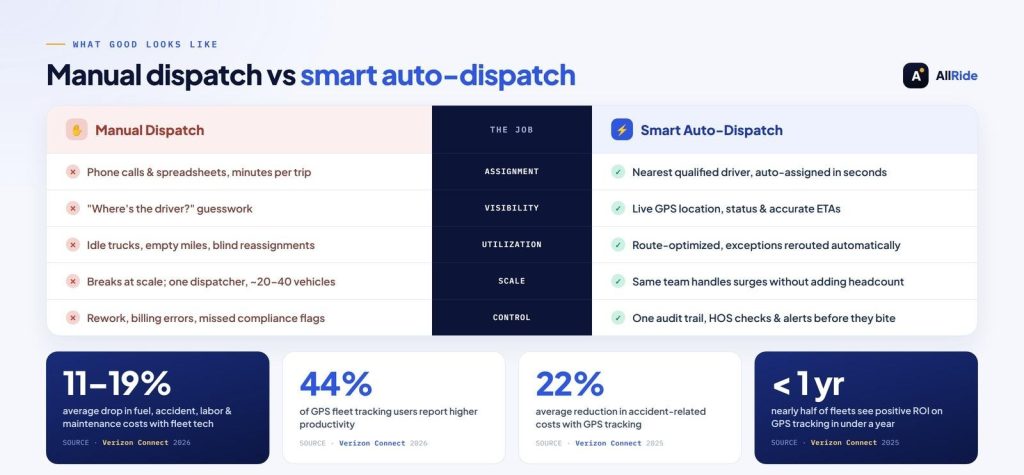
What Good Looks Like
Notice that none of those five moves is a standalone tactic. Auto-assignment needs live GPS to know who’s closest. Route optimization needs the same location data and compliance rules. Exception handling needs the unified record a single platform provides. Pull on one thread and the others follow — which is the whole point.
The fleets that get this right aren’t bolting a tracker onto a manual process — they’re running one connected workflow from job-in to job-done, where every decision draws on the same real-time picture. Integrated automated dispatch systems are the throughline: it’s what lets a lean team dispatch faster, drive fewer empty miles, stay compliant, and keep customers informed all at once. Lower cost and tighter control aren’t opposing columns to choose between — they’re both outputs of one well-run system. The dispatcher doesn’t disappear; they get promoted from switchboard operator to operations strategist.
The Bottom Line
The auto dispatch vs manual question was never really about speed versus control. Manual dispatch forces a false trade-off — you can move fast or stay in control, but not both, and either way you pay in empty miles, idle assets, and missed trips. Automated dispatch systems built on dispatch software with GPS dissolve that trade-off: the fastest assignment is also the most controlled one, because the same engine that books the trip in seconds is the one enforcing the rules and watching the map.
The operators who win the next few years won’t be the biggest — they’ll be the ones whose dispatch turns demand into completed, profitable, on-time trips with the least waste. That’s the kind of company a great dispatch system builds: faster, leaner, more reliable, and ready to scale without losing its grip on a single vehicle.
Take the Next Step
Explore how AllRide’s dispatch and fleet management platform puts auto-assignment, live GPS, route optimization, and compliance into one system you can run with the team you already have.
Frequently Asked Questions
Is auto-dispatch better than manual dispatch?
For anything beyond a handful of vehicles, yes. Automated dispatch systems make the same routing and assignment decisions a strong dispatcher would, but in seconds and with a live audit trail — so you gain speed without giving up control. Manual dispatch keeps some flexibility for tiny fleets, but it loses money to empty miles, idle assets, and slow assignment as volume grows.
What’s the difference between dispatch software with GPS and a basic GPS tracker?
A basic tracker shows where a vehicle is. Dispatch software with GPS turns that location into action — auto-assigning the nearest qualified driver, optimizing routes, generating accurate ETAs, and flagging exceptions. The tracker is a map; the dispatch platform is the decision engine that uses the map.
How much does manual dispatch really cost?
More than the salaries on the books. With marginal operating costs near $2.26 per mile and empty miles averaging 16.7% (ATRI), the bigger losses are usually invisible: missed high-margin trips, deadhead miles, overtime from last-minute scrambles, and billing or compliance rework — which add up far faster than a software subscription.
Will smart dispatch software replace my dispatchers?
No — it removes the busywork that consumes their day. Smart dispatch software automates dialing, status updates, and routine assignment so your dispatchers focus on exceptions, broker and customer relationships, and growth. You typically handle more volume with the same team, not fewer people.
Is automated dispatch worth it for a small fleet?
Often it’s where the percentage payoff is highest, because inefficiency is a bigger share of a small operation’s costs. Per Verizon Connect, nearly half of fleets see positive ROI on GPS tracking within a year, and fleet technology drives average cost decreases of 11–19%. Even a handful of vehicles benefit from faster assignment, fewer empty miles, and accurate ETAs.