


 Fleet Management
 Route optimization
 Shuttle Transportation
 Delivery Management
 School Bus Transportation
 Ride Sharing Management
 Airport Transfer Booking
  Vehicle inspection
 Car Rental Management
 Trucking & Logistics
 Food & Beverage
 E-Commerce
 Passenger Transit
 Delivery
 School & Corporate
Reduce Driver Churn with Better Tools and Fairer Dispatch
Drivers rarely quit over one bad shift — they leave when unfair, unclear, and unpredictable assignments become a pattern. That’s why efforts to reduce driver churn aren’t just only an HR or pay problem; it’s an operations problem. Clearer trip assignments, predictable recurring schedules, clean driver records, fairer dispatch, and support-first tracking give drivers a better daily experience — and give operators a structured way to improve driver retention and lower driver turnover.
The warning signs are familiar: a trip assigned at the last minute, a preferred route that always goes to someone else, an unclear delivery task, a shuttle schedule that changes without warning, one driver overworked while another waits for jobs. To a dispatcher these are fast calls under pressure; to drivers they feel unfair and inconsistent — and that frustration is what eventually drives turnover.
The takeaway: pay and incentives matter, but daily operations decide whether drivers stay just as much as the paycheck does. This holds across every operation juggling multiple vehicles, drivers, and service lines — from airport transfer and shuttle operators to bus fleets, delivery teams, and large multi-service brands.
What Is Driver Churn?
Driver churn is the repeated loss of drivers from a fleet, platform, or transport operation. It shows up in taxi fleets, shuttle operations, delivery companies, logistics teams, private hire businesses, chauffeur services, and corporate transport networks alike.
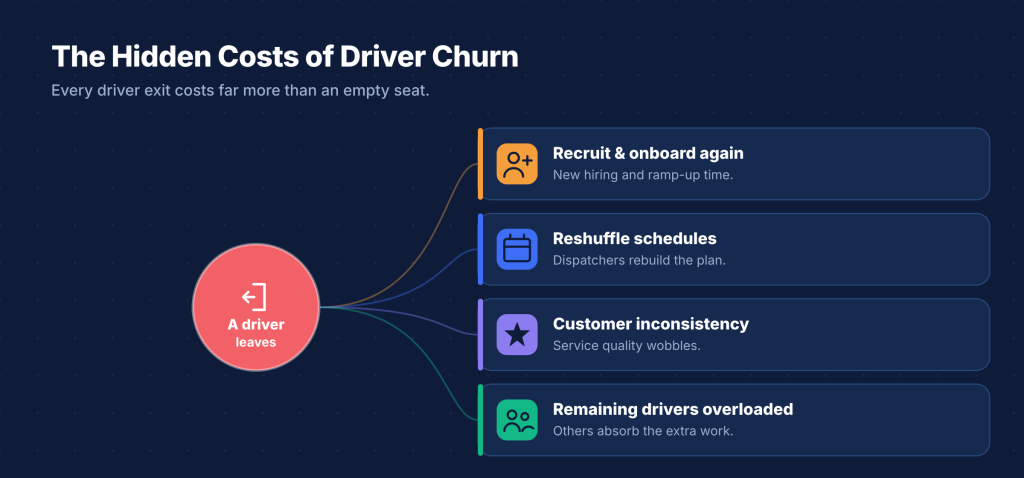
Every exit costs more than a seat. The business loses experience, local route knowledge, customer familiarity, and operational stability — and then absorbs the hidden costs that follow:
- Managers have to recruit and onboard again.
- Dispatchers rebuild and reshuffle schedules.
- Customers feel the inconsistency.
- Remaining drivers carry the extra workload until replacements ramp up.
That is why fleet operators should treat and reduce driver churn as an operational risk, not just an HR line item.
Driver Churn vs Driver Retention vs Driver Turnover
These three terms are related but distinct, and keeping them straight helps you measure the right thing.
| Term | Definition | Focus area | Key question | Common causes | Business impact |
| Driver churn | The repeated loss of drivers from a fleet or platform. | Driver exits. | Why are drivers leaving? | Unclear dispatching, poor assignment visibility, inconsistent workload, weak communication, last-minute schedules, little support. | Higher recruitment cost, service disruption, loss of experienced drivers, weaker customer satisfaction. |
| Driver retention | The ability to keep drivers engaged and working longer. | Driver satisfaction and loyalty. | What keeps drivers longer? | Fair dispatch, predictable schedules, clear communication, balanced workload, better tools. | Higher satisfaction, lower hiring cost, stable operations, better service quality. |
| Driver turnover | The rate at which drivers leave and must be replaced in a given period. | Workforce stability. | How often are drivers leaving and being replaced? | High churn, poor work experience, limited growth, operational inefficiency. | More onboarding and training cost, lost productivity, management overhead. |
Why Drivers Really Leave
Driver turnover is rarely about pay alone. Drivers also care about predictable work, clear job details, reliable equipment, fair assignment, respectful communication, and being supported when something goes wrong on the road.
One driver leaves because the work feels unstable. Another, because schedules change too often. Another, because the same people always get the better trips. A delivery driver leaves because tasks are vague or constantly reassigned. A shuttle driver leaves because recurring routes are planned by hand and communicated late.
The common thread is trust. When assignments feel random, biased, or poorly explained, trust erodes — and once trust is gone, driver retention gets much harder.
Better operational tools don’t replace fair management, but they give managers and dispatchers a structured way to plan, assign, review, and improve work — so fairness becomes the default instead of the exception.
Why Fair Dispatch Matters for Driver Retention
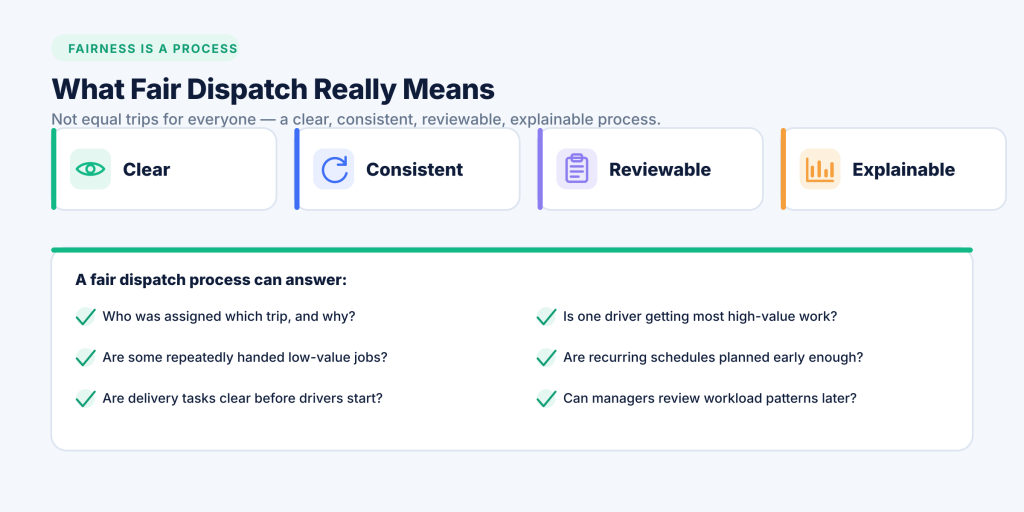
Fair dispatch doesn’t mean every driver gets the same trip every day. It means assignments are clear, consistent, reviewable, and explainable.
Drivers don’t expect every ride, route, or delivery to be identical. They expect the process to feel fair. When work distribution is hidden, drivers fill the gap with assumptions — and “the dispatcher was just moving fast” reads as favoritism.
A fairer dispatch approach should be able to answer practical questions:
- Who was assigned which trip, and why?
- Is one driver receiving most of the high-value work?
- Are some drivers repeatedly handed the difficult or low-value jobs?
- Are recurring schedules planned early enough?
- Are delivery tasks clear before drivers start?
- Can managers review workload patterns later?
Answering these gets far easier when assignments are visible, driver records are clean, recurring trips are planned ahead, and reports let managers check workload balance over time. The rest of this guide walks through each of those operational foundations.
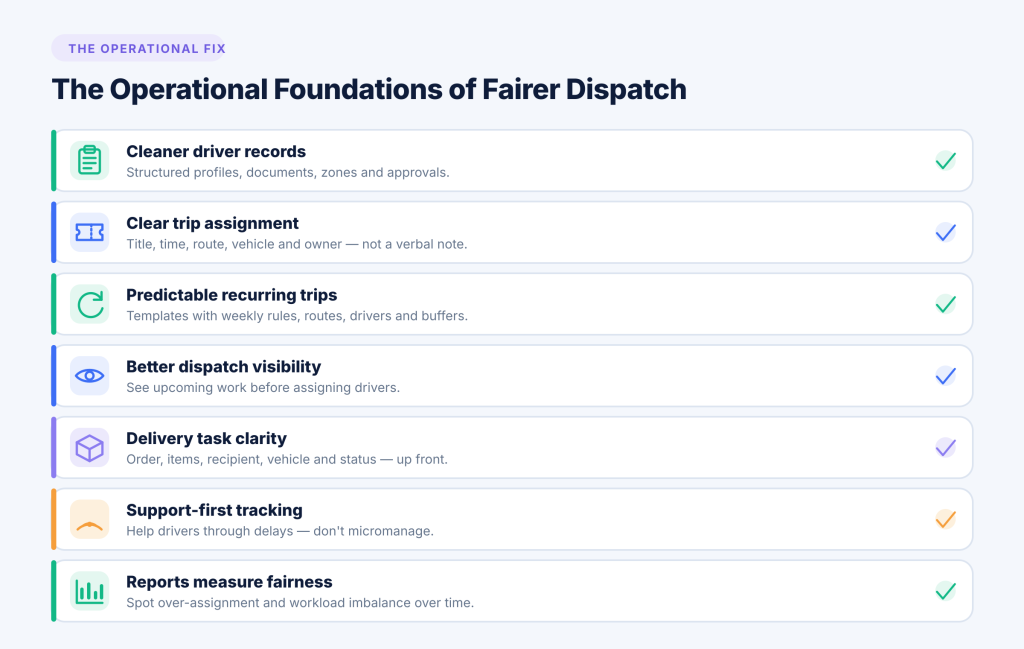
The Operational Foundations of Fairer Dispatch
Cleaner driver records create a better start
Driver retention begins before the first trip. If records are incomplete, onboarding turns messy; if documents are missing, approvals stall; if work type or zone context is unclear, dispatchers assign work without enough understanding.
A stronger driver-management process keeps structured information — profile details, work type, zone, approval status, documents, license details, and other operational fields — in one place. That removes confusion about who’s ready to drive, and it sets a professional first impression. A company that manages records clearly tends to manage assignments clearly too. Early friction, left unchecked, becomes early churn.
Clear trip assignment reduces confusion
Drivers need to know what they’re assigned to, when they’re expected to work, and which details matter for the job. A trip shouldn’t live only in a phone call, a message thread, or a last-minute verbal instruction. It should carry clear structure: title, time, route, vehicle, driver assignment, and the relevant trip information.
Clear ownership cuts misunderstandings between dispatch and drivers, and gives managers a record of who received which work. When drivers stop calling dispatch for basic details, the job simply feels less heavy — and a more professional experience supports retention.
Predictable recurring trips reduce turnover
Predictability is one of the most underrated retention tools in transport. Many operators run repeat work — employee shuttles, school routes, airport crew transfers, hotel pickups, campus transport, corporate routes, fixed shuttle loops. When that work is rebuilt manually every time, drivers get their schedules late and inconsistently, and stress follows.
Recurring trips and templates let operators define repeatable schedules with weekly rules, excluded dates, routes, vehicles, drivers, and buffer time. A shuttle driver who knows their regular route is far easier to retain than one facing an unpredictable assignment every morning. Predictable scheduling gives drivers confidence in their workweek — and confidence keeps them around.
Better dispatch visibility supports fairer decisions
Dispatchers make better calls when they can see what’s coming. Date-range views, trip lists, reservation details, and structured dispatch records let teams review upcoming work before assigning drivers. Without that visibility, dispatch turns reactive — and reactive dispatch feels unfair because decisions happen too fast to explain.
The need is concrete: an airport transfer operator juggling private transfers, hourly bookings, round trips, and multi-stop journeys needs a clear view of upcoming work; an employee shuttle operator needs visibility into repeat schedules; a bulk-event provider needs to see large booking batches before assigning drivers and vehicles. Structured visibility reduces last-minute pressure and makes balanced decisions possible.
Delivery task clarity matters too
Delivery drivers and agents face their own churn risk, usually rooted in unclear task ownership, missing item details, poor timing, or constantly changing assignments. A solid delivery workflow makes it obvious which order is assigned, which items are included, who the sender and recipient are, which vehicle or agent is responsible, and whether the task is ready to publish or still a draft.
A driver who starts with complete details is more confident than one who keeps calling for order, recipient, timing, or vehicle information. For courier, grocery, parcel, and event-logistics teams, clarity removes wasted communication and lowers daily stress.
Support-first real-time tracking, not micromanagement
Real-time tracking can strengthen operations — but only if drivers experience it as support, not surveillance. Used well, live visibility helps the operations team assist drivers during active work: understanding location context when a delivery runs late, responding faster when a shuttle slips behind, or guiding a driver when a route becomes unclear.
The goal isn’t to watch every second; it’s to reduce uncertainty and step in when a driver needs help. That distinction is everything. Support-first tracking builds trust. Micromanagement erodes it.
Reports make fairness measurable
Fairness can’t run on memory. Managers need reports and workload visibility to know whether assignments stay balanced over time. Driver, trip, vehicle, operator-level, and transaction reports can surface the patterns behind frustration:
- Are some drivers consistently over-assigned, and others underused?
- Are certain drivers repeatedly getting the preferred work?
- Are recurring trips distributed clearly?
- Are vehicle assignments creating unnecessary friction?
- Are delivery tasks balanced across agents?
- Are specific operators, branches, or service lines creating workload pressure?
Reports don’t fix driver turnover on their own, but they give managers the evidence to act. If you want to reduce driver churn, you have to be willing to review the patterns behind the complaints.
Driver Retention by Fleet Type
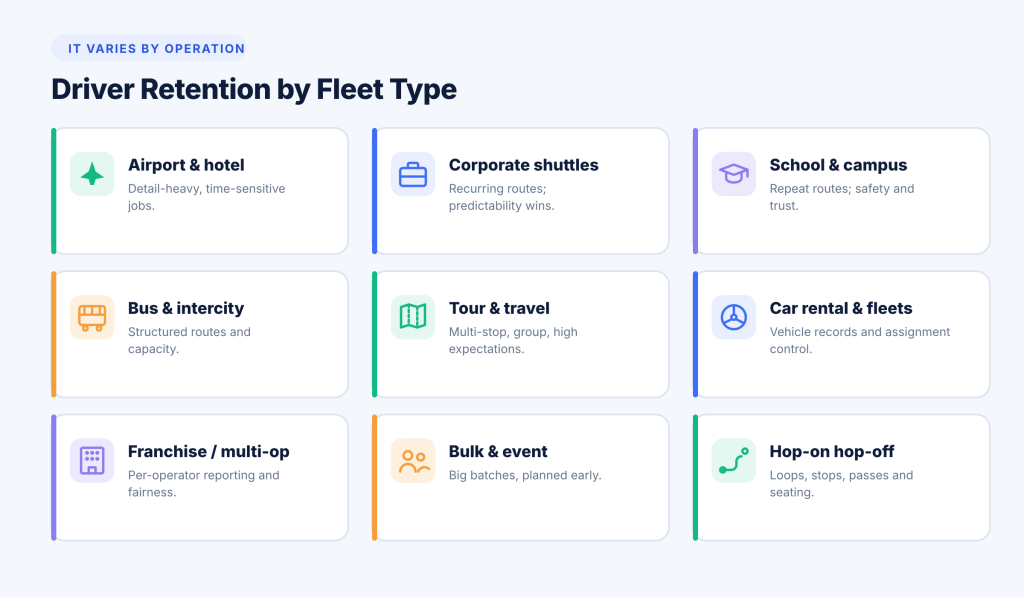
Different operations face different retention challenges, but the principle holds across all of them: better structure creates a better driver experience and reduce driver churn.
- Airport & hotel transfers — time-sensitive, detail-heavy jobs (one-way, round-trip, hourly, multi-stop, passenger, luggage, add-ons, tickets) where assignment clarity is non-negotiable.
- Employee & corporate shuttles — recurring trips, templates, weekly-repeat rules, excluded dates, buffer days, and route-based shared transfers; predictability is the whole game.
- School & campus transport — repeat routes, passenger records, seating visibility, and approved driver assignment, where consistency and trust are tied to safety.
- Bus & intercity services — structured routes, shared-transfer booking, bulk reservations, and capacity planning, so loads and passengers are planned clearly.
- Tour & travel operators — round-trip, hourly, multi-stop, add-on, group-booking, and ticket workflows, where complete trip details meet high guest expectations.
- Car rental & large fleet owners — structured vehicle records, availability visibility, and assignment control to cut asset-and-assignment confusion.
- Franchise & multi-operator businesses — operator-specific reporting and lifecycle management, since workload and fairness can differ across branches.
- Bulk & event transport — large booking batches handled without manual chaos, with trips planned early and communicated clearly.
- Hop-on hop-off services — route-based shared transfers, recurring trips, passes, seating layouts, and tickets for capacity-controlled loops.
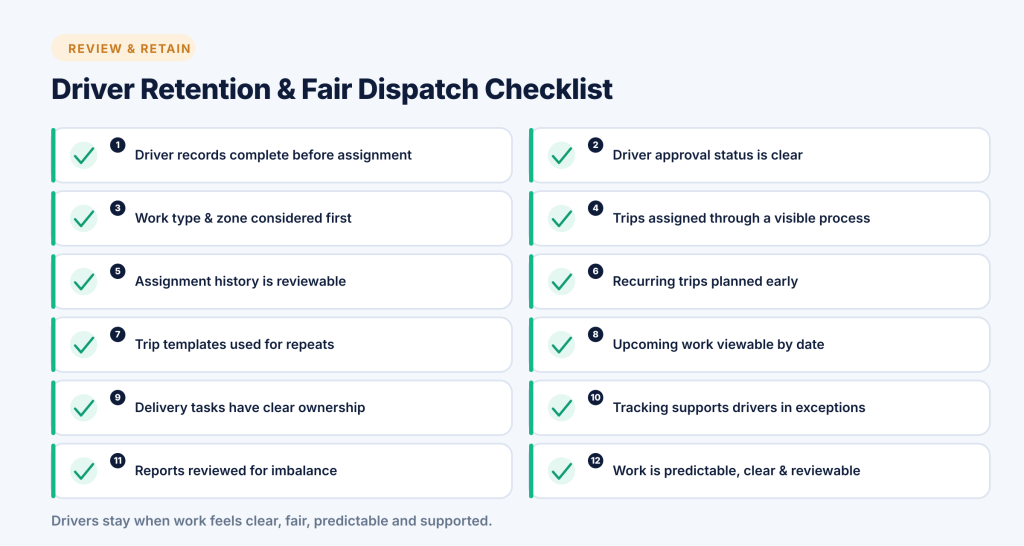
Driver Retention & Fair Dispatch Checklist
To reduce driver churn, review whether your operation can answer “yes” to each of these:
- Are driver records complete before assignment?
- Is driver approval status clear?
- Are work type and zone considered before assigning work?
- Are trips assigned through a visible process?
- Can managers review assignment history?
- Are recurring trips planned early?
- Are trip templates used for repeat schedules?
- Can dispatchers view upcoming work by date or period?
- Are delivery tasks assigned with clear agent and vehicle ownership?
- Is real-time tracking used to support drivers during exceptions?
- Are reports reviewed to catch workload imbalance?
- Are drivers given predictable, clear, and reviewable work?
How AllRide Fits This Conversation and Can Reduce Driver Churn
AllRide Apps supports transport and delivery operators with structured workflows across driver records, trip planning, recurring schedules, private and shared transport use cases, delivery task assignment, reporting, and real-time operational visibility.
For teams trying to reduce driver churn, the value isn’t an automatic “churn-reduction button” — it’s operational structure. When drivers are onboarded properly, trips are assigned clearly, recurring schedules are planned ahead, delivery tasks are structured, reports are reviewed, and active work is visible, operators can build a better working environment — one that supports stronger driver retention and helps reduce avoidable driver turnover over time.
To explore broader fleet and driver operations, visit AllRide Apps or learn more about AllRide Cab, AllRide Bus, and AllRide Delivery.
Final Recommendation
Reducing driver churn takes more than recruitment campaigns and short-term incentives. It takes better daily operations.
Drivers stay longer when work feels clear, fair, predictable, and supported. They leave faster when assignments feel random, communication is weak, schedules are chaotic, and workload imbalance goes ignored. Better tools and fairer dispatch can support stronger driver retention and help reduce driver turnover across taxi, shuttle, delivery, school transport, airport transfer, bus, courier, and mixed-fleet operations.
To see how structured transport and delivery workflows can support clearer assignments, better driver visibility, and fairer workload planning, book a 20-minute AllRide demo.
FAQs
What is driver churn? Driver churn is when drivers repeatedly leave a fleet, platform, or transport operation. High driver churn creates hiring pressure, service disruption, and operational instability.
What is driver retention? Driver retention means keeping drivers longer by improving their work experience — assignment clarity, predictability, communication, and operational support.
What is driver turnover? Driver turnover measures how often drivers leave and need to be replaced. Reducing driver turnover improves service stability and eases hiring pressure.
How can fleet operators reduce driver churn? By improving dispatch fairness, creating clearer trip assignments, planning recurring work, maintaining clean driver records, reviewing workload reports, and supporting drivers during active work.
Why does unfair dispatch increase driver turnover? Unfair dispatch makes drivers feel overlooked, overworked, or treated inconsistently. When assignments feel biased or unclear, trust drops and drivers leave.
How does predictable scheduling improve driver retention? Predictable scheduling lets drivers plan their work and personal time. Recurring trips and templates reduce last-minute pressure and build driver confidence.
Can real-time tracking help driver retention? Yes — when it’s used as a support tool. Real-time tracking helps dispatchers assist drivers during delays, exceptions, or task issues. It shouldn’t be used purely for micromanagement.
What tools help improve driver retention? Driver records, assignment history, recurring trip planning, dispatch visibility, delivery task assignment, real-time support, and workload reports.