

 Fleet Management
 Route optimization
 Shuttle Transportation
 Delivery Management
 School Bus Transportation
 Ride Sharing Management
 Airport Transfer Booking
  Vehicle inspection
 Car Rental Management
 Trucking & Logistics
 Food & Beverage
 E-Commerce
 Passenger Transit
 Delivery
 School & Corporate
Route Optimization Explained: How the Algorithms Work
Route optimization is the process of finding the most efficient set of routes for one or more vehicles to serve a list of stops, given real-world goals and limits — distance, time, cost, vehicle capacity, and delivery time windows. It’s the engine behind how modern fleets decide who goes where, in what order, and by which path.
It’s easy to assume this is just “plotting points on a map.” It isn’t. Behind a clean set of routes sits one of the hardest problems in computer science and operations research — the vehicle routing problem — and a family of routing algorithms built specifically to tame it. This article explains, in plain terms, what route optimization is, why it’s so difficult, and how the algorithms actually work.
What Is Route Optimization?
At its simplest, route optimization mathematically searches across many possible ways to serve a set of stops and selects the one that best meets your objective — usually minimizing total distance, drive time, fuel, or the number of vehicles needed, or maximizing on-time deliveries and asset utilization.
Route Planning vs. Route Optimization
These are often confused, but they’re different:
- Route planning simply sequences stops that a human already chose. It’s organization.
- Route optimization mathematically evaluates many possible sequences to minimize or maximize an objective. It’s computation.
Planning answers “what’s the order of the stops I picked?” Optimization answers “out of all possible orders and assignments, which is genuinely best?”
The Two Layers Underneath
Every route optimization system works on two layers:
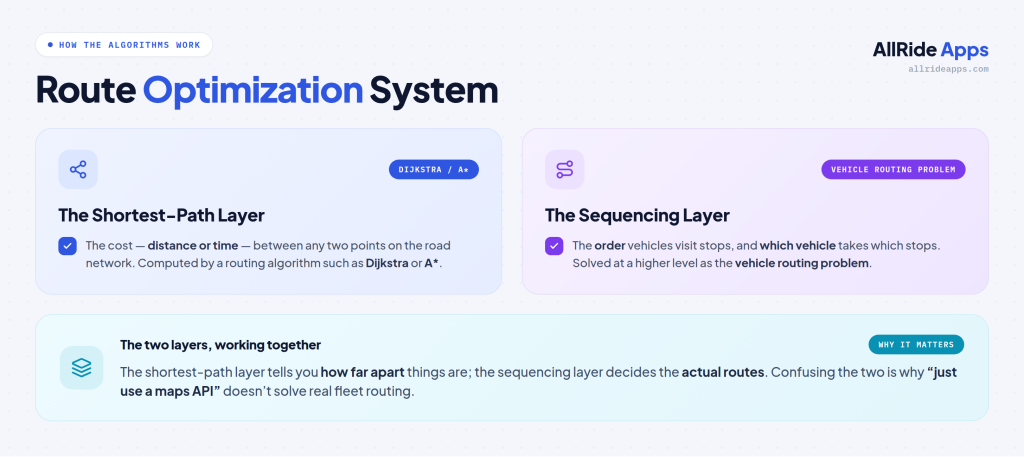
- The shortest-path layer — the cost (distance or time) between any two points on the road network. This is handled by a routing algorithm such as Dijkstra or A*.
- The sequencing layer — the order in which vehicles visit stops, and which vehicle takes which stops. This is framed as the vehicle routing problem and solved by a higher-level algorithm.
The shortest-path layer tells you how far apart things are; the sequencing layer decides the actual routes. Confusing the two is why “just use a maps API” doesn’t solve real fleet routing.
Why Route Optimization Matters
Route optimization isn’t an academic exercise — it moves the numbers operators care about most:
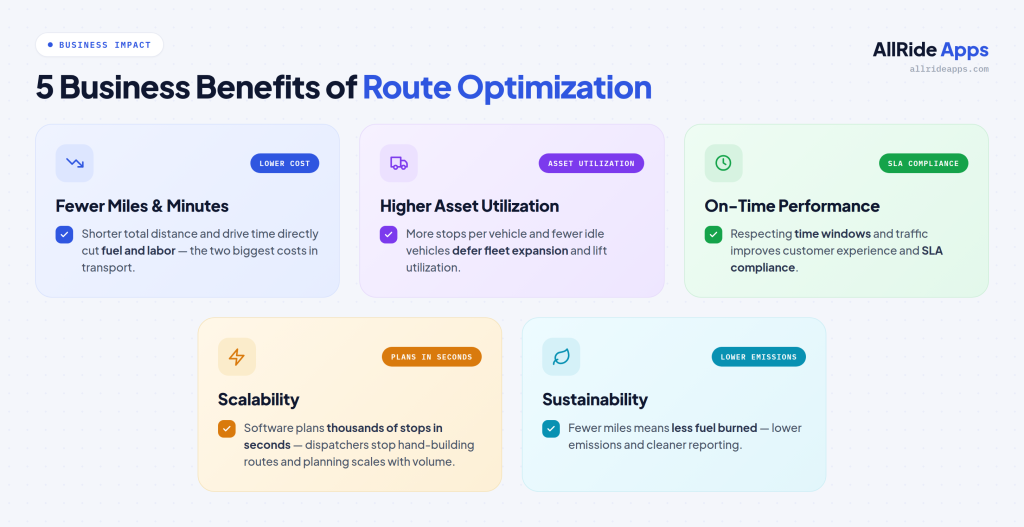
- Fewer miles and minutes. Shorter total distance and drive time directly cut fuel and labor — the two biggest costs in transport.
- Higher asset utilization. More stops per vehicle and fewer idle vehicles defer fleet expansion and lift fleet utilization.
- On-time performance. Respecting time windows and traffic improves customer experience and SLA compliance.
- Scalability. Software plans thousands of stops in seconds, so dispatchers stop hand-building routes and planning scales with volume.
- Sustainability. Fewer miles means less fuel burned — lower emissions and better reporting.
In short: the same optimization that saves money also raises service quality. That’s why it sits at the heart of serious fleet operations.
The Vehicle Routing Problem (VRP)
The vehicle routing problem is the formal name for the sequencing layer. It generalizes the classic Travelling Salesman Problem (TSP) — one vehicle visiting every stop once — to many vehicles operating under real-world constraints.
Here’s why it’s hard: the VRP is NP-hard. The number of possible route combinations explodes as stops increase, so beyond a handful of stops you simply cannot check every option — the count grows faster than any computer could ever evaluate. That single fact is the reason specialized algorithms exist at all.
The VRP isn’t one problem but a family of variants, each adding a real-world constraint:
| VRP variant | What it adds | Typical real-world fit |
|---|---|---|
| TSP (base case) | One vehicle, visit every stop once, return to start | Single-driver multi-stop day; the conceptual foundation |
| CVRP (capacitated) | Vehicles have a load or seat-capacity limit | Delivery vans; shuttle and bus seat capacity |
| VRPTW (time windows) | Each stop must be served within a time range | Appointment deliveries; scheduled pickups |
| VRPPD (pickup & delivery) | Items picked up and dropped within the same routes | Courier, parcel, ride-pooling |
| MDVRP (multi-depot) | Multiple start/end depots | Operators with several yards or hubs |
| HFVRP (heterogeneous fleet) | Mixed vehicle types and sizes | Fleets with sedans, vans, and buses |
| DVRP (dynamic) | Stops and traffic change in real time | Live dispatch; on-demand requests |
TSP vs. VRP in one line: TSP is one route for one vehicle; VRP is many routes for many vehicles under real constraints.
How Routing Algorithms Work
There is no single best routing algorithm. The right choice depends on how many stops you have, how complex the constraints are, and how fast you need an answer. The fundamental trade-off is always the same: solution quality versus speed and scale.
Algorithms fall into four families:
| Family | How it works | Strengths | Limits |
|---|---|---|---|
| Exact | Mathematically proves the optimal route (branch-and-bound, branch-and-cut, dynamic programming) | Guaranteed optimal solution | Only practical for small instances; run time grows exponentially |
| Heuristic | Builds a good route with smart rules (nearest neighbor, Clarke-Wright savings, insertion) then improves it (2-opt, Or-opt) | Very fast; intuitive; great starting solutions | No optimality guarantee; can get stuck in local optima |
| Metaheuristic | Higher-level search that escapes local optima (genetic algorithms, simulated annealing, tabu search, ant colony, ALNS) | Near-optimal at large scale; handles messy constraints; the workhorse of commercial software | Needs tuning; non-deterministic; no proof of optimality |
| ML-based | Learns to construct or guide routes from data (reinforcement learning, attention models, graph neural networks) | Fast inference once trained; adapts to patterns and live conditions | Emerging; needs data and training; usually paired with classic methods, not replacing them |
The Named Algorithms Worth Knowing
You’ll see the same names recur across the field. Dijkstra and A* compute shortest paths on the road graph — they feed the cost matrix. Held-Karp solves small TSPs optimally via dynamic programming, while branch-and-cut handles limited-size VRPs exactly. On the heuristic side, nearest neighbor gives a fast rough baseline, the classic 1964 Clarke-Wright savings method merges trips by their combined “savings,” and 2-opt / Lin-Kernighan shorten existing routes by swapping segments.
The heavy lifting in real software comes from metaheuristics: genetic algorithms evolve a population of routes, simulated annealing accepts some bad moves early to escape local optima, tabu search remembers recent moves to avoid cycling, ant colony optimization reinforces good segments via simulated pheromone trails, and ALNS (Adaptive Large Neighborhood Search) repeatedly destroys and repairs parts of a solution — the state of the art for rich, constraint-heavy VRPs.
How a Route Optimization Engine Runs, End to End
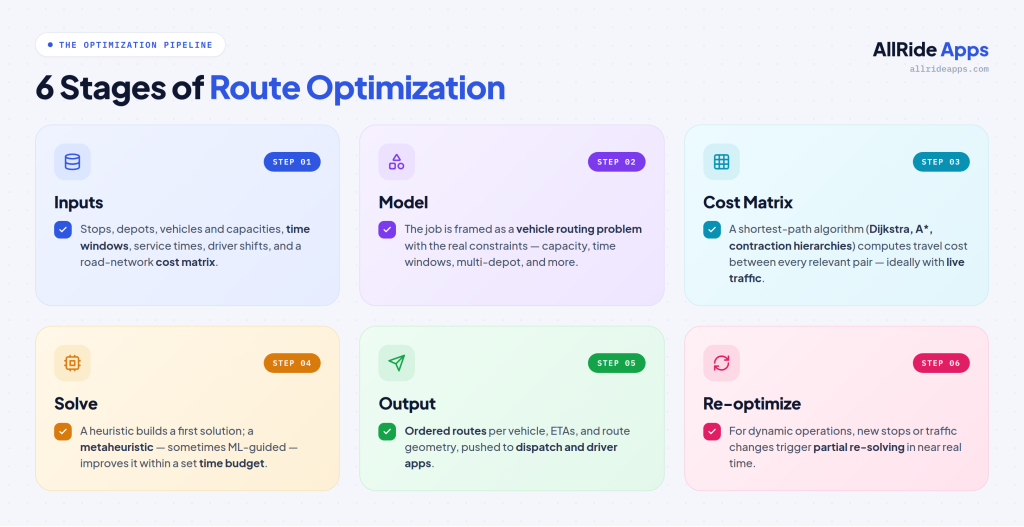
Put together, a modern engine moves through six stages:
- Inputs. Stops and addresses, depots, vehicles and their capacities, time windows, service times, driver shifts, and a road-network cost matrix.
- Model. The job is framed as a vehicle routing problem with the relevant constraints — capacity, time windows, multi-depot, and so on.
- Cost matrix. A shortest-path routing algorithm (Dijkstra, A*, or contraction hierarchies) computes travel cost between every relevant pair of points, ideally with live traffic.
- Solve. A heuristic builds a first solution; a metaheuristic — sometimes guided by ML — improves it within a set time budget.
- Output. Ordered routes per vehicle, ETAs, and route geometry, pushed to dispatch and driver apps.
- Re-optimize. For dynamic operations, new stops or traffic changes trigger partial re-solving in near real time.
This is also why “how does Google Maps optimize my route?” and “how does a fleet app optimize routes?” are different questions. A maps app mostly solves the shortest-path layer between points you give it. A fleet engine solves the full vehicle routing problem — which stops, which vehicle, what order, under what constraints — on top of that.
Where Route Optimization Delivers Value
Optimization shows up most clearly in operations with multi-stop, shared, or recurring movement:
- Airport and hotel transfers — tighter pickup sequencing and accurate ETAs across one-way, round-trip, and hourly transfers.
- Corporate and employee shuttles — design a recurring office route once, then run it capacity-aware and on time, week after week.
- School and campus transport — capacity-controlled routing on fixed routes with proper driver assignment.
- Bus and intercity shuttles — capacity-aware shared routing that seat-by-seat tools can’t match.
- Tours and group travel — efficient multi-stop day itineraries.
- Large fleets — optimization that lifts utilization and trims mileage, the metrics fleet owners track most closely.
Platforms like AllRide apply these principles to booking, dispatch, and fleet workflows — framing routing around multi-stop sequencing, recurring routes, and capacity-aware shared transport rather than treating every job as a one-off. The goal is the same one optimization has always served: more value from every vehicle, driver, and trip.
The Bottom Line
Route optimization looks simple from the outside and is anything but underneath. It rests on a genuinely hard problem — the vehicle routing problem — and a deep toolkit of routing algorithms, from exact solvers to metaheuristics to emerging ML. Understanding how those pieces fit together is what separates operators who plan routes from those who truly optimize them.
The payoff is concrete: fewer miles, higher utilization, better on-time performance, and a fleet that scales without scaling its costs.
Frequently Asked Questions
What is route optimization?
Route optimization is the process of finding the most efficient set of routes for one or more vehicles to serve a set of stops, given goals and limits like distance, time, cost, capacity, and time windows. It minimizes cost while respecting real-world constraints.
How does route optimization work?
It works in two layers: a shortest-path algorithm computes travel cost between points, then a higher-level algorithm solves the vehicle routing problem — deciding which vehicle serves which stops, in what order — usually using fast heuristics improved by metaheuristics within a time budget.
What is the vehicle routing problem?
The vehicle routing problem (VRP) is the mathematical problem of assigning and sequencing stops across multiple vehicles under constraints such as capacity and time windows. It generalizes the Travelling Salesman Problem from one vehicle to many.
What is the difference between TSP and VRP?
The Travelling Salesman Problem (TSP) finds one route for a single vehicle visiting every stop once. The vehicle routing problem (VRP) extends this to many vehicles operating under real constraints like capacity, time windows, and multiple depots.
Why is route optimization so hard (NP-hard)?
The vehicle routing problem is NP-hard: the number of possible route combinations grows explosively as stops increase, so checking every option becomes impossible beyond a few stops. That’s why specialized algorithms approximate the best answer instead.
What algorithms are used for route optimization?
Four families: exact methods (branch-and-cut, dynamic programming), heuristics (nearest neighbor, Clarke-Wright, 2-opt), metaheuristics (genetic algorithms, simulated annealing, tabu search, ALNS), and emerging ML-based methods. Commercial software relies mostly on metaheuristics.
What is the best route optimization algorithm?
It depends on the problem. Exact methods suit small instances needing a guaranteed optimum; heuristics and metaheuristics handle large, constraint-heavy fleets where near-optimal-but-fast wins. There is no single best algorithm for all cases.