


 Fleet Management
 Route optimization
 Shuttle Transportation
 Delivery Management
 School Bus Transportation
 Ride Sharing Management
 Airport Transfer Booking
  Vehicle inspection
 Car Rental Management
 Trucking & Logistics
 Food & Beverage
 E-Commerce
 Passenger Transit
 Delivery
 School & Corporate
How to Reduce Dead Mileage and Improve Fleet Utilization
Operators reduce dead mileage — the unproductive, empty miles a vehicle travels without a passenger, load, or assigned task — by planning earlier in the workflow: capturing complete booking details, grouping compatible trips into shared transfers, scheduling recurring routes, matching the right driver and vehicle to each job, structuring delivery tasks, and reviewing utilization reports. Dead mileage is less a routing problem than a planning problem — and better planning is what lifts fleet utilization.
Every mile your fleet travels without a passenger, order, load, or useful assigned task costs money. It burns fuel, consumes driver time, adds wear to the vehicle, and reduces available capacity. It also quietly lowers fleet utilization, because the vehicle is moving but not producing meaningful output.
That’s why transport operators are paying closer attention to how they can reduce dead mileage and control empty miles across daily operations. And the key realization is this: a vehicle rarely becomes “empty” by accident. It usually becomes empty because demand, timing, driver availability, vehicle capacity, and dispatch decisions aren’t connected early enough.
For cab operators, shuttle providers, private-hire companies, airport transfer businesses, delivery fleets, and logistics teams, the opportunity is clear: better planning supports better vehicle usage.
What Is Dead Mileage?
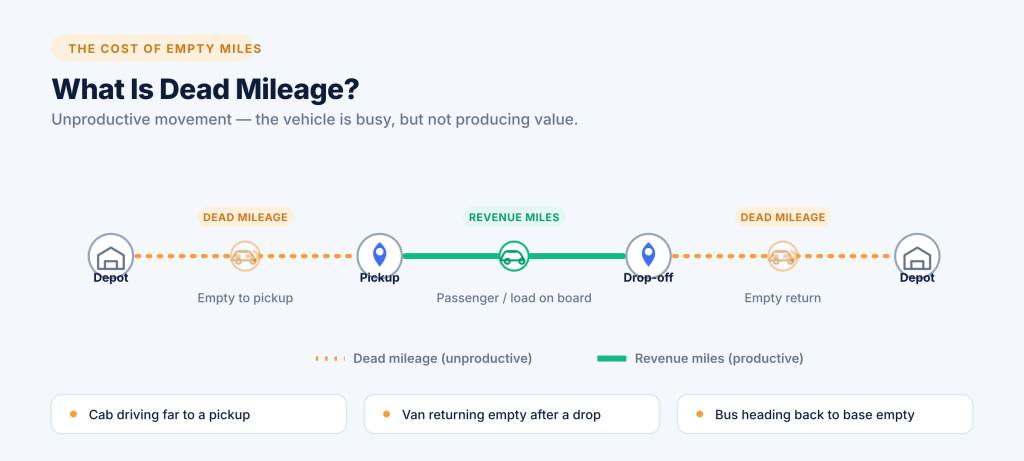
Dead mileage is unproductive vehicle movement — when a vehicle travels without carrying a passenger, load, order, parcel, or useful assigned work.
In passenger transport, that might be a cab travelling far to reach a pickup. In delivery, it could be a van returning empty after a drop-off. In shuttle operations, it could be a bus returning to base without passengers.
The terms shift by region and industry. Many operators call it dead mileage. Logistics teams often say empty miles. In US freight and trucking, it’s usually deadhead miles. The business impact is identical: the asset is being used, but not productively. That’s why learning how to reduce dead mileage is one of the most practical ways to improve fleet productivity.
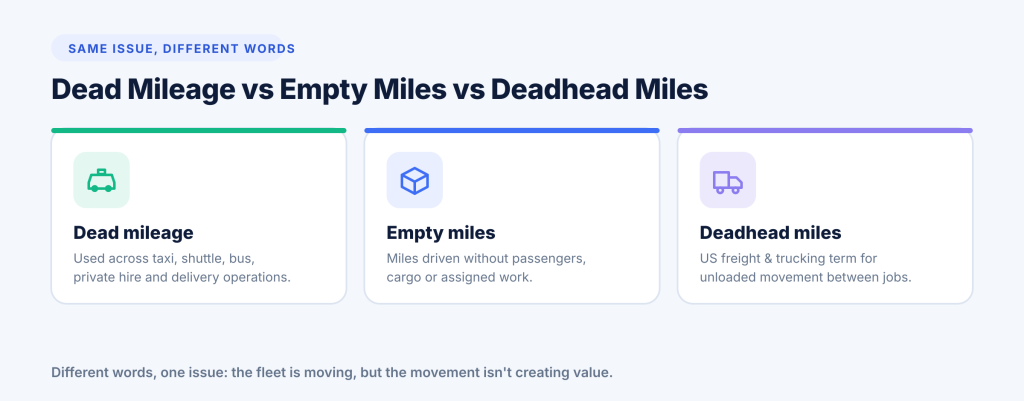
Dead Mileage vs. Empty Miles vs. Deadhead Miles
These three terms are closely related and, for most operators, point to the same problem:
- Dead mileage — a broad term used across taxi, shuttle, bus, private-hire, and delivery operations.
- Empty miles — typically miles driven without passengers, cargo, or assigned work.
- Deadhead miles — common in US freight and trucking for unloaded movement between jobs.
For a global audience, all three describe one operational issue: the fleet is moving, but the movement isn’t creating enough value. And reducing empty miles isn’t only about saving distance — it’s about increasing fleet utilization.
Why Empty Miles Hurt Fleet Utilization
Fleet utilization measures how effectively your vehicles and drivers are used. A fleet may have 50 vehicles available, but if only 30 are productively assigned at peak, utilization is weak. If some vehicles run multiple trips while others sit idle, utilization is uneven. If drivers travel long distances empty between jobs, utilization looks active on the road but inefficient in the business.
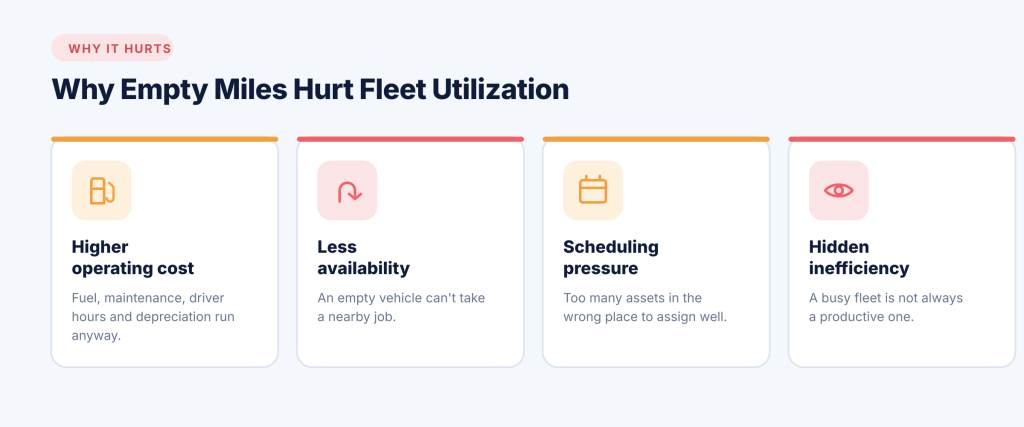
Empty miles create four problems at once:
- They increase operating cost. Fuel, maintenance, driver hours, parking, and depreciation continue even when the trip isn’t revenue-generating.
- They reduce vehicle availability. A vehicle travelling empty to a distant pickup can’t serve a nearby job.
- They create scheduling pressure. Dispatchers struggle to assign the right asset when too many are in the wrong place.
- They hide inefficiency. A busy fleet isn’t always a productive one — vehicles can move all day and still generate poor output.
The lesson: don’t only measure total trips. Measure productive movement, vehicle utilization, driver utilization, and patterns of empty miles.
Where Dead Mileage Happens in Daily Operations
Dead mileage usually appears in small operational gaps — and the root cause is the planning process behind the movement, not just the route. Watch for it here:
- Long empty travel to pickup points, and empty return trips after drop-offs
- Poor vehicle-to-demand matching
- One-off dispatching for predictable, recurring demand
- Separate vehicles serving similar pickup/drop-off patterns
- Delivery tasks assigned without route or agent visibility
- Underused vehicles during peak demand
- Drivers assigned without workload or location awareness
- Weak reporting around vehicle and driver productivity
The more disconnected the workflow, the harder it becomes to reduce dead mileage.
How Better Dispatch Planning Helps Reduce Dead Mileage
The most effective dead-mileage reduction starts before the vehicle moves. Strong dispatch planning connects the key elements of fleet work — demand, timing, customer, route, vehicle, driver, task, fare, ticket, report, and live visibility.
When operators capture the right details early, they make better decisions later. Organized private and shared demand prevents scattered movement. Recurring trips planned in advance let the fleet prepare capacity before demand turns urgent. Delivery orders converted into assigned tasks make movement more structured. Reports reviewed regularly surface repeated empty-mile patterns.
The shift operators need to make is simple: don’t treat dead mileage as only a driver problem — treat it as a planning problem.
Better Reservation Planning Creates Better Fleet Usage
Every trip starts with demand capture. For passenger transport, that means recording reservation type, trip mode, journey date and time, pickup and stop locations, drop-off, passenger and customer details, luggage count, add-ons, and fare details where required.
A vague booking creates guesswork; a clear booking creates operational visibility. Knowing the pickup time, drop-off, passenger count, luggage, and vehicle type helps the dispatcher avoid sending the wrong vehicle or allocating capacity poorly — which supports better fleet utilization, because vehicles are matched closer to actual demand.
Shared Transfers Reduce Separate Empty Vehicle Movement
One of the simplest ways to reduce empty miles is to group compatible demand. Shared-transfer planning organizes passengers around a trip, route, recurring trip, or location — so instead of sending separate vehicles for similar patterns, operators consolidate where service rules allow. It’s especially useful for:
- Airport transfers and corporate shuttles
- Employee and school transport
- Event movement and scheduled shared rides
- Community, hotel, or campus shuttles
Shared transfers don’t mean every trip should be shared — premium private rides and time-sensitive pickups may require dedicated service. But when demand is compatible, grouping trips reduces dead mileage and improves occupancy.
Recurring Trips Turn Predictable Demand into Planned Capacity
Repeat demand is one of the best opportunities for better fleet utilization. Many businesses run journeys that repeat daily or weekly: employee shuttles, school routes, airport crew transfers, corporate transport, hotel pickups, and recurring reservations.
Rebuilt manually each time, this demand costs dispatch teams visibility and consistency. Recurring trips and trip templates let operators define repeat schedules using start and end dates, journey time, weekly repeat days, routes, vehicle type, driver assignment, excluded dates, and buffer days. The more predictable the demand, the easier it is to reduce unnecessary repositioning.
Bulk Reservations Improve Early Capacity Planning
When operators need to manage many bookings together — corporate travel, shuttle movement, events, school transport, large transfer programs — bulk reservations let teams upload structured files instead of creating each booking by hand.
That early visibility matters, because dead mileage often increases when teams react too late. If the fleet sees demand only at the last moment, allocation becomes rushed; if demand is visible earlier, operators can plan routes, capacity, and assignments more calmly. Bulk planning turns scattered demand into organized operational input.
Driver and Vehicle Assignment Directly Affect Empty Miles
Assignment is one of the most overlooked causes of dead mileage. If a driver far from the pickup is assigned while a closer one is available, empty travel rises. If a driver has too many gaps between jobs, utilization drops. If one driver gets most assignments while others sit idle, productivity becomes uneven.
Vehicle assignment matters just as much. A large vehicle on a low-demand trip wastes capacity; a small vehicle on a high-demand trip creates pressure; a vehicle without the right availability or location adds empty movement before the trip even starts.
Better assignment won’t automatically eliminate empty miles, but matching the right driver and vehicle to each trip gives dispatch teams a far stronger foundation to reduce avoidable movement.
Delivery Teams Also Need to Reduce Dead Mileage
Dead mileage isn’t only a passenger-transport problem. A van finishes a delivery and returns empty. A courier crosses town for a single task. One vehicle carries a light load while another sits unused. An order waits unassigned until dispatch becomes urgent.
A structured delivery workflow reduces this. The process should connect order creation, sender and recipient details, pickup date and time, item details, weight, volume, delivery instructions, fare calculation, task creation, agent and vehicle assignment, and task tracking. When orders become assigned tasks and task locations are visible, delivery movement becomes far easier to manage. For delivery fleets, reducing empty miles starts with turning demand into planned work.
Reports and Real-Time Tracking: Measure Before You Improve
You can’t improve what you don’t measure. Reports help identify repeat patterns across reservations, trips, drivers, vehicles, customers, transactions, and operator-level performance — answering questions like:
- Which vehicles are underused, and which drivers have low productive hours?
- Which trips create frequent empty returns?
- Which customers or routes create repeat demand?
- Which time windows create idle capacity?
- Which branches or operators show weaker utilization?
Real-time tracking adds another layer: when task positions are visible on a map, dispatchers can monitor field activity and respond faster. Tracking doesn’t reduce dead mileage on its own — but combined with planning, assignment, and reporting, it helps teams make better decisions because they can see where work is happening.
Dead Mileage Reduction Checklist for Fleet Operators
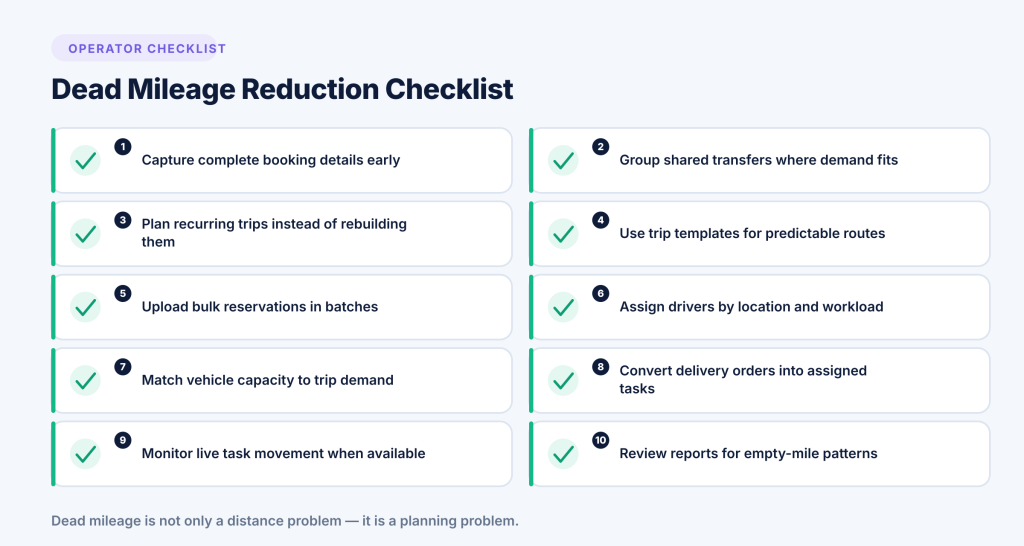
To reduce dead mileage, review the following:
- Capture complete booking details early
- Use shared transfers where demand can be grouped
- Plan recurring trips instead of rebuilding repeat schedules
- Use trip templates for predictable routes
- Upload bulk reservations when demand comes in batches
- Assign drivers based on availability, workload, and location context
- Match vehicle type and capacity to trip or task demand
- Convert delivery orders into assigned tasks
- Monitor live task movement when available
- Review reservation, trip, driver, vehicle, customer, transaction, and operator reports
- Identify repeated empty-mile patterns
- Improve weekly planning before peak demand begins
How AllRide Fits This Conversation
AllRide Apps supports transport and delivery operators with structured workflows across reservations, shared transfers, trips, recurring trips, delivery orders and tasks, driver and customer records, reporting, invoices, and real-time tracking.
For fleet teams trying to reduce dead mileage, the value isn’t a single magic feature — it’s structure. When reservations are captured properly, trips are planned clearly, shared transfers are organized, recurring demand is scheduled, delivery tasks are assigned, and reports are reviewed, operators gain better control over fleet movement. That can support stronger fleet utilization and fewer avoidable empty miles over time.
To explore broader fleet workflows, visit AllRide Apps or learn more about fleet management software.
Final Recommendation
Dead mileage is not only a distance problem — it’s a planning problem. Operators can reduce dead mileage by capturing demand earlier, grouping shared trips, planning recurring work, assigning drivers and vehicles more carefully, structuring delivery tasks, monitoring live movement, and reviewing reports.
The goal isn’t just to cut empty miles. It’s to improve fleet utilization so every vehicle, driver, trip, and task contributes more value.
See how structured transport and delivery workflows support better fleet utilization — book a 20-minute AllRide demo for more practical ways to improve fleet operations.
Frequently Asked Questions
What is dead mileage?
Dead mileage is vehicle movement that doesn’t carry passengers, cargo, orders, or useful assigned work. It’s unproductive movement that increases cost and lowers fleet utilization.
What are empty miles?
Empty miles are miles driven without a passenger, shipment, delivery order, or assigned task. They’re common across passenger transport, delivery, logistics, shuttle, and freight operations.
How can operators reduce dead mileage?
By improving reservation planning, grouping shared trips, scheduling recurring work, assigning drivers and vehicles carefully, managing delivery tasks, using real-time visibility, and reviewing reports.
How does fleet utilization relate to dead mileage?
High dead mileage usually means lower fleet utilization, because vehicles are moving without producing enough useful work. Better planning helps vehicles spend more time on productive assignments.
What is fleet utilisation?
“Fleet utilisation” is the UK spelling of fleet utilization — how effectively available vehicles and drivers are used for productive transport or delivery work.
How do shared transfers reduce empty miles?
Shared transfers group compatible passenger demand around trips, routes, recurring trips, or locations, which can reduce the need for separate vehicle movements.
Do recurring trips help reduce dead mileage?
Yes. Repeat demand becomes predictable, so planning recurring schedules in advance reduces last-minute dispatch decisions and unnecessary repositioning.
Does real-time tracking reduce dead mileage automatically?
No. Real-time tracking supports better visibility and faster decisions, but planning, assignment, and reporting are still essential to actually reduce dead mileage.