


 Fleet Management
 Route optimization
 Shuttle Transportation
 Delivery Management
 School Bus Transportation
 Ride Sharing Management
 Airport Transfer Booking
  Vehicle inspection
 Car Rental Management
 Trucking & Logistics
 Food & Beverage
 E-Commerce
 Passenger Transit
 Delivery
 School & Corporate
Reducing the Cost of Staff Commutes Without Cutting Safety
Companies cut commute costs safely by consolidating individual trips into shared and managed transport, optimizing routes and fleet utilization, offering multi-modal options and commuter benefits, and adopting employee transportation software that builds safety in — live GPS tracking, driver verification, and emergency alerts — rather than treating it as an expense to trim. The key insight: cost efficiency and safety come from the same investment, not from cutting one to fund the other.
For most organizations, getting employees to work is one of the largest and least-examined line items in the people budget. As return-to-office mandates spread and transport prices climb, the corporate commute cost is rising fast — and the tempting response is to economize on the part of the journey that protects employees. That’s a costly mistake.
This guide explains why staff commutes have become so expensive, why safety can never be the variable you sacrifice, and how forward-looking enterprises are doing both — lowering cost and raising safety at the same time.
The Rising Corporate Commute Cost Problem
Commuting has quietly become one of the most expensive routines in working life — and estimates of just how expensive vary widely depending on what you count.
In the U.S., for example, the cost of getting to work ranges from roughly $2,600 a year in direct out-of-pocket spending, per the Citi Commuter Index, to around $8,466 a year by U.S. Bureau of Labor Statistics figures, to as much as $9,470 a year once the value of lost time is included, according to a LendingTree analysis of U.S. Census data — a figure that rose sharply from about $5,725 just two years earlier.
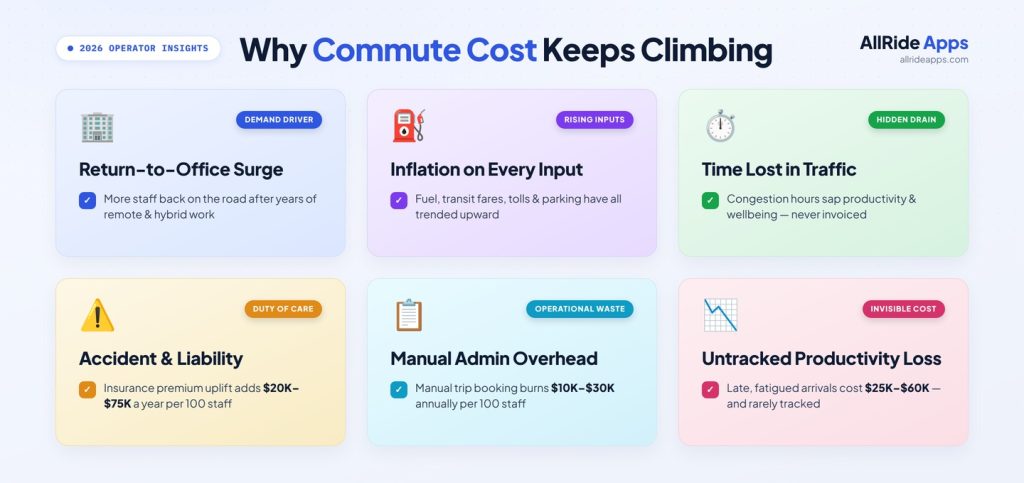
The exact number matters less than the direction: it’s large, and it’s climbing. Several forces are pushing the corporate commute cost up at once:
- Return-to-office mandates are putting more people back on the road after years of remote and hybrid work.
- Fuel, transit fares, tolls, and parking have all trended upward with inflation.
- Time itself — the hours lost in traffic — is a real productivity and wellbeing cost, even when it never appears on an invoice.
For employers, this lands in two places. Where the company funds transport directly — shuttles, allowances, fleets — it’s a visible operating expense. Where employees absorb the cost, it shows up indirectly as a drag on recruitment, retention, and morale.
And there’s a third dimension: sustainability. With the average passenger vehicle emitting roughly 4.6 tons of CO2 a year, according to the U.S. Environmental Protection Agency, single-occupancy commuting carries an environmental cost that increasingly sits inside corporate ESG commitments.
Why Safety Can’t Be the Trade-Off
When commute budgets tighten, the instinct is to cut corners — cheaper vendors, looser vetting, less oversight. It’s exactly the wrong place to economize.
Employers carry a duty of care for staff travelling on company-arranged transport, and that duty doesn’t pause to save money. The risk is most acute for employees on late-night or early-morning shifts — common in IT, BPO, healthcare, and manufacturing operations worldwide. Consider a frequent reality in many global hubs: an employee finishing a 2 a.m. shift, getting into an unfamiliar vehicle with a driver they’ve never met, on a route no one is monitoring. That scenario plays out nightly across the world, and it’s precisely where cut-rate transport becomes dangerous.
The false economy is simple to see once you look:
- A single safety incident can cost more in liability, investigation, and reputational damage than years of “savings” from a cheaper provider.
- Employees who don’t feel safe getting home won’t stay — turnover is its own expensive line item.
- For organizations serious about inclusion, unsafe commutes disproportionately limit who can take certain shifts or roles, narrowing the talent pool.
The goal, then, isn’t to choose between cost and safety. It’s to find the approaches that deliver both — and they exist.
How to Reduce Commute Cost Without Cutting Safety
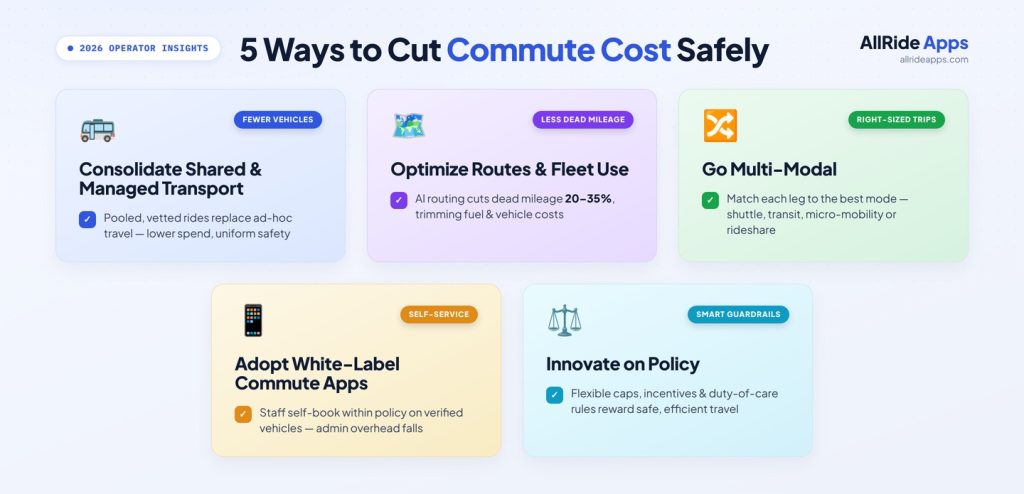
The organizations getting this right treat the commute as a system to optimize, not a perk to ration. Five strategies consistently lower cost while strengthening safety.
1. Consolidate with Shared and Managed Transport
The fastest way to reduce commute cost is to stop moving people one car at a time. Shuttles, vanpools, and managed employee transport pool many riders into far fewer vehicles.
- Fewer vehicles and drivers per employee moved means a dramatically lower cost per head.
- Consolidation also improves safety: a managed shuttle with a vetted driver and a tracked route is safer than dozens of individual late-night rides.
- Scale is real here — enterprise employee-transport platforms already move large workforces this way.
2. Optimize Routes and Fleet Utilization
Whatever vehicles you run, efficiency is where cost and safety align. Route optimization and better fleet utilization cut the two biggest waste sources — empty miles and idle vehicles — while reducing time on the road.
- Smarter routing lowers fuel, hours, and vehicle wear, trimming the corporate commute cost directly.
- Less time on the road and fewer rushed trips also means lower accident exposure.
- Utilization data reveals where you’re over- or under-provisioned, so you right-size capacity instead of guessing.
3. Go Multi-Modal
No single mode is cheapest or safest for everyone. A multi-modal approach lets employees mix shuttles, public transit, carpooling, micromobility, and walking based on what’s most efficient for their route — and helps reduce commute cost across a diverse workforce.
- Pairing managed transport for first/last-mile or unsafe segments with public transit for the rest balances cost and safety.
- Giving employees options improves uptake far more than mandating one mode.
4. Adopt White-Label Employee Commute Apps
This is where technology turns the cost-versus-safety tension into a single solution. Modern employee transportation platforms — often deployed as white-label apps under the company’s own brand — make safety a built-in feature rather than an added cost.
The safety capabilities that used to be expensive extras are now standard in good employee transportation software:
- Live GPS tracking visible to a designated contact, so someone always knows where the vehicle is.
- Driver verification — employees see the assigned driver’s name, photo, and vehicle details before pickup.
- SOS / panic alerts that notify coordinators and emergency contacts with the rider’s location.
- Geofence and route-deviation alerts that flag an off-route trip automatically.
- Last-drop confirmation verifying the employee reached their registered destination.
Crucially, these same platforms drive cost down — through automated routing, utilization analytics, and demand-based scheduling — so the investment that makes commutes safer is the same one that makes them cheaper.
5. Innovate on Policy
Some of the biggest savings come not from vehicles but from policy design.
- Commuter benefit programs let employees pay for transit or vanpools with pre-tax income.
- Hybrid and staggered scheduling reduces the number of commutes outright; Global Workplace Analytics estimates flexible arrangements can save workers anywhere from a few hundred to several thousand dollars a year.
- Transparent monitoring policy. Where GPS and tracking are used for safety, doing it right matters: tracking should be limited to company-arranged trips, disclosed in writing, and consent-based. Rules vary by jurisdiction — from U.S. state notice requirements to GDPR-style data protection — so safety tech must be paired with a clear, privacy-respecting policy. Done well, this builds trust rather than eroding it.
What Good Looks Like: Cost and Safety, Together
The throughline across all five strategies is that cost efficiency and safety are not opposing forces — they’re outputs of the same well-run system. A consolidated, optimized, technology-enabled commute is simultaneously cheaper and safer than a fragmented, manual, unmonitored one.
This is why employee transportation is shifting from a patchwork of vendors and spreadsheets toward integrated SaaS platforms. A single platform that handles routing, scheduling, fleet utilization, and safety monitoring lets an organization lower its corporate commute cost and raise its duty-of-care standard in one move — with the data to prove both to finance and to HR.
The best operators have stopped asking “how do we spend less on commutes?” and started asking “how do we run commutes better?” The savings follow from the second question; the safety comes free with it.
The Bottom Line
Staff commutes are expensive and getting more so, but the answer is never to economize on employees’ safety. The organizations pulling ahead reduce their corporate commute cost by running smarter — consolidating trips, optimizing fleets, offering multi-modal choice, adopting employee commute apps with safety built in, and designing policy that helps both sides. Each of these lowers cost and raises safety, because both come from the same source: a better-managed commute.
The companies that internalize this won’t just spend less getting people to work. They’ll be the ones employees actually want to work for.
Want practical playbooks on running smarter, safer employee transport? Subscribe to the Operator Insights Newsletter for data-driven guidance straight to your inbox — and explore our employee transportation solutions to see how cost and safety come together on one platform. Subscribe now.
Frequently Asked Questions
How can companies reduce corporate commute cost without compromising safety?
By consolidating trips into shared or managed transport, optimizing routes and fleet use, offering multi-modal options and commuter benefits, and using employee transportation software with built-in safety features like GPS tracking, driver verification, and SOS alerts. These lower cost and improve safety at the same time.
What is the average corporate commute cost?
Estimates vary by methodology. According to Urban Transport Magazine, the average corporate commuter in the US spends nearly $5,750 annually on out-of-pocket transportation costs. When adding the opportunity cost of lost time, the true impact rises to over $9,000 per employee each year.
How does employee transportation software improve safety?
It adds real-time visibility and response: live GPS tracking, driver identity verification, SOS/panic alerts, route-deviation (geofence) alerts, and last-drop confirmation — so trips are monitored and emergencies can be acted on quickly, rather than relying on manual coordination.
Do commuter benefits actually reduce commute cost?
Yes. Pre-tax commuter benefit programs let employees pay for transit or vanpools with untaxed income, lowering their cost at minimal expense to the employer. Combined with hybrid scheduling, they can meaningfully reduce commute cost for staff.
Is it legal to track employee commutes with GPS?
Generally yes for company-arranged transport, but rules vary widely by jurisdiction. Best practice is to limit tracking to work-related trips, disclose it in writing, obtain consent, and comply with local data-protection laws (such as GDPR). Transparency turns safety tracking into a trust-builder rather than a privacy concern.