


 Fleet Management
 Route optimization
 Shuttle Transportation
 Delivery Management
 School Bus Transportation
 Ride Sharing Management
 Airport Transfer Booking
  Vehicle inspection
 Car Rental Management
 Trucking & Logistics
 Food & Beverage
 E-Commerce
 Passenger Transit
 Delivery
 School & Corporate
Multi-Tenant Architecture: Why It Matters for SaaS Transport
What is multi-tenant architecture in SaaS transport software? Multi-tenant architecture is a model where a single instance of the software serves many separate businesses — called tenants — on shared cloud infrastructure, with each tenant’s data, branding, and configuration kept isolated. In transport, it means one platform can run dozens or thousands of independent fleets at once, instead of standing up separate software for every operator.
That single design choice quietly shapes everything that follows: how fast a transport platform can grow, what it costs to run, how quickly it improves, and how easily an operator can launch under its own brand. For anyone evaluating multi-tenant transport software — whether you’re building a mobility platform or choosing one — understanding this architecture is the difference between a system that scales and one that stalls.
This guide explains what multi-tenancy is, why it matters for SaaS transport, and how it underpins the white-label platform model reshaping global mobility.
What Is Multi-Tenant Architecture in SaaS Transport Software?
The clearest way to picture multi-tenant architecture is an apartment building. Every resident has their own private, locked unit — their own space, their own key — but they share the building’s foundation, plumbing, and infrastructure. One structure efficiently houses many independent households.
A multi-tenant SaaS transport platform works the same way. Many transport businesses operate on one shared system, each with isolated data and its own branding, while the underlying infrastructure, codebase, and maintenance are shared. The provider runs and upgrades one platform; every tenant benefits.
Single-Tenant vs. Multi-Tenant: The Core Difference
- Single-tenant: Each customer gets a separate, dedicated copy of the software and infrastructure. More isolation, but higher cost, slower updates, and heavier maintenance — every instance must be upgraded individually.
- Multi-tenant: One shared instance serves all customers, with logical separation keeping each tenant’s data private. Lower cost per tenant, instant platform-wide updates, and far easier scaling.
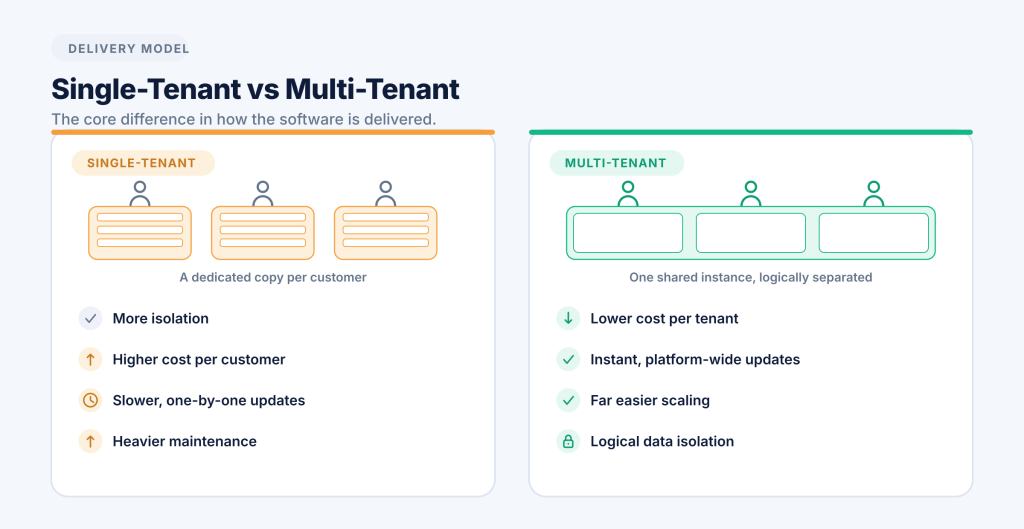
For modern multi tenant SaaS, the multi-tenant model has become the default precisely because it solves the economics of serving many customers at once — which is exactly the challenge transport platforms face.
Why Multi-Tenant Architecture Matters for SaaS Transport
Transport is an unusually demanding environment for software: many operators, fluctuating demand, real-time dispatch, fleets of every size, and customers spread across regions, currencies, and languages. Multi-tenant transport software is built to absorb that complexity. Here’s where it pays off.
Scalability: Add Fleets Without Rebuilding
The biggest advantage is the ability to grow without friction. Onboarding a new operator onto a multi tenant fleet platform means provisioning a new tenant — not building, deploying, and maintaining a brand-new system.
- A platform can take on its tenth or ten-thousandth fleet on the same infrastructure.
- New operators can launch in days rather than months.
- Growth doesn’t multiply the maintenance burden, because there’s still only one platform to run.
This is why the fastest-growing mobility platforms in the world are multi-tenant: the architecture turns each new customer into a configuration, not a construction project.
Cost Efficiency: Economies of Scale
Because tenants share infrastructure, the cost of running the platform is spread across all of them. That economy of scale flows in both directions — the provider operates more efficiently, and operators pay far less than they would to build or host dedicated software.
- No per-operator servers to provision and idle.
- Maintenance, security patching, and uptime are handled once, for everyone.
- Lower total cost of ownership makes professional-grade transport software accessible to small and mid-sized operators, not just enterprises.
For a multi tenant fleet operator, that means enterprise capability without enterprise infrastructure spend.
Faster Innovation: Ship Once, Improve Everyone
In a single-tenant world, a new feature has to be rolled out to every isolated instance separately — slow and uneven. In a multi-tenant model, there’s one codebase, so improvements reach every tenant at once.
- New features, integrations, and security updates deploy platform-wide instantly.
- Every operator runs the current version; no one is stranded on outdated software.
- The provider can reinvest the savings from shared infrastructure into building better products faster.
Innovation compounds: each improvement benefits the whole network of tenants the moment it ships.
Security and Isolation Done Right
A fair question about shared infrastructure is whether one tenant can see another’s data. In a well-architected multi-tenant SaaS platform, the answer is no — logical isolation keeps each tenant’s data, users, and operations private, while centralized security means patches and protections are applied once across the entire system rather than unevenly across scattered instances.
Multi-Tenancy and the White-Label / Platform Model
This is where multi-tenant architecture becomes strategically powerful. The white-label platform model — where operators run a proven system under their own brand — is only possible at scale because of multi-tenancy.
A multi-tenant platform can give every tenant its own:
- Branding and identity — logo, colors, app name, and domain, fully isolated from other tenants.
- Configuration — pricing rules, service types, regions, languages, and currencies tuned to each operator.
- Data and customers — completely separated, so each business owns its own relationships and records.
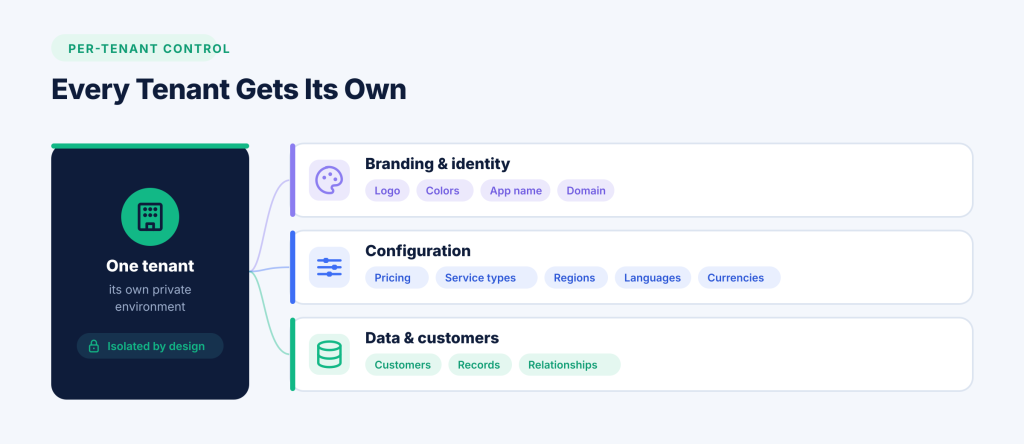
All of this runs on one shared, continuously improving foundation. That’s the magic of white-label multi tenant transport software: an operator launches a branded mobility service quickly and affordably, while the provider maintains a single platform behind hundreds or thousands of distinct brands.
Without multi-tenancy, white-label at scale is impractical — you’d be rebuilding and maintaining a separate system for every brand. With it, launching a new branded fleet becomes a matter of onboarding, not engineering.
Global Trends Driving Multi-Tenant Transport Software
Multi-tenant architecture isn’t a trend in itself — it’s the foundation under several bigger ones reshaping global mobility:
- Cloud-native is the baseline. Across industries, modern SaaS is overwhelmingly multi-tenant and cloud-hosted. Transport is following the same path, moving off bespoke, on-premise systems toward shared platforms.
- Mobility-as-a-Service (MaaS) and super-apps. Platforms that combine rides, shuttles, rentals, and delivery in one experience depend on multi-tenant foundations to support many service providers and regions simultaneously.
- Globalization of operators. Transport businesses increasingly serve multiple cities and countries, demanding multi-currency, multi-language, and region-specific compliance — capabilities a multi-tenant platform delivers through configuration rather than custom builds.
- The platformization of mobility. The industry is shifting from “buy software” to “join a platform.” Operators want to plug into a living, improving system, not own and maintain code — and multi-tenancy is what makes that platform economically viable for the provider.
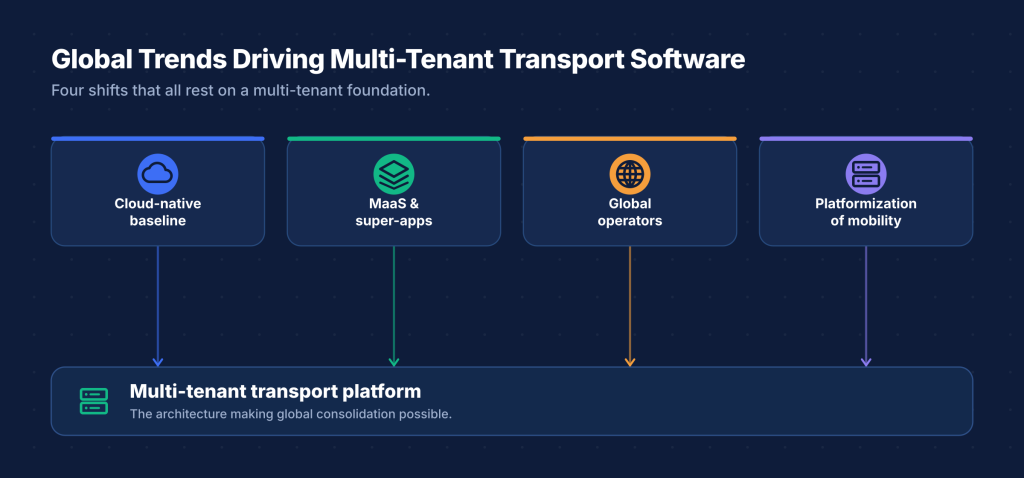
The common thread is consolidation onto shared, scalable platforms. Multi-tenant transport software is the architecture making that consolidation possible worldwide.
What to Watch For
Authoritative guidance means being honest about trade-offs. Multi-tenancy is the right model for most transport platforms, but it isn’t free of considerations:
- The “noisy neighbor” effect. When tenants share resources, a spike from one shouldn’t degrade others. Mature platforms manage this with resource controls and monitoring — worth confirming with any provider.
- Customization limits. Shared codebases favor configuration over deep, tenant-specific custom code. The best platforms offer rich configuration and APIs so operators get flexibility without fragmenting the system.
- Data residency and compliance. Serving a global, multi tenant fleet means handling regional rules like GDPR and data-residency requirements. Strong platforms build isolation and regional hosting options to address this.
- Migration and lock-in. Joining a platform is a relationship. Evaluate data portability and integration openness up front.
None of these are reasons to avoid multi-tenancy — they’re the questions a serious buyer or builder should ask to choose well.
The Bottom Line: Architecture Is a Strategic Decision
Multi-tenant architecture rarely makes the marketing brochure, yet it determines whether a transport platform can scale affordably, improve continuously, and power branded services for many operators at once. For SaaS transport, it’s not a technical footnote — it’s the foundation of the modern platform model.
Whether you’re weighing building your own system or buying onto an established multi-tenant platform, the architecture underneath should be a deciding factor, not an afterthought.
Already exploring platforms? You can also book a demo to see a multi-tenant transport platform in action.
Frequently Asked Questions
What is multi-tenant architecture in SaaS transport software? It’s a model where one instance of the software serves many separate transport businesses (tenants) on shared infrastructure, with each tenant’s data and branding kept isolated. One platform can run many independent fleets at once instead of requiring separate software for each.
What’s the difference between multi-tenant and single-tenant software? Single-tenant gives each customer a dedicated copy of the software and infrastructure — more isolation but higher cost and slower updates. Multi-tenant SaaS shares one instance across all customers with logical data separation, delivering lower cost, instant platform-wide updates, and easier scaling.
Why does multi-tenancy matter for fleets? A multi tenant fleet platform lets operators access enterprise-grade software without enterprise infrastructure costs, onboard quickly, and always run the latest version — because the shared platform is maintained and upgraded once for everyone.
Is multi-tenant SaaS secure? Yes, when properly architected. Logical isolation keeps each tenant’s data private, and centralized security means patches and protections are applied consistently across the whole platform rather than unevenly across separate instances.
How does multi-tenant architecture support white-label transport platforms? It lets one shared platform present many distinct brands — each with its own branding, configuration, and isolated data — without rebuilding the software per operator. That’s what makes launching a branded, white-label transport service fast and affordable.