


 Fleet Management
 Route optimization
 Shuttle Transportation
 Delivery Management
 School Bus Transportation
 Ride Sharing Management
 Airport Transfer Booking
  Vehicle inspection
 Car Rental Management
 Trucking & Logistics
 Food & Beverage
 E-Commerce
 Passenger Transit
 Delivery
 School & Corporate
Flight Tracking in Dispatch: Why Real-Time Data Saves Pickups
Quick answer: Flight tracking dispatch connects live flight status — delays, early arrivals, gate changes, and diversions — directly to your pickup scheduling, so vehicles are dispatched against a plane’s actual arrival time instead of its booked one. That single shift prevents missed pickups, eliminates vehicles idling at the curb for delayed flights, and cuts the no-shows and wait-time charges that quietly erode airport transfer margins.
Airport work looks simple on paper: a passenger books a pickup, you send a car, they land, they ride. In practice, the one variable you can’t control — the flight — moves constantly. It lands twenty minutes early. It sits on the tarmac for an hour. The gate changes, baggage is slow, customs is backed up. Every one of those events breaks a pickup that was scheduled against a time printed days earlier.
The operators who win airport business aren’t the ones with the most cars. They’re the ones whose dispatch knows what the flight is actually doing. This is why flight tracking dispatch has moved from a nice-to-have to the backbone of any serious airport transfer operation.
What Is Flight Tracking in Dispatch?
Flight tracking in dispatch is the integration of real-time flight data into your booking and dispatch system, so pickup timing adjusts automatically to what the aircraft is actually doing. Instead of a dispatcher manually checking a flight board and guessing when to send a car, the system pulls live status and recalculates the pickup on its own.
Good flight tracking software doesn’t just show a flight’s status on a screen — it feeds that status into the dispatch decision. When the estimated arrival shifts, the dispatch time shifts with it. The booking, the driver assignment, and the customer’s expectations all stay synced to reality rather than to a plan that’s already out of date.
The difference is subtle but decisive: one approach displays information; the other acts on it.
Why Static Schedules Break Airport Pickups
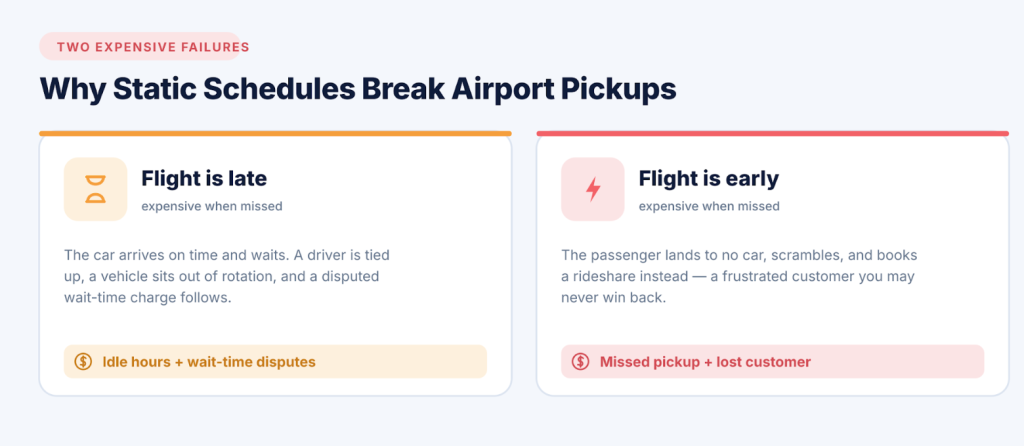
The core problem is that a booking captures an intended time, and flights don’t honor intentions.
Consider the two failure modes, both expensive:
- The flight is late. The car arrives at the scheduled time and waits. The meter on your costs starts running — a driver tied up, a vehicle out of rotation, and often a wait-time charge the customer disputes. Multiply that across a clustered arrival bank and you’ve parked a chunk of your fleet to watch an empty jet bridge.
- The flight is early. The passenger lands, walks to the curb, and there’s no car — because it was scheduled for later. Now you have a frustrated customer, a scramble to reassign, and a real risk they book a rideshare instead and never come back.
Add gate changes, terminal switches, tarmac delays, diversions, and the ordinary variance of baggage and customs, and a static schedule is wrong far more often than it’s right. A dispatcher can chase a handful of these manually. They cannot chase hundreds during a peak arrival window — which is exactly when the misses cost the most.
How Real-Time Flight Data Saves Pickups
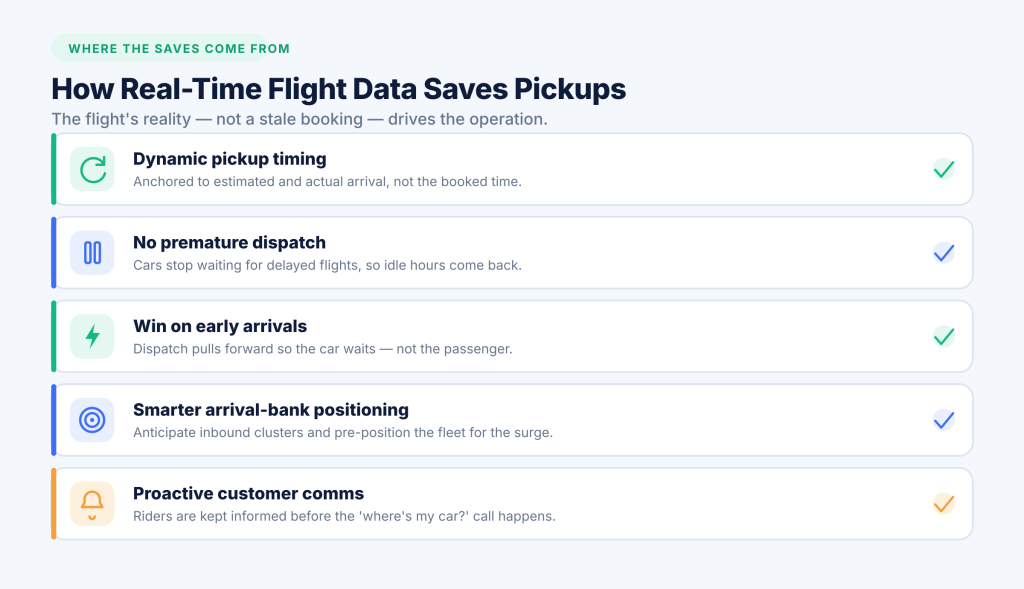
A flight tracking dispatch system turns the flight itself into the trigger for dispatch. Here’s where the saves come from:
- Dynamic pickup timing. The system anchors the pickup to the flight’s estimated and actual arrival, not its booked time. When the plane slips an hour, the car goes an hour later — automatically — so it’s there when the passenger is, not before.
- No more premature dispatch. Vehicles stop being sent to wait for delayed flights, which immediately recovers idle hours and reduces the wait-time disputes that come with them.
- Fewer missed pickups on early arrivals. When a flight beats its schedule, the system pulls the dispatch forward so the car is waiting — not the passenger.
- Smarter positioning around arrival banks. Real-time data lets the fleet anticipate clusters of inbound flights and position vehicles for the surge instead of reacting to it.
- Proactive customer communication. Because the system knows the flight changed, it can keep the rider informed — a quiet trust-builder that prevents the “where’s my car?” call before it happens.
The throughline is that the flight’s reality, not a stale booking, drives the operation. That’s what keeps pickups intact when the day doesn’t go to plan.
The Operational Payoffs
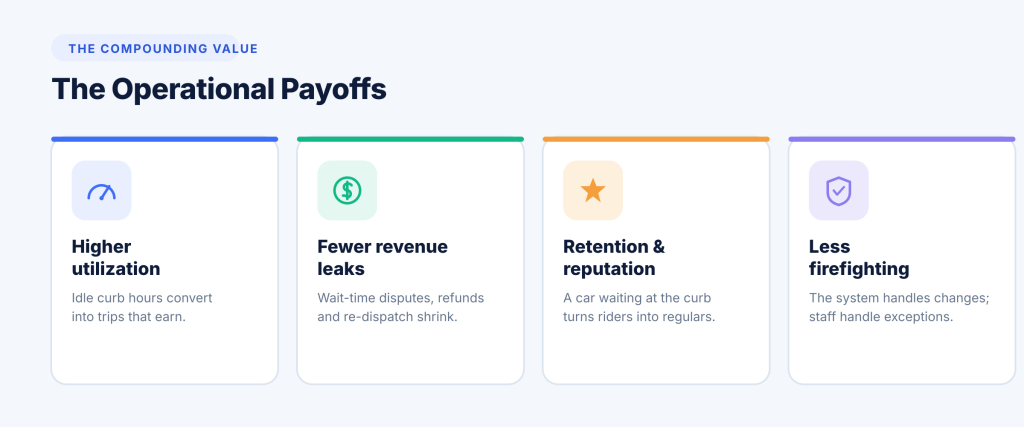
Saving individual pickups is the visible benefit. The compounding value shows up across the operation.
Higher utilization. Cars that aren’t idling at the curb for delayed flights are available for other trips. Every hour you don’t waste waiting is an hour the vehicle can earn.
Fewer revenue leaks. Wait-time disputes, goodwill refunds for missed early arrivals, and re-dispatch costs all shrink when timing tracks the flight. These are small line items individually and a meaningful number in aggregate.
Stronger retention and reputation. Airport transfers are a trust business. A passenger who lands tired and finds their car waiting becomes a repeat customer; one stranded at the curb writes the review. Reliability at the curb is the product.
Less dispatcher firefighting. When the system handles flight-driven adjustments, your team stops babysitting flight boards and can focus on the exceptions that actually need a human.
What Good Flight Tracking Integration Looks Like
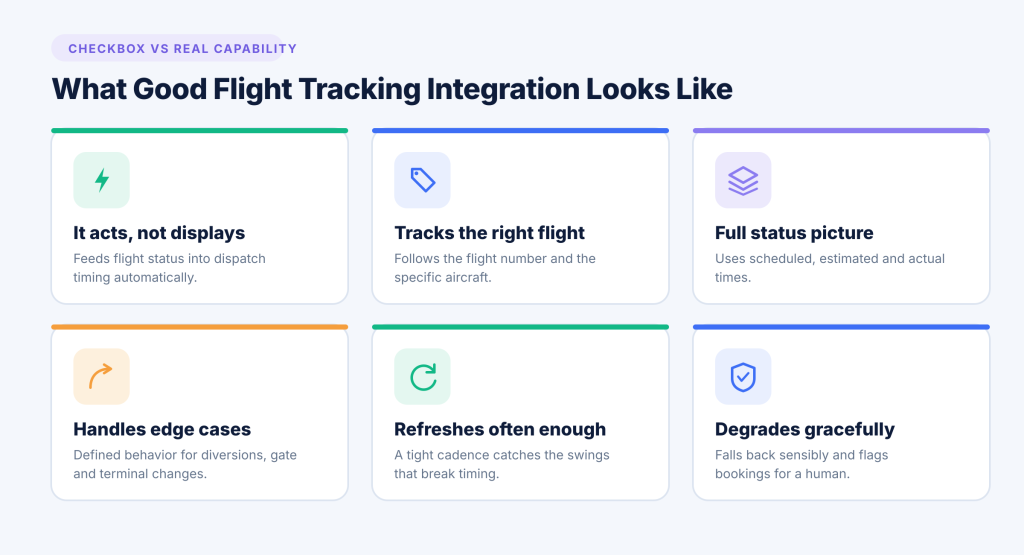
If you’re evaluating flight tracking software for your dispatch, the difference between a checkbox feature and a real capability comes down to a few details:
- It acts, not just displays. The integration must feed flight status into dispatch timing automatically — not simply show a status the dispatcher still has to act on.
- It tracks the right identifier. Reliable systems follow the flight by number and, where possible, account for the specific aircraft, so a delayed inbound leg doesn’t quietly become a delayed pickup you didn’t see coming.
- It uses the full status picture. Scheduled, estimated, and actual times each matter at different moments; the system should adjust as the estimate firms up and again when the flight actually lands.
- It handles the edge cases. Gate and terminal changes, diversions, and cancellations need defined behavior — not silent failure. Ask how the system reacts when a flight is diverted or the data goes missing.
- It refreshes often enough to matter. Status that updates once an hour can’t protect a pickup; the cadence has to be tight enough to catch the swings that break curbside timing.
- It degrades gracefully. When flight data is unavailable, the system should fall back to sensible defaults and flag the booking for human attention rather than dispatching blind.
A platform that ties this directly into automated assignment — so a changed arrival reflows the dispatch without anyone touching it — is doing the real work.
Where It Matters Most
Any operator touching airport runs feels this, but a few feel it acutely:
Dedicated airport transfer companies live entirely on this. Their whole promise is being there when the passenger lands, and flight-aware dispatch is what makes that promise keepable at scale.
Hotel and resort shuttles handling guest arrivals avoid sending vehicles too early or leaving guests waiting, smoothing both cost and the first impression of the stay.
Corporate and executive transport can’t afford a stranded VIP or a billed hour of idle time; flight-synced pickups protect both the relationship and the invoice.
Tour operators coordinating arrivals into a tight itinerary keep the whole day on schedule by starting it against the flight’s real arrival, not its planned one.
The Bottom Line
In airport work, the flight is the one thing you can’t control and the one thing everything depends on. Flight tracking dispatch resolves that tension by making the flight’s live status — not a booked time — the thing that drives your vehicles. The payoff is fewer missed pickups, fewer idle hours, fewer disputes, and the kind of curbside reliability that turns one-time riders into regulars.
Modern platforms build this in. AllRide’s airport transfer booking platform, for example, integrates with flight tracking systems to fetch real-time status and automate scheduling around it.
The operators pulling ahead aren’t guessing at arrival times anymore. They’ve made the flight tell the fleet when to move.
Frequently Asked Questions
What is flight tracking dispatch? Flight tracking dispatch is the integration of real-time flight data into your dispatch system, so airport pickup timing adjusts automatically to a flight’s actual delays, early arrivals, gate changes, and diversions — instead of relying on the booked time.
How does flight tracking save airport pickups? It anchors dispatch to the flight’s live arrival. When a flight is late, the car is sent later so it isn’t idling at the curb; when a flight is early, the pickup is pulled forward so the passenger isn’t left waiting.
What should I look for in flight tracking software for dispatch? Confirm that it feeds flight status into dispatch timing automatically (not just displays it), tracks flights reliably, uses scheduled/estimated/actual times, handles diversions and missing data gracefully, and refreshes frequently enough to catch real-time changes.
Does flight tracking reduce wait-time charges? Yes. By preventing vehicles from being dispatched before a delayed flight lands, it reduces idle waiting and the disputed wait-time fees that come with it, while keeping cars available for other trips.
Which businesses benefit most from flight tracking in dispatch? Airport transfer companies, hotel and resort shuttles, corporate and executive transport, and tour operators handling arrivals — any operation whose service quality depends on being at the curb at the right moment.