

 Fleet Management
 Route optimization
 Shuttle Transportation
 Delivery Management
 School Bus Transportation
 Ride Sharing Management
 Airport Transfer Booking
  Vehicle inspection
 Car Rental Management
 Trucking & Logistics
 Food & Beverage
 E-Commerce
 Passenger Transit
 Delivery
 School & Corporate
How Automated Dispatch Cuts Wait Times and Idle Vehicles
Quick answer: Automated dispatch cuts wait times by assigning each trip to the best-positioned driver the instant a request comes in — no human bottleneck — and reduces idle vehicles by balancing work across the fleet and positioning drivers ahead of demand. The result is shorter passenger waits and higher vehicle utilization from the same fleet.
For decades, dispatch was a person with a radio and a mental map of where every car was. That worked at small scale. It does not work when you’re coordinating hundreds of vehicles across a city, fielding bookings from an app, a website, and a phone line at once, and trying to keep wait times low without parking half your fleet. The math simply outgrows the dispatcher.
This is the problem automated dispatch was built to solve — and why it has quietly become the difference between fleets that scale profitably and fleets that stall. Below is how automation actually moves the two numbers that matter most: how long passengers wait, and how often your vehicles sit empty.
What Is Automated Dispatch?
Automated dispatch is software that assigns trips to drivers automatically, using live data — vehicle location, availability, proximity, and demand — instead of a human deciding each allocation by hand. When a booking arrives, the system evaluates the fleet in real time and routes the job to the driver who can serve it best.
The terms auto dispatch and dispatch automation describe the same shift: moving the allocation decision from a person to an algorithm that can weigh more variables, faster, and at far greater scale than any dispatcher. The dispatcher’s role doesn’t disappear — it moves up a level, from assigning individual rides to supervising the system and handling exceptions.
The Hidden Cost of Manual Dispatch
Manual dispatch fails in two directions at once, and both cost money.
The first failure is wait times. Every booking waits in a queue behind the dispatcher’s attention. During a rush — a flight landing, a school letting out, a Friday-night surge — requests pile up faster than one person can assign them. Passengers wait not because no car is available, but because no one has assigned it yet. That gap is pure friction, and in a market where riders can open a rideshare app instead, it’s where you lose them.
The second failure is idle vehicles. A human dispatcher can’t track the real-time position and status of an entire fleet, so allocation skews toward the drivers they remember or the ones who call in. Cars in the wrong zone sit empty while nearby demand goes unserved. Utilization drops, drivers earn less, and your cost per trip climbs even though the vehicles are paid for either way.
Both problems share one root cause: a single human decision-maker is a bottleneck. Automation removes the bottleneck.
How Automated Dispatch Cuts Passenger Wait Times
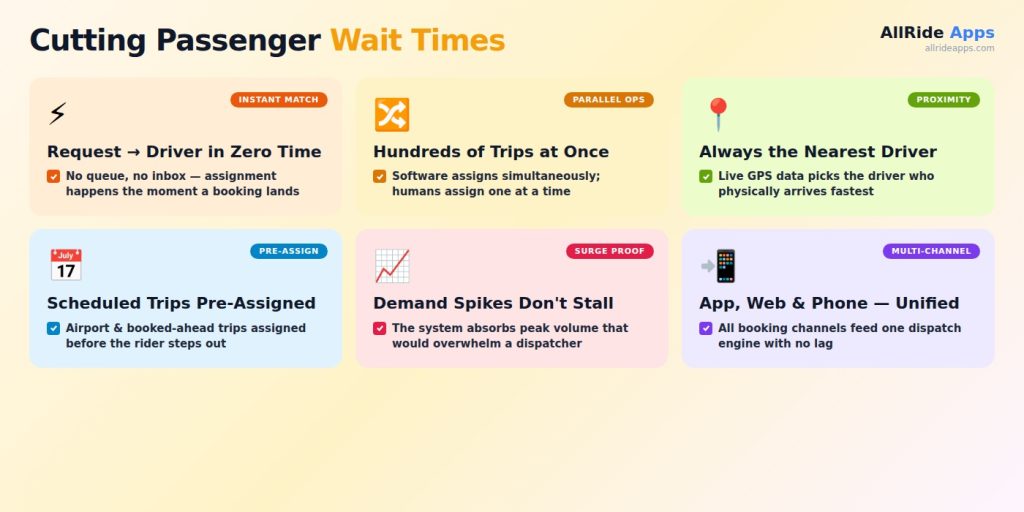
Automation compresses the time between request and assignment to near zero. Here’s where the savings come from:
- Instant matching. The moment a booking lands, the system identifies the nearest available, eligible driver and assigns the trip — no queue, no manual lookup. The wait that used to live in the dispatcher’s inbox disappears.
- Parallel allocation. Software assigns hundreds of trips simultaneously. A human assigns them one at a time. During peak demand, that difference is the entire reason wait times spike — or don’t.
- Proximity-aware decisions. Instead of guessing who’s closest, the system uses live location to match the trip to the driver who can physically get there fastest, which shortens the wait before pickup, not just the wait before assignment.
- Pre-assignment for scheduled work. For booked-ahead trips — airport transfers, scheduled pickups — automation can assign and sequence drivers in advance, so the vehicle is already moving toward the rider before they’re standing at the curb.
The cumulative effect is that demand surges stop translating directly into longer waits. The system absorbs the spike that would have overwhelmed a person.
How Automated Dispatch Reduces Idle Vehicles
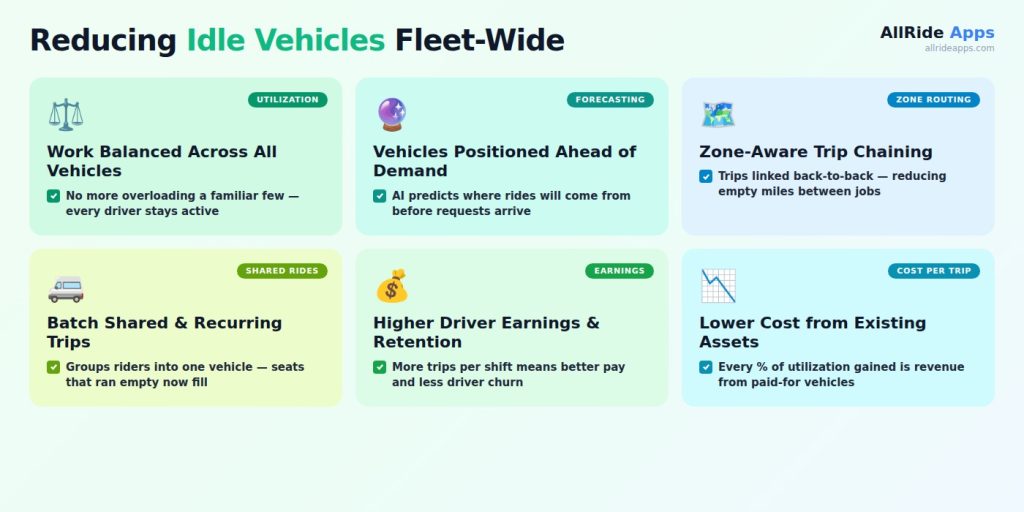
Cutting wait times is the visible win. Reducing idle vehicles is the one that shows up in your margins.
- Utilization balancing. Automated dispatch spreads work across the whole fleet rather than overloading a familiar few. More vehicles stay active, idle time drops, and driver earnings even out — which also helps retention.
- Demand forecasting and positioning. Smarter systems anticipate where demand will build and prompt vehicles to reposition before requests arrive, so cars are already where they need to be instead of deadheading across town after the fact.
- Zone-based and route-aware allocation. By accounting for zones and routes, automation keeps vehicles working within efficient areas and chains trips together, reducing the empty miles between jobs.
- Batching shared and recurring trips. For shared routes, shuttles, and recurring services, automation groups riders and assigns the right vehicle once — filling seats that would otherwise run empty.
Idle vehicles are the most expensive thing a fleet owns: fully paid for, earning nothing. Every percentage point of utilization automation recovers is revenue from assets you already have.
Where Automation Matters Most
Dispatch automation pays off across transport models, but a few feel the difference most acutely:
Airport and hotel transfers live and die on timing. Flights land in clusters, and a manual dispatcher can’t pre-position and assign fast enough to keep arrivals from waiting. Automated, pre-assigned dispatch tied to scheduled pickups keeps vehicles moving toward riders ahead of demand.
Corporate and employee shuttles run the same routes on repeating schedules. Automation handles recurring assignment without a dispatcher rebuilding the plan every day, and keeps the right vehicle — and the right number of seats — matched to each run.
Bus and intercity routes depend on balancing vehicle and seat capacity against demand across stops. Automated allocation keeps loads efficient instead of running half-empty vehicles on one route while another is oversubscribed.
Large and mixed fleets gain the most from utilization balancing and analytics. The bigger and more varied the fleet, the more impossible manual allocation becomes — and the more idle capacity automation can recover.
The common thread: the more vehicles you run, and the more your demand fluctuates, the more a human bottleneck costs you — and the more automation returns.
Automation handles the volume so your people can handle the judgment. That’s the balance that actually moves the numbers.
The Bottom Line
Wait times and idle vehicles are two symptoms of the same constraint: a dispatch process that can’t keep up with the fleet. Automated dispatch removes that constraint by making the allocation decision instant, data-driven, and fleet-wide — shrinking the gap between request and assignment, and keeping more vehicles earning instead of idling.
Modern platforms build this in. AllRide, for example, automates driver assignment based on proximity and availability and pairs it with dynamic dispatching, demand forecasting, and route optimization — so fleets can scale without scaling their wait times.
If manual dispatch is capping how far your fleet can grow, the fastest way to see the difference is on your own numbers.
See how automated dispatch run against your routes — book a demo.
Frequently Asked Questions
What is automated dispatch?
Automated dispatch is software that assigns trips to drivers automatically using live data — location, availability, proximity, and demand — instead of a human assigning each ride by hand. It allocates many trips at once and in real time.
How does automated dispatch reduce passenger wait times?
It removes the human bottleneck. The moment a booking arrives, the system matches it to the nearest available driver and assigns it instantly, and it can pre-assign scheduled trips in advance — so demand surges no longer pile up behind one dispatcher.
How does auto dispatch reduce idle vehicles?
By balancing trips across the entire fleet, forecasting demand to reposition vehicles before requests arrive, and batching shared or recurring trips. More vehicles stay active, which raises utilization and lowers cost per trip.
Does dispatch automation replace human dispatchers?
No. It moves them from assigning individual rides to supervising the system and handling exceptions — VIP riders, accessibility needs, contract SLAs — while the software handles routine volume.
What kinds of transport businesses benefit most from automated dispatch?
Operations with larger fleets or fluctuating demand benefit most: airport transfers, corporate and school shuttles, bus and intercity routes, and large mixed fleets, where manual allocation can’t keep pace.