


 Fleet Management
 Route optimization
 Shuttle Transportation
 Delivery Management
 School Bus Transportation
 Ride Sharing Management
 Airport Transfer Booking
  Vehicle inspection
 Car Rental Management
 Trucking & Logistics
 Food & Beverage
 E-Commerce
 Passenger Transit
 Delivery
 School & Corporate
Best White-Label Taxi & Delivery Apps in 2026
Launching a branded ride or transport service in the U.S. no longer takes a development team and a year of build time. The best white-label taxi app in 2026 lets you put your own brand on a proven platform and go live in weeks — and the right one depends on how you move people: on demand, on a schedule, on fixed routes, or all three.
Here’s the short answer: there is no single best app for everyone. A platform built for on-demand street-hail taxis is a poor fit for a corporate shuttle contract, and a limo-focused tool won’t run a 200-vehicle airport transfer operation. The best white-label taxi app is the one that matches your booking model and fleet size.
This guide compares five of the top white-label apps for transport and delivery businesses in 2026 — AllRide, iCabbi, Moovs, YelowSoft, and Jugnoo — then maps each to the business models it serves best, so you can shortlist the right fit in minutes.
What Is a White-Label Taxi App?
A white-label taxi app is a ready-made booking-and-dispatch platform you launch under your own brand — your logo, your colors, your app name, your domain. The technology provider builds and maintains the underlying system; you focus on running and growing the business.
A complete white-label solution typically bundles a rider app, a driver app, an admin/dispatch dashboard, and a booking website or widget. Instead of months of custom development, you configure branding and pricing and go to market on a tested foundation. For most operators, that means faster time-to-launch, lower upfront cost, and far less technical risk than building from scratch.
The trade-off is fit. Because these platforms are pre-built, the depth of their booking models, fleet tools, and customization options varies widely — and that’s where the comparison below matters.
What to Look For in the Best White-Label Taxi App
Before comparing products, weigh your operation against these criteria:
- Booking flexibility. Can it handle more than on-demand hailing? Scheduled rides, recurring trips, shared routes, and bulk bookings are essential for shuttle, school, and corporate contracts.
- Dispatch and driver management. Look for a real dispatch console, driver profiles and approvals, trip assignment, and live GPS tracking.
- Fleet depth. Vehicle records, documents (registration, insurance), utilization analytics, and seating layouts matter once you run more than a handful of vehicles.
- Multi-service capability. If you may expand from rides into shuttles or delivery later, a platform that supports several verticals saves you a costly migration.
- White-label depth. Confirm how far branding goes — full branded app-store listings versus a branded dispatch console only.
- Launch speed and support. Ready-made setup timelines and onboarding support shorten time-to-revenue.
- Integrations and payments. U.S. operators should verify maps, flight tracking for airport work, and card/online payment support out of the box.
- Total cost of ownership. Look past the headline price to per-driver fees, per-ride commissions, setup fees, and app-store costs.
The Best White-Label Taxi & Delivery Apps in 2026
1. AllRide — Best for multi-model and scheduled transport
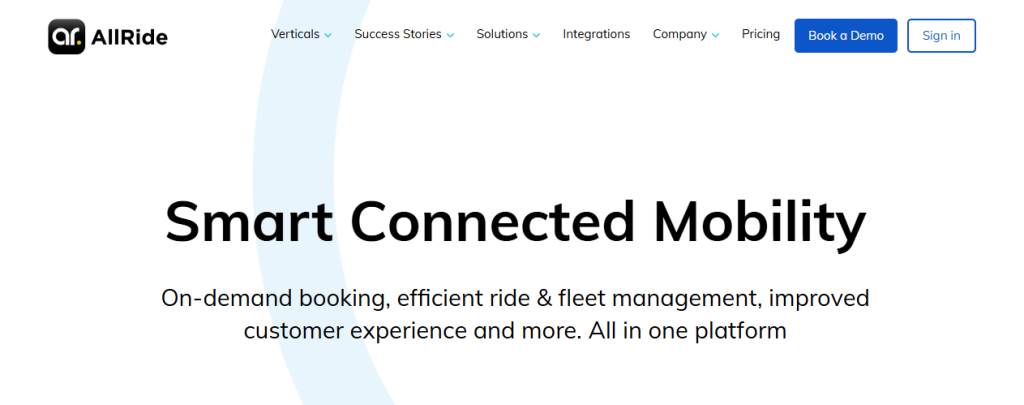
AllRide is a white-label transport and delivery platform, built for businesses that run more than simple on-demand rides. Its standout strength is breadth of booking model: alongside on-demand cab booking, it natively supports scheduled transfers, shared rides by route or trip, recurring trips with reusable templates, and bulk reservation uploads — the workflows that shuttle, school, tour, and corporate contracts actually require.
The platform spans four product lines — AllRide Cab, AllRide Bus, AllRide Logistics, and AllRide Delivery — so a single operator can run passenger transport and delivery from one system, one fleet, and one set of reports rather than stitching together separate tools. Fleet management is unusually deep for this category, with full vehicle records (registration, ownership, insurance, warranty), utilization and mileage analytics, and a visual seating-layout builder for buses and shared vehicles.
Best for: operators running scheduled, shared, recurring, or multi-vertical services — airport transfers, corporate and school shuttles, intercity bus, tours, and mixed ride-plus-delivery businesses.
See how AllRide handles your booking models in a live walkthrough — book a demo.
2. iCabbi — Best for large, dispatch-heavy taxi fleets
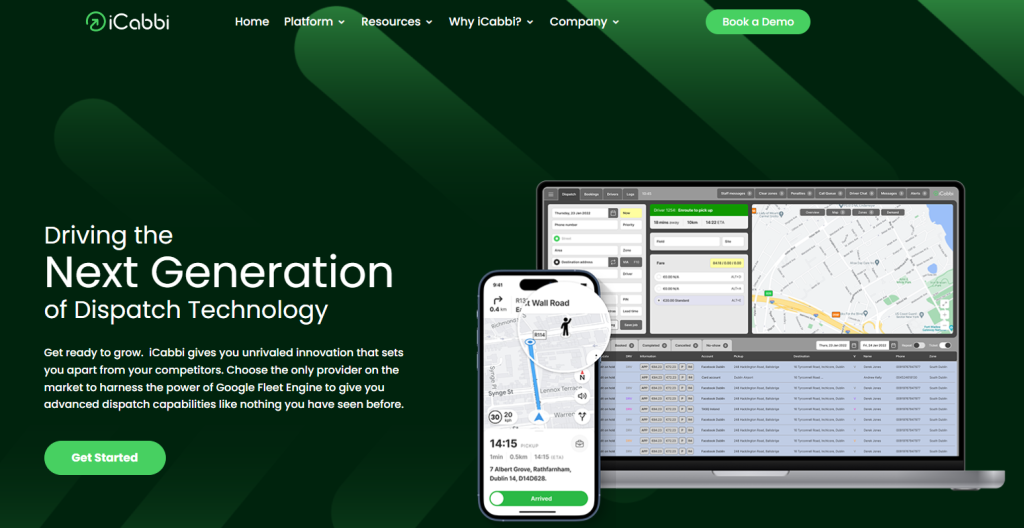
iCabbi is an enterprise-grade taxi dispatch platform aimed at established fleets, and is expanding its U.S. and Canadian presence. It is positioned around dispatch reliability and scale — high uptime, a large library of configurable settings, strong telephony for phone-based bookings, and the use of Google Fleet Engine for traffic-aware dispatch. [VERIFY claims and current U.S. availability before publish.]
It tends to suit traditional taxi companies moving off radio dispatch and networks running larger fleets. Pricing follows a per-driver subscription model, which buyers should weigh against smaller-fleet economics. Branding is often noted as focused more on the dispatch console than on fully branded consumer apps. [VERIFY.]
Best for: medium-to-large taxi and private-hire fleets that prioritize automated dispatch, reliability, and phone-booking volume.
3. Moovs — Best for U.S. chauffeured, limo, and small shuttle operators
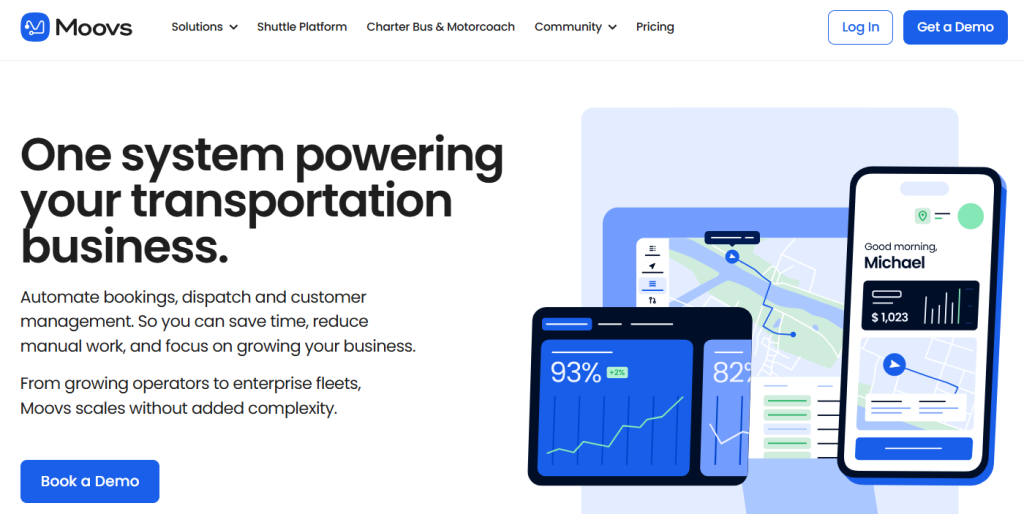
Moovs is a California-based, all-in-one transportation platform popular with chauffeured, limo, party-bus, and shuttle operators, particularly smaller and mid-sized U.S. businesses. It bundles a booking app, dispatch automation, payments and invoicing, a website builder, and built-in customer communication, with U.S.-based support. [VERIFY current feature set and tier details before publish.]
Its appeal is a modern, easy-to-learn interface and quick onboarding for operators moving off spreadsheets or older tools. It is generally less oriented toward complex shared-route or large-network dispatch than enterprise systems.
Best for: owner-operated and growing U.S. chauffeured/limo and small shuttle businesses that want one simple platform.
4. YelowSoft — Best for launching a branded ride-hailing service
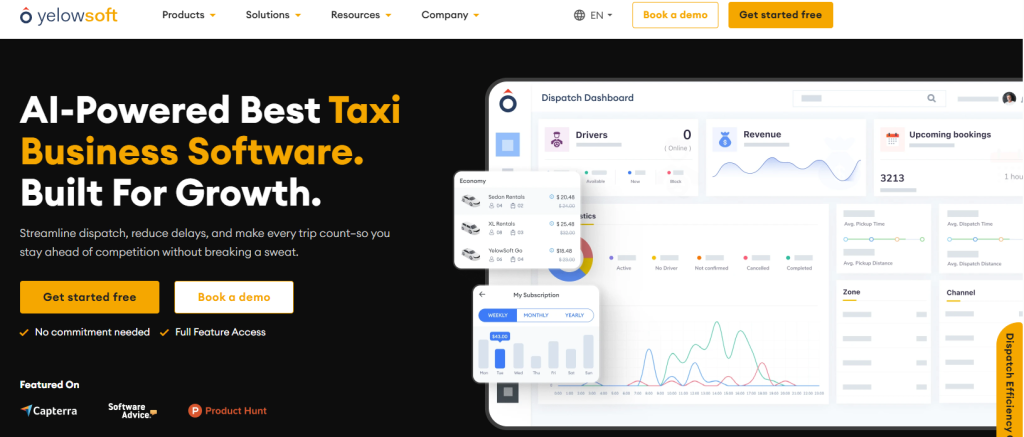
YelowSoft focuses on operators launching or rebranding ride-hailing services, providing white-label rider and driver apps alongside a dispatch workspace. The pitch is a ready environment to get drivers online and start accepting trips quickly, with room to grow into new areas. [VERIFY current positioning and module list before publish.]
Best for: new and reshaping ride-hailing operators that want included branded apps and a straightforward dispatch setup.
5. Jugnoo — Best for budget-conscious, multi-mode mobility

Jugnoo offers a mobility-as-a-service platform covering several models — taxi dispatch, shuttle, car rental, carpool, airport transfer, and a “super app” marketplace — with white-label apps, automated dispatch, and geo-analytics. It is frequently positioned as a cost-effective option for operators experimenting across mobility models. [VERIFY current feature set and U.S. support before publish.]
Best for: entrepreneurs and operators wanting an affordable, flexible platform across multiple mobility models.
Which White-Label App Fits Your Transport Business?
The fastest way to shortlist is to start from your business model, not the feature list. Here’s how the most common U.S. transport operations map to capability — and where AllRide’s scheduled, shared, and fleet-heavy depth tends to stand out.
| Your business | What you need most | Strong-fit notes |
|---|---|---|
| Airport & hotel transfers | Pre-scheduled bookings, one-way/round-trip/hourly modes, multi-stop routing, passenger & luggage detail, branded tickets | AllRide and Moovs both handle this well; AllRide adds shared and bulk options for high-volume transfer desks |
| Corporate / employee shuttles | Recurring trips, weekly-repeat templates, fixed routes, seating layouts for assigned seats | A clear fit for AllRide’s recurring + seating-layout tooling; Jugnoo also targets shuttle |
| School & campus transport | Recurring shared routes, per-passenger records, driver approvals | AllRide’s recurring shared reservations and approval gates suit managed, repeating service |
| Bus & intercity shuttle | Seating-layout builder, route/trip configuration, bulk bookings | Strongest differentiator for AllRide vs. taxi-only tools |
| Tour & travel operators | Hourly/round-trip transfers, multi-stop itineraries, add-ons, group/bulk bookings | AllRide’s add-ons and CSV bulk upload fit group itineraries |
| Car rental services | Time- and trip-based booking, detailed vehicle records, categories & add-ons, availability filters | AllRide supports booking + catalog management (confirm rental-contract specifics with vendor) |
| Large fleet & leasing operators | Vehicle documents, utilization & mileage analytics, custom fields | AllRide’s fleet depth is built for asset and compliance tracking |
| Franchise / multi-operator | Operator assignment, operator-level reports, partner lifecycle | AllRide’s operator and reporting structure suits distributed operations |
| Bulk & event transport | Mass booking upload, field overrides | AllRide’s bulk reservation upload handles conferences, weddings, corporate events |
| Hop-on hop-off (HOHO) | Fixed-loop routes, recurring shared trips, rider passes | AllRide supports routes, recurring loops, and customer pass records (confirm pass-sales/validation flow with vendor) |
If your operation is mostly on-demand street-hail or large-fleet phone dispatch, a dispatch-first platform like iCabbi deserves a close look. If you’re a small U.S. chauffeured operator, Moovs is purpose-built for you. But if your model involves scheduled, shared, recurring, or multi-vertical transport, that’s where a broad platform like AllRide tends to separate from taxi-only tools.
Where Delivery Fits In
Many transport operators eventually add delivery — or run both side by side. The advantage of a multi-service platform is that you don’t rebuild when that day comes. AllRide, for example, runs passenger transport and delivery on the same system, with order management, agent and vehicle assignment, and live delivery tracking available alongside its ride modules.
For operators weighing a “taxi and delivery” future, that single-platform approach is the practical reason to favor a multi-vertical white-label app over a ride-only one: one fleet, one team, one source of truth.
The Bottom Line
There is no single best white-label taxi app for everyone — there’s a best one for your model. Dispatch-heavy taxi fleets, U.S. chauffeured operators, ride-hailing launches, and budget multi-mode operators each have a strong candidate above. But if you run scheduled, shared, recurring, or mixed transport-and-delivery services — or expect to grow into them — a broad platform built for that complexity will serve you longer than a single-purpose tool.
The best next step is a side-by-side look at your actual workflows.
See how AllRide fits your operation — Book a demo.
Frequently Asked Questions
What is the best white-label taxi app in 2026? It depends on your business model. For scheduled, shared, recurring, or multi-vertical transport, AllRide is a strong fit; for large dispatch-heavy taxi fleets, iCabbi; for small U.S. chauffeured operators, Moovs; for ride-hailing launches, YelowSoft; and for budget multi-mode mobility, Jugnoo.
How much does a white-label taxi app cost? Cost varies by pricing model (per-driver subscription, per-ride commission, or flat SaaS), fleet size, and the features you enable. Because pricing differs widely, request a current quote from each vendor rather than relying on list figures. [Link to AllRide pricing page.]
Can one white-label app handle both rides and delivery? Yes — multi-service platforms support passenger transport and delivery on the same system. AllRide, for instance, offers cab, bus, logistics, and delivery product lines, so operators can run both without migrating to a new tool.
How long does it take to launch a white-label taxi app? Ready-made solutions can go live far faster than custom builds — AllRide reports launch timelines of roughly five days for its ready-made solutions. [VERIFY before publish.] Actual timelines depend on branding, configuration, and integrations.
Is a white-label app better than building from scratch? For most operators, yes. White-label delivers faster time-to-market, lower upfront cost, and lower technical risk on a proven foundation. Building from scratch only makes sense when you need highly unique functionality that no platform supports.