

 Fleet Management
 Route optimization
 Shuttle Transportation
 Delivery Management
 School Bus Transportation
 Ride Sharing Management
 Airport Transfer Booking
  Vehicle inspection
 Car Rental Management
 Trucking & Logistics
 Food & Beverage
 E-Commerce
 Passenger Transit
 Delivery
 School & Corporate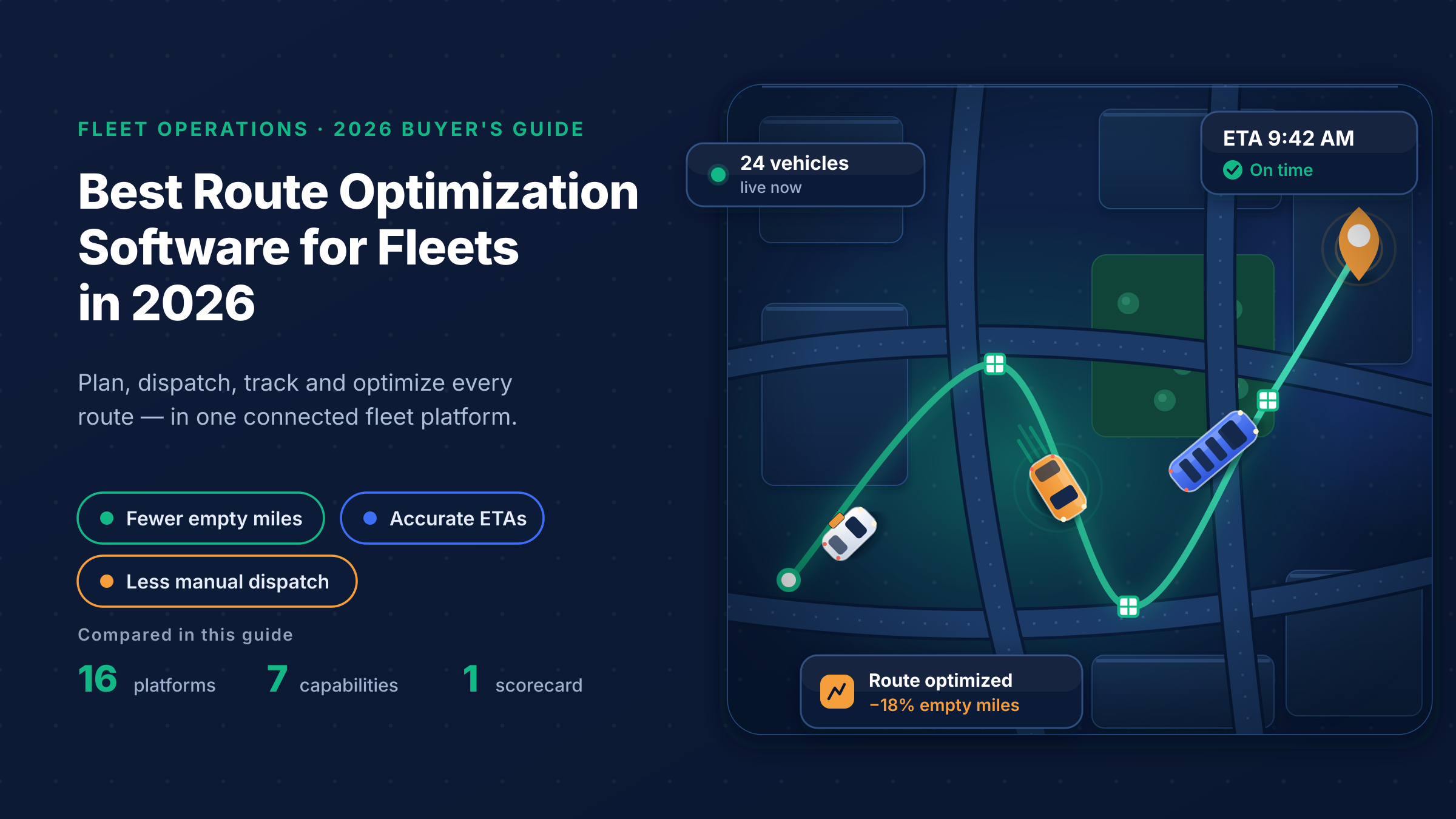
Best Route Optimization Software for Fleets in 2026
Every unnecessary mile eats into profit.
Every late arrival weakens customer trust.
Every idle vehicle silently adds cost to the business.
That is why fleet operators in 2026 are no longer asking, “Which tool can draw the shortest route?” They are asking a sharper question: which route optimization software can help my fleet dispatch faster, track better, reduce manual work, improve ETAs, and scale without operational chaos?
The best route optimization software for fleets is not just a digital map with multiple stops. It is a connected fleet operations system that brings route planning, dispatch, real-time tracking, driver workflows, telematics, AI insights, customer communication, and fleet reliability into one operating rhythm.
For delivery businesses, this means fewer failed deliveries and better customer updates. For logistics companies, it means tighter dispatch control and smarter vehicle usage. For cab, bus, shuttle, and mixed transport operators, it means better route visibility, scheduled movement, driver assignment, and passenger confidence.
This blog compares the top route software for fleets in 2026 and explains why AllRide Apps is a strong choice for growing operators that need more than basic route planning.
What Is Route Optimization Software?
Route optimization software helps fleet operators create smarter and more efficient routes by using operational data such as pickup points, drop-off locations, vehicle capacity, driver availability, traffic conditions, delivery windows, distance, travel time, business rules, and customer priorities.
A basic route planner may tell a driver where to go. A stronger route optimization platform helps the business decide which driver should go, which vehicle should be assigned, which sequence of stops is most efficient, what delay risks exist, and how route performance can improve over time.
That difference matters when a business grows from 10 vehicles to 100 vehicles, or from one city to multiple service regions. Manual route planning may work at the beginning, but once orders, drivers, routes, passengers, vehicles, and customer expectations increase, the business needs a more intelligent system.
That is where route optimization software becomes a serious operational advantage.
Route Planning vs Route Optimization: What’s the Difference?
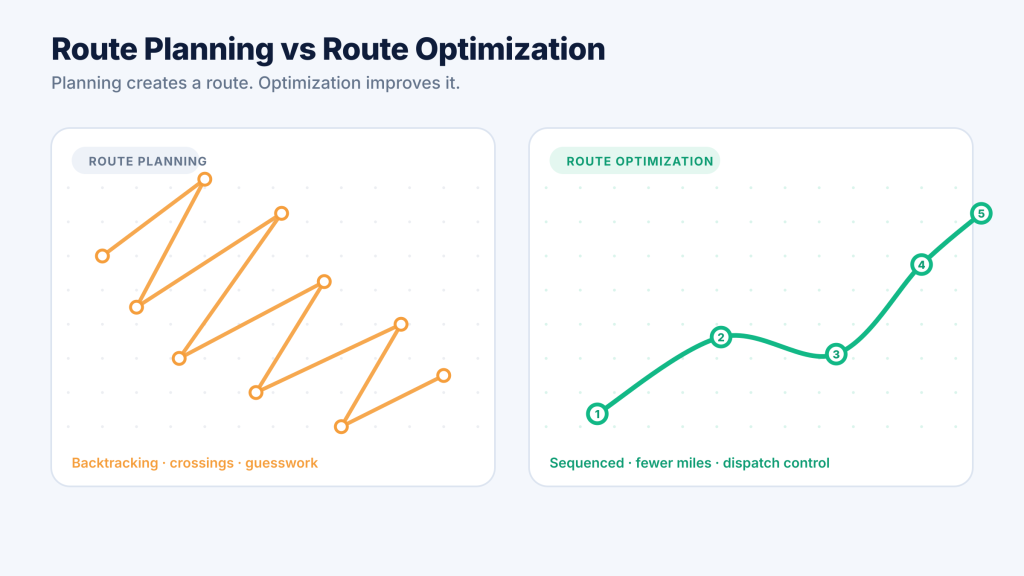
Route planning creates a route. Route optimization improves the route.
A route planning tool usually focuses on directions and stop arrangement. Route optimization goes deeper. It considers traffic, delivery windows, vehicle capacity, driver availability, route priority, service rules, mileage, cost, utilization, and real-time changes.
For example, a courier company may have 300 deliveries in one city. A simple route planner may divide those stops into multiple routes. A route optimization platform can group deliveries by neighborhood, reduce backtracking, assign the right driver, adjust routes when delays happen, and help dispatchers keep customers updated.
This is why modern fleet route optimization software is not only about movement. It is about operational control.
Signs You Have Outgrown Basic Route Planning Software
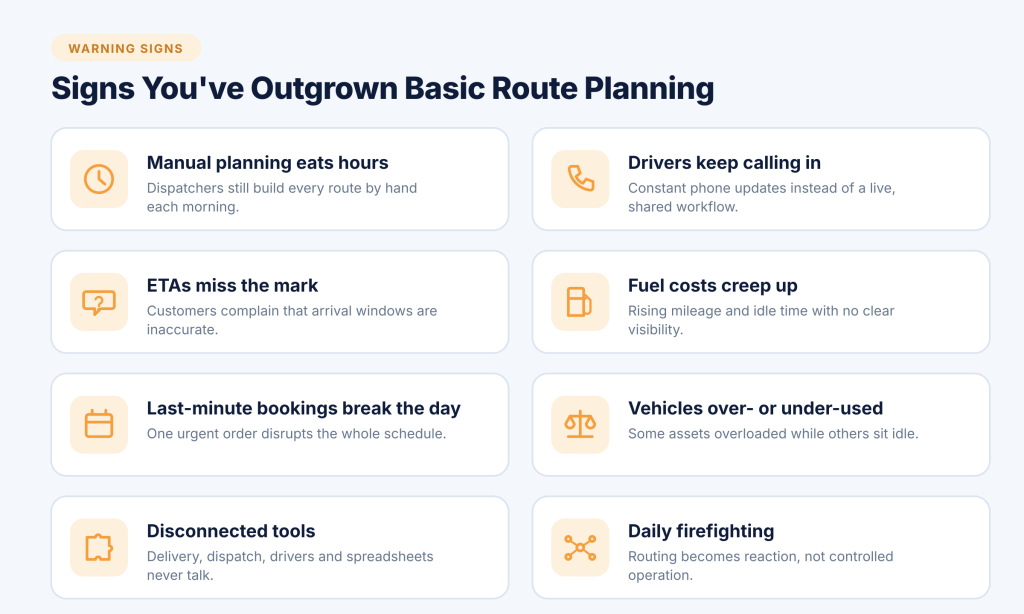
Your fleet may have outgrown basic routing if dispatchers still spend hours manually planning routes, drivers frequently call the office for updates, customers complain about inaccurate ETAs, fuel costs keep rising without clear visibility, last-minute bookings disrupt the whole schedule, or vehicles are either overloaded or underused.
Another strong sign is disconnected software. If your delivery team uses one tool, dispatchers use another, drivers depend on phone calls, and managers rely on spreadsheets, route planning becomes a daily firefighting activity instead of a controlled workflow.
At that stage, the business does not only need route planning software. It needs a connected fleet operations platform that supports planning, dispatching, tracking, reporting, and vehicle intelligence in one place.
What Fleet Operators Should Compare Before Choosing Top Route Software
Before choosing any route optimization software, fleet operators should compare the full operating workflow, not only the route map.
The first question is whether the platform can optimize routes using time, distance, traffic, capacity, driver availability, and business rules. The second is whether dispatchers can track drivers, vehicles, delays, and route progress in real time. The third is whether the system can support route changes when traffic, cancellations, urgent bookings, or new orders appear during the day.
Fleet operators should also look at driver app support, dispatch integration, customer notifications, proof of delivery, reporting, analytics, telematics, predictive maintenance, and scalability. Pricing also matters because route software may be priced by vehicle, driver, user, delivery task, order volume, or custom package. You can compare AllRide package options on the AllRide pricing page.
The most important question is simple: will this tool only help us plan routes, or will it help us run the fleet better?
Best Route Optimization Software for Fleets in 2026
1. AllRide Apps
AllRide Apps is best suited for growing fleet operators, logistics companies, delivery businesses, cab operators, bus and shuttle providers, and mixed transport fleets that need route optimization connected with broader fleet operations.
What makes AllRide different is that it is not positioned as a single-function route planner. It brings together route optimization, dispatch, real-time tracking, vehicle telematics, driver workflows, delivery and logistics operations, predictive maintenance, AI-powered fleet intelligence, and multi-vertical support across cab, bus, shuttle, logistics, delivery, and mixed fleet businesses.
For operators that want routing to connect with daily execution, AllRide is a strong fit. A delivery business can use AllRide Delivery to manage delivery workflows. A logistics operator can explore AllRide Logistics for fleet and dispatch operations. Passenger transport businesses can use AllRide Cab or AllRide Bus depending on their use case.
AllRide is especially useful when a business does not want to manage route planning in one tool, dispatch in another, vehicle tracking somewhere else, and maintenance in spreadsheets.
2. Geotab
Geotab is a strong option for telematics-heavy fleets that need GPS tracking, routing, driver behavior data, compliance insights, and fleet analytics. It is best suited for businesses that want route optimization connected closely with vehicle and driver data.
Fleet operators should compare Geotab when telematics and fleet data are the primary decision-making requirements. However, businesses that need multi-vertical transport workflows may also want to compare whether a broader operations platform like AllRide is a better fit.
3. Route4Me
Route4Me is built for route-heavy teams that need route planning, dispatch, route sequencing, driver workflows, and dynamic optimization. It can be useful for delivery companies, territory operations, and field teams.
Fleet operators should compare plan depth, add-ons, integrations, and whether they need route planning alone or a wider fleet management workflow.
4. OptimoRoute
OptimoRoute is a good fit for delivery and field service teams that need route planning, scheduling, logistics routing, and driver assignment. It is particularly useful for businesses where appointment windows, job scheduling, and delivery timing are important.
Buyers should compare whether OptimoRoute’s scheduling-first approach is enough or whether they also need telematics, predictive maintenance, and multi-vertical fleet operations.
5. Onfleet
Onfleet is strong for last-mile delivery operations that need AI route optimization, driver tracking, proof of delivery, customer notifications, and delivery analytics.
It is a practical option for courier, grocery, pharmacy, food, beverage, and last-mile delivery businesses. However, buyers should compare whether their long-term need is delivery management only or a broader fleet operations platform that also covers vehicle health, telematics, and mixed transport use cases.
6. Locus
Locus is built for enterprise logistics teams that need AI-powered routing, dispatch automation, SLA tracking, geocoding, and supply chain visibility.
It is a strong fit for large logistics and last-mile operations. Smaller teams, however, may want to compare implementation complexity and whether they need an enterprise logistics platform or a more flexible fleet operations system.
7. Samsara
Samsara is known for fleet telematics, GPS tracking, safety, compliance, routing, dashcams, driver behavior, and fleet visibility.
It is a strong option for fleets where safety, compliance, and telematics are high priorities. Buyers should compare pricing structure, contract model, and whether their business needs a telematics-first platform or a transport-operations-first platform.
8. Verizon Connect
Verizon Connect supports large fleet operations with GPS tracking, route planning, dispatch, driver behavior, maintenance tracking, fuel visibility, and analytics.
It can be relevant for field service, distribution, delivery, and commercial fleet operators. Buyers should compare pricing transparency, support requirements, contract terms, and implementation needs.
9. Descartes
Descartes is a strong enterprise option for route planning, optimization, dispatch, delivery sequencing, real-time tracking, proof of delivery, and mobile telematics.
It fits complex distribution, logistics, and delivery operations. It may be more suitable for enterprise businesses than small teams looking for faster setup and simpler workflows.
10. Routific
Routific is useful for growing delivery businesses that need delivery route optimization, driver app support, and simple route planning.
It is best suited for small and mid-sized delivery teams. Businesses that expect to expand into logistics, cab, shuttle, or broader fleet management should compare whether Routific is broad enough for future needs.
11. Circuit
Circuit is a simple and user-friendly multi-stop route planner for small delivery teams and individual drivers.
It is a good fit for businesses that need easy route planning without complex fleet operations. Larger fleets may eventually need stronger dispatch, tracking, telematics, analytics, and maintenance capabilities.
12. Upper
Upper supports SMB delivery and field service teams with route optimization, proof of delivery, customer notifications, and driver tracking.
It is a good option for smaller teams looking for AI route optimization and delivery execution. Buyers should compare scalability and integrations before choosing it for larger fleet operations.
13. WorkWave RouteManager
WorkWave RouteManager is built for field service and recurring route operations. It supports route planning, schedule optimization, dispatch, mobile GPS, and route performance tracking.
It is suitable for service businesses and recurring routes. Buyers should compare whether it fits mixed fleet operations or mainly service-route workflows.
14. FarEye
FarEye focuses on enterprise last-mile logistics, dynamic routing, capacity planning, AI dispatching, delivery experience, and customer visibility.
It is strong for enterprise delivery and supply chain operations. Smaller operators may want to compare complexity and implementation fit before choosing it.
15. Trimble/Appian
Trimble/Appian is suitable for trucking, carriers, shippers, private fleets, and commercial vehicle routing.
It is strong in commercial routing, mapping, mileage, ETAs, dispatch visibility, and multi-vehicle optimization. It may be more trucking-specific than multi-vertical transport platforms.
16. Fleetio
Fleetio is best for maintenance-heavy fleets that need inspections, asset lifecycle management, cost tracking, and maintenance workflows.
It is not primarily a native route optimization platform, but it can be valuable for fleets where maintenance, uptime, and vehicle cost control are major priorities.
Comparison Matrix: Best Route Optimization Software
| Software | Route Optimization | Real-Time Tracking | Dispatch / Driver App | Telematics | Predictive Maintenance | AI Capabilities | Multi-Vertical Support |
| AllRide Apps | Yes | Yes | Yes | Yes | Yes | Strong | Strong |
| Geotab | Yes | Strong | Yes | Strong | Strong | Strong | Moderate |
| Route4Me | Strong | Yes | Yes | Integrations | Limited | Optimization-led | Moderate |
| OptimoRoute | Strong | Yes | Yes | Limited | Not Core | Routing automation | Moderate |
| Onfleet | Strong | Strong | Strong | Limited | Not Core | Strong | Delivery-focused |
| Locus | Strong | Strong | Strong | Yes | Limited | Strong | Enterprise |
| Samsara | Yes | Strong | Strong | Strong | Yes | Strong | Strong |
| Verizon Connect | Yes | Strong | Strong | Strong | Yes | Moderate | Strong |
| Descartes | Strong | Strong | Strong | Yes | Limited | Strong | Logistics-focused |
| Routific | Strong | Yes | Yes | Limited | Not Core | Moderate | Delivery-focused |
| Circuit | Good | Moderate | Good | Limited | Not Core | Basic | Limited |
| Upper | Strong | Yes | Yes | Limited | Not Core | Strong | Moderate |
| WorkWave RouteManager | Strong | Yes | Yes | Mobile GPS | Limited | Optimization-led | Moderate |
| FarEye | Strong | Strong | Strong | Logistics visibility | Limited | Strong | Enterprise |
| Trimble/Appian | Strong | Strong | Yes | Commercial routing | Not Core | Planning support | Logistics-focused |
| Fleetio | Limited | Via integrations | Maintenance workflows | Via integrations | Strong | Maintenance automation | Moderate |
Why Route Optimization Should Include Telematics and Fleet Intelligence
A route can look perfect on a dashboard and still fail on the road.
A vehicle may break down. A driver may stop unexpectedly. A customer may change the delivery window. Traffic may shift. A dispatcher may not see the issue until it becomes a service failure.
That is why route optimization should not work alone.
Modern fleets need routing connected with GPS location, driver behavior, vehicle health, route deviation, maintenance schedules, fuel visibility, mileage performance, fleet utilization, and predictive maintenance.
AllRide’s approach supports this broader fleet intelligence layer. It helps operators move from reactive route management to proactive fleet control, where delays, downtime, and inefficient dispatching can be identified earlier.
2026 Route Optimization Trends Fleet Operators Should Watch
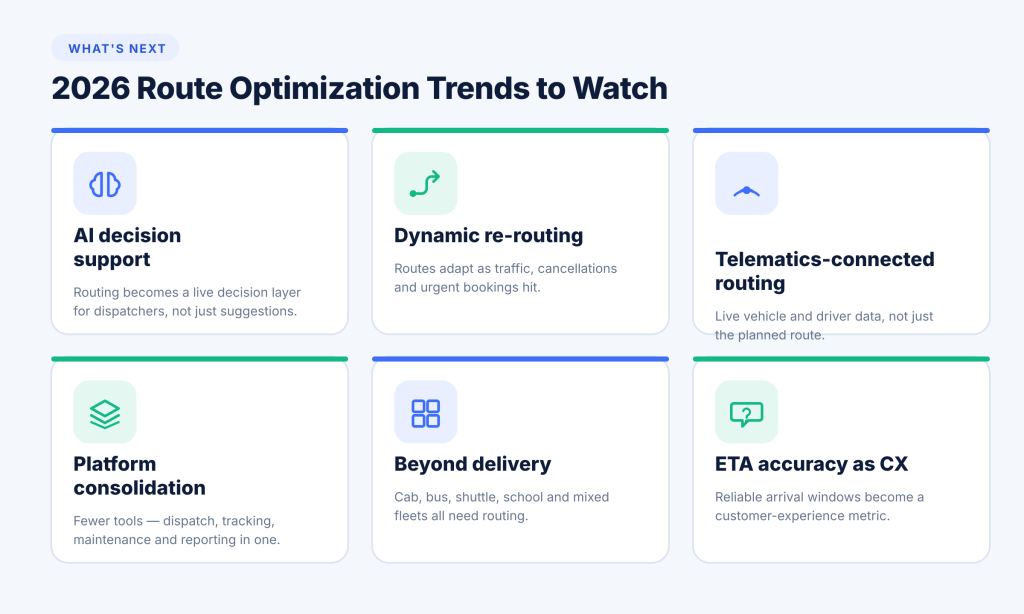
AI route optimization software is moving beyond route suggestions and becoming a decision-support layer for dispatchers. Instead of simply showing a route, AI-powered systems can help teams make faster decisions based on live data, past route patterns, vehicle availability, and operational rules.
Dynamic re-routing is also becoming more important. Static routes are not enough when traffic, cancellations, urgent bookings, failed deliveries, or driver delays happen throughout the day. Fleets need top route software that can adapt as operations change.
Telematics-connected routing is becoming a stronger buying priority because fleet managers want live vehicle and driver data, not just planned routes. The future of routing is not only where the vehicle should go, but what is happening with that vehicle right now.
Fleet platform consolidation is another major trend. Operators are tired of managing separate tools for dispatch, routing, tracking, maintenance, and reporting. They want fewer systems, better visibility, and cleaner decision-making.
Route optimization is also expanding beyond delivery. Cab fleets, bus operators, shuttle providers, school transportation, field service businesses, logistics companies, and mixed fleet operators now need route optimization in different forms.
Finally, ETA accuracy is becoming a customer experience metric. Customers do not only want fast service. They want reliable updates, accurate arrival windows, and fewer surprises.
Which Top Route Software Fits Your Fleet Type?
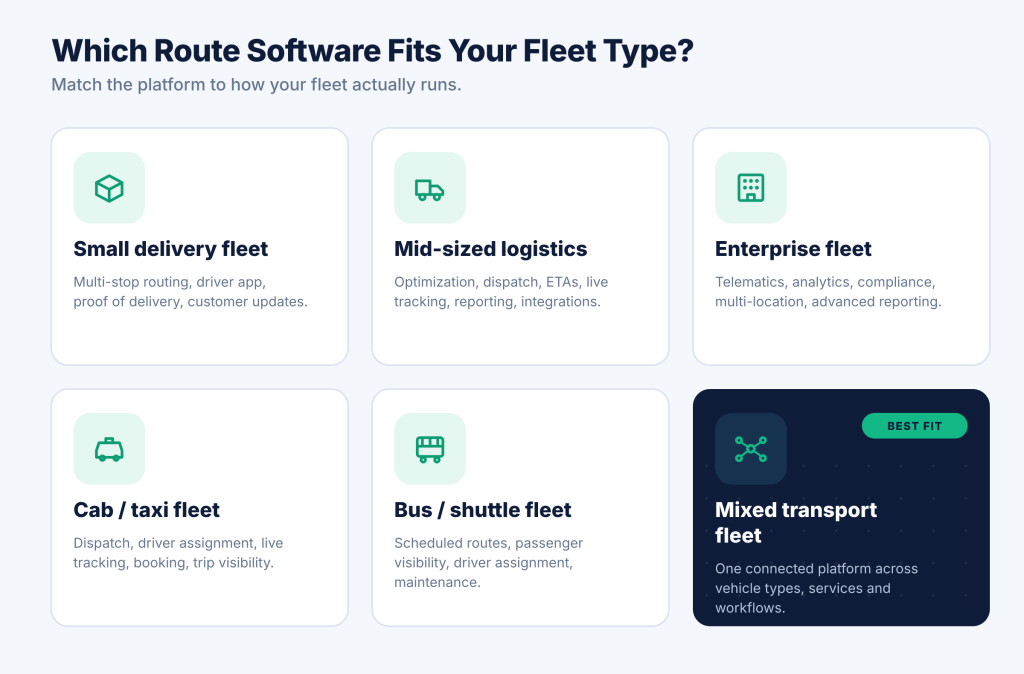
- A small delivery fleet usually needs simple multi-stop routing, a driver app, proof of delivery, and customer updates.
- A mid-sized logistics fleet needs route optimization, dispatch, ETAs, live tracking, reporting, and integrations.
- An enterprise fleet needs telematics, analytics, compliance, multi-location support, and advanced reporting.
- A cab or taxi fleet needs dispatch, driver assignment, live tracking, customer booking, and trip visibility.
- A bus or shuttle fleet needs scheduled routes, passenger visibility, vehicle tracking, driver assignment, and maintenance support.
- A mixed transport fleet needs something broader: one connected platform that can support multiple vehicle types, service models, and operational workflows.
- This is where AllRide has a clear advantage. It is built for transport and delivery businesses that need room to grow across multiple verticals.
Why AllRide Is a Strong Choice for Growing Fleets
Most route optimization platforms specialize in one operational area. Some focus on delivery. Some focus on telematics. Some focus on route planning. Some focus on maintenance.
AllRide brings these workflows closer together.
This matters because growing fleet businesses rarely stay simple. A courier company may expand into logistics. A cab operator may add airport transfers. A shuttle provider may need scheduled routes and passenger visibility. A logistics company may need better dispatching, ETAs, vehicle utilization, and driver coordination.
AllRide gives these businesses a broader operating foundation. Instead of managing routes in one tool, dispatch in another, tracking in another, and maintenance separately, operators can move toward a more connected fleet ecosystem.
For businesses planning a fleet software migration, this can reduce operational friction and prevent the need to switch systems again when the fleet grows.
Final Recommendation
In a nutshell,
- If you only need simple multi-stop routing, a lightweight route planner may be enough.
- If you need last-mile delivery workflows, a delivery-first platform may fit.
- If you need telematics and safety visibility, a fleet tracking platform may be suitable.
But if your business needs route optimization, dispatch, tracking, telematics, predictive maintenance, AI insights, and support for cab, bus, logistics, delivery, shuttle, and mixed fleet operations, AllRide is one of the strongest platforms to compare in 2026.
Book a demo with AllRide to see how your fleet can connect route optimization, dispatch, tracking, telematics, and fleet intelligence in one scalable platform.
FAQs
What is the best route optimization software for fleets in 2026?
The top route optimization software depends on fleet type and business complexity. Delivery teams may need proof of delivery and customer ETAs. Enterprise fleets may need telematics and analytics. Mixed fleet operators should compare AllRide because it connects route optimization, dispatch, tracking, telematics, predictive maintenance, and multi-vertical fleet workflows.
What is route optimization software?
Route optimization software helps fleets plan efficient routes using stops, vehicle capacity, driver availability, traffic, delivery windows, distance, time, and business rules.
What is route optimization software?
Route optimisation software is the UK, India, and Europe spelling of route optimization software. Both terms refer to software that improves routing efficiency for fleets.
What is the difference between route planning and route optimization?
Route planning creates routes. Route optimization improves those routes based on time, cost, traffic, distance, driver availability, vehicle capacity, customer priority, and service rules.
Which route optimization software is best for delivery fleets?
Delivery fleets can compare Onfleet, Routific, Circuit, Upper, Route4Me, OptimoRoute, FarEye, and AllRide Delivery depending on whether they need simple delivery routing or a complete fleet operations platform.
Which route software is best for small fleets?
Small fleets usually need simple setup, multi-stop routing, driver apps, customer updates, and affordable pricing. Growing small fleets may also consider AllRide if they want to scale into dispatch, tracking, telematics, and fleet management workflows.
Does route optimization software reduce fuel costs?
Yes. Route optimization software can help reduce unnecessary mileage, idle time, backtracking, inefficient dispatching, and poor route sequencing.
Does AllRide offer route optimization?
Yes. AllRide offers route optimization as part of a broader fleet operations platform that can include dispatch, tracking, vehicle telematics, predictive maintenance, AI insights, and multi-vertical fleet workflows.