

 Fleet Management
 Route optimization
 Shuttle Transportation
 Delivery Management
 School Bus Transportation
 Ride Sharing Management
 Airport Transfer Booking
  Vehicle inspection
 Car Rental Management
 Trucking & Logistics
 Food & Beverage
 E-Commerce
 Passenger Transit
 Delivery
 School & Corporate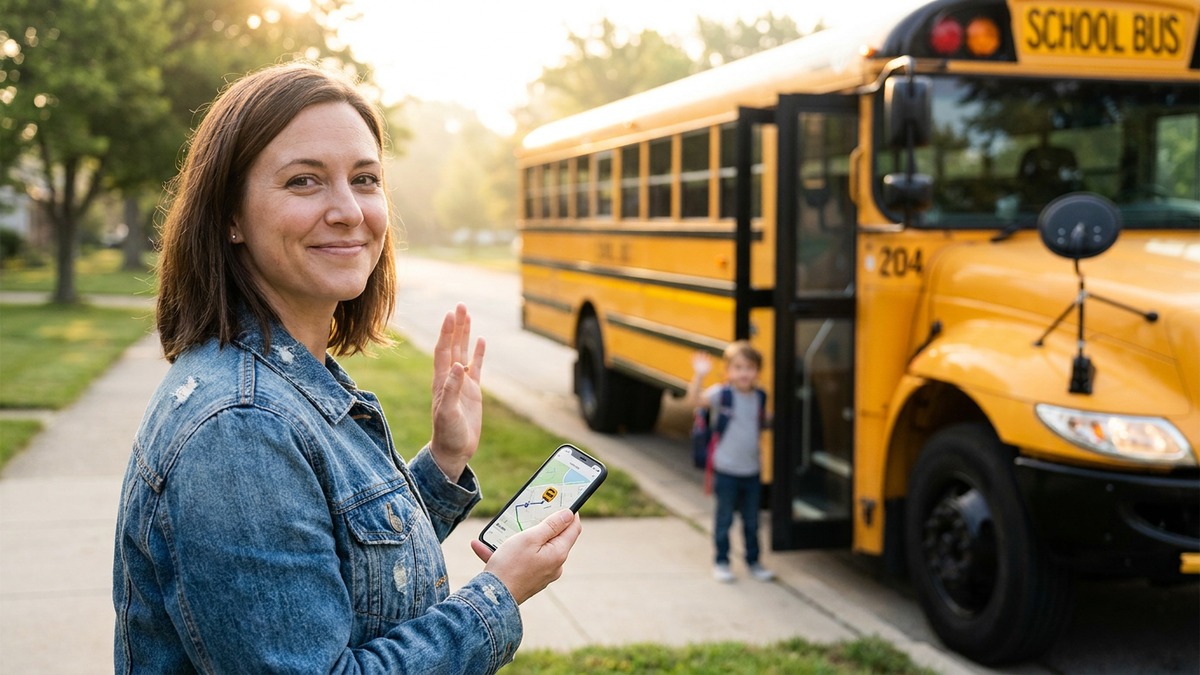
The Complete Guide to School Bus Tracking Systems in 2026: Safer Routes Without a Bigger Budget
The best school bus tracking systems are not a standalone GPS dongle — it is an integrated platform that pairs real-time vehicle location with route optimization, digital student manifests, driver management, and automated parent notifications so that a single source of truth drives every decision. Real-time visibility cuts the “where is the bus?” phone calls and lets dispatchers reroute instantly around a breakdown or a snowstorm; optimized routes trim fuel and overtime while shortening the minutes students spend on the road; digital ridership confirms every child boarded and got off at the right stop. Because these capabilities share one dataset, each dollar spent on efficiency also buys a unit of safety — which is exactly why the operators who get this right stop treating the two as a trade-off.
The key insight: with the right school bus tracking systems, safety and cost control aren’t competing line items — they are two returns on the same investment.
Student transportation is under more pressure today than at almost any point in a generation. Driver shortages, tighter budgets, and rising safety scrutiny are all landing at once — and, at the same time, parents now expect the same live-tracking experience they get from a food-delivery or rideshare app the moment their child steps onto a bus.
For a transportation director, the stakes are concrete. A child left asleep on a bus. A missed stop that pulls a teacher out of the classroom to cover a route. A fuel bill climbing faster than the budget. An illegal-passing incident with no footage to review. Every one of those is both a safety failure and a cost failure — which is precisely why the old instinct to solve them separately no longer holds.
This guide breaks down what a modern school bus tracking system actually is in 2026, why the cheapest shortcut usually ends up the most expensive, and five practical strategies for building a setup that is safer and leaner at the same time.
The Student Transportation Visibility Problem
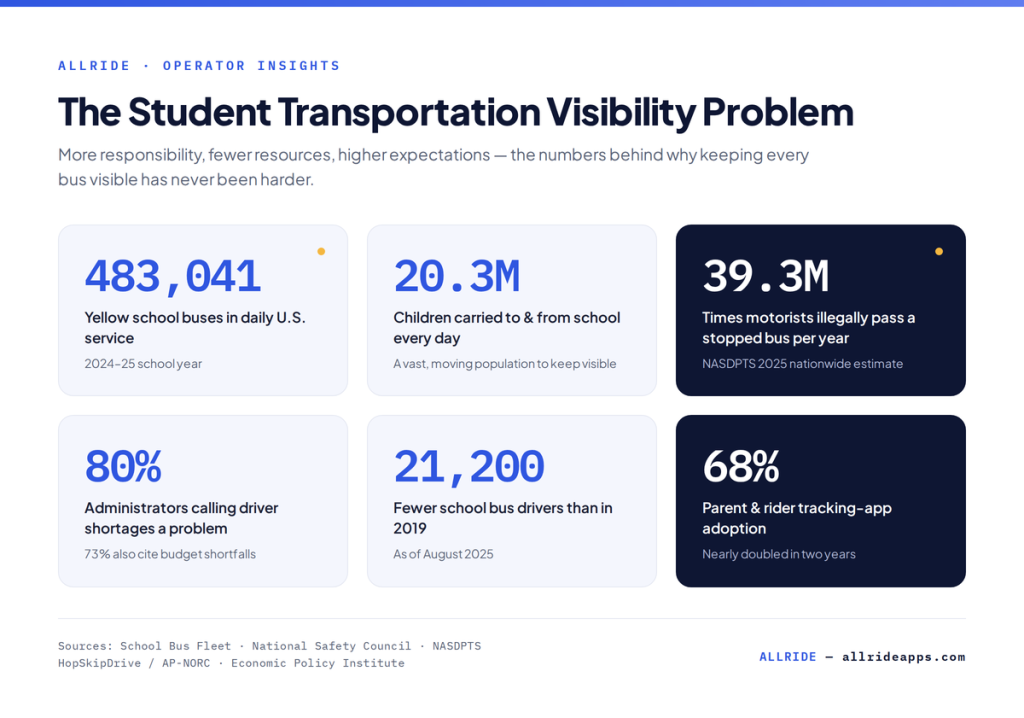
The scale of the challenge is easy to underestimate until you put numbers to it — and the numbers point in the same direction: more responsibility, fewer resources, higher expectations.
In the 2024–25 school year, an estimated 483,041 yellow school buses were in daily service across the United States, carrying about 20.3 million children to and from school each day, according to School Bus Fleet and the National Safety Council. That is a vast, moving population to keep visible.
Keeping them safe is getting harder on the road. The National Association of State Directors of Pupil Transportation Services (NASDPTS) estimated in its 2025 survey that motorists illegally pass stopped school buses roughly 39.3 million times a year nationwide; on a single sampled day, 114,239 drivers logged 67,258 violations — even after the first year-over-year decline the survey has ever recorded.
And the teams responsible are stretched thin. In the 2025 HopSkipDrive / AP-NORC State of School Transportation study, 80% of school administrators said driver shortages were a problem, 73% pointed to budget shortfalls, and 26% had already cut or shortened routes — while the Economic Policy Institute counted 21,200 fewer school bus drivers employed in August 2025 than in 2019.
Meanwhile, expectations keep climbing. School Bus Fleet’s 2025 district survey found parent- and rider-tracking app adoption jumped to 68%, nearly doubling in two years. Live visibility is no longer a differentiator — it’s the baseline families assume.
Several forces are driving the problem at once:
- A shrinking driver pool that pushes more substitute and double runs, exactly where route knowledge is thinnest.
- Flat or shrinking budgets that make every wasted mile and every overtime hour painfully visible.
- Rising parent expectations for real-time, app-based visibility into where the bus is.
- Heightened safety and compliance scrutiny around stop-arm violations and loading-zone incidents.
- Paper manifests, two-way radios, and spreadsheets that simply can’t scale to today’s route complexity.
Why the Cheapest Tracker Is a False Economy
When the pressure is on, the tempting shortcut is obvious: buy the cheapest GPS trackers you can find, stick a dot on a map, and call it a tracking system. It looks like a win on the invoice. It rarely is one on the road.
Picture a sleet-gray Tuesday in February. A veteran driver calls in sick, and a substitute takes Route 12 with a bargain GPS dongle suction-cupped to the windshield — a location dot, nothing more. Unfamiliar with the subdivision, the sub misses a turn. Dispatch sees the dot drift but has no route overlay to know it’s wrong, no two-way alert to warn the driver, and no digital manifest to confirm which of the 40 students are still aboard. The office phones light up with worried parents. By the time someone reaches the driver by radio, three children are 25 minutes late, one parent is driving the route herself to look for the bus, and there’s no footage to review afterward. The “$99 tracker” just cost a morning of dispatcher overtime, a stack of complaint calls, and a near-miss nobody can learn from.
That is the trap of buying location alone. The false economy shows up fast:
- A bare GPS feed tells you where a bus is — not whether it’s on the right route, on time, or safe.
- Disconnected tools leave data in silos (trackers here, rosters there, maintenance in a binder), so no one gets the full picture quickly.
- Without route optimization, you keep paying for wasted miles and overtime that dwarf any software “savings.”
- Without digital ridership, a missed or mis-dropped student stays invisible until a parent calls.
- Cheap, unsupported hardware becomes e-waste the moment it fails — and it tends to fail on the worst possible morning.
How to Build School Bus Tracking Systems That’s Safer and Leaner
The goal isn’t more gadgets — it’s a connected system where every efficiency gain also closes a safety gap. Here are five strategies that do exactly that.
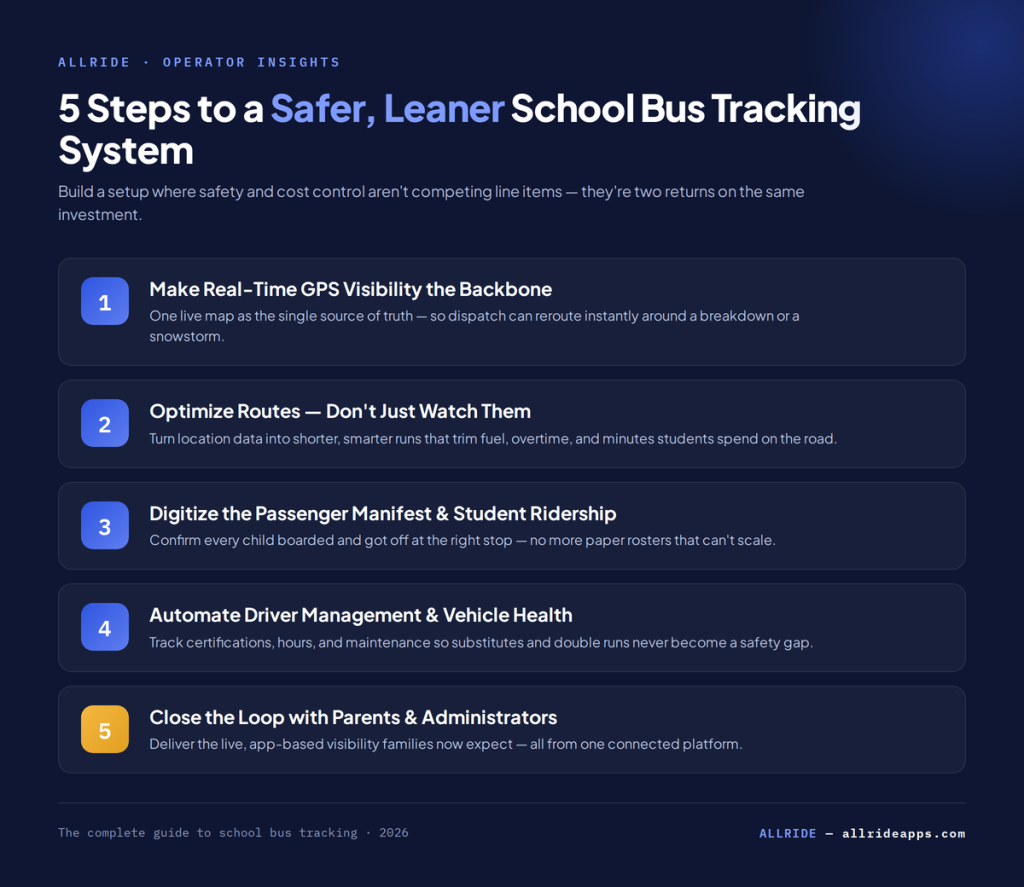
1. Make Real-Time GPS Visibility the Backbone
Start by making live location the foundation of your school bus tracking system — one dashboard, every vehicle, in real time.
- Live location on a single dashboard ends the “where’s the bus?” calls that eat staff hours and means dispatch always knows exactly where every student-carrying vehicle is right now.
- Instant rerouting around a crash, closure, or storm avoids idle miles and overtime and gets children out of a hazard faster.
- Geofenced stop alerts confirm arrivals automatically instead of by phone and flag a bus that skips or overshoots a stop before it becomes an incident.
See how this comes together in AllRide’s school bus transportation software.
2. Optimize Routes — Don’t Just Watch Them
Modern school bus tracking systems should optimize routes, not just display them — turning raw location into a leaner, safer plan.
- Algorithmic routing cuts total miles and fuel spend and shortens the time each child spends on board.
- Balanced loads and smarter stops let the same drivers cover more ground amid the shortage and reduce risky maneuvers like left turns across busy traffic.
- Consolidated routes free up spare buses and hours and give substitute drivers a predictable, well-mapped day.
Explore route optimization within AllRide’s school and corporate fleet solutions.
3. Digitize the Passenger Manifest and Student Ridership
Best school bus tracking systems replaces the paper manifest with a live digital roster — so who’s aboard is never a guess.
- Tap-on / tap-off or scan-based ridership ends manual headcounts and paperwork and guarantees no child is left on a bus or dropped at the wrong stop.
- Accurate ridership data right-sizes routes and proves utilization to the budget office and creates a verified record for every student, every trip.
- Automated attendance syncs with school systems to save staff time and surfaces a missing-student exception instantly instead of hours later.
This is core to how AllRide Bus manages fixed-route, roster-based transport.
4. Automate Driver Management and Vehicle Health
A capable school bus tracking system extends to drivers and vehicles, not just the map — because a tracked bus still has to be a roadworthy one.
- Preventive-maintenance alerts on mileage and engine data catch problems early: planned service is far cheaper than a roadside breakdown and keeps only safe buses in service.
- Driver-behavior monitoring — speeding, harsh braking, harsh acceleration — lowers accident risk and can reduce insurance premiums, delivering the cost win and the safety win together.
- Digital assignment and credential tracking cut dispatcher admin and ensure every run is covered by a qualified, properly endorsed driver.
These capabilities live in AllRide’s fleet management software.
5. Close the Loop with Parents and Administrators on One Platform
The final layer of school bus tracking systems is communication — turning visibility into trust for families and decisions for admins.
- A parent app with live ETAs and arrival alerts absorbs the calls that used to swamp the front office and gives families the transparency that replaces frantic morning uncertainty.
- Automated delay and route-change notifications reach everyone at once and shorten response time when something actually goes wrong.
- One connected dataset turns scattered reports into fast decisions for admins and creates the audit trail regulators and parents increasingly expect.
That connected, AI-powered backbone is what the AllRide platform is built to provide.
What Good Looks Like
Read those five strategies back to back and a pattern emerges: they aren’t five products bolted together — they’re five outputs of one well-run system. GPS location is only useful because it sits on top of an optimized route. The route is only trustworthy because the digital manifest confirms who’s aboard. The manifest is only reliable because driver and vehicle data keep the bus running. And all of it is only valuable because parents and admins can see it in real time.
When those functions live in separate tools, your team spends its day reconciling them — and the safety gaps hide in the seams between systems. When they live on one platform, efficiency and safety stop trading against each other, because they’re drawing from the same source of truth. That is the throughline of integrated student transportation SaaS: one dataset, many returns.
The Bottom Line
The operators who win at student transportation in 2026 have quietly retired the old choice between “safe” and “affordable.” They treat school bus tracking systems as operational infrastructure, not a safety accessory — and they invest in the integrated platform rather than the cheapest dot on a map. The payoff is a fleet that costs less to run and keeps more kids safer at the same time, run by a team that spends its energy on students instead of spreadsheets.
Because the best-run transportation operations aren’t the ones with the biggest budgets — they’re the ones whose systems make every mile count twice.
Keep Building Safer, Leaner Fleets
Want more field-tested playbooks like this one? Subscribe to the Operator Insights Newsletter for practical guidance on running safer, leaner transportation operations — and when you’re ready to see what an integrated setup looks like, explore AllRide’s school bus transportation software to build a tracking system that protects your students and your budget at once.
Frequently Asked Questions
1. What is the best school bus tracking system for safety and cost control in 2026?
The best school bus tracking system is an integrated platform — not a standalone GPS device — that combines real-time location, route optimization, digital student manifests, driver and vehicle management, and parent notifications on one dataset. Because those features share a single source of truth, each efficiency gain also strengthens safety, so you don’t have to choose between the two.
2. How much do school bus tracking systems cost?
Pricing varies with fleet size, feature set, and whether you buy hardware, software, or both, so most vendors quote per bus or per district. The more useful question is total cost of ownership: an integrated system usually pays for itself through lower fuel, reduced overtime, fewer breakdowns, and less administrative time — savings a bare GPS tracker can’t deliver.
3. What is the best tracking software for school buses versus a plain GPS device?
A plain GPS device shows a location; the best tracking software turns that location into decisions by layering routing, ridership, maintenance, and communication on top of it. For student transportation, software that connects those functions is far more valuable than hardware alone, because safety depends on context — who’s aboard, whether the route is right, and whether the bus is roadworthy.
4. How does school bus tracking software improve student safety?
It confirms every student boards and exits at the correct stop, alerts staff instantly to route deviations or missed stops, keeps only well-maintained buses in service, and gives dispatch and parents real-time visibility. Together, those capabilities shrink the windows in which a child can be lost, delayed, or exposed to a hazard.
5. Can a school bus tracking system help with the driver shortage?
Yes. By optimizing routes and balancing loads, a tracking system lets the same number of drivers cover more ground, and clear digital assignments make it easier for substitutes to run unfamiliar routes safely. It won’t hire drivers for you, but it helps a short-staffed team do more without cutting corners on safety.