


 Fleet Management
 Route optimization
 Shuttle Transportation
 Delivery Management
 School Bus Transportation
 Ride Sharing Management
 Airport Transfer Booking
  Vehicle inspection
 Car Rental Management
 Trucking & Logistics
 Food & Beverage
 E-Commerce
 Passenger Transit
 Delivery
 School & Corporate
Shuttle Software for Small Business: Best Options for Growing Operators
Shuttle software for a small business manages recurring routes rather than individual trips — publishing schedules, holding seat capacity, taking rider bookings, assigning drivers to routes, tracking vehicles live, and reporting to the contract holder who pays for the service. That last point is what separates shuttle work from taxi or transfer software: your customer is often an employer, hotel, campus or property manager buying a service for other people, and they expect evidence it ran properly.
Key takeaways
- Shuttle work is route-and-schedule based, not trip-based.
- Seat capacity, not vehicle assignment, is the core booking unit.
- Your paying customer is often a contract holder, not the rider.
- Recurring schedules need roster-aware planning, not live dispatch.
- Contract reporting is what renews the business.
- Small operators should prioritise schedule reliability over feature depth.
Why shuttle operations need different software
Most transport software assumes a customer requests a ride and a vehicle is assigned to them. Shuttle operations invert that. You publish a route and a timetable, riders join it, and the vehicle runs whether it carries three people or thirteen. The operational question isn’t “who takes this booking?” but “is every route covered tomorrow, and are we within capacity?”
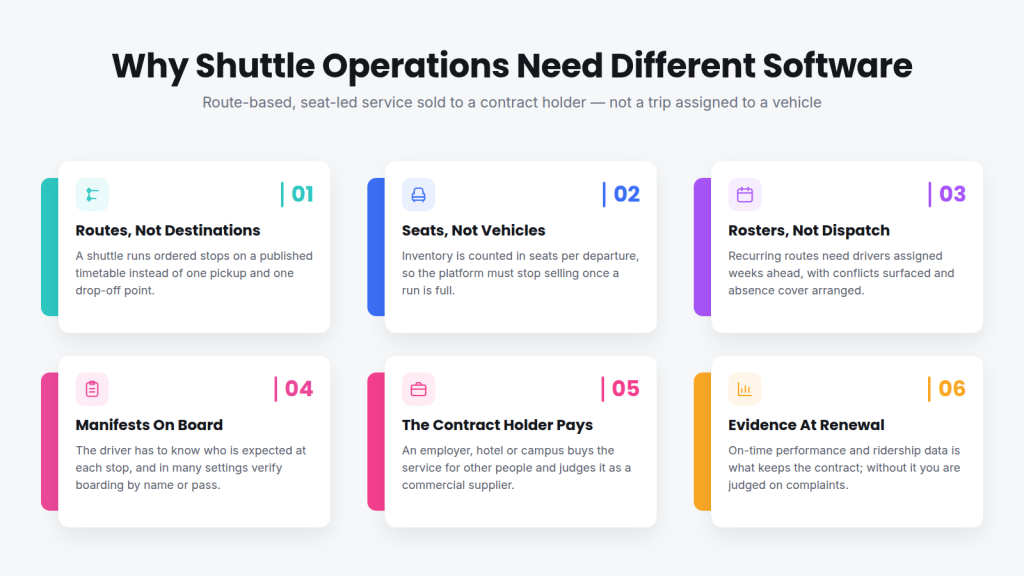
That difference runs through everything. A shuttle needs stops and sequences rather than a pickup and a destination. It needs seat inventory rather than vehicle availability. It needs a driver roster planned weeks ahead rather than live availability. And it needs a manifest — the driver has to know who should be aboard, and in some settings, verify it.
The commercial model is different too. A hotel shuttle, employee shuttle or campus service is usually sold as a contract to an organisation, not per-ride to individuals. That organisation cares about on-time performance, ridership numbers and cost per rider, and it reviews those at renewal. A taxi platform can run shuttle routes badly; it usually can’t produce the evidence that keeps the contract.
This guide covers what shuttle software for small business should do, how the main shuttle models differ, what a growing operator can defer, what it costs, and how to evaluate options quickly.
What is shuttle software?
Shuttle software is a platform for managing scheduled, shared passenger transport — route and stop definition, timetables, seat capacity, rider booking, driver and vehicle rostering, live tracking, and reporting for contract holders.
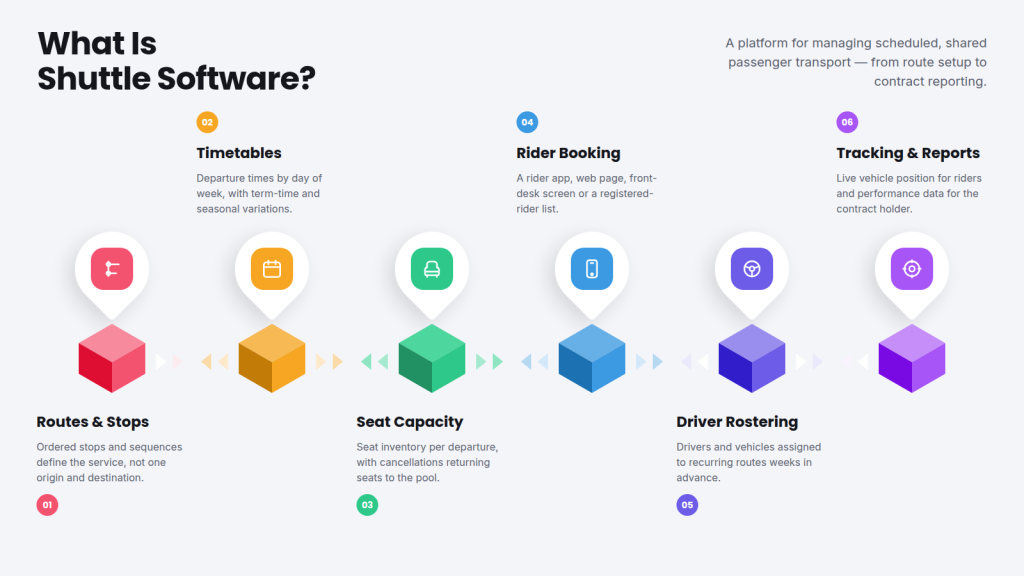
The category is searched as shuttle reservation software, shuttle bus booking software, shuttle booking software, shuttle management system, shuttle dispatch software and shuttle scheduling software. The labels differ mainly by which part of the workflow a vendor emphasises: reservation-led products focus on rider booking and seat inventory, dispatch-led products on driver assignment and live operations, and scheduling-led products on route and roster planning. Most small operators need a workable amount of all three.
The shuttle models — and what each demands
Employee, hotel, campus, event and community shuttles share a structure but stress software in different places, so identify your dominant model before shortlisting.
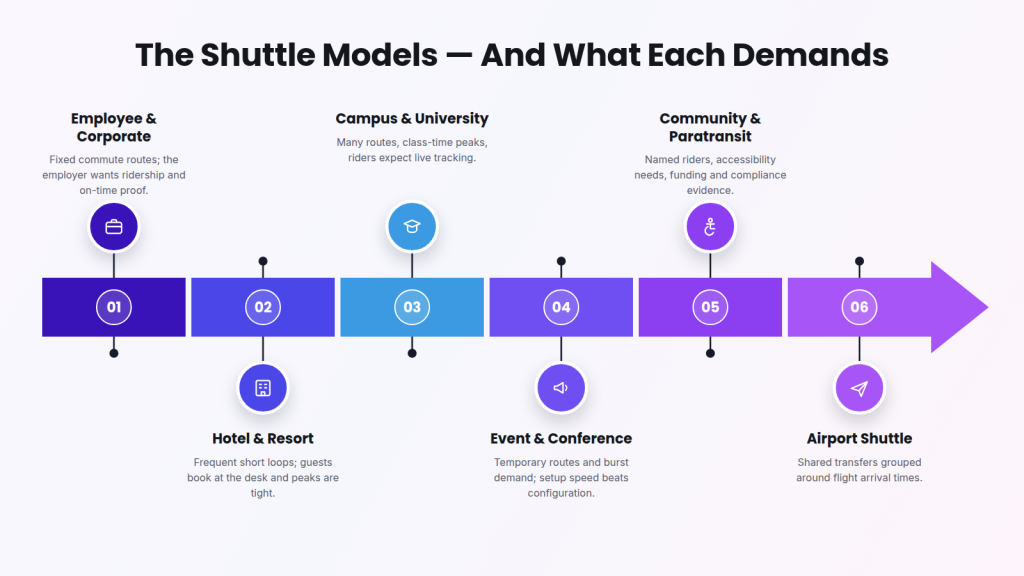
Employee and corporate shuttles. Fixed morning and evening routes serving a workplace, often with registered riders, sometimes with seat reservation to manage demand. The contract holder is the employer, who wants ridership data, on-time performance and cost justification. Reliability and reporting matter most.
Hotel and resort shuttles. Frequent short loops to airports, town centres or attractions, often on demand within a schedule. Guests book at the desk or by app, capacity is tight at peak, and the hotel wants a guest experience that reflects on them.
Campus and university shuttles. Multiple routes, published timetables, high peak loads between classes, and riders who expect live vehicle tracking. Route adherence and rider information dominate.
Event and conference shuttles. Short bursts of intense demand, temporary routes, multiple vehicles running loops, and no tolerance for confusion. Rapid setup and clear rider communication matter more than long-term configuration.
Community, senior and paratransit shuttles. Recurring bookings for named riders, accessibility requirements, and often funding or compliance reporting. Rider records and evidence of service are central.
Airport shuttles. Shared transfers grouped around flight arrivals, sitting between shuttle and transfer work — if this is your main model, our airport taxi booking software guide covers the flight-driven side in more depth.
What a small shuttle operator actually needs
Prioritise route and schedule management, seat capacity, rider booking, driver rostering, live tracking with rider visibility, manifests, and contract reporting.
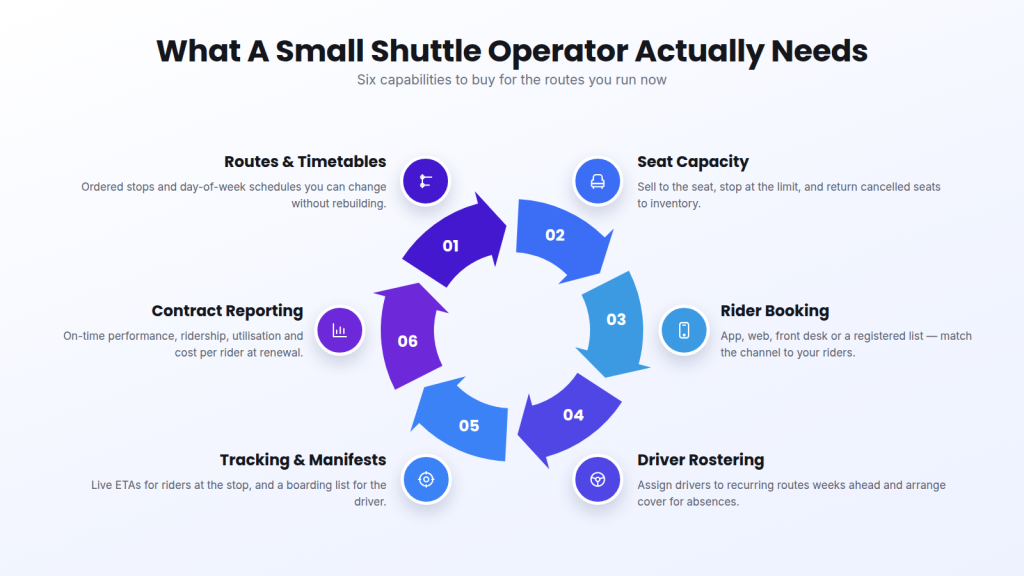
Route, stop and timetable management. Define routes with ordered stops, assign timetables by day of week, handle term-time or seasonal variations, and change a schedule without rebuilding it. This is the foundation everything else sits on.
Seat capacity and reservation. Shuttle bookings are seats, not vehicles. The system must know how many seats each departure has, stop selling at capacity, handle cancellations returning inventory, and — for tighter operations — manage a waitlist. A platform that can’t prevent overbooking will cost you a contract eventually.
Rider booking across channels. Depending on the model: a rider app or web booking, a front-desk or reception interface for hotels, an employer portal, or simply a registered-rider list with no per-trip booking at all. Match the channel to how your riders actually behave rather than assuming an app.
Driver and vehicle rostering. Recurring routes need drivers assigned weeks ahead, with conflicts surfaced early, cover arranged for absences, and shift rules respected. This is the shuttle equivalent of dispatch, and it’s planning work rather than live allocation.
Live tracking and rider information. Riders standing at a stop want to know where the vehicle is. A tracking link or in-app map cuts “where is the shuttle?” calls dramatically and is one of the most visible service improvements a small operator can make.
Manifests and boarding. The driver should see who is expected at each stop. Depending on the setting, boarding may be verified by name, QR code, staff ID or pass — check what your contracts require.
Contract and ridership reporting. On-time performance, ridership by route and stop, capacity utilisation, no-shows and cost per rider. This is what you present at renewal, and it’s the feature small operators most often overlook when buying.
What a growing shuttle operator can defer
Buy for the routes you run now, but confirm the platform can add the rest without a migration.
| Usually essential now | Can wait until you grow |
| Route and timetable management | Multi-depot and multi-city operations |
| Seat capacity control | Demand-responsive or dynamic routing |
| Rider booking or registered-rider lists | Fully branded rider apps |
| Driver rostering | Automated driver settlement |
| Live tracking and rider ETA | Deep BI and custom dashboards |
| Driver manifests | Complex multi-contract billing hierarchies |
| Basic on-time and ridership reporting | Extensive API integrations |
The exception is contract reporting. If you serve organisational clients, do not defer it — a hotel or employer that can’t see performance data will judge your service on complaints alone, which is the worst possible measure.
Booking channels: match them to your riders
Shuttle riders behave differently from taxi passengers, and forcing an app on people who won’t download one is a common and expensive mistake.
Employees on a daily commute route often want no booking at all, or a simple recurring registration. Hotel guests book at the front desk far more often than through an app. Campus riders want a live map, not a reservation. Event attendees need a QR code or nothing. Community and paratransit riders frequently book by phone.
So before comparing rider apps, ask what your riders will genuinely use. For many small shuttle operators, a web booking page, a reception interface and a public live-tracking link deliver more value than a branded app that sits uninstalled — and cost considerably less.
What shuttle software costs a small operator
Expect a monthly subscription priced per vehicle, driver, route or rider, and watch the lines that scale differently from your revenue.
| Cost line | What to confirm |
| Subscription basis | Per vehicle, driver, route, seat or rider |
| Minimum commitment | Whether there’s a floor above your fleet size |
| Rider app | Included, extra, or replaceable with web booking |
| Setup and onboarding | Route building, timetable configuration, training |
| Per-booking or per-rider fees | Behaviour at peak, and on high-ridership routes |
| SMS and notifications | Per-message costs for schedule alerts |
| Reporting | Whether contract-grade reports need a higher tier |
| Integrations | HR systems, property management, campus SSO |
| Support | Cover during live service hours |
| Contract and exit | Term, data export, route configuration portability |
One shuttle-specific trap: per-rider or per-booking pricing can penalize success. A route that fills up is good for your business but may cost more to run on the platform. If your contracts are fixed-fee, per-rider software pricing puts your cost and revenue on different curves — model it before signing.
How to evaluate shuttle software quickly
Define your model, shortlist three, and test each on the same five scenarios — a small operator can complete this in two weeks.
Run these tests in any shuttle software demo or free trial:
- Build one of your actual routes with its real stops and timetable.
- Fill a departure to capacity and attempt one more booking.
- Cancel a rider and confirm the seat returns to inventory.
- Change tomorrow’s schedule and see what reaches drivers and riders.
- Make a rostered driver unavailable and arrange cover.
- Show the driver’s manifest for a stop.
- Show what a rider sees waiting at a stop.
- Pull the on-time and ridership report you’d send a contract holder.
Then ask the commercial questions: total monthly cost at your route count and peak ridership, minimum commitment, what setup involves, whether contract reporting is in your tier, and what happens to your route configuration and data if you leave. (Our dispatch software buyer checklist covers the wider evaluation framework.)
Common mistakes small shuttle operators make
- Buying taxi software for shuttle work. It handles trips well and routes, seats and timetables poorly.
- Ignoring seat capacity. Overbooking a fixed-capacity vehicle is a visible service failure.
- Deferring contract reporting. It’s what renews the business, not a nice-to-have.
- Assuming riders want an app. Match the channel to actual rider behaviour.
- Underestimating rostering. Recurring routes are a planning problem; live dispatch tools don’t solve it.
- Choosing per-rider pricing on fixed-fee contracts. Your cost rises while your revenue doesn’t.
- Skipping the driver manifest. Drivers who don’t know who’s expected can’t run the service properly.
- Not testing a schedule change. Timetables change constantly; how the platform propagates that is the real test.
How AllRide Bus fits small shuttle operators
AllRide Bus is the shuttle, bus and scheduled group transport product in the AllRide Apps suite, covering employee and corporate shuttles, school and campus transport, and scheduled route services alongside AllRide Cab for taxi and transfer work.
For a small shuttle operator, the relevant confirmed capabilities are multi-channel booking; automated dispatch and driver assignment with manual control; real-time GPS tracking and route optimisation; configurable fares and service zones; payment gateway integration; branded rider and driver apps; and reporting dashboards. Operators running shuttles alongside taxi, transfer or delivery services can do so on one platform rather than separate tools.
On the shuttle-specific mechanics, ask rather than assume: seat-level capacity control, timetable and stop configuration, driver manifests and contract-grade ridership reporting vary by vendor and configuration across this category, so raise them directly — including what’s achievable through the platform’s integrations — before shortlisting anyone, us included. Those are the four capabilities this guide says to test, and they should be tested on every platform you consider.
See how AllRide Bus fits your routes — book a free demo.
Frequently asked questions
What is shuttle software for small business?
Shuttle software for a small business manages scheduled, shared passenger transport: defining routes and stops, publishing timetables, controlling seat capacity, taking rider bookings, rostering drivers, tracking vehicles live, and reporting to contract holders. It’s sized for operators running a handful of routes without a dedicated IT team.
How is shuttle software different from taxi dispatch software?
Taxi software assigns individual trips to vehicles on demand. Shuttle software manages recurring routes with fixed stops and timetables, where riders book seats rather than vehicles and drivers are rostered weeks ahead rather than dispatched live. A taxi platform can run shuttle routes, but usually can’t handle seat inventory, manifests or contract reporting properly.
What is shuttle reservation software?
Shuttle reservation software lets riders book seats on scheduled shuttle departures, managing seat inventory per departure, cancellations returning inventory, waitlists where supported, and manifests for drivers. Its central job is filling vehicles without overbooking them, which is what protects both margin and service quality on fixed-capacity routes.
Do small shuttle operators need a rider app?
Not always, and this is worth thinking about before paying for one. Employees on daily routes often need no booking at all, hotel guests book at the front desk, and campus riders mainly want live tracking. A web booking page, a reception interface and a public tracking link frequently deliver more value at lower cost than a branded app.
How much does shuttle software cost for a small fleet?
Typically a monthly subscription per vehicle, driver, route or rider. Beyond the base rate, confirm setup, rider app fees, per-booking charges, SMS costs, whether contract-grade reporting requires a higher tier, integrations, support and any minimum commitment. Be careful with per-rider pricing if your contracts are fixed-fee, since costs then rise with ridership while revenue doesn’t.
What reporting do shuttle contract holders expect?
Usually on-time performance, ridership by route and stop, capacity utilisation, no-show rates and cost per rider. Employers, hotels, campuses and property managers review these at renewal, so the ability to produce them easily is a commercial capability rather than an administrative one — and it’s the feature small operators most often overlook when buying.
Can shuttle software handle schedule and route changes?
It should, and this is worth testing directly. Timetables change for term dates, seasons, events and contract adjustments. Check how quickly you can amend a route or schedule, whether changes propagate automatically to drivers and riders, and whether a recurring series can be edited without rebuilding it from scratch.
Can one platform run shuttles alongside other services?
Some can. Operators running shuttles plus airport transfers, taxi work or delivery often prefer one platform for consistent operations and a single source of truth. Confirm the platform genuinely supports scheduled route-based work rather than treating shuttles as repeated point-to-point trips, which is a common shortcut that breaks down at capacity.
Is there a free trial for shuttle software?
Some vendors offer a free trial or demo environment. Use it to build one of your real routes with its actual stops and timetable, fill a departure to capacity, change tomorrow’s schedule, and pull a ridership report. Those four tests reveal more about shuttle suitability than any scripted product tour.
Conclusion
Shuttle work rewards reliability over sophistication. Routes need to run on time, seats need to be there when riders expect them, drivers need to know who’s aboard, and the organisation paying for the service needs evidence it worked. A small operator who gets those four right will keep contracts that larger, better-equipped competitors lose.
So choose on route and timetable management, seat capacity, rostering and contract reporting — then test any shortlist by building one of your real routes and changing it. To see how a platform handles scheduled shuttle operations alongside your other services, book a free AllRide Bus demo.