


 Fleet Management
 Route optimization
 Shuttle Transportation
 Delivery Management
 School Bus Transportation
 Ride Sharing Management
 Airport Transfer Booking
  Vehicle inspection
 Car Rental Management
 Trucking & Logistics
 Food & Beverage
 E-Commerce
 Passenger Transit
 Delivery
 School & Corporate
School Transport Software Cost: Pricing Models, Features & Buying Checklist
School transport software cost is typically per bus, per route, per student, or as an annual district-wide licence, and the total usually lands well above the subscription once routing modules, parent apps, student ridership hardware, integration with the student information system, and implementation are included. Because school transport is bought against an annual budget and often through formal procurement, the number that matters is the three-year total against a defined scope — not a monthly rate.
Key takeaways
- Pricing is usually per bus, per route, per student, or district-wide.
- Routing, parent apps and ridership tracking are the biggest cost drivers.
- Student information system integration is frequently underestimated.
- Special education transport costs more to route and to run.
- Student data privacy is a procurement requirement, not a feature.
- Budget on a three-year total aligned to the school year, not a monthly rate.
Why school transport is priced differently
School transport software is bought differently from most fleet technology. The buyer is usually a district transportation director, a school business manager, or a contracted operator serving several schools — and the purchase is made against an annual budget, frequently through a formal procurement or tender process, with a school-year implementation window that cannot slip.
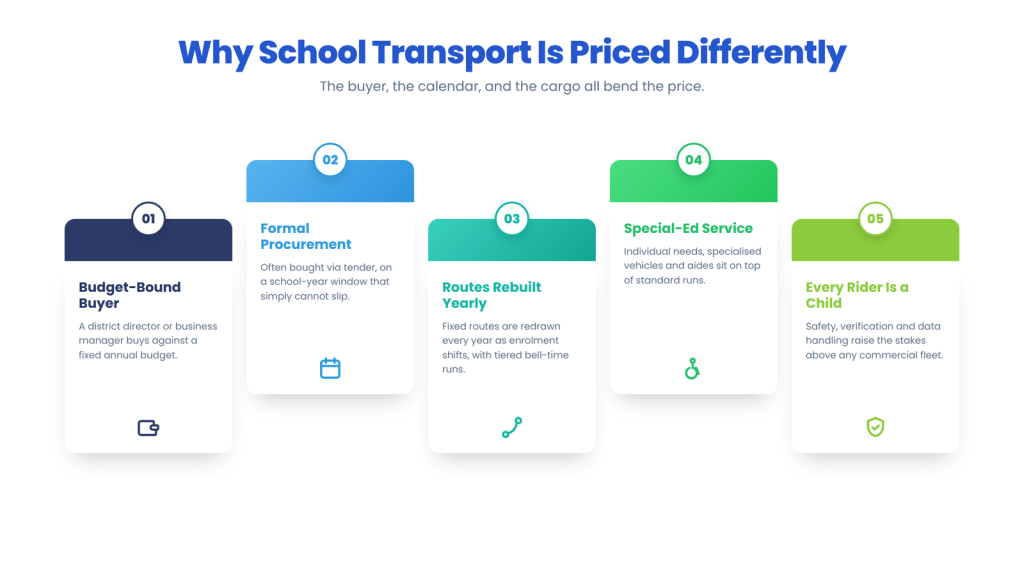
The operation itself is also unusual. Routes are fixed but must be rebuilt every year as enrolment changes. Bell times create tiered runs where the same bus covers elementary, middle and high school in sequence. Special education transport adds individual requirements, specialised vehicles and aides. Parents expect to know where the bus is. And every rider is a child, which raises the stakes on safety, verification and data handling well above a commercial fleet.
All of that shapes the price. This guide covers what school transport software cost actually comprises, the pricing models vendors use, the features that drive price up, the costs that get missed, and a checklist for buying — whether you run a district fleet or contract the service out.
What school transport software includes
A school transport platform typically covers routing and planning, student and stop management, driver and vehicle management, live tracking, parent communication, ridership records, and reporting for the district or school.
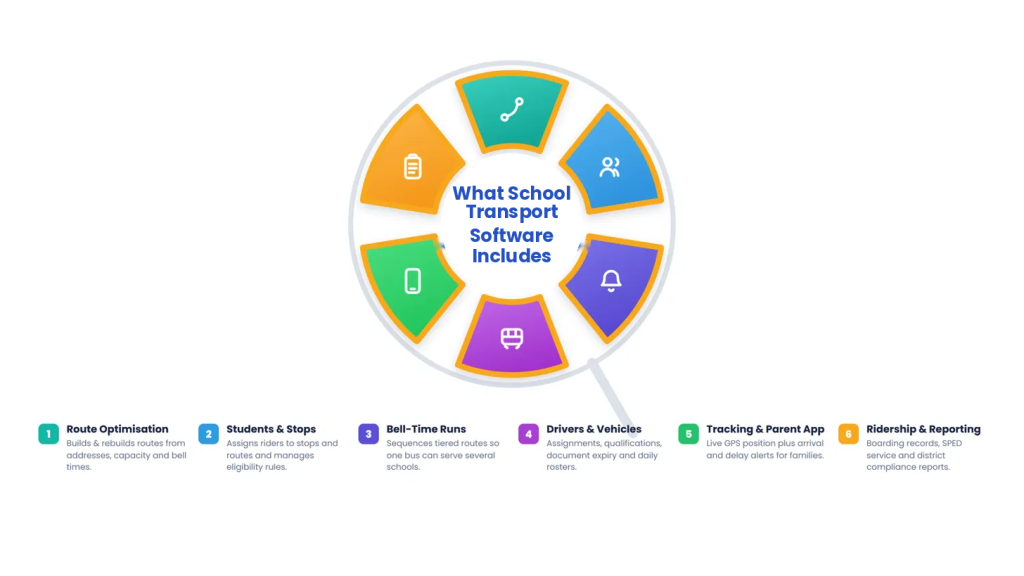
The core components:
- Routing and route optimisation — building bus routes from student addresses, stops, capacity and bell times, and rebuilding them each year as enrolment changes.
- Student and stop management — assigning students to stops and routes, handling address changes, and managing eligibility rules such as walk-distance thresholds.
- Bell-time and tiered-run planning — sequencing routes so one bus can serve multiple schools.
- Driver and vehicle management — assignments, qualifications, document expiry, and daily rosters.
- Live GPS tracking — vehicle position for the transport office and, where offered, for parents.
- Parent communication — arrival notifications, delay alerts, and often a parent app or portal.
- Student ridership — records of which students boarded and alighted where, sometimes using cards, tags or scanning.
- Special education transport — individual requirements, specialised vehicles, aides and door-to-door routing.
- Reporting and compliance — ridership, on-time performance, mileage, cost per student, and whatever your jurisdiction requires.
Not every district needs every component, and that is precisely where school transport software cost is controlled.
School transport software pricing models
Vendors price school transport software in four main ways, and which one suits you depends on fleet size, student numbers and how much your routes change.
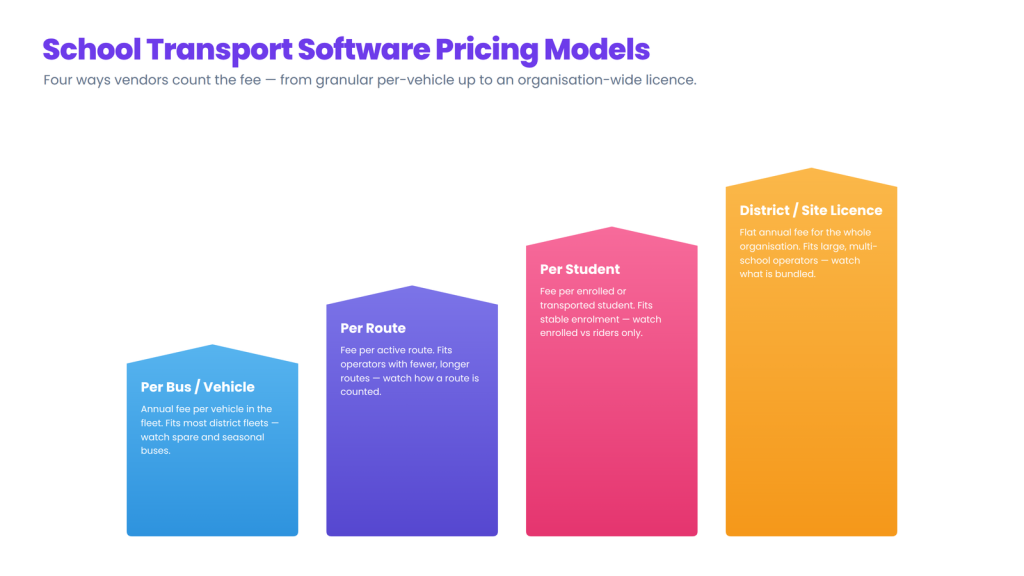
| Pricing model | How it works | Suits | Watch for |
| Per bus or per vehicle | Annual fee per vehicle in the fleet | Most district fleets | Cost of spare and seasonal vehicles |
| Per route | Fee per active route | Operators with fewer, longer routes | How a route is defined and counted |
| Per student | Fee per enrolled or transported student | Districts with stable enrolment | Whether all enrolled or only riders count |
| District or site licence | Flat annual fee for the organisation | Larger districts, multi-school operators | What is bundled and what is extra |
Two structural points specific to this sector. First, contracts are usually annual and aligned to the school year, not monthly — which means less flexibility to exit mid-year but a budget cycle that matches how schools plan. Second, module-based pricing is common: routing, parent apps and ridership tracking are frequently priced separately from the core platform, so two quotes with the same headline figure can cover very different scope.
What actually drives the school transport software cost
Six things move school transport software cost more than anything else: routing depth, parent-facing apps, ridership tracking hardware, special education requirements, SIS integration, and implementation.
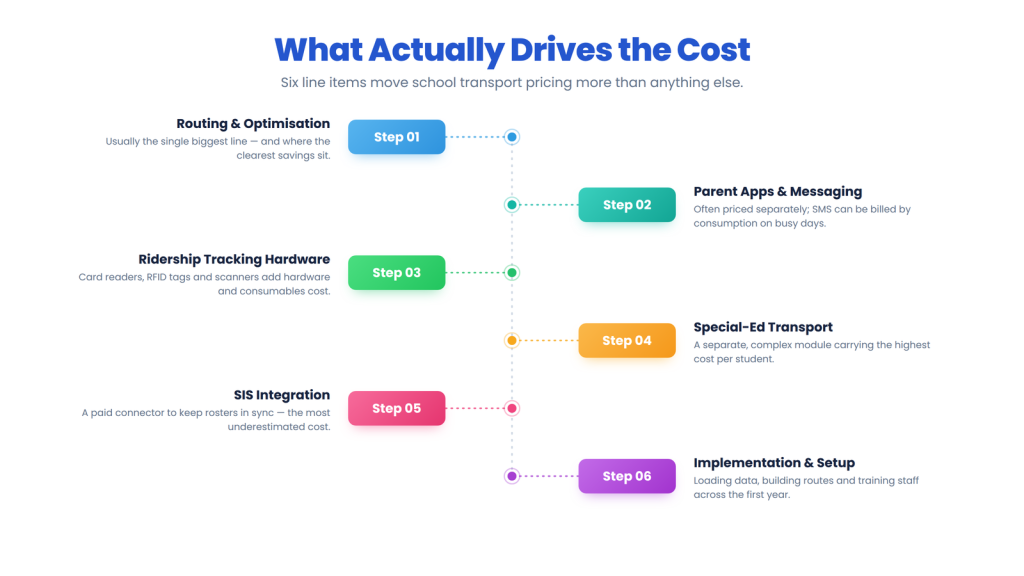
Routing and optimisation. This is usually the most valuable and most expensive module. Basic route management is one thing; genuine optimisation that considers student addresses, capacity, bell times, ride-time limits, hazards and turnaround is another. School bus route optimisation software cost is typically the single biggest line, and it is also where the clearest savings sit — fewer buses covering the same students is a direct budget reduction.
Parent apps and communication. Parent-facing tracking is now widely expected and often priced separately, sometimes per student or per family. Messaging costs (SMS in particular) can be billed on consumption, which matters when a snow day generates thousands of notifications at once.
Student ridership tracking. Recording which students boarded which bus usually requires hardware — card readers, RFID tags or scanners — plus the tags themselves and their replacement. This is a hardware and consumables cost as much as a software one, and it is frequently the item that turns a modest quote into a large one.
Special education transport. SPED routing is more complex and often a separate module: individual student requirements, specialised vehicles, wheelchair positions, aides, and door-to-door rather than stop-based service. It also carries the highest cost per student in most districts, so software that plans it well has an outsized budget impact.
Student information system integration. Student rosters, addresses and enrolment changes live in the SIS, and keeping transport in sync manually is unsustainable. Integration is often a paid connector or a custom development item — and it is the cost most commonly underestimated at quote stage.
Implementation and data setup. The first year involves loading student and address data, building or importing routes, configuring bell times and eligibility rules, and training staff. Ask whether implementation is a fixed fee, a day rate, or bundled.
The school transport software costs that get missed
Beyond the subscription, budget for the lines below — they routinely account for a large share of first-year spend.
| Cost line | What to confirm |
| Implementation | Fixed fee, day rate, or bundled; who does the data load |
| Route building | Whether year-one routes are built for you or by you |
| SIS integration | Connector included, paid, or custom development |
| Ridership hardware | Readers, tags, mounting, spares and replacement rate |
| Parent app | Per student, per family, or included |
| Messaging | SMS and push costs, especially on disruption days |
| Training | Dispatchers, drivers, school office staff, and refresh training |
| Annual re-routing | Whether rebuilding routes each year is supported or chargeable |
| Support | Cover during morning and afternoon runs specifically |
| Data migration and exit | Historic ridership records, and export terms |
The one most specific to this sector is annual re-routing. Enrolment changes every year, so routes are rebuilt every year. Confirm whether that is a normal part of the licence, a professional-services engagement, or something your team does — the answer materially changes the ongoing cost.
Student data privacy is part of the purchase
School transport software handles children’s names, addresses, schools and daily movements, so data protection is a procurement requirement rather than a feature to compare later.
Confirm before shortlisting: where student data is stored and under which jurisdiction; who at the vendor can access it; what happens to it at contract end; whether the vendor will sign the data-protection agreement your authority requires; what parent-facing data is exposed and to whom; how location history is retained and for how long; and how access is controlled by role, so a driver sees their own manifest rather than the whole district’s student list.
Two practical points. Role-based access is a safeguarding control, not just an admin convenience — the number of people who can see where a specific child is picked up should be as small as the operation allows. And parent-facing tracking needs boundaries: parents seeing their own child’s bus is standard; parents seeing other children’s details is a breach. Ask exactly what a parent account can see.
Your jurisdiction will have specific rules governing student records and children’s data. Involve whoever owns data protection at your organisation early, because retrofitting compliance after selection is expensive and sometimes impossible.
Where AI fits in school transport software
AI in school transport is most credible in planning and analysis, and least appropriate in decisions affecting individual children without a human in the loop — so ask what it does, what it learns from, and who reviews its output.
Three applications are genuinely useful:
- AI school bus routing — generating route plans from student addresses, capacity, bell times and ride-time limits, and testing scenarios far faster than manual planning. This is where the clearest budget savings sit, because a plan that removes even one bus from the fleet is a substantial recurring reduction.
- AI transportation planning software — modelling the effect of changes before committing to them: a bell-time shift, a school boundary change, a depot relocation, or a different tiering structure.
- AI-powered ridership analytics — identifying consistently under-used routes, stops nobody uses, and services that regularly run late, so resources move to where students actually are.
Two questions to put to any vendor. What does it learn from — your own historical ridership and run-time data, or generic assumptions? And who reviews the output before it affects a child’s journey? An optimised route that lengthens one student’s ride beyond policy, or moves a stop to a road with no safe crossing, is a decision that needs a human transport professional to approve. Treat AI here as a planning accelerator with mandatory review, not an autonomous decision-maker.
Buying checklist for school transport software
Work through these before you take a demo, and the shortlist gets much shorter.
Define the scope. How many buses, routes, students and schools? Do you run in-house, contract out, or both? Do you need SPED routing, ridership tracking, parent apps — or only routing and tracking?
Confirm the pricing model. Per bus, route, student or district licence; what is bundled versus modular; and what happens as enrolment or fleet size changes.
Get the full first-year figure. Subscription plus implementation, route building, SIS integration, hardware, training and messaging. Then get years two and three.
Check the routing depth. Can it handle your bell times and tiered runs, capacity limits, maximum ride times, hazard avoidance, and SPED requirements?
Check integration. Which SIS do you use, and is there a supported connector? What about payroll, maintenance and finance systems?
Check the parent experience. What do parents see, what are they notified about, and what is deliberately hidden from them?
Check data protection. Storage location, access controls, retention, contract-end handling, and whether the vendor signs your data agreement.
Check support hours. Morning and afternoon runs are when problems occur — confirm support covers those windows in your time zone.
Check the exit. Route configurations, student data and historic ridership records; what exports, in what format, and at what cost.
Questions to ask in a demo
Build your own scenario rather than watching theirs. Ask the vendor to: import a sample student list with addresses; generate routes against your bell times; show a tiered run where one bus serves two schools; add a student mid-year and re-route; handle a student with a wheelchair requirement; show the driver’s manifest for a run; show what a parent sees; record a student boarding and alighting; show a route running late and the parent notification that follows; produce an on-time performance and ridership report; and demonstrate role-based access limiting what a driver can see.
Then the commercial questions: which modules are in this price, what implementation involves, whether year-one route building is included, whether annual re-routing is chargeable, what hardware is required for ridership, what the SIS connector costs, and what the three-year total is at your scale. (Our dispatch software buyer checklist covers the general framework, and our transport software pricing models guide breaks down SaaS, licensed and white-label structures.)
Common costing mistakes in school transport procurement
- Comparing subscriptions rather than scope. Two quotes at the same headline price often cover very different modules.
- Forgetting ridership hardware. Tags and readers are a real capital and consumables line.
- Underestimating SIS integration. It is frequently the largest surprise in year one.
- Ignoring annual re-routing. Routes are rebuilt every year; confirm who does it and at what cost.
- Overlooking messaging costs. Disruption days generate notification volumes that show up on the bill.
- Treating data protection as a later step. It is a procurement gate; retrofitting it is expensive.
- Buying SPED routing you do not need — or skipping it when you do. It is a significant module either way.
- Not budgeting support in run windows. Problems happen at 07:00, not at 14:00.
How AllRide Bus fits school transport operations
AllRide Bus is the shuttle, bus and scheduled group transport product in the AllRide Apps suite — an AI-powered, white-label platform built and maintained by Innofied Solutions and used by 300+ transport businesses globally, covering school and campus transport alongside employee shuttles and scheduled route services.
The confirmed platform capabilities relevant to school operations are multi-channel booking; automated dispatch and driver assignment with manual control; real-time GPS tracking and route optimisation; configurable service zones; branded apps for riders and drivers; payment gateway integration where relevant; and reporting dashboards — on a cloud platform with 50+ language and multi-currency support, 100+ API integrations, and post-launch maintenance handled by Innofied. For contracted operators running school routes alongside corporate shuttles or transfers, those services can sit on one platform rather than separate tools.
On the school-specific mechanics, ask rather than assume — and we would say the same about any vendor on your shortlist. Student ridership tracking and verification, bell-time and tiered-run planning, special education routing, parent-facing apps, and student information system integration vary substantially across this category and by configuration. Raise them directly, including what is achievable through the platform’s API integrations, and ask any vendor to demonstrate them on your own student and route data. Given this sector’s data-protection obligations, also confirm storage, access controls and contract-end handling in writing before shortlisting.
Discuss your school transport requirements with the AllRide team — book a free demo.
Frequently asked questions
How much does school transport software cost?
School transport software cost is typically priced per bus, per route, per student, or as an annual district-wide licence, usually on a contract aligned to the school year. The total depends heavily on which modules you need — routing, parent apps, ridership tracking and special education routing are often priced separately — plus implementation, student information system integration, hardware and training. Compare a three-year total against a defined scope rather than a headline rate.
What pricing models do school bus software vendors use?
Four are common: per bus or vehicle, per route, per student, and a flat district or site licence. Per-bus pricing suits most district fleets; per-route suits operators with fewer, longer routes; per-student suits districts with stable enrolment; and licences suit larger or multi-school organisations. Confirm what counts — for example whether spare vehicles or all enrolled students are billable.
What drives the cost of school bus routing software?
Routing depth is the main driver: basic route management costs far less than optimisation that accounts for student addresses, capacity, bell times, ride-time limits, hazards and special education requirements. Optimisation is also where the clearest savings are, since reducing the number of buses needed to carry the same students is a direct recurring budget reduction.
What costs are usually missed in school transport software budgets?
Implementation and data loading, year-one route building, student information system integration, ridership hardware and tags, parent app and messaging costs, training, annual re-routing as enrolment changes, support during morning and afternoon runs, and data export at contract end. SIS integration and ridership hardware are the two most commonly underestimated.
Does school transport software include a parent app?
Many platforms offer one, but it is frequently priced separately — sometimes per student or per family — and messaging costs may be billed on consumption. Confirm what parents can see, since parents viewing their own child’s bus is standard while exposure to other students’ details is a data-protection problem.
How is student data protected in school transport software?
That depends on the vendor and must be confirmed during procurement rather than after. Ask where data is stored and under which jurisdiction, who can access it, how long location history is retained, what happens at contract end, whether the vendor will sign your data-protection agreement, and how role-based access limits what drivers and parents can see. Your jurisdiction will have specific rules governing student records.
What is special education transport software and does it cost more?
Special education transport software handles individual student requirements, specialised vehicles, wheelchair positions, aides and door-to-door rather than stop-based routing. It is often a separate priced module, and it carries the highest cost per student in most districts — which also means planning it well has an outsized budget impact.
Does school transport software integrate with a student information system?
Good platforms do, because student rosters, addresses and enrolment changes originate in the SIS and maintaining transport records manually is unsustainable. Integration may be an included connector, a paid add-on, or custom development. Confirm your specific SIS is supported and what the connector costs before committing.
What does AI school bus routing actually do?
It generates and tests route plans against constraints such as student addresses, bus capacity, bell times and maximum ride times, far faster than manual planning, and can model the effect of changes before you commit to them. Ask what data it learns from, and ensure a human transport professional reviews any plan before it affects a child’s journey — an optimised route can still create an unsafe stop or an over-long ride.
Is there a free trial for school transportation software?
Some vendors offer a demo environment or limited trial. Use it on your own data rather than a sample district: import real addresses, generate routes against your bell times, add a mid-year student, and produce a ridership report. Confirm what a trial includes and whether student data can be used in it under your data-protection rules.
Conclusion
School transport software is not expensive or cheap in the abstract — it is expensive or cheap relative to a defined scope. A district needing routing optimization, parent apps, ridership hardware and SIS integration is buying a substantially different product from one that needs route management and GPS tracking, even from the same vendor.
So define the scope first, get the three-year total for that scope in writing, and settle data protection before you shortlist rather than after. Then make every vendor build your routes against your bell times using your student data — that demo tells you more than any price list. To discuss what your school transport operation would need, book a free AllRide Bus demo.