


 Fleet Management
 Route optimization
 Shuttle Transportation
 Delivery Management
 School Bus Transportation
 Ride Sharing Management
 Airport Transfer Booking
  Vehicle inspection
 Car Rental Management
 Trucking & Logistics
 Food & Beverage
 E-Commerce
 Passenger Transit
 Delivery
 School & Corporate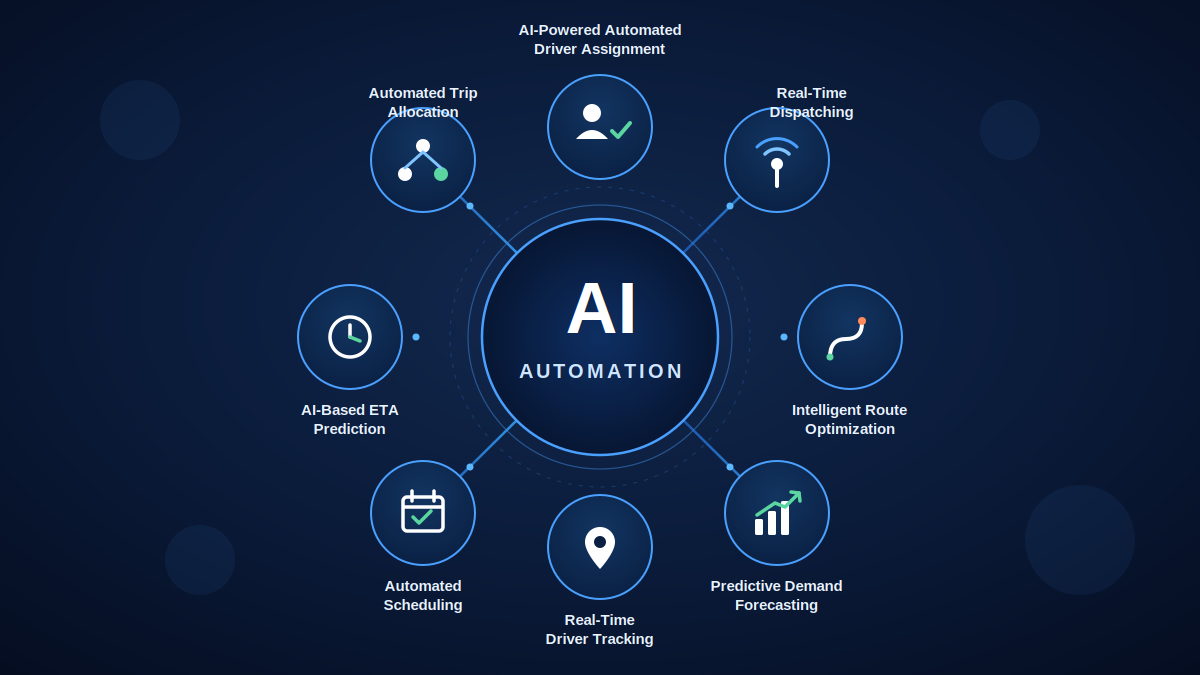
10 Best AI Dispatch Software Platforms for Automated Driver Assignment in 2026
Every dispatch platform now claims to be AI-powered, but the label covers everything from genuine machine learning to a rules engine with a rebrand — so this comparison is organised around what each AI dispatch software actually does. Ten platforms, grouped by the operation they suit, with the specific automated driver assignment capability each one offers and what to verify before you buy.
Here’s what this guide covers:
- The ten AI dispatch platforms and which operation each fits.
- What the AI genuinely does in each — assignment, routing, extraction or analytics.
- Pros, cons and the key differentiator for each platform.
- How to tell real AI dispatch from a rules engine with a marketing label.
Key takeaways
- “AI dispatch” spans genuine learning systems and fixed rule engines — ask which you are buying.
- The most valuable AI is usually specific: assignment scoring, load extraction, ETA prediction.
- Eligibility filtering must happen before AI scoring, or proximity beats suitability.
- Dispatcher override and decision explainability are operational requirements.
- Vertical fit matters more than AI sophistication — a delivery AI will not run chauffeur work.
- Test the failure paths: declines, timeouts, drivers going offline mid-assignment.
What is AI dispatch software?
AI dispatch software assigns trip or job requests to drivers and vehicles by scoring eligible candidates against multiple weighted factors — estimated time to pickup, current trajectory, existing commitments, fleet balance, driver performance and job requirements — rather than simply selecting the nearest available driver.
The distinction from ordinary automated dispatch software is worth being precise about. Automated dispatch applies fixed rules: assign the nearest available driver, or rotate through a list. AI dispatch weighs competing factors and, where genuinely implemented, adjusts those weightings based on operating history. Both are legitimate products. Only one of them learns.
For a stage-by-stage explanation of how the assignment logic works internally, see our companion guide to how an AI dispatch system works. This article focuses on which platforms to consider.
The four kinds of AI in dispatch platforms
Before comparing vendors, it helps to know which AI capability you are actually shopping for, because platforms differ sharply on this.
| AI capability | What it does | Matters most for |
| Assignment intelligence | Scores drivers against multiple weighted factors | High-volume on-demand operations |
| Route and ETA prediction | Uses live and historical data for realistic timing | Multi-stop delivery, airport work |
| Data extraction and automation | Creates jobs from documents, emails or messages | Freight and B2B order intake |
| Exception and analytics intelligence | Flags at-risk jobs, surfaces patterns | Larger fleets with dispatcher overload |
A platform can be excellent at one and absent on the others. Identify which of the four solves your actual bottleneck before you read the vendor list.
How we selected these platforms
These ten were reviewed using publicly available vendor information current in August 2026, selected to span the main operating models where automated driver assignment matters: passenger transport, last-mile delivery, enterprise logistics and freight.
We assessed each on assignment logic and configurability; routing and ETA capability; driver workflow; real-time visibility; exception handling; integrations; the specific AI capability offered; dispatcher control and override; and operating-model fit.
AllRide Apps develops transport and dispatch software and is included in this comparison. For that reason this is not presented as a ranked one-to-ten list — each platform is identified by the operation it suits, and every vendor’s AI claims should be verified directly, including ours.
The 10 best AI dispatch software platforms: TL;DR
| Platform | Best for | Primary AI capability | White-label |
| AllRide | Multi-service passenger transport and delivery | Automated assignment, route optimisation | Yes |
| Samsara | Telematics-led commercial fleets | Safety intelligence, routing | No |
| Motive | Regulated trucking and physical operations | Compliance-connected dispatch, safety AI | No |
| Onfleet | Last-mile delivery execution | Predictive ETA, dispatch automation | Partial |
| Locus | High-volume multi-hub logistics | Optimisation and capacity intelligence | Enterprise |
| Bringg | Retail with owned plus 3PL fleets | Orchestration across mixed fleets | Enterprise |
| Route4Me | Multi-stop route-first operations | Route optimisation at scale | Partial |
| Yelowsoft | Taxi and ride-hailing operators | Automated dispatch and driver management | Yes |
| Tookan | On-demand and hyperlocal delivery | Auto-allocation | Yes |
| TMS.ai / Rose Rocket | Carriers and brokers | AI agents, order creation from documents | No |
Pricing and review scores intentionally omitted from this table pending verification — see the pre-publication note in EXTRAS.
1. AllRide
Best for: Operators running more than one passenger or delivery service who want automated assignment inside a configurable, branded platform.
AllRide Apps is an AI-powered, white-label transport platform used by a wide range of transport businesses globally, spanning taxi and ride-hailing, airport transfer, chauffeur, shuttle, school transport, delivery and logistics.
How its dispatch works. Automated dispatch and driver assignment run on configured operating rules, with manual dispatcher control retained for exceptions — the pattern that matters most in practice, since VIP trips, specialised vehicles and service recovery need human judgement. Route optimisation and real-time GPS tracking supply the live inputs that make time-based assignment meaningful rather than distance-based.
Key features: multi-channel booking into one queue; automated dispatch and driver assignment; manual dispatcher override; real-time GPS tracking; route optimisation; configurable fares and service zones; payment gateway integration; branded customer and driver apps; reporting dashboards; multiple languages and multi-currency; 100+ API integrations.
Pros: covers multiple passenger and delivery verticals on one platform, so operators adding services do not migrate; genuinely white-label including branded apps; dispatcher override preserved rather than removed.
Cons: not a telematics or compliance platform, so regulated trucking operations needing ELD/HOS will need an integrated specialist; breadth means the exact configuration matters more than with a single-vertical tool.
Key differentiator: multi-service coverage under one brand. Most platforms on this list serve one vertical well. AllRide’s case is for the operator running taxi plus airport transfers, or shuttles plus delivery, who wants one operating environment rather than three.
Who it’s best for: multi-service passenger transport operators, growing taxi and transfer businesses wanting their own brand, and logistics operators who want dispatch connected to wider fleet operations.
What to verify: which assignment factors are weighted and which you can configure yourself; offer, timeout and fallback behaviour; whether assignment weightings adapt from your operating history or are configured once; and package inclusions for your service mix.
2. Samsara

Best for: Commercial fleets where dispatch sits inside a broader safety, compliance and telematics strategy.
How its dispatch works. Samsara connects route planning, dispatch, navigation and telematics, letting dispatchers track route progress, respond to changing conditions and reroute remotely. Its AI strength is concentrated in safety — dash-cam intelligence detecting risk events — rather than in assignment scoring.
Key features: routing and dispatch; commercial navigation; GPS and telematics; AI dash cams and safety intelligence; ELD and compliance; maintenance and asset tracking; driver mobile workflow; open APIs.
Pros: strongest safety AI in this comparison; integrated hardware and software; deep fleet data; established at scale.
Cons: hardware-dependent with associated cost and commitment; dispatch is not the product’s centre of gravity; less suited to booking-led passenger operations.
Key differentiator: AI applied to the physical world — cameras and sensors detecting driver and road risk — rather than to job allocation.
Who it’s best for: mid-to-large commercial fleets in trucking, construction and field services where safety and compliance outrank dispatch sophistication.
3. Motive

Best for: Regulated trucking and physical-operations fleets needing dispatch connected to hours-of-service data.
How its dispatch works. Motive Dispatch supports job creation and import, route building, driver and vehicle assignment, live tracking and driver-submitted documentation, connected to its wider fleet and compliance environment. The AI contribution sits largely in safety detection and fleet data rather than assignment scoring.
Key features: dispatch and job import; driver and vehicle assignment; route planning; GPS and telematics; ELD and HOS; digital forms, POD and signatures; customer tracking links; safety and compliance tooling.
Pros: compliance and dispatch in one environment; strong driver workflow; HOS visibility supports legally viable assignment.
Cons: hardware and platform scope exceeds what a booking-led operation needs; less relevant outside regulated fleet operations.
Key differentiator: dispatch decisions informed by compliance data — the nearest driver is not the right driver if they lack the hours.
Who it’s best for: North American trucking, logistics and service fleets where ELD and HOS are non-negotiable.
4. Onfleet

Best for: Last-mile delivery operations prioritising execution quality and customer visibility.
How its dispatch works. Onfleet combines route optimisation, automated and hybrid-fleet dispatching, live driver tracking, customer communication and proof of delivery. Its optimisation can account for hubs, time windows, driver schedules, vehicle capacities, service time and traffic history — and its predictive ETA is the AI capability customers actually notice.
Key features: route optimisation; automated dispatch; on-demand order insertion; driver app; live tracking; predictive ETA; customer notifications; photo, signature and barcode POD; delivery analytics; API integrations.
Pros: strong last-mile execution and customer-facing experience; hybrid fleet support; mature API.
Cons: delivery-first, so passenger transport operators will find gaps; route optimisation packaging varies by plan.
Key differentiator: predictive ETA quality — the metric last-mile customers judge you on.
Who it’s best for: retail, grocery, pharmacy, prepared food and courier operations mixing internal and external drivers.
5. Locus

Best for: High-volume, multi-hub logistics operations with complex allocation constraints.
How its dispatch works. Locus treats dispatch planning as an integrated layer across hub operations, capacity management, route optimisation and real-time re-dispatch — the AI applied to resource allocation at a scale where manual planning is impossible.
Key features: hub operations; capacity management; route planning and resource allocation; dynamic re-dispatch; driver app; proof of delivery; exception management; enterprise integrations.
Pros: genuine optimisation depth at high volume; handles multi-depot and mixed fleets; strong exception management.
Cons: enterprise-oriented implementation; disproportionate for smaller operations.
Key differentiator: decision intelligence across hubs rather than per-trip assignment.
Who it’s best for: organisations running hundreds or thousands of daily deliveries across multiple depots with contracted or mixed fleets.
6. Bringg

Best for: Retailers and enterprises orchestrating owned fleets, 3PLs and crowdsourced carriers together.
How its dispatch works. Bringg connects planning, route optimisation, dispatch, driver management and customer experience across mixed fleet types, distinguishing planned routes using optimisation from on-demand routes using automated dispatch.
Key features: resource planning; route optimisation; automated dispatch; owned and third-party fleet support; real-time monitoring; configurable exception workflows; driver apps; POD; customer tracking; carrier-network connectivity.
Pros: best-in-class mixed-fleet orchestration; strong retail and ecommerce fit; configurable exception handling.
Cons: built for enterprise complexity; more platform than most operators need.
Key differentiator: treating third-party and crowdsourced carriers as first-class dispatch resources rather than an afterthought.
Who it’s best for: large retail and ecommerce operations coordinating internal drivers, 3PLs and multiple fulfilment models.
7. Route4Me

Best for: Operations where multi-stop route planning is the central daily problem.
How its dispatch works. Route4Me plans and optimises high-volume multi-stop routes, dispatches them to driver apps, and allows active routes to be modified — adding, removing, reordering or splitting stops mid-execution.
Key features: high-volume route optimisation; business and fleet constraints; route dispatch; driver apps; live progress; planned-versus-actual views; active-route modification; notifications; analytics.
Pros: routing depth at volume; active-route modification is genuinely useful mid-day; modular so you buy what you need.
Cons: routing-first rather than assignment-first; modularity means confirming exactly what your configuration includes.
Key differentiator: the ability to restructure routes while they are being executed.
Who it’s best for: distribution, collection services, field sales and recurring multi-stop operations.
8. Yelowsoft

Best for: Taxi and ride-hailing operators wanting configurable automated dispatch with driver-management depth.
How its dispatch works. Yelowsoft combines multi-channel booking with automated driver assignment that can consider availability, location, vehicle type, zone rules and trip requirements while keeping dispatchers in the loop — the eligibility-then-scoring pattern done correctly.
Key features: multi-channel booking; automatic and manual dispatch; driver and vehicle management; live tracking; configurable pricing rules; wallet and payout workflows; reporting; passenger safety tools; white-label options.
Pros: strong taxi and ride-hailing fit; driver financial tooling included; configurable assignment rules.
Cons: ride-hailing orientation may not suit reservation-heavy chauffeur work; confirm which capabilities need higher plans.
Key differentiator: driver-side financial workflows — wallets and payouts — alongside dispatch.
Who it’s best for: taxi and ride-hailing operators who need dispatch plus driver settlement in one system.
9. Tookan

Best for: On-demand and hyperlocal delivery businesses needing auto-allocation at speed.
How its dispatch works. Tookan covers order management, auto-allocation to nearby available agents, dispatch planning, capacity management and route optimisation, with customer and driver interfaces around it.
Key features: order and task management; automatic allocation; dispatch planning; capacity management; route optimisation; driver and customer apps; live tracking; geofencing; analytics; payment integrations.
Pros: fast auto-allocation for hyperlocal work; broad marketplace of extensions; accessible entry point.
Cons: functionality spans multiple extensions, so total cost needs assembling carefully; on-demand orientation.
Key differentiator: speed of allocation for hyperlocal food, grocery and courier work.
Who it’s best for: food delivery, grocery, local pickup and drop-off, and courier operations.
10. TMS.ai

Best for: Carriers and brokers wanting configurable freight workflows with AI handling administrative intake.
How its dispatch works. Positioned as an AI-native transportation platform, it covers orders, dispatch, tracking, driver management, compliance and invoicing, with AI agents creating orders from incoming information and suggesting drivers.
Key features: order management; dispatch; driver assignment; track and trace; invoicing; route optimisation; compliance; workflow automation; APIs; AI agents.
Pros: the clearest example here of AI doing specific administrative work; highly configurable workflows.
Cons: configuration depth needs internal resource; freight-oriented rather than passenger.
Key differentiator: AI agents that remove manual order entry — the highest-volume repetitive task in freight dispatch.
Who it’s best for: carriers and brokers where order intake volume is the bottleneck.
Which AI dispatch software fits your operation?
| Your operation | Platforms worth shortlisting |
| Taxi or ride-hailing | AllRide, Yelowsoft |
| Multi-service passenger transport | AllRide |
| Airport transfer and chauffeur | AllRide |
| Last-mile delivery | Onfleet, Tookan |
| Hyperlocal on-demand | Tookan, Onfleet |
| Enterprise multi-hub logistics | Locus, Bringg |
| Retail with mixed owned and 3PL fleets | Bringg, Locus |
| Multi-stop distribution | Route4Me |
| Regulated trucking | Motive, Samsara |
| Safety and compliance-led fleets | Samsara, Motive |
| Freight brokerage and carriers | TMS.ai, Motive |
| Branded white-label operation | AllRide, Yelowsoft, Tookan |
A shortlist, not a ranking. The demo decides it.
How to tell real AI dispatch from a rules engine
Four questions separate genuine AI dispatch software from automated dispatch with a marketing label.
What does it learn from? Your own operating history, aggregated cross-customer data, or nothing at all? A system trained on your city’s actual traffic and your drivers’ actual behaviour is worth substantially more than a generic model — and “nothing” means you are buying configurable rules, which may be entirely adequate but should be priced as such.
Which factors can you configure? Every fleet dispatches differently. If weightings are fixed by the vendor, the system will eventually fight your operating policy rather than express it.
Can it explain a decision? When a driver asks why they did not get a trip, or a client asks why the nearest vehicle was not sent, someone needs an answer. Explainability is operational, not academic.
Can a dispatcher override it? Overrides should be easy, logged, and ideally fed back as signal. A system that resists correction is one your team will route around within a fortnight.
What to test in an AI dispatch demo
Never accept a clean assignment demonstration — the information is in the failure paths.
- Enter one of your genuinely awkward pickup or delivery locations.
- Compare the system’s estimated time against reality for that route and hour.
- Create a job requiring a vehicle type only one driver holds.
- Set a driver offline and confirm they leave the candidate pool.
- Ask why a specific assignment was made — and judge whether the answer is legible.
- Decline the first offer; let the second time out.
- Take a driver offline after they accept.
- Create a delay and check whether knock-on jobs are flagged.
- Override an automated assignment as a dispatcher.
- Change a scoring weight and observe the effect.
Then ask which tier includes automated assignment, which factors are configurable versus vendor-set, whether the model uses your data, and what dispatch does if the scoring service is unreachable.
Bottom line: which should you choose?
Go with AllRide if you run more than one passenger or delivery service — taxi plus airport transfers, shuttles plus delivery — and want automated assignment inside a branded platform you will not outgrow when you add the next service. It is the multi-service and white-label case rather than the deepest single-vertical tool.
Frequently asked questions
What is AI dispatch software?
AI dispatch software assigns jobs to drivers and vehicles by scoring eligible candidates against multiple weighted factors — estimated time to pickup, trajectory, existing commitments, fleet balance, driver performance and job requirements — rather than simply picking the nearest driver. Stronger implementations also adjust their weightings based on operating history and adapt assignments live as conditions change.
What is the difference between AI dispatch and automated dispatch software?
Automated dispatch applies fixed rules, most commonly “assign the nearest available driver.” AI dispatch weighs multiple competing factors and, where genuinely implemented, learns from outcomes. Both are legitimate, but only one improves over time — so ask what the system learns from and whether its behaviour changes.
Which is the best AI dispatch software?
There is no universal best. Passenger and multi-service operators should look at AllRide and Yelowsoft; last-mile delivery at Onfleet and Tookan; enterprise logistics at Locus and Bringg; routing-first operations at Route4Me; regulated trucking at Motive and Samsara; and freight brokerage at TMS.ai. Vertical fit matters more than AI sophistication.
Does AI dispatch replace dispatchers?
No, and good implementations do not try. Automation handles the repetitive majority of assignments so dispatchers focus on exceptions, VIP requirements and service recovery. Dispatchers should always be able to override an automated assignment, and the system should log those overrides.
How does automatic driver assignment work?
The system structures the job request, filters the fleet to eligible drivers and vehicles, scores those candidates against weighted factors, offers the job and handles declines and timeouts, then monitors and adjusts. Eligibility and scoring must be separate stages, or a nearby but unsuitable driver wins the assignment.
Is AI dispatch software worth it for a small fleet?
Often not immediately. With a handful of drivers a dispatcher already holds the full picture, and configuration effort can outweigh the benefit. The case strengthens as volume rises or assignment becomes genuinely complex — multiple vehicle classes, zones, and scheduled plus on-demand work running together.
How much does AI dispatch software cost?
Pricing varies widely by model — per driver, vehicle, trip, task or enterprise licence — and AI capabilities are frequently gated behind higher tiers. Beyond subscription, factor in setup, branded apps, hardware where telematics is involved, integrations, and usage-based messaging or mapping costs. Compare total cost at your real volume and at double it.
What should we test in an AI dispatch demo?
Test the failure paths: an awkward location, a job needing a scarce vehicle type, a driver going offline, a declined offer, a timed-out offer, a driver dropping after acceptance, a delay creating knock-on effects, and a dispatcher override. Also ask the system to explain a specific assignment — if it cannot, your dispatchers will not be able to either.
Conclusion
The AI in dispatch software is real, but it is unevenly distributed. Some platforms apply it to assignment scoring, others to safety detection, others to extracting orders from documents, and a few mainly to their marketing. None of those is wrong — but they solve different problems, and buying the wrong one is an expensive way to discover which problem you actually had.
So identify your bottleneck first: is it who gets assigned, how long routes take, how orders arrive, or which exceptions get missed? Then shortlist the platforms whose AI addresses that specific thing, and make each one prove it on your own failing scenarios rather than their clean demo. To test automated assignment against your own dispatch rules, book a free AllRide demo.