


 Fleet Management
 Route optimization
 Shuttle Transportation
 Delivery Management
 School Bus Transportation
 Ride Sharing Management
 Airport Transfer Booking
  Vehicle inspection
 Car Rental Management
 Trucking & Logistics
 Food & Beverage
 E-Commerce
 Passenger Transit
 Delivery
 School & Corporate
10 Best AI Fleet Management Software Platforms in 2026
AI fleet management splits into two product categories that buyers routinely confuse: telematics-led platforms that apply AI to vehicle and driver data, and operations-led platforms that apply AI to jobs, dispatch and customer delivery. Both are sold as “AI fleet management software.” They solve different problems, and buying the wrong one is the most expensive mistake in this category.
This guide maps ten platforms across both groups, explains which AI each actually runs, and gives you a weighted framework for choosing.
Key takeaways
Short on time? Here is the guide in seven points.
- AI fleet management is now two categories. Telematics-led platforms (Samsara, Geotab, Motive) apply AI to sensors, cameras and vehicle health. Operations-led platforms (AllRide, Locus) apply AI to jobs, assignment and customer experience. Most fleets need one as their core and the other as an integration.
- “AI-powered” spans genuine machine learning and rebranded rules engines. The four questions in the evaluation section separate them in about ten minutes.
- AI predictive maintenance requires hardware. If failure prediction is your goal, you are buying sensors and connectivity as much as software — budget accordingly.
- Passenger and delivery fleets are usually mis-served by telematics-first platforms, because their real cost leak is idle drivers and missed jobs, not engine faults.
- Fleet management software price is a three-part number: hardware, subscription and implementation. The per-vehicle sticker figure is the least useful of the three.
- The top 10 comparison below maps each platform by AI type, ideal fleet profile and where it is genuinely strong — not by an invented score.
- The shortlist criteria that matter: data quality, AI depth and explainability, hardware certification where relevant, integration openness, implementation support, and three-year total cost.
How does fleet management tie in with AI?
Fleet management software has moved through three recognisable generations, and knowing which one a vendor belongs to tells you what you are actually buying.
Generation 1 — Track and trace. A dot on a map. You know where a vehicle is and little else. Plenty of budget GPS vendors still live here.
Generation 2 — Telematics and reporting. Location plus vehicle health, fuel data, driver scoring and scheduled reports. Much of the market sits here today.
Generation 3 — AI-native fleet intelligence. Platforms that ingest continuous operational data and use it to predict rather than just report: forecasting maintenance failures, predicting arrival times, optimising routes and assignments, and automating workflows a human used to run manually.
The important nuance is what the AI is applied to. A telematics platform’s AI reads engine diagnostics, camera footage and driving patterns. An operations platform’s AI reads jobs, bookings, driver availability and customer promises. Both are Generation 3. They are not substitutes.
| AI capability | What it predicts or automates | Requires |
| Predictive maintenance | Component failure before it strands a vehicle | OBD/CAN sensors, telematics hardware |
| Driver behaviour AI | Risk events, fatigue, distraction | Dashcams, accelerometer data |
| Fuel and emissions analytics | Theft, anomalies, consumption outliers | Calibrated fuel sensors |
| AI dispatch and assignment | The best driver for each job | Live job, driver and location data |
| AI route optimisation | Realistic sequences and arrival times | Historical trip and traffic data |
| Demand and exception intelligence | Where demand will be, which jobs will fail | Operational history at volume |
Rows one to three are telematics-led. Rows four to six are operations-led. Identify which rows describe your actual cost leak before you read the vendor list — it is the single most useful thing you can do in this process.
How we compared the platforms
These ten were reviewed using publicly available vendor information current in August 2026, selected to represent both categories and a range of fleet profiles from small operators to enterprise.
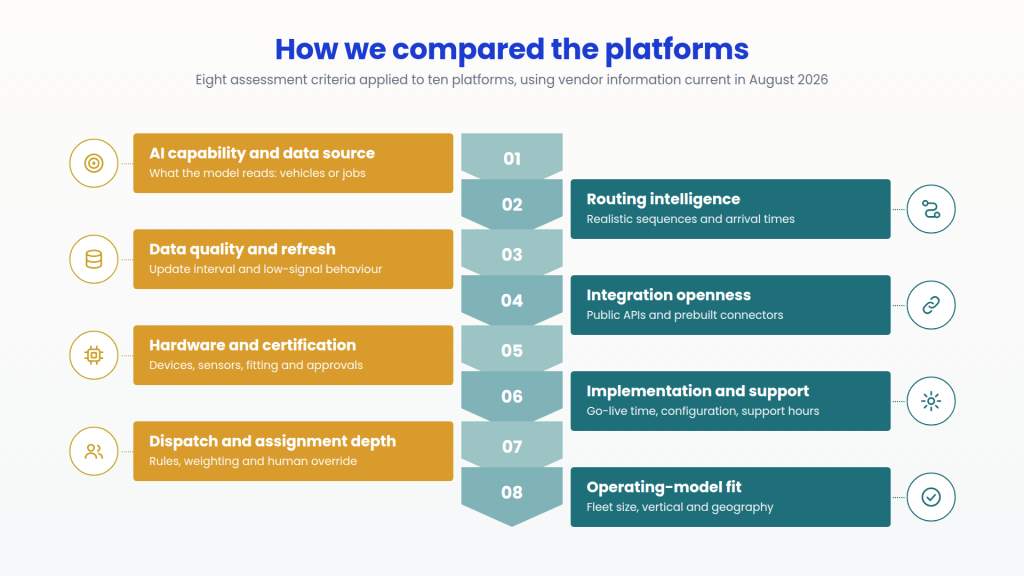
We assessed each on the specific AI capability offered and what data it runs on; data quality and refresh; hardware requirements and certification; dispatch and assignment depth; routing intelligence; integration openness; implementation and support model; and operating-model fit.
AllRide Apps develops transport and fleet software and is included in this comparison. For that reason this is not an invented ranking — each platform is identified by the category it belongs to and the operation it genuinely suits, and every vendor’s AI claims should be verified directly, including ours.
The top 10 AI fleet management software platforms: at a glance
| # | Platform | Category | AI applied to | Ideal fleet profile |
| 1 | AllRide | Operations-led | Dispatch, assignment, routing, customer experience | Multi-service passenger and delivery fleets wanting one branded platform |
| 2 | Samsara | Telematics-led | Video safety, vehicle health, routing | Large mixed commercial fleets with safety mandates |
| 3 | Geotab | Telematics-led | Vehicle data, benchmarking, extensibility | Data-driven enterprise and government fleets |
| 4 | Motive | Telematics-led | Compliance, driver safety, dispatch | Regulated North American trucking |
| 5 | Verizon Connect | Telematics-led | Tracking, field productivity | Service fleets and distributed field teams |
| 6 | Fleetio | Maintenance-led | Maintenance scheduling and asset health | Fleets where maintenance is the core problem |
| 7 | Locus | Operations-led | Allocation, capacity, re-dispatch | High-volume multi-hub logistics |
| 8 | Webfleet | Telematics-led | European telematics and OEM data | European commercial fleets |
| 9 | Azuga | Telematics-led | Driver scoring and rewards | SMB fleets focused on driver behaviour |
| 10 | Trimble | Enterprise TMS + telematics | Network-scale planning | Very large asset-heavy carriers |
1. AllRide — best for multi-service passenger and delivery fleets
Category: Operations-led AI fleet management.
AllRide Apps is an AI-powered, white-label transport platform spanning taxi and ride-hailing, airport transfer, chauffeur, shuttle, school transport, delivery and logistics — with AllRide Cab covering passenger work, AllRide Bus covering shuttle and scheduled transport, and AllRide Delivery and Logistics covering goods movement.
Where its AI is applied. AllRide’s intelligence sits on the operational layer rather than the vehicle-hardware layer: automated dispatch and driver assignment, route optimisation, and real-time GPS tracking feeding both. For a fleet whose cost leak is idle drivers, missed jobs and manual coordination — rather than engine faults — that is the layer where money is actually recovered.
How it works in practice. Bookings arrive from app, web or phone into a single queue. Automated assignment matches jobs to drivers and vehicles on configured operating rules, with dispatcher override preserved for exceptions and VIP work. Route optimisation and live tracking supply the timing inputs, and reporting closes the loop on what actually happened. Because the platform is white-label, the customer-facing experience carries the operator’s brand rather than a vendor’s.
Key capabilities: multi-channel booking; automated dispatch and driver assignment; manual dispatcher control; route optimisation; real-time GPS tracking; configurable fares and service zones; payment gateway integration; branded customer and driver apps; reporting dashboards; multi-language and multi-currency support; third-party API integrations.
Pros
- Covers passenger and delivery verticals on one platform, so operators adding services do not migrate.
- Genuinely white-label, including branded customer and driver apps — rare among fleet platforms.
- Dispatcher override preserved rather than removed, which matters for premium and exception work.
- No hardware dependency, so deployment is faster and cheaper than telematics-led alternatives.
- Vendor-managed maintenance rather than an internal platform team.
Cons
- Not a telematics or compliance platform. Fleets needing predictive maintenance, ELD/HOS or dashcam AI should pair it with a specialist rather than expect it to replace one.
- Breadth means configuration matters more than with a single-vertical tool — the demo should use your own workflow.
Key differentiator: it is the operations-led AI platform on this list that is also fully brandable. Most operations platforms serve one vertical or run under the vendor’s identity. AllRide’s case is the operator running taxi plus airport transfers, or shuttles plus delivery, who wants automated assignment inside their own brand and does not want to migrate when they add the next service.
Who it’s best for: multi-service passenger transport operators, taxi and transfer businesses wanting their own brand, shuttle and school transport operators, and delivery fleets where dispatch quality — not vehicle diagnostics — is the constraint.
2. Samsara — best for safety-led commercial fleets

Category: Telematics-led.
Samsara combines GPS telematics, AI dash cams, routing and dispatch, maintenance and compliance in one hardware-and-software platform.
Where its AI is applied. Primarily to safety: video intelligence detecting distracted driving, tailgating and risk events, plus vehicle health and route execution.
Key capabilities: AI dash cams and video safety; real-time GPS and telematics; routing and dispatch; predictive maintenance signals; ELD and compliance; asset tracking; driver app; open APIs.
Pros: the strongest safety AI in this comparison; integrated hardware and software; proven at large scale. Cons: hardware cost and contract commitment; dispatch is not its centre of gravity; heavy for booking-led passenger operations.
Key differentiator: AI applied to the physical world through cameras and sensors, rather than to job allocation.
Who it’s best for: mid-to-large commercial fleets where safety, compliance and insurance economics dominate.
3. Geotab — best for data-driven and extensible fleets

Category: Telematics-led.
Geotab is an open telematics platform with deep vehicle data, benchmarking and a large marketplace of third-party add-ons.
Where its AI is applied. Vehicle data analysis, benchmarking against wider datasets, and predictive signals from engine diagnostics.
Key capabilities: OEM and OBD data depth; benchmarking; extensive marketplace; open APIs; compliance tooling; sustainability and EV reporting.
Pros: exceptional data depth and extensibility; strong EV and sustainability reporting; large partner ecosystem. Cons: value depends on selecting the right add-ons; less an out-of-the-box operations tool than a data platform.
Key differentiator: openness — you build the fleet stack you want on top of it.
Who it’s best for: enterprises and government fleets with the appetite to configure and integrate.
4. Motive — best for regulated trucking

Category: Telematics-led.
Motive connects dispatch with ELD, hours-of-service, GPS, safety AI and driver workflow.
Where its AI is applied. Driver safety detection and compliance-connected fleet data, with dispatch informed by hours available.
Key capabilities: ELD and HOS; AI dashcams; dispatch and job import; driver and vehicle assignment; digital forms and POD; maintenance signals.
Pros: compliance and dispatch in one place; strong driver workflow; HOS visibility makes assignments legally viable. Cons: scope exceeds what booking-led operations need; North America-centric compliance focus.
Key differentiator: assignment informed by hours-of-service — the nearest driver is irrelevant if they cannot legally drive.
Who it’s best for: North American trucking and regulated service fleets.
5. Verizon Connect — best for field service fleets

Category: Telematics-led.
Carrier-grade tracking with field service scheduling and productivity tooling.
Where its AI is applied. Tracking analytics, routing and field productivity insights.
Key capabilities: GPS tracking; scheduling and dispatch for field teams; driver safety; maintenance; reporting.
Pros: mature tracking; broad field-service tooling; established support footprint. Cons: less depth in AI-native prediction than the leaders; varies by region.
Key differentiator: breadth across vans and distributed field teams rather than heavy trucking.
Who it’s best for: service fleets, vans and mobile workforces.
6. Fleetio — best for maintenance-first fleets

Category: Maintenance-led.
Fleetio centres on maintenance operations, workshop workflows, inspections and asset records.
Where its AI is applied. Maintenance scheduling intelligence, issue detection and asset health rather than dispatch.
Key capabilities: preventive maintenance scheduling; work orders and parts; inspections and DVIR; fuel logs; asset records; integrations with telematics providers.
Pros: best-in-class maintenance depth; integrates with most telematics platforms rather than competing with them. Cons: not a dispatch or routing platform; needs a telematics partner for live vehicle data.
Key differentiator: it treats maintenance as the core problem rather than a module.
Who it’s best for: asset-heavy fleets where downtime and repair cost are the dominant leak.
7. Locus — best for high-volume logistics allocation

Category: Operations-led.
Locus applies optimisation and decision intelligence across hub operations, capacity and re-dispatch at scale.
Where its AI is applied. Resource allocation and route optimisation at volumes where manual planning is impossible.
Key capabilities: hub operations; capacity management; route planning; dynamic re-dispatch; driver app; POD; exception management; enterprise integrations.
Pros: genuine optimisation depth; handles multi-depot and mixed fleets; strong exception management. Cons: enterprise implementation; disproportionate below a certain volume.
Key differentiator: decision intelligence across hubs rather than per-vehicle telematics.
Who it’s best for: organisations running high daily volumes across multiple depots.
8. Webfleet — best for European commercial fleets

Category: Telematics-led.
Mature European telematics with strong OEM relationships, now part of Bridgestone.
Where its AI is applied. Vehicle data, driver performance and fuel analytics tuned to European operating and regulatory conditions.
Key capabilities: GPS and telematics; driver performance; fuel and emissions reporting; tachograph and EU compliance tooling; OEM integrations.
Pros: European regulatory fit; established OEM data access; strong reporting. Cons: less relevant outside Europe; telematics-first rather than operations-first.
Key differentiator: European compliance and OEM depth.
Who it’s best for: European commercial fleets and mobility operators.
9. Azuga — best for driver-behaviour-led SMB fleets

Category: Telematics-led.
Azuga focuses on driver scoring, safety and rewards, often with insurance economics in mind.
Where its AI is applied. Driver behaviour scoring and risk detection.
Key capabilities: driver scorecards and rewards; dashcams; GPS tracking; maintenance reminders; reporting.
Pros: accessible entry point; driver engagement through rewards rather than only penalties; insurance-relevant data. Cons: less depth for complex routing or dispatch; SMB-oriented.
Key differentiator: gamified driver behaviour improvement.
Who it’s best for: small and mid-sized fleets where driving style and insurance cost are the priority.
10. Trimble — best for enterprise carrier networks

Category: Enterprise TMS plus telematics.
Trimble combines enterprise transportation management with telematics depth for asset-heavy carriers.
Where its AI is applied. Network-scale planning, capacity and freight execution.
Key capabilities: enterprise TMS; telematics; planning and optimisation; compliance; extensive integrations.
Pros: depth at very large scale; connects freight execution with fleet data. Cons: implementation weight; well beyond mid-market needs.
Key differentiator: enterprise freight network scale.
Who it’s best for: very large carriers and shippers with complex networks.
Which AI fleet management platform fits your fleet?
| Your fleet | Shortlist |
| Taxi, ride-hailing or chauffeur | AllRide |
| Airport transfer and shuttle | AllRide |
| School and campus transport | AllRide |
| Multi-service passenger plus delivery | AllRide |
| Last-mile delivery at scale | AllRide, Locus |
| Enterprise multi-hub logistics | Locus, Trimble |
| Regulated North American trucking | Motive, Samsara |
| Safety and insurance-driven fleets | Samsara, Azuga |
| Maintenance-dominated asset fleets | Fleetio |
| Data-led enterprise or government | Geotab |
| European commercial fleets | Webfleet, Geotab |
| Field service and van fleets | Verizon Connect |
A shortlist, not a ranking. The demo decides it.
How should you compare AI fleet management vendors?
Once you have two or three candidates, score them rather than relying on demo charisma. This weighting suits a typical mid-market fleet.
| Criterion | Weight | Questions that expose the truth |
| AI depth and explainability | 25% | What does the AI learn from — our data or generic models? Can it explain a decision? Can a human override it? |
| Fit to your cost leak | 20% | Does the AI address idle drivers and missed jobs, or engine faults? Which is actually costing us? |
| Data quality and refresh | 15% | What is the update interval? What happens in low-signal areas? Show last week’s raw data. |
| Integration openness | 15% | Documented public API? Prebuilt connectors? What does connecting our ERP or telematics actually take? |
| Implementation and support | 15% | Who configures it? Average go-live time? Named success contact? Support during our operating hours? |
| Three-year total cost | 10% | Hardware plus subscription plus installation plus training over three years, not the monthly sticker. |
The first two rows carry nearly half the weight deliberately. Most disappointing fleet software purchases are not bad products — they are good products aimed at the wrong cost leak.
How much does AI fleet management software cost?
Fleet management software price has three parts: hardware, subscription and implementation. Telematics-led platforms carry all three; operations-led platforms usually carry only the last two.
| Cost line | Telematics-led platforms | Operations-led platforms |
| Hardware | Per-vehicle trackers, sensors, dashcams | Usually none |
| Installation | Per-vehicle fitting and calibration | Not applicable |
| Subscription | Per vehicle per month | Per vehicle, driver, trip or job |
| Connectivity | SIM and data per device | Included in platform |
| Implementation | Configuration and training | Configuration, rate cards, branding |
| AI tier | Advanced AI often a higher tier | Often tier-gated too — confirm |
| Contract | Multi-year commitments common | More often annual or monthly |
Three cost traps worth naming:
The sticker-price trap. A low subscription with paid add-ons for every report, API call and alert usually costs more than an inclusive plan. Price the modules you will need in year two.
The hardware-lock trap. Subsidised hardware can mean proprietary devices no other platform reads. Ask explicitly about device portability and exit terms.
The wrong-category trap. The most expensive mistake here is not overpaying — it is buying a telematics platform to fix a dispatch problem, or vice versa. You then pay twice: once for the system that did not fit, and again for the one that does.
What ROI should you expect?
Vendors promise a great deal, so treat ranges carefully and insist on evidence from fleets resembling yours.
The pattern worth understanding regardless of the numbers: no single capability delivers the return. Fuel savings alone rarely justify an enterprise telematics deployment, and faster assignment alone rarely justifies an operations platform. The return comes from compounding — fewer wasted miles, plus higher utilisation, plus less manual coordination, plus fewer failed jobs. Which is also why the most convincing evidence is never a benchmark table; it is a deployment story from an operation like yours, with a before and an after.
What mistakes do first-time AI fleet buyers make?
- Buying the wrong category. Telematics AI will not fix a dispatch problem. Diagnose the cost leak first.
- Accepting “AI-powered” without interrogation. Ask what it learns from and whether it can explain a decision.
- Ignoring hardware reality. Predictive maintenance needs sensors. Software demos are polished; a failed device on a highway at 2am is not.
- Treating drivers as subjects rather than users. Systems introduced as surveillance get sabotaged; systems introduced as fairness, with recognition as well as scoring, get adopted.
- Switching on every alert at once. Fifty alert types on day one produces alert fatigue by day ten. Start with five tied to three metrics.
- Not baselining success metrics. If utilisation, idle time and cost per job were not measured before go-live, the 90-day review becomes an argument about feelings.
- Postponing integration indefinitely. Every month the platform stays disconnected from your ERP or accounting system is a month of manual reconciliation you paid to avoid.
The meta-mistake beneath all seven: treating this as an IT purchase rather than an operations change. Budget for adoption, not just licences.
How do you implement without disrupting operations?
- Pilot on your hardest routes, not your easiest. If it survives the worst corridor, the rollout is de-risked.
- Define three metrics before day one. Utilisation, idle or wait time, and cost per job or per km is a strong default trio.
- Bring drivers in early and frame it honestly. Pair scoring with recognition, not only penalties.
- Calibrate hardware properly where it applies — a badly calibrated fuel sensor produces false alerts, and false alerts kill trust in the entire system within a month.
- Automate one report per week through the first quarter. By week twelve the back office runs differently.
- Integrate once field data is clean. Plug dirty data into your ERP and you have automated your confusion.
- Review at 90 days against step two — expand, renegotiate, or exit while the sunk cost is small.
Where is AI fleet management heading?
From dashboards to decisions. The interface is becoming the alert and the automated action rather than the map. Control towers that watch continuously and escalate only genuine exceptions are the only model that scales past a few hundred vehicles.
Video as default. AI dashcams detecting fatigue and distraction are moving from premium add-on to expected, driven by insurance economics as much as safety culture.
Electrification changes the data. Range planning replaces fuel monitoring, charging schedules replace fuel stops, battery health replaces engine diagnostics. Platforms with native EV telemetry will age better than retrofitted ones.
Convergence of the two categories. Telematics platforms are adding dispatch; operations platforms are adding telematics integration. Within a few years the distinction this article draws will blur — but for a purchase made today, it remains the most useful lens available.
The bottom line: which should you choose?
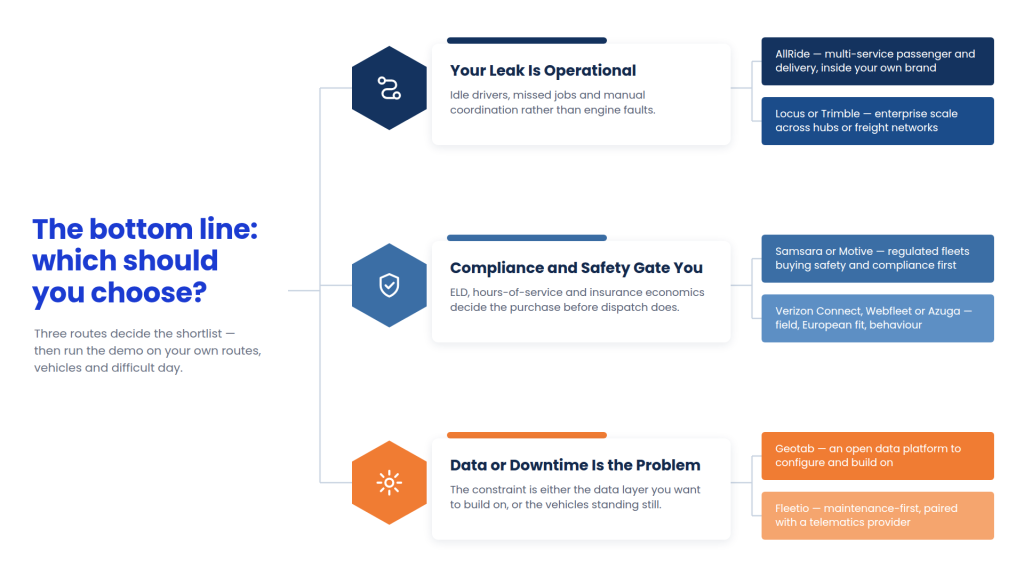
Go with AllRide if you run passenger transport, delivery, or several services at once, and your cost leak is idle drivers, missed jobs and manual coordination rather than engine faults. It is the operations-led AI platform on this list that is also fully white-label, so you get automated assignment inside your own brand and do not migrate when you add the next service.
Go with Samsara or Motive if you run regulated commercial fleets where safety, ELD and hours-of-service are the gate. You are buying compliance and safety intelligence first, dispatch second.
Go with Geotab if you want an open data platform to build on and have the appetite to configure it.
Go with Fleetio if maintenance and downtime — not trips — are the core problem. Pair it with a telematics provider.
Go with Locus or Trimble if you operate at enterprise scale across multiple hubs or a complex freight network.
Go with Verizon Connect, Webfleet or Azuga if your priority is field service tooling, European regulatory fit, or driver-behaviour improvement respectively.
And whichever you shortlist, run the demo on your own routes, your own vehicles and your own difficult day. Every vendor’s showcase account works perfectly.
Frequently asked questions
What is AI fleet management?
AI fleet management applies machine learning to fleet data to predict and automate rather than only report. In practice it splits into two categories: telematics-led AI, which reads sensors, cameras and vehicle health to predict maintenance failures and detect risky driving; and operations-led AI, which reads jobs, drivers and locations to automate assignment, optimise routes and predict arrival times. Most fleets need one as their core and the other as an integration.
How does fleet management tie in with AI?
Fleet platforms evolved from track-and-trace, to telematics and reporting, to AI-native systems that predict and automate. AI ties in wherever there is enough operational data to learn from: forecasting component failure from engine diagnostics, detecting risk from video, scoring drivers for assignment, optimising routes from historical traffic, and flagging jobs likely to fail before they do.
What is the best AI fleet management software?
There is no universal best, only the best fit for your cost leak. Passenger and delivery operators should look at operations-led platforms such as AllRide; safety and compliance-driven commercial fleets at Samsara and Motive; data-led enterprises at Geotab; maintenance-dominated fleets at Fleetio; and high-volume logistics at Locus or Trimble. Diagnose the problem before comparing products.
What is the difference between AI fleet management and AI dispatch software?
AI dispatch software focuses specifically on assigning jobs to drivers and vehicles. AI fleet management is broader, covering vehicle health, maintenance, fuel, safety and compliance alongside — or instead of — assignment. Many operations-led platforms include dispatch as their core AI capability, while telematics-led platforms treat dispatch as one module among many.
Does AI predictive maintenance actually work?
It works where the data supports it. Predictive maintenance depends on sensor data from OBD or CAN interfaces, fault-code capture and enough failure history for models to learn patterns. That means hardware, connectivity and time before predictions become reliable. Fleets without telematics hardware cannot get genuine predictive maintenance from software alone, whatever a platform’s marketing suggests.
How much does AI fleet management software cost?
Cost has three parts: hardware, subscription and implementation. Telematics-led platforms carry all three, with per-vehicle devices plus installation and a monthly subscription, often on multi-year contracts. Operations-led platforms usually have no hardware, pricing per vehicle, driver, trip or job. In both, advanced AI is frequently gated behind higher tiers, so confirm which capabilities your quoted plan includes.
Is AI fleet management worth it for small fleets?
Often yes, but for different reasons than enterprises. In a small fleet every vehicle is a meaningful share of revenue and the owner is usually also the dispatcher and the back office, so the time saved matters as much as the cost saved. Start with the capability that addresses your single biggest leak rather than an enterprise bundle, and choose a platform that lets you add modules as you grow.
How do I tell genuine AI from marketing?
Ask four questions. What data does it learn from — your operating history, aggregated data, or nothing? Which factors can you configure yourself? Can it explain why it made a specific decision? Can a human override it, and is that override logged? A system that cannot explain a decision or accept correction is a rules engine, which may be entirely adequate but should be priced as one.
Can AI fleet management software integrate with our existing systems?
Most enterprise-grade platforms offer APIs and prebuilt connectors for ERP, accounting, TMS, CRM and telematics providers. This matters especially if you are combining categories — for example running an operations-led platform for dispatch and a telematics provider for vehicle data. Confirm which integrations are native versus custom development, and what a custom connector costs.
What should we test in a demo?
Run your own hardest day, not their showcase. Create a real job, assign it, break the assignment by taking a driver offline, force a delay and check the knock-on effects, override an automated decision, and ask the system to explain a specific choice. Then check reporting, data export, and what happens when connectivity drops. Difficult scenarios reveal the product; clean ones reveal the marketing.
Conclusion
The most consequential decision in AI fleet management is not which vendor you pick. It is which category you buy from — because the two groups on this list are solving genuinely different problems under the same label.
So start by naming your cost leak honestly. If it is engine failures, fuel loss and unsafe driving, you are shopping for telematics-led AI and you should be talking to Samsara, Geotab or Motive. If it is idle drivers, missed jobs, manual coordination and customers who cannot see where their vehicle is, you are shopping for operations-led AI — and that is where AllRide belongs at the top of your shortlist.
Then make every shortlisted platform prove it on your own difficult day. To see automated assignment and route optimization running against your own fleet and workflow, book a free AllRide demo.