


 Fleet Management
 Route optimization
 Shuttle Transportation
 Delivery Management
 School Bus Transportation
 Ride Sharing Management
 Airport Transfer Booking
  Vehicle inspection
 Car Rental Management
 Trucking & Logistics
 Food & Beverage
 E-Commerce
 Passenger Transit
 Delivery
 School & Corporate
Best Limousine Dispatch Software for Limo & Chauffeur Fleets in 2026
Limousine dispatch software manages pre-booked chauffeur work end to end — reservations, quotes, chauffeur and vehicle assignment, trip tracking, and billing — and it differs from taxi dispatch because limo operations are reservation-first, not street-hail. The best system for a limo or chauffeur fleet handles advance bookings and corporate accounts as well as it handles live assignment, and protects the premium service experience your customers are paying for.
Key takeaways
- Limo dispatch is reservation-first; taxi dispatch is on-demand-first.
- Advance bookings, quotes and corporate accounts are core, not extras.
- Chauffeur management matters as much as vehicle dispatch.
- Airport transfers need flight-aware scheduling and clear waiting rules.
- Affiliate and farm-out work needs its own workflow, not a manual workaround.
- Compare total cost and test your real bookings before buying.
Why limo dispatch is a different problem from taxi dispatch
A taxi operation is built around immediacy: a passenger wants a car now, and the software’s job is to find the nearest available driver fast. A limo or chauffeur operation works almost the opposite way. Most work is booked in advance — an airport pickup next Tuesday, an hourly charter for a wedding, a standing corporate account for executive travel — and the value the customer is paying for is certainty, discretion and polish, not speed of allocation.
That difference shapes everything the software has to do. It needs to hold detailed reservations for weeks, quote accurately before the trip, assign the right chauffeur and the right vehicle class, brief the chauffeur on passenger preferences, adapt when a flight lands late, and bill a corporate account at month end. A dispatch tool built purely for on-demand taxi work will handle the assignment moment well and leave gaps everywhere else.
The commercial stakes are different too. A taxi passenger who waits an extra four minutes is mildly annoyed. A chauffeur client whose car is late for an airport departure, or whose wedding transport arrives at the wrong entrance, may never book again — and in corporate and event work, a single failure can cost an account worth thousands a year rather than one fare. Software that reduces those failure modes is not an administrative purchase; it protects revenue that is expensive to win and easy to lose.
This guide covers what limousine dispatch software should do for a limo or chauffeur fleet, how the booking, dispatch and reservation layers fit together, what chauffeur management involves, what it costs, and how to evaluate a platform against your own operation.
What is limousine dispatch software?
Limousine dispatch software is a platform that manages chauffeur-driven trips from reservation to completion — capturing bookings and quotes, assigning chauffeurs and vehicles, tracking trips live, handling payments and accounts, and reporting on the operation. It’s the operational system behind a limo, black car, or executive transport business.
The category is searched under several near-identical names — limo dispatch software, limo booking software, limo reservation software, limousine booking software, limo management software, and chauffeur dispatch software. In practice most modern platforms combine the booking and dispatch layers, but the emphasis differs: some are reservation-led and weaker on live dispatch, others the reverse. Which emphasis you need depends on how much of your work is pre-booked versus same-day.
A complete system usually spans four connected pieces: a booking layer (web form, passenger app, phone-entry screen, and corporate portal), an operations layer (the dispatcher console where reservations are reviewed, assigned and monitored), a chauffeur layer (the mobile app delivering assignments, briefs and status controls), and an administration layer (fares, accounts, invoicing, users and reporting). When all four share one trip record, an operator can answer any question about any booking from one screen. When they don’t, staff rebuild the picture manually — which is the problem most limo operators are actually trying to solve.
Which limo and chauffeur operations need it most?
The more your work is pre-booked, account-based or event-driven, the more reservation depth matters — and the less a generic dispatch tool will serve you. Different chauffeur businesses stress the software in different places.
- Corporate and executive transport. Standing accounts, cost centres, repeat passengers with preferences, monthly consolidated invoicing, and strict service-level expectations. Account structure and reporting matter more than raw dispatch speed.
- Airport and hotel transfers. Flight-aware scheduling, meet-and-greet instructions, waiting-time rules, and hotel or concierge booking channels. Timing precision is the whole product.
- Weddings and events. Multi-vehicle bookings on a single date, hourly hire, precise timing, multiple pickup points, and a low tolerance for error. Look for multi-vehicle reservations under one booking reference.
- Hourly charter and “as-directed” work. Open-ended trips billed by time, with overage rules, wait time and extras — a fare model many taxi-first systems handle poorly.
- Funeral and ceremonial transport. Fixed timings, multiple vehicles, and discretion; scheduling accuracy outweighs everything else.
- Affiliate and farm-out networks. Work sent to or received from partner operators in other cities, with rates, confirmations and settlement to manage.
- Mixed fleets. Limo plus airport transfers, corporate shuttles or event transport, where one platform across services avoids running separate tools.
Identifying which of these describes most of your revenue is the fastest way to shorten a shortlist, because it tells you which capability below is non-negotiable.
Limo booking vs dispatch vs reservation software
Booking and reservation software capture and manage the trip; dispatch software assigns it to a chauffeur and vehicle and tracks execution. Most limo fleets need both, with reservation depth taking priority.
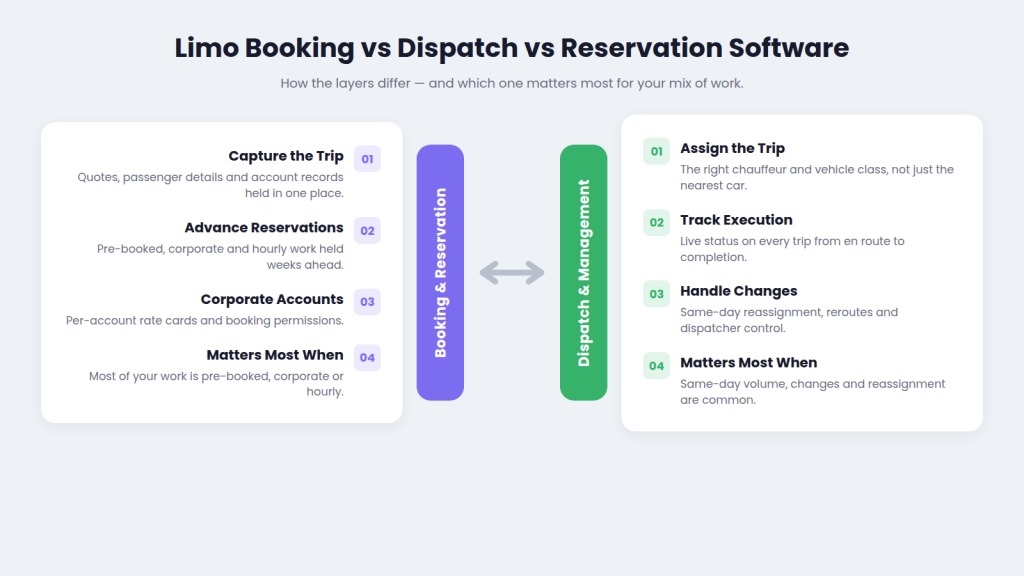
The practical test is simple: if a platform demos beautifully on an instant booking but struggles when you enter a reservation for three weeks out with a specific vehicle class, a named chauffeur and a corporate account, it isn’t built for limo work.
The reservation lifecycle: what the software should manage
A chauffeur booking has a longer life than a taxi trip, and the software should hold it reliably at every stage — from enquiry to invoice. Mapping this lifecycle against a demo is the clearest way to spot gaps.
1. Enquiry and quote. A customer or corporate contact requests a price. The system should generate an accurate quote from your rate rules — hourly, transfer, vehicle class, wait time, tolls, gratuity — and hold it as a pending reservation rather than an email thread.
2. Confirmation. The quote is accepted and becomes a firm booking, with confirmation to the passenger and the booker (often different people in corporate work), plus any deposit or card authorisation your policy requires.
3. Pre-assignment. Days or weeks ahead, the reservation is matched to a vehicle class and, in premium work, often to a named chauffeur. The system should flag conflicts against chauffeur shifts and vehicle availability before the day arrives, not on the morning.
4. Pre-trip preparation. Reminders to passenger and chauffeur, the full trip brief (passenger name, flight, preferences, special instructions, entrance details), and any change handling — rescheduled flights, added stops, vehicle upgrades.
5. Execution. Chauffeur en route, arrival, wait time, passenger onboard, trip in progress, completion — each with live visibility for the dispatcher and appropriate updates for the passenger.
6. Completion and billing. Final fare including wait, extras and gratuity; immediate payment or posting to a corporate account; receipt or invoice; and the record retained for disputes.
7. Post-trip. Chauffeur earnings, passenger feedback, complaint handling if needed, and the data feeding reporting on accounts, chauffeurs and vehicles.
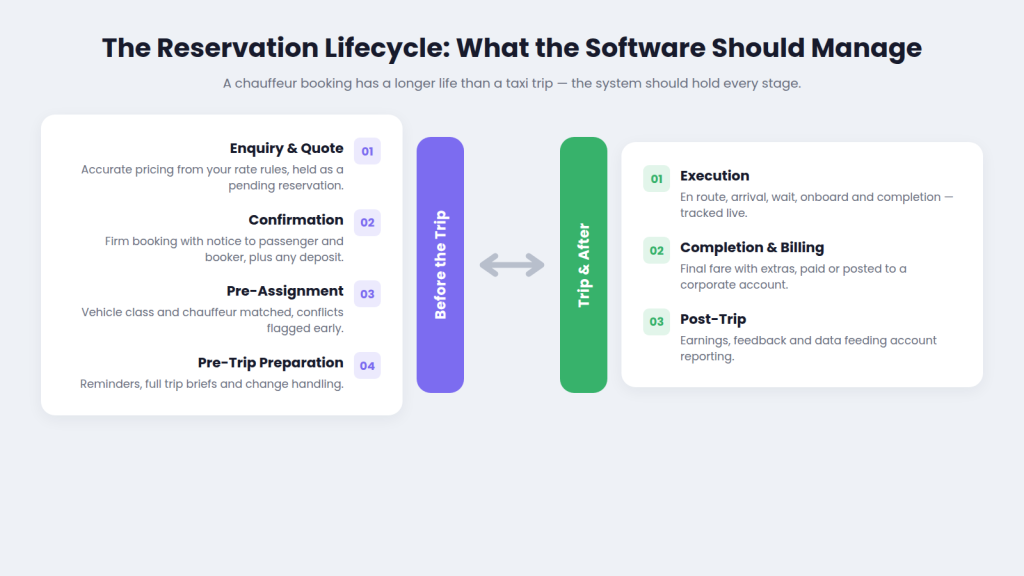
Any platform can demo step five. The steps that separate genuine limo software are one, three and six — quoting, conflict-aware pre-assignment, and account billing.
The features limo and chauffeur fleets actually need
Prioritise advance reservations, quoting, chauffeur and vehicle assignment by class, airport and flight handling, corporate accounts, live tracking, and branded customer experience.
Advance and recurring reservations. Hold bookings weeks or months out, with hourly hire, round trips, multi-stop itineraries, multi-vehicle bookings under one reference, and standing arrangements — the core of most chauffeur revenue. Check how far ahead bookings can be held, whether recurring trips can be created as a series, and how amendments to one instance affect the rest.
Quotes and fare rules. Produce accurate quotes before the trip, covering hourly rates with minimum-hour rules and overage, point-to-point transfer rates, vehicle-class differentials, wait time, tolls and parking, gratuity handling, airport fees, and seasonal or event pricing. Confirm whether quotes convert to bookings without re-keying, and whether different accounts can carry different rate cards.
Chauffeur and vehicle assignment by class. Assign not just the nearest car but the right vehicle class and the right chauffeur, respecting shifts, qualifications, licences and customer preferences — some corporate clients expect the same chauffeur every time. The system should surface conflicts and allow the dispatcher to override any automated suggestion.
Airport transfer handling. Flight-aware scheduling that adjusts pickups to actual arrival times, plus clear meet-and-greet instructions, terminal and door details, and waiting-time rules with free-wait allowances and chargeable overage. Airport work is where chauffeur reputations are made or lost, so test this specifically rather than assuming generic scheduling covers it.
Corporate accounts and billing. Account hierarchies, cost centres and department tagging, per-account rate cards, booking permissions (who in the client organisation can book), spending controls, consolidated monthly invoicing, and itemised trip statements. Corporate clients almost always want to see the trips behind a total before they pay.
Live tracking and dispatcher control. Real-time vehicle location, accurate ETAs, and the ability to reassign, reroute or intervene when something changes mid-day. Ask to see the dispatcher view on a busy day, not a five-vehicle mock-up.
Branded passenger experience. Confirmations, tracking links and communication carrying your brand, since a premium service shouldn’t hand its customer relationship to a generic app. Confirm what is brandable and who owns the app-store listings.
Reporting. Revenue by account, service type and vehicle class; chauffeur performance and on-time arrival; vehicle utilisation; quote-to-booking conversion; and cancellation patterns — the numbers that tell you where the business actually earns.
Affiliate and farm-out work
Limo operators regularly send work to partner operators in other cities and receive it back, and that workflow needs to live in the system rather than in email. Farm-outs are a normal part of chauffeur business and a common gap in generic dispatch tools.
If affiliate work is part of your model, check how the platform handles sending a booking to a partner with agreed rates and instructions; confirming acceptance and tracking status on a trip your own chauffeurs aren’t driving; presenting the trip to your customer under your brand regardless of who drives it; and reconciling what you owe partners and what they owe you. Where a platform has no native affiliate handling, ask how operators typically manage it — a documented workaround is acceptable, an unacknowledged gap is not.
Chauffeur management: the other half of the job
Chauffeur management software covers the people side — scheduling, briefing, documents, performance and earnings — and it matters as much as vehicle dispatch in a premium service business. Your chauffeur is the product.
Look for shift and availability scheduling that works with advance bookings rather than only live status, so next month’s roster can be checked against next month’s reservations. The chauffeur app should deliver complete trip briefs — passenger name, flight details, preferences, entrance and parking instructions, dress or service notes — rather than just an address, because a chauffeur who arrives informed is the difference the client is paying for.
Beyond the trip, look for licence and document tracking with expiry alerts so compliance doesn’t slip; performance visibility including ratings, on-time arrival and complaint history, so service standards are measurable rather than anecdotal; and clear earnings records. For fleets working with owner-operators or affiliates, add commission, settlement and payout records to the list, and confirm the chauffeur can see how a figure was calculated rather than receiving an unexplained total.
Integrations that matter for limo operators
A limo platform rarely stands alone — check how it connects to payments, accounting, flight data, communications and any corporate booking channels you rely on.
Payment gateways determine which methods you can accept and how reconciliation works. Accounting integration decides whether monthly invoicing flows into your books or is re-keyed. Flight-data feeds power airport scheduling. SMS and email providers handle passenger communication. And in corporate work, some clients book through travel-management systems or expect a portal — ask what’s supported natively versus what needs custom development, and what any custom integration costs. Also confirm API availability if you plan to connect anything the vendor hasn’t built.
How much does limo dispatch software cost?
Limo dispatch software pricing is usually a monthly subscription per vehicle, chauffeur or trip, or custom white-label pricing, with enterprise deployments typically quote-based — and the headline rate rarely reflects the operating total.
When comparing limo booking software pricing, get the full picture in writing. The table below covers the cost lines most often missed:
| Cost line | What to confirm |
| Subscription basis | Per vehicle, chauffeur, user or trip — and how it scales |
| Setup and onboarding | Configuration, rate-card build, training |
| Branded apps | Passenger and chauffeur app fees, and who owns the listings |
| Per-trip or usage fees | How they behave at your busiest month |
| Payment processing | Gateway fees on every transaction |
| SMS, email and map usage | Often billed on consumption |
| Support tier | Whether live-operations cover is included or extra |
| Integrations | Native versus custom, and development cost |
| Migration | Moving customer, booking and account history |
| Contract and exit | Term length, exit cost, data export |
A low monthly price with per-trip charges can cost more at volume than a higher flat plan, so model the total at your real booking volume and at double it. The right question is not “what’s the cheapest limo software?” but “what will this cost to run at our volume, and what manual work does it replace?”
How to evaluate limousine dispatch software
Test the platform on your own bookings, not a clean demo trip — and make it prove the reservation-first scenarios that matter to chauffeur work.
In any limo dispatch software demo or free trial, work through: a reservation booked three weeks ahead with a specific vehicle class; an hourly charter with minimum hours, wait time and extras; an airport pickup with a delayed flight; a corporate account booking billed to a cost centre; a multi-vehicle wedding booking under one reference; a chauffeur change after assignment; a multi-stop itinerary; a last-minute cancellation and its fee; a farm-out to an affiliate if you use them; and a month-end account invoice.
Then check what the chauffeur sees in the app, how the passenger and the corporate booker are kept informed, what happens when connectivity is poor, and what reporting you can pull without custom development.
Also settle the commercial questions before signing: total cost at your volume, what’s included versus chargeable, migration of your customer and booking history, support during live operations, who owns your branded app listings, and what happens to your data if you leave. Ask for references from operators of similar size and service mix — a wedding-heavy fleet and a corporate black-car fleet stress the same software very differently. (Our dispatch software buyer checklist covers the full evaluation framework, and if you’re comparing named platforms, see our limo software comparison.)
Which KPIs should a limo operator track?
Track the numbers that reflect premium service and account health, not just trip volume. A useful starting set:
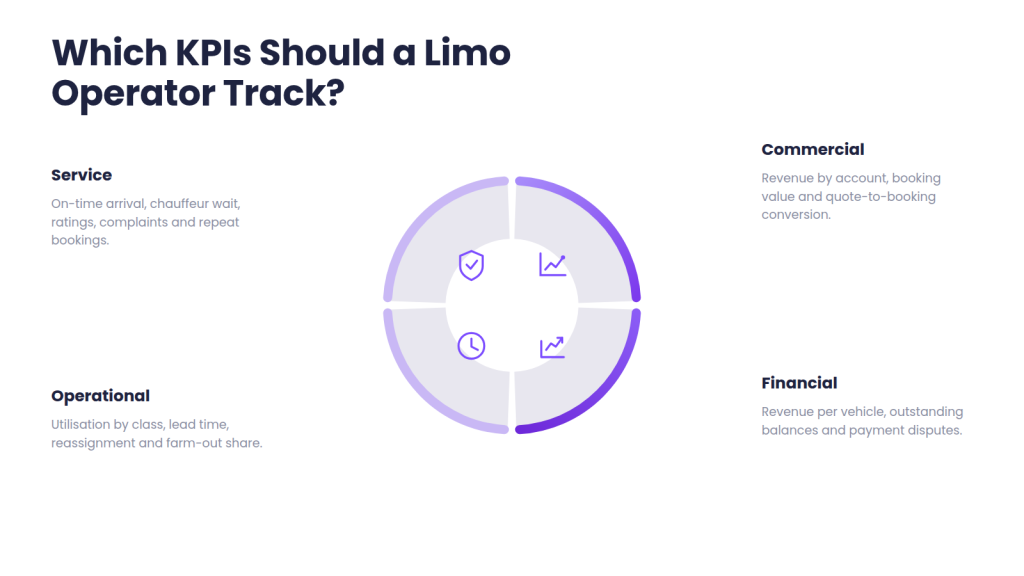
- Service: on-time arrival rate, average chauffeur wait at pickup, complaint rate, repeat-booking rate, passenger ratings.
- Commercial: revenue by account and service type, average booking value, quote-to-booking conversion, cancellation and no-show rates.
- Operational: vehicle utilisation by class, chauffeur utilisation, advance-booking lead time, reassignment rate, farm-out share of trips.
- Financial: revenue per vehicle, outstanding account balances, and payment failure or dispute rate.
On-time arrival and quote-to-booking conversion are the two most under-used numbers in chauffeur businesses: the first predicts retention, the second tells you whether your pricing and response speed are winning the work you quote.
Implementation and migration: what to plan for
Switching limo software is mostly a data and configuration project, and the risk sits in your rate cards and forward bookings. Plan for five things.
Rate-card configuration. Your hourly rates, transfer rates, vehicle-class differentials, account rate cards, wait and overage rules all need building and testing. Inconsistent or undocumented pricing has to be resolved first — software applies the rules it’s given.
Data migration. Customers, corporate accounts, chauffeurs, vehicles, and — critically — forward bookings already taken. Confirm how future reservations transfer, since a lost booking is a lost client.
Parallel running. Run both systems for a short period, or at minimum reconcile a full week, before cutting over.
Training. Dispatchers on the console and exception handling, chauffeurs on the app, and admin staff on accounts and invoicing. Chauffeur adoption is the usual failure point — brief them before go-live, not on the day.
Go-live timing. Avoid switching during your peak season or a major event week. Choose a quiet period where a problem is recoverable.
Common mistakes limo operators make when buying
- Buying a taxi-first tool. It demos well on instant bookings and disappoints on quotes, accounts and scheduled work.
- Judging on the demo trip. Vendors demo the easy path; the difficult scenarios above reveal the product.
- Ignoring app-store ownership. Discovering the vendor owns your branded apps at exit is an expensive surprise.
- Comparing monthly price only. Per-trip fees, app charges and payment costs change the ranking entirely.
- Skipping the chauffeur’s view. If chauffeurs need workarounds, the system quietly fails in the field.
- Under-planning migration. Forward bookings and rate cards cause more go-live pain than anything else.
- Not asking about affiliates. If farm-outs are part of your model, an unacknowledged gap becomes daily manual work.
How AllRide Cab fits limo and chauffeur operators
AllRide Cab is the taxi, chauffeur and ride-hailing product in the AllRide Apps suite — an AI-powered, white-label platform, covering limo and chauffeur work alongside airport transfers, taxi and car rental.
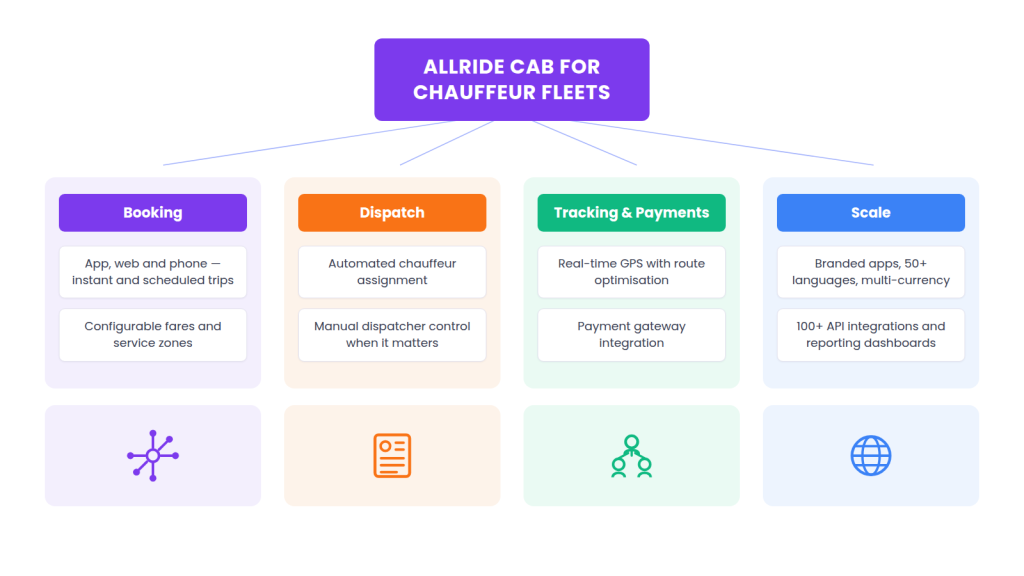
For a chauffeur operation, the relevant capabilities are booking across app, web and phone with instant and scheduled trips; automated dispatch and chauffeur assignment with manual dispatcher control; configurable fares and service zones; real-time GPS tracking with route optimisation; payment gateway integration; branded passenger and driver apps; and reporting dashboards — with multiple language and multi-currency support and multiple API integrations for operators working across markets.
Where it’s most relevant: operators whose chauffeur work sits alongside other services — a limo company also running airport transfers, corporate shuttles or event transport — since those run on one platform rather than separate tools. If your business is purely high-end chauffeur work with deeply specialised livery requirements, compare AllRide against dedicated limo platforms on the reservation-depth features above rather than assuming breadth wins. As with any vendor, confirm the specifics that matter most to your model — account billing structure, affiliate handling, and exact package inclusions — against your configuration rather than assuming.
See how AllRide Cab handles your chauffeur bookings — book a free demo.
Frequently asked questions
What is limousine dispatch software?
Limousine dispatch software is a platform that manages chauffeur-driven trips from reservation through to completion — capturing bookings and quotes, assigning chauffeurs and vehicles by class, tracking trips live, handling payments and corporate accounts, and reporting on the operation. It is built around pre-booked work rather than street-hail demand.
What’s the difference between limo booking software and limo dispatch software?
Limo booking or reservation software captures and manages the trip — quotes, passenger details, accounts, and scheduling. Limo dispatch software assigns that trip to a chauffeur and vehicle and tracks execution. Most modern platforms combine both, but they differ in emphasis, so confirm the reservation depth if the majority of your work is pre-booked.
How is limo dispatch software different from taxi software?
Taxi software is built for immediacy: find the nearest driver now. Limo dispatch software is reservation-first, built around advance bookings, quotes, vehicle class, chauffeur assignment, corporate accounts and airport transfers. A taxi-first tool usually handles the assignment moment well but leaves gaps in quoting, account billing and scheduled-trip management.
Does limo dispatch software handle airport transfers?
Good limo software does, and it’s worth testing specifically. Look for flight-aware scheduling that adjusts pickups to actual arrival times, clear meet-and-greet and waiting-time rules, and passenger communication for delays. Airport work is where chauffeur reputations are made, so don’t assume generic scheduling covers it.
What is chauffeur management software?
Chauffeur management software covers the people side of a limo operation: shift and availability scheduling, trip briefs delivered to the chauffeur app, licence and document tracking, performance and ratings, and earnings or settlement records. In a premium service business it matters as much as vehicle dispatch, because the chauffeur is the product.
Can limo software handle hourly and as-directed bookings?
It should, and this is worth testing directly. Hourly charter and as-directed work needs minimum-hour rules, overage billing, wait time, and open-ended itineraries — a fare model many taxi-first systems handle poorly. Confirm how the quote, the chauffeur’s view and the final invoice each treat an hourly booking that runs longer than planned.
Does limo dispatch software support corporate accounts?
Good platforms do. Look for account hierarchies with cost centres, per-account rate cards, controls over who can book, consolidated monthly invoicing, and itemised statements showing the trips behind each total. Corporate work is usually the most valuable and most retention-sensitive revenue in a chauffeur business, so account handling deserves close testing.
Can limo software manage affiliate or farm-out trips?
Some platforms handle affiliate work natively; many don’t. If you send trips to or receive them from partner operators, check how the system sends bookings with agreed rates, confirms acceptance, tracks a trip your own chauffeurs aren’t driving, presents it to your client under your brand, and reconciles what’s owed each way. Where there’s no native support, ask how other operators manage it.
How much does limo booking software cost?
Limo booking and dispatch software is typically priced per vehicle, chauffeur or trip on a monthly subscription, or via custom white-label pricing, with enterprise deployments often quote-based. Beyond the base rate, factor in setup, branded apps, per-trip fees, payment and map costs, support tier, integrations and migration. Compare the operating total at your real booking volume.
How long does it take to switch limo dispatch platforms?
It depends mainly on rate-card configuration and data migration rather than the software itself. Plan for building and testing your rates, migrating customers, accounts, chauffeurs, vehicles and forward bookings, a parallel-running or reconciliation period, and staff and chauffeur training. Avoid going live during peak season or a major event week.
Can I get a demo or free trial of limo dispatch software?
Many vendors offer a demo or free trial, and you should use it on your own bookings rather than a scripted tour. Test an advance reservation with a specific vehicle class, an hourly charter with extras, a delayed-flight airport pickup, a corporate account trip, a multi-vehicle event booking, and a month-end invoice — the scenarios that reveal whether a platform genuinely fits chauffeur work.
Conclusion
The best limousine dispatch software isn’t the one with the most features — it’s the one built for how chauffeur work actually runs: pre-booked, precise, account-driven and reputation-sensitive. Reservation depth, accurate quoting, chauffeur and vehicle-class assignment, flight-aware airport handling, corporate billing and affiliate handling are the capabilities that separate a genuine limo platform from a taxi tool with a limo label.
Start by identifying which type of chauffeur work drives most of your revenue, then test any shortlist on those exact bookings. Get total cost in writing, plan the rate-card and migration work honestly, and confirm what happens to your data and branded apps if you leave. To see how a white-label platform handles chauffeur reservations, dispatch, tracking and billing across your services, book a free AllRide Cab demo.