


 Fleet Management
 Route optimization
 Shuttle Transportation
 Delivery Management
 School Bus Transportation
 Ride Sharing Management
 Airport Transfer Booking
  Vehicle inspection
 Car Rental Management
 Trucking & Logistics
 Food & Beverage
 E-Commerce
 Passenger Transit
 Delivery
 School & Corporate
Airport Taxi Booking Software: Best Systems for Pre-Booked Transfer Operators
Airport taxi booking software manages pre-booked airport transfers end to end — capturing reservations with flight details, adjusting pickups when flights move, assigning drivers and vehicles, tracking trips live, and billing passengers or accounts. The best system for a transfer operator is built around flight-aware scheduling and advance bookings rather than street-hail demand, and handles the two things airport passengers actually judge you on: being there when the flight lands, and being easy to find.
Key takeaways
- Airport work is pre-booked and flight-dependent, not on-demand.
- Flight-aware scheduling is the single most valuable capability.
- Private transfers and shared shuttles need different booking logic.
- Waiting time, meet-and-greet and no-show rules must be explicit.
- Hotel, travel-agent and corporate channels feed most repeat volume.
- Test a delayed-flight scenario before you buy anything.
Why airport transfer is a distinct operation
Most transport software is built around one of two models: someone wants a car now, or someone wants a car at a fixed time next week. Airport work is neither. It’s booked in advance, but the actual pickup time is decided by something outside everyone’s control — the aircraft.
That single fact reshapes the whole operation. A booking made three weeks ago for 14:00 may need to become 15:40 because the inbound flight is delayed, and nobody should have to notice that manually. A driver dispatched on the original time either waits unpaid for an hour or leaves before the passenger clears customs. Multiply that across a day of arrivals and you have the core operational problem of every transfer business.
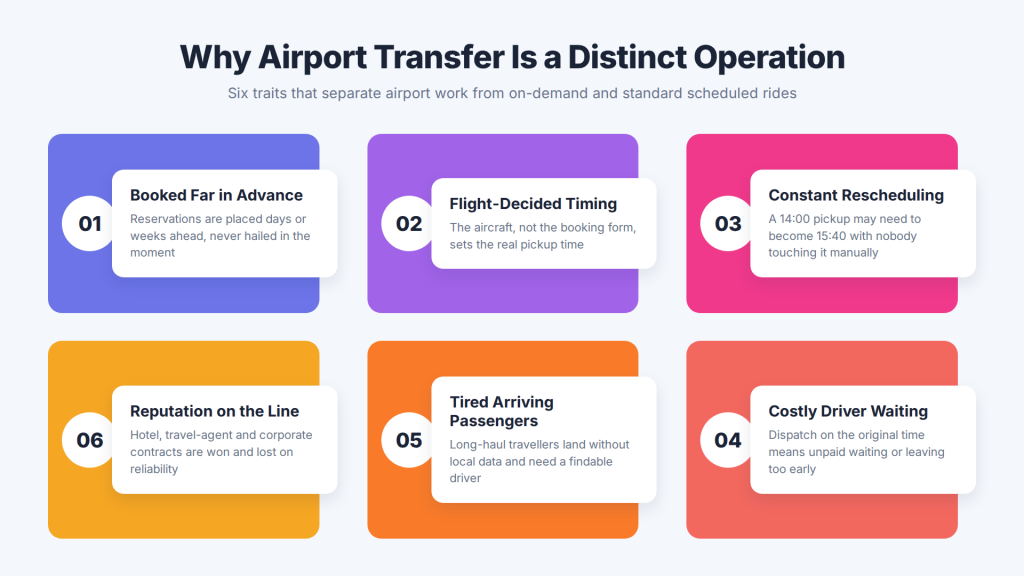
The customer experience is equally distinctive. A passenger stepping off a long-haul flight into an unfamiliar airport is tired, often without local data, and looking for one thing: a driver who is there and findable. Meeting that expectation reliably is what earns hotel contracts, travel-agent referrals and repeat corporate bookings — and failing it is what loses them, because a missed airport pickup is a story the client tells.
This guide covers what airport taxi booking software should do for a pre-booked transfer or shuttle operator, how private and shared models differ, the booking channels that drive volume, what it costs, and how to evaluate a platform on the scenarios that actually break airport operations.
What is airport taxi booking software?
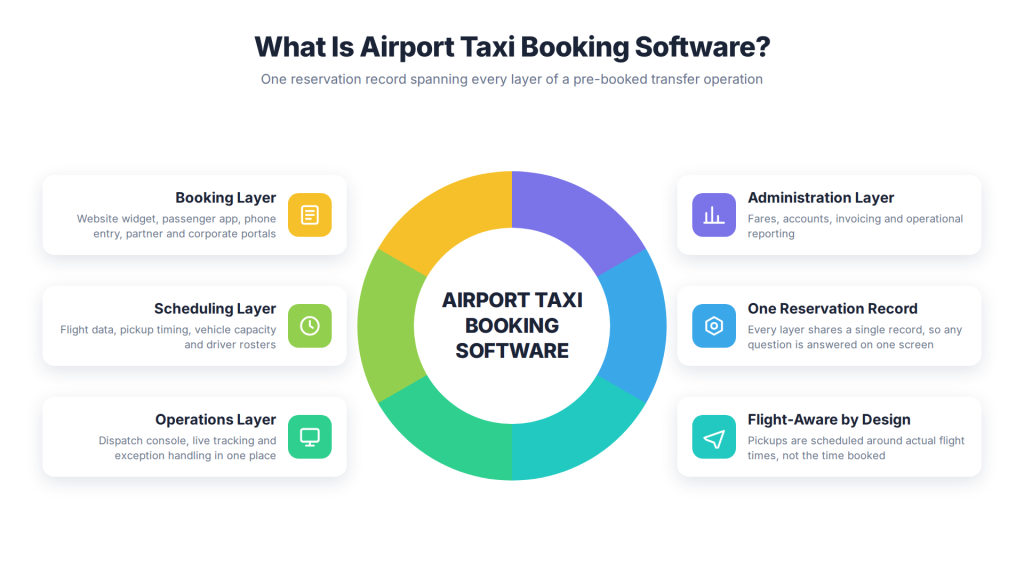
Airport taxi booking software is a platform that captures pre-booked airport transfer reservations with flight information, schedules pickups around actual flight times, assigns drivers and vehicles, tracks trips live, and handles payment or account billing. It sits between the passenger’s booking and the driver’s arrival, and its job is to make the connection reliable.
The category overlaps with several adjacent labels — airport transfer booking software, airport transfer software, airport taxi dispatch software, ground transportation software — and, for shared services, airport shuttle software, airport shuttle reservation software and airport shuttle management software. The terms differ mainly by service model rather than by underlying function.
A complete system typically spans four layers: a booking layer (website widget, passenger app, phone-entry screen, and partner or corporate portals), a scheduling layer (flight data, pickup timing, capacity and driver rosters), an operations layer (dispatch console, live tracking, exception handling), and an administration layer (fares, accounts, invoicing, reporting). When they share one reservation record, a dispatcher can answer any question about any transfer from a single screen — which matters most at 6am when twelve arrivals are landing inside an hour.
Private transfers vs shared shuttles: two different problems
Private transfers are a scheduling-and-assignment problem; shared shuttles are a capacity-and-routing problem — and software that handles one well may handle the other poorly. Most operators run some mix, so check both.
| Factor | Private airport transfer | Shared airport shuttle |
| Booking unit | The vehicle | The seat |
| Core constraint | Right vehicle, right time | Available capacity per departure |
| Pricing | Per trip, by vehicle class | Per passenger, often per route |
| Timing | Driven by one flight | Fixed schedule or grouped arrivals |
| Routing | Point to point | Multi-stop, sequence matters |
| Main risk | Late or missed pickup | Overbooking or long onboard time |
| Software need | Flight-aware assignment | Seat inventory and route planning |
If you run private transfers, prioritise flight tracking, vehicle-class assignment and waiting rules. If you run shared shuttles, prioritise seat inventory, per-departure capacity, route sequencing and manifest management — an airport shuttle booking system that can’t stop you selling the thirteenth seat on a twelve-seat vehicle will cost you more than it saves. Operators doing both need a platform that keeps the two models separate rather than forcing shuttle bookings through a private-transfer workflow.
The airport booking lifecycle
An airport transfer has a longer and more fragile life than a normal trip, and the software should hold it at every stage — especially the hours between the flight moving and the driver arriving.
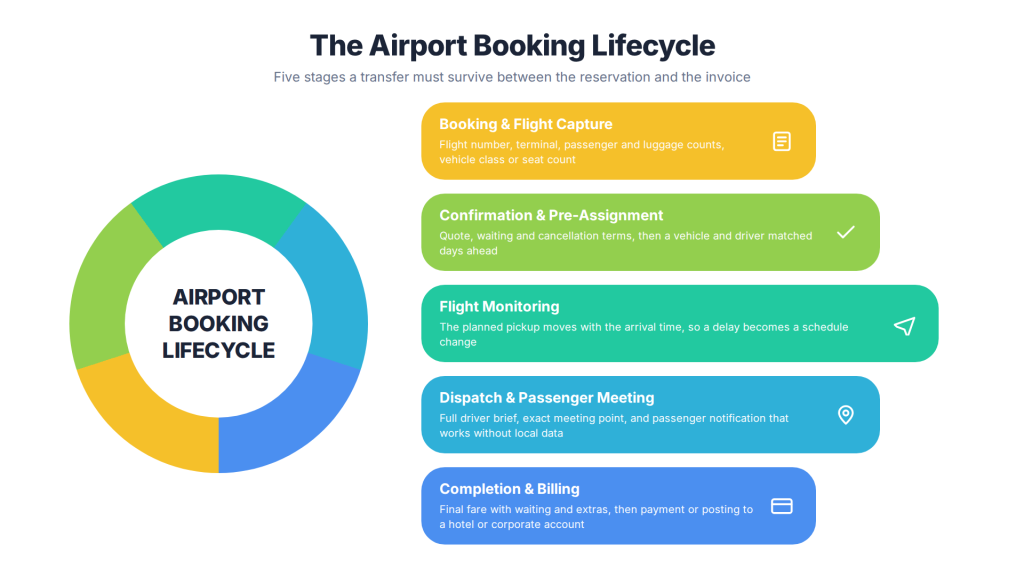
1. Booking and flight capture. The reservation is created with the flight number, arrival or departure time, terminal, passenger and luggage counts, vehicle class or seat count, and any meet-and-greet requirement. Capturing the flight number at booking is what makes everything downstream possible.
2. Confirmation and quote. The passenger or booker receives confirmation with the price, pickup arrangement, and clear waiting and cancellation terms. For arrivals, the confirmation should explain where the driver will be, not just when.
3. Pre-assignment. Days or hours ahead, the trip is matched to a vehicle and driver, checked against rosters and other bookings, with conflicts surfaced early rather than on the morning.
4. Flight monitoring. The system watches the flight and adjusts the planned pickup as the arrival time moves, notifying dispatch and driver so a delay becomes a schedule change rather than an incident.
5. Driver dispatch and arrival. The driver receives the full brief — terminal, exact meeting point, passenger name, sign requirements, parking instructions — and the system records arrival, starting the waiting clock.
6. Meeting the passenger. Whether kerbside or meet-and-greet, this is where transfers succeed or fail. Passenger notification with driver and vehicle details, plus a contact route that works for someone without local data, matters more here than anywhere else.
7. Trip and completion. Live tracking, ETA to destination, and completion with final fare including any waiting or extras.
8. Billing and follow-up. Immediate payment or posting to a hotel, travel-agent or corporate account; receipt or consolidated invoice; and the record retained for disputes and reporting.
Any platform demos step seven well. Steps one, four and six are where airport software proves itself.
Core features for airport transfer operators
Prioritise flight-aware scheduling, clear waiting and no-show rules, meet-and-greet handling, multi-channel booking, capacity management for shared services, live tracking, and account billing.
Flight-aware scheduling. The highest-value capability in airport work. Confirm whether the platform tracks flight status and adjusts pickup times automatically, or simply stores the flight number for reference — those are very different products. Ask which data source is used, how early it detects a delay, what happens with diversions and cancellations, and whether dispatch and driver are notified automatically or someone must watch a screen.
Waiting time and no-show rules. Arrivals need a free-wait allowance measured from the actual landing or a defined point, chargeable overage, contact attempts, and a documented no-show closure with evidence. Departures need buffer rules and late-passenger handling. These policies should be enforced by the system and visible to the passenger before booking, because they’re the most disputed part of transfer billing.
Meet-and-greet handling. For arrivals, the driver brief should include terminal, exact meeting point, name-board requirements, parking arrangements and any service instructions. If you offer greeter services as a paid extra, confirm the platform can price and schedule it.
Multi-channel booking. Airport volume comes from more places than a single app. Support website booking, passenger app, phone entry into the same queue, and — importantly — partner channels for hotels, travel agents and corporate bookers. A booking taken by phone should be as visible and as trackable as one taken online.
Capacity and manifest management for shared services. Shared shuttles need seat inventory per departure, luggage constraints, route sequencing, manifests for the driver, and rules for grouping arrivals into a departure. Airport shuttle dispatch software without real seat control invites overbooking.
Dispatch and driver assignment. Automated assignment with dispatcher override, respecting vehicle class, capacity, driver shifts and existing commitments — and quick reassignment when a delay cascades into the next booking.
Live tracking and passenger communication. Driver location, ETA, and status updates the passenger can use. For arrivals, a tracking link and driver details sent at landing are worth more than a notification sent at booking.
Payments and account billing. Card, wallet and cash handling, plus account-based billing with consolidated invoices and itemised statements for hotels, travel agencies and corporate clients — usually your most valuable revenue.
Reporting. On-time arrival rate, waiting time, no-shows, revenue by channel and partner, vehicle and seat utilisation, and cancellation patterns.
Booking channels: where airport volume actually comes from
Most transfer businesses grow through partners rather than direct consumer traffic, so the software must support hotel, travel-agent, OTA and corporate channels — not just a passenger app.
Hotels and concierges book on behalf of guests and need a simple channel, clear confirmations, and often account billing rather than card payment per trip. Travel agents and tour operators book ahead in volume and expect confirmations they can forward. Corporate accounts need cost-centre tagging, booking permissions and monthly invoicing. OTAs and transfer marketplaces may feed you volume through an API or a partner portal, usually at a commission.
Check what each channel requires: a portal, an API, a booking widget, or simply a well-structured phone workflow. Also check whether partner-originated bookings can carry different rate cards and commission handling, and whether you can report revenue by partner — because knowing which hotel actually drives your margin is how you decide where to invest.
What airport taxi booking software costs
Airport transfer software pricing is usually a monthly subscription per vehicle, driver or trip, or custom white-label pricing, with enterprise deployments typically quote-based — and flight-data and branded apps are the lines most often missed.
| Cost line | What to confirm |
| Subscription basis | Per vehicle, driver, user or trip, and how it scales |
| Setup and onboarding | Configuration, rate cards, partner setup, training |
| Flight data | Whether flight tracking is included, extra, or absent |
| Branded apps | Passenger and driver app fees, and who owns the listings |
| Per-trip or usage fees | Behaviour in peak travel season |
| Payment processing | Gateway fees per transaction |
| SMS, email and map usage | Often billed on consumption; matters for arrival alerts |
| Partner portals / API | Whether hotel and OTA channels cost extra |
| Support tier | Live-operations cover included or extra |
| Migration and exit | Moving bookings and accounts; data export terms |
Model the total at your real booking volume and at peak season, not at an average month — transfer demand is seasonal, and per-trip pricing that looks fine in November can bite in July. (For a fuller breakdown of pricing models, see our guide to transport software pricing models; insert verified vendor figures where you need published numbers.)
How to evaluate airport transfer software
Test the delayed-flight scenario first — if a platform handles that badly, nothing else it does well will save your operation.
In any airport transfer software demo or free trial, work through: a booking made three weeks ahead with a flight number; that flight delayed by ninety minutes; the same flight diverted or cancelled; an early arrival; a meet-and-greet booking with a name board; a shared shuttle departure filling to capacity and the next booking attempt; a passenger no-show with waiting time and evidence; a departure transfer with a pickup buffer; a hotel-originated booking billed to the hotel’s account; a driver change after assignment; and a month-end partner invoice.
Then check what the driver sees in the app at 5am, what the passenger receives on landing, how the system behaves with poor connectivity, and what reporting you can pull by partner and channel without custom development.
Settle the commercial questions before signing: total cost at peak volume, whether flight data is included, migration of forward bookings and partner accounts, support during live operations, who owns your branded app listings, and what happens to your data if you leave. Ask for references from operators with a similar mix of private and shared work. (Our dispatch software buyer checklist covers the full evaluation framework.)
KPIs airport transfer operators should track
- Service: on-time arrival rate, average passenger wait after landing, no-show rate, complaint rate, repeat and partner-referred bookings.
- Operational: driver waiting time per arrival, delay-triggered reschedules, reassignment rate, vehicle and seat utilisation, shared-shuttle load factor.
- Commercial: revenue by channel and partner, average booking value, quote-to-booking conversion, cancellation rate, seasonal demand curve.
- Financial: revenue per vehicle, outstanding partner and corporate balances, payment failure rate.
Load factor on shared shuttles and driver waiting time on private transfers are the two numbers most directly tied to margin — the first is revenue you didn’t capture, the second is cost you didn’t need to spend.
Common mistakes transfer operators make when buying
- Assuming flight numbers mean flight tracking. Storing a flight number and monitoring the flight are different capabilities; confirm which you’re getting.
- Testing only the happy path. The delayed, diverted and no-show scenarios are the ones that define airport work.
- Ignoring shared-shuttle capacity. If you run any shared service, seat inventory is not optional.
- Overlooking partner channels. Hotel and travel-agent bookings are often the majority of volume and need their own workflow and billing.
- Pricing on an average month. Seasonal peaks are where per-trip models get expensive.
- Leaving waiting rules implicit. Undocumented wait and no-show policy is the most common source of transfer disputes.
- Skipping the passenger’s arrival experience. A tired traveller without local data needs driver details and a contact route that works — test it.
How AllRide supports airport transfer and shuttle operators
AllRide Apps is an AI-powered, white-label transport platform built and maintained. Airport work spans two of its products: AllRide Cab for private transfers, taxi and chauffeur services, and AllRide Bus for shared shuttle and scheduled group transport.
The relevant capabilities for transfer operators are booking across app, web and phone with instant and scheduled trips; automated dispatch and driver assignment with manual dispatcher control; real-time GPS tracking and route optimisation; configurable fares and service zones; payment gateway integration; branded passenger and driver apps; and reporting dashboards — with 50+ language and multi-currency support and 100+ API integrations, which matter when your passengers are arriving from other countries and your partners want to connect their own systems.
Where it fits best: operators whose airport work sits alongside other services — a transfer company also running city taxi work, corporate shuttles, hotel contracts or event transport — since those run on one platform rather than separate tools, with a consistent passenger experience across all of them.
What to verify for your configuration: airport work depends on specifics that vary by package and by vendor across this category, so confirm directly how flight tracking and delay handling are supported, how meet-and-greet and waiting rules are configured, how shared-shuttle seat capacity is managed, and how partner or hotel account billing works — rather than assuming any platform, including this one, covers all of them out of the box.
See how AllRide handles your airport transfer workflow — book a free demo.
Frequently asked questions
What is airport taxi booking software?
Airport taxi booking software is a platform that captures pre-booked airport transfer reservations with flight information, schedules pickups around actual flight times, assigns drivers and vehicles, tracks trips live, and handles payment or account billing. It is built around advance, flight-dependent bookings rather than on-demand street-hail demand.
How does flight tracking work in airport transfer software?
Flight-aware systems monitor the status of the flight attached to a booking and adjust the planned pickup time when the arrival moves, notifying dispatch and the driver. Confirm what a vendor actually offers: some platforms track flights and reschedule automatically, while others only store the flight number for reference. Also ask about diversions, cancellations and how early a delay is detected.
What’s the difference between airport transfer and airport shuttle software?
Airport transfer booking software handles private, vehicle-based bookings where the customer books the car. Airport shuttle software handles shared services where the customer books a seat, so it needs seat inventory per departure, capacity limits, route sequencing and driver manifests. Operators running both should confirm the platform keeps the two models separate rather than forcing one workflow.
How should waiting time be handled for airport pickups?
Waiting rules should be explicit and system-enforced: a free-wait allowance measured from actual landing or another defined point, chargeable overage after that, documented contact attempts, and a clear no-show closure with evidence. Passengers should see the policy before booking, since waiting and no-show charges are the most commonly disputed part of transfer billing.
Can airport booking software handle hotel and travel-agent bookings?
Good platforms support partner channels — a portal, API or structured workflow for hotels, concierges, travel agents and OTAs — with account-based billing rather than per-trip card payment, partner-specific rate cards, and revenue reporting by partner. Since partner channels drive most volume for many transfer businesses, this deserves testing rather than assuming.
What is airport shuttle reservation software?
Airport shuttle reservation software manages shared airport transport where passengers book seats rather than vehicles. It handles seat inventory per departure, luggage constraints, route and stop sequencing, grouping arrivals into departures, driver manifests, and per-passenger pricing. Its central job is preventing overbooking while keeping load factors high enough to be profitable.
Does airport transfer software support corporate accounts?
Most capable platforms do. Look for account hierarchies with cost centres, per-account rate cards, controls over who can book, consolidated monthly invoicing and itemised statements. Corporate travel is typically the highest-value and most retention-sensitive airport revenue, so account handling deserves close testing during a demo.
How much does airport transfer software cost?
Pricing is usually a monthly subscription per vehicle, driver or trip, or custom white-label pricing, with enterprise deployments often quote-based. Beyond the base rate, confirm whether flight data is included, plus setup, branded app fees, per-trip charges, payment and messaging costs, partner portal or API access, support tier and migration. Model the total at peak season, not an average month.
Can I get a demo or free trial of airport transfer software?
Many vendors offer a demo or free trial, and you should use it on your own scenarios. Test a booking with a flight delayed by ninety minutes, a diverted flight, a shared shuttle reaching capacity, a no-show with waiting time, and a hotel-account booking through to invoice. These reveal far more than a standard product tour.
What should airport transfer operators measure?
Track on-time arrival rate, passenger wait after landing, driver waiting time, no-show rate, shared-shuttle load factor, vehicle and seat utilisation, revenue by channel and partner, and cancellation patterns. Load factor and driver waiting time are the two most directly tied to margin — one is revenue not captured, the other is cost not needed.
Conclusion
Airport transfer is a business where the software either absorbs the chaos or passes it to your dispatchers and drivers. Flights move, passengers land late, shuttles fill up, and hotels book at short notice — and the operators who stay reliable through all of that are usually the ones whose airport taxi booking software was chosen for exactly those conditions rather than for a polished demo.
Work out whether your revenue is mainly private transfers, shared shuttles or both, then test any shortlist on a delayed flight, a full shuttle, a no-show and a partner invoice. Get flight-data inclusion and peak-season cost in writing. To see how one white-label platform handles airport transfers alongside taxi, shuttle and corporate work, book a free AllRide demo.