

 Fleet Management
 Route optimization
 Shuttle Transportation
 Delivery Management
 School Bus Transportation
 Ride Sharing Management
 Airport Transfer Booking
 Vehicle inspection
 Car Rental Management
 Trucking & Logistics
 Food & Beverage
 E-Commerce
 Passenger Transit
 Delivery
 School & Corporate
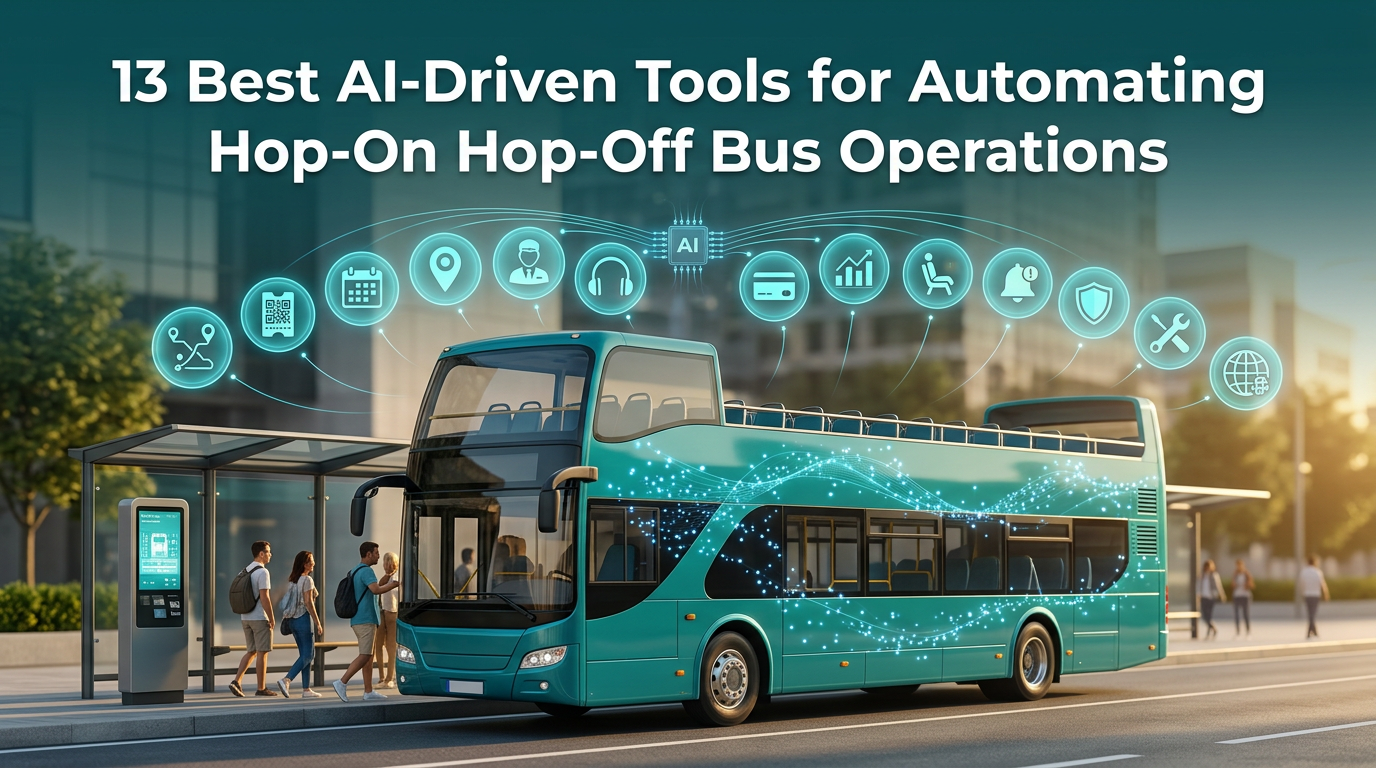
13 Best AI-Driven Tools for Automating Hop-On Hop-Off Bus Operations in 2026
AI hop on hop off software operations split into seven automatable functions: scheduling and headway, fleet operations, ticketing and validation, distribution, pricing, demand forecasting and rider communication. No single tool covers all seven, so operators pair a transport operations platform such as AllRide with a ticketing and distribution system suited to their market.
Key takeaways
- No single platform automates a HOHO operation end to end. Operators run an operations layer and a ticketing layer, and the integration between them is the decision that matters most.
- Headway is the operational metric, not punctuality. Passengers at a stop judge you on wait time, and bunching is simultaneously a service failure and wasted capacity.
- Dynamic pricing is the fastest return available in sightseeing, because pass prices are usually fixed while demand swings violently by season, weather and cruise arrivals.
- Demand is more forecastable than it feels. Cruise schedules, event calendars and seasonal patterns are known weeks ahead if the software is configured to look.
- Validation must work offline. Scanning a pass on a bright open top deck with poor signal is the real test, not a demo in an office.
- Automate in order of cost recovered: scheduling first, then pricing, then distribution, then communication.
A cruise ship disembarks two thousand passengers at the port stop. Three of your buses arrive within four minutes of each other while the next stop has had nothing for half an hour. The open-top deck is closed because of rain, your 48-hour passes are selling at the same price as a wet Tuesday in November, and your OTA inventory has not updated since this morning.
Every one of those is an automation gap, and each one costs money in a different way. Hop-on hop-off is unusually well suited to automation precisely because its problems are repetitive, data-rich and predictable — and unusually badly served by generic transport software, because passes, headways and multi-day validity break assumptions built for point-to-point trips.
This guide maps the seven operations worth automating and the thirteen tools that address them.
What “automating HOHO operations” actually means
It means replacing recurring manual decisions — how often buses run, what a pass costs today, which OTA has current inventory, when the next bus reaches stop seven — with systems that make those decisions from live data.
The reason it matters commercially is that sightseeing economics are driven by two numbers most operators manage by instinct: boardings per pass sold, which tells you whether your network is genuinely convenient, and capacity utilisation by hour, which tells you whether you are turning passengers away at eleven and running empty at three. Both are automatable inputs, and both move margin directly.
The category is searched as AI hop on hop off software, hop on hop off scheduling software, hop on hop off management software and tour bus management software. What those terms describe in practice is not one product but a stack.
The seven AI hop on hop off software (HOHO) operations worth automating
| # | Operation | What automation does | Cost of leaving it manual |
| 1 | Scheduling and headway | Builds and adjusts frequency-based schedules; detects bunching | Service failures and wasted vehicle hours |
| 2 | Fleet and driver operations | Assigns vehicles and drivers to runs, tracks live position | Dispatcher time; uncovered runs |
| 3 | Ticketing and validation | Sells and validates multi-day passes across repeated boardings | Boarding delays; revenue leakage |
| 4 | Distribution | Syncs inventory and availability to OTAs and resellers | Overselling, stale inventory, lost sales |
| 5 | Pricing | Adjusts pass prices to demand, season and channel | Flat pricing against violently variable demand |
| 6 | Demand forecasting | Predicts volume from seasonality, events and cruise arrivals | Over- or under-resourcing every day |
| 7 | Rider communication | Live arrival information, delay notices, service alerts | Queues at stops and support calls |
Automate in order of recovered cost. Scheduling and headway first, because they determine vehicle hours. Pricing second, because it is the fastest revenue lever. Distribution third, because stale inventory costs sales invisibly. Communication last — valuable, but it improves an experience rather than a number.
The 13 Best AI hop on hop off software, by what they automate
Organized by function rather than ranked, because these tools are not substitutes for one another.
Operations and scheduling
1. AllRide
Automates: fleet and driver operations, route and stop management, live tracking, rider-facing arrival information.
AllRide is an AI-powered, white-label transport platform covering route-based passenger services including sightseeing and hop-on hop-off, alongside shuttle and bus transport, airport transfers, taxi and chauffeur work, car rental and delivery. In an AI hop on hop off software context it operates the transport layer — the buses, routes, drivers and live tracking behind the service, under the operator’s own brand.
What it handles
- Route and stop management — defined loops with ordered stops, which is the structural foundation a HOHO network needs rather than point-to-point trip handling.
- Automated dispatch and driver assignment — allocation across routes and shifts on configured rules, with dispatcher override when a vehicle is withdrawn or a route is disrupted by an event closure.
- Real-time GPS tracking — live vehicle positions across the network, which is what lets dispatch manage spacing and lets a passenger at a stop know when the next bus arrives.
- Route optimization — sequencing and timing across multi-stop loops.
- Branded rider and driver apps — genuinely white-label, which matters in tourism where the brand is the product.
- Multi-channel booking and payment integration — direct sales handled in-platform alongside distributed inventory.
- Multi-language and multi-currency support — relevant when passengers arrive from many countries.
- Multi-service coverage — sightseeing routes alongside airport transfers, shuttles or private transport on one platform.
Where it fits: operators who want the transport operations layer under their own brand, particularly those running sightseeing alongside transfers, shuttles or private hire.
What to confirm: multi-day pass handling with unlimited boardings, on-board scanning and validation, and OTA channel distribution are the ticketing-side capabilities that define sightseeing commerce. These vary by vendor and configuration across the whole category — raise them directly, including what is achievable through API integration with a ticketing platform. Operators with significant OTA volume typically pair an operations platform with a distribution platform from the list below.
2. Optibus

Automates: scheduling, run-cutting, driver rostering.
Optibus applies optimization to public transport scheduling and vehicle and crew planning. For larger HOHO operations running multiple loops with driver shift constraints, it addresses the planning problem rather than the live one.
Where it fits: operators large enough that building schedules and driver rosters is a significant weekly task.
Consider: it is a planning platform rather than a live operations or ticketing system, so it sits alongside others rather than replacing them.
3. Swiftly

Automates: headway management, arrival prediction, operational analytics.
Swiftly focuses on transit data and real-time operations, including arrival prediction and service performance analysis — directly relevant to the headway and bunching problem that defines frequency-based sightseeing routes.
Where it fits: operations where wait time at stops and vehicle spacing are the service quality issue.
Consider: oriented to transit agencies and larger operators; confirm fit and integration path for a commercial sightseeing operation.
Ticketing, passes and validation
4. Ventrata

Automates: pass sales, multi-boarding validation, combination products.
Ventrata works extensively with attractions and sightseeing operators including hop-on hop-off, and is among the platforms most obviously built for pass-based, high-throughput visitor operations.
Where it fits: sightseeing and attraction operators wanting ticketing designed for repeated boarding across multiple days.
Consider: commercial terms are typically quote-based by volume and configuration.
5. Betterez

Automates: transport-oriented ticketing, reservations, route-aware products.
Betterez focuses on ticketing and reservations for bus, coach and passenger transport, including sightseeing — built around transport rather than general activities, so routes and services are native concepts.
Where it fits: bus and coach operators running sightseeing alongside scheduled or intercity services.
Consider: confirm OTA channel depth against specialist distribution platforms if third-party sales are a large share of volume.
6. Masabi

Automates: mobile ticketing, fare validation, account-based ticketing.
Masabi provides mobile ticketing and fare collection for transit, including validation hardware and mobile products. For HOHO operators moving to app-based passes with on-board validation, it addresses the fare collection layer specifically.
Where it fits: operations prioritising mobile passes and robust validation, particularly where offline scanning matters.
Consider: fare collection rather than tour commerce — combination products and OTA distribution are a different problem.
7. Vix Technology

Automates: fare collection, validation, transit payment systems.
Vix works in automated fare collection and transit ticketing at scale, including validation infrastructure.
Where it fits: larger operations with substantial validation volume and an appetite for integrated fare hardware.
Consider: enterprise and transit orientation; likely disproportionate for a small sightseeing operator.
Distribution and channel management
8. Rezdy

Automates: OTA and reseller distribution, inventory sync, agent management.
Rezdy focuses on tours and activities with particular strength in channel distribution, connecting operator inventory to OTAs and trade partners at scale.
Where it fits: operators for whom reseller and OTA distribution is the primary growth channel.
Consider: subscription with commission or booking-fee components — confirm the structure against your volume and average pass price.
9. Bókun

Automates: marketplace distribution, inventory and availability sync.
Bókun, part of the Tripadvisor group, centres distribution as its proposition, connecting operators with resellers and large travel marketplaces.
Where it fits: operators prioritising reach through major travel marketplaces.
Consider: subscription and commission components; confirm the total against your channel mix.
10. TrekkSoft

Automates: booking, channel management, on-site point of sale.
TrekkSoft provides booking and channel management for tour and activity operators with a notable European presence, including point-of-sale tooling for walk-up ticket buyers — which matters at busy sightseeing stops.
Where it fits: European sightseeing operators with a mix of online and on-site sales.
Consider: subscription with transaction components.
Pricing, forecasting and customer experience
11. Checkfront

Automates: inventory management across varied product types, booking and payments.
Checkfront handles booking management across tours, activities and rentals with flexible inventory handling, which suits operators whose product mix extends beyond sightseeing routes alone.
Where it fits: operators with a varied product catalogue.
Consider: tiered subscription — confirm which capabilities sit in each tier.
12. FareHarbor

Automates: direct booking, website conversion, capacity management.
FareHarbor serves tours and activities with booking technology plus a hands-on operator support model, embedding direct sales into the operator’s own site.
Where it fits: operators wanting booking technology with substantial implementation and support assistance.
Consider: typically booking-fee based — model the fee against your actual pass prices, since a flat fee behaves very differently on a €15 single than a €45 multi-day pass.
13. Peek Pro

Automates: booking conversion, mobile checkout, remarketing.
Peek Pro emphasises conversion and the customer booking experience, with mobile-first checkout relevant where travellers book on a phone at the destination.
Where it fits: operators where direct online conversion is a priority alongside distribution.
Consider: booking-fee and subscription components; confirm against your direct-versus-OTA mix.
Which combination fits your AI hop on hop off software operation?
Most established HOHO operators run one tool from the operations group and one or two from ticketing and distribution.
| Your operation | Operations layer | Ticketing and distribution layer |
| Single-city loop, moderate volume | AllRide | Ventrata or Betterez |
| Sightseeing alongside transfers or shuttles | AllRide | Ventrata, plus Rezdy if OTA-heavy |
| Multi-loop network with driver rostering | AllRide, with Optibus for planning | Ventrata or Betterez |
| OTA distribution is the growth channel | AllRide | Rezdy or Bókun |
| Heavy walk-up sales at stops | AllRide | TrekkSoft or Ventrata |
| Mobile passes with strict validation | AllRide | Masabi or Ventrata |
| Combination tickets with attractions | AllRide | Ventrata or Checkfront |
| Direct conversion is the priority | AllRide | FareHarbor or Peek Pro |
| Large operation, headway is the issue | AllRide, with Swiftly for analytics | Ventrata or Vix |
| Varied product catalogue beyond routes | AllRide | Checkfront |
Establish who owns the integration before you sign either contract. If neither vendor owns the connection between your ticketing and operations layers, a person with a spreadsheet does — and that person becomes the bottleneck you bought software to remove.
What AI genuinely automates in HOHO operations
Four applications deliver most of the measurable value. Two of them are specific to sightseeing and underused.
AI dynamic pricing. Pass prices in sightseeing are usually fixed while demand swings violently by season, weather, day of week and cruise schedule. AI dynamic pricing adjusts the price of a 24, 48 or 72-hour pass against those conditions, which is the fastest revenue lever available in this business and standard practice in adjacent travel sectors. Two cautions: apply it to direct and flexible channels rather than contracted rates, and keep the price a passenger sees stable once they begin a booking.
AI demand forecasting. Sightseeing demand feels chaotic and is substantially predictable. AI demand forecasting combining historical patterns with cruise arrival schedules, local event calendars and weather forecasts turns a daily guess about how many buses to run into a planning decision made days ahead. For an open-top operator, weather alone explains a large share of variance, and it is forecastable.
AI ETA prediction. On a frequency-based loop, the number a waiting passenger cares about is minutes-to-next-bus. AI ETA prediction using live position and historical journey times by segment and hour produces an estimate that holds, which is both a service improvement and the single most effective way to reduce queue anxiety at busy stops.
Headway and bunching management. Vehicles on a loop naturally bunch — one falls behind, collects more passengers, falls further behind, while the one following runs empty. Software that detects developing bunching and recommends holding or spacing adjustments prevents the situation where a passenger sees three buses at once and then nothing for forty minutes.
Four questions separate genuine capability from positioning. What data does it learn from — your own boarding and sales history, or generic assumptions? Which factors can you configure? Can it explain a specific recommendation? And can a controller override it? On a live network, a controller watching three vehicles converge knows something the model may not.
What these AI hop on hop off software cost
Pricing differs sharply between the layers, which makes cross-layer comparison meaningless unless you separate them.
| Layer | Typical model | What to watch |
| Operations platform | Per vehicle, per driver, or platform licence | Seasonal vehicles billed year-round unless deactivation is supported |
| Ticketing and distribution | Booking fee per ticket, commission, or subscription | Fee structure against your average pass price; OTA commissions stack on top |
| Scheduling and analytics | Per vehicle or enterprise licence | Whether it replaces or supplements your operations platform |
| Fare collection | Per validation, per device, or licence | Hardware and installation costs |
Beyond the headline, budget for implementation and route or product configuration, scanning hardware and device provisioning, OTA channel setup, payment processing, SMS and notification costs, integration between layers, multilingual content, support during operating hours, and data export at exit.
Two traps specific to sightseeing. Booking-fee pricing interacts directly with your ticket price — model it against your actual product mix rather than an average. And seasonal fleets get billed year-round on per-vehicle models unless you can deactivate vehicles off-season; confirm that explicitly before a winter of paying for parked buses.
For a fuller breakdown of how SaaS, licensed and white-label structures compare, see our guide to transport software pricing models.
Metrics that tell AI hop on hop off software automation is working
Five numbers, and the first is the one most operators under-use.
Boardings per pass sold. The clearest read on network convenience. A pass averaging under two boardings is being used as an expensive one-way transfer, which means your stop spacing or headway is failing. Passengers stop boarding long before they stop buying, so this moves before revenue does.
Average wait at stop by hour. The passenger-facing measure of headway performance, and far more meaningful than schedule adherence on a frequency service.
Bunching incidents per day. Simultaneously a service failure and wasted capacity.
Revenue and margin by channel. Direct, OTA, reseller and walk-up perform very differently once commission is counted.
Capacity utilisation by route and hour. Where you are turning passengers away and where you are running near-empty — usually the same network at different times of day.
Add weather-adjusted comparisons if you run open-top vehicles. Comparing a wet August against a dry one without adjustment produces conclusions that will mislead you.
What to test before you buy AI hop on hop off software
Use your own network and your own products.
Operations layer:
- Build one of your actual routes with its real stops and headway.
- Assign vehicles and drivers across a full operating day.
- Remove a vehicle mid-day and see how the network rebalances.
- Simulate bunching and check what dispatch is shown.
- Show what a passenger waiting at a stop sees, including minutes to next bus.
- Add a seasonal second route without rebuilding the first.
Ticketing and distribution layer:
7. Build 24, 48 and 72-hour passes with unlimited boardings.
8. Create a combination ticket bundling an attraction.
9. Scan the same pass for a fourth boarding on day two.
10. Disable connectivity, scan, then restore it and check sync and timestamp.
11. Push inventory to an OTA and change availability to see propagation speed.
12. Pull revenue by channel with commission deducted.
A vendor who handles the clean cases and stumbles on offline scanning or a mid-day vehicle withdrawal is showing you exactly where your peak season will go wrong.
How to roll out without disrupting the season
- Configure products and fares before routes. Pass structure determines much of what follows.
- Set up OTA channels early and test inventory sync well before peak, not during it.
- Pilot scanning on one route and one device type before fleet-wide rollout.
- Migrate in the off-season. A switchover during peak is the most avoidable risk in this vertical.
- Baseline three metrics first: boardings per pass, average wait at stop, revenue by channel.
- Train drivers and on-board hosts on scanning specifically — it is the step most likely to slow boarding.
- Review at four weeks against boardings per pass, and adjust stop placement or headway before adjusting marketing spend.
The bottom line
Hop-on hop-off looks simple from the pavement and is a two-system problem underneath: running a frequency-based network of vehicles that will not bunch, and selling a time-based pass through a dozen channels. No single tool does both well.
Start with the operations layer if your problem is vehicle hours, bunching and dispatcher time — that is where AllRide fits, particularly for operators running sightseeing alongside transfers, shuttles or private hire and wanting it all under one brand. Add a ticketing and distribution layer matched to how you actually sell: Ventrata or Betterez for pass-based validation, Rezdy or Bókun for OTA reach, FareHarbor or Peek Pro for direct conversion, TrekkSoft where walk-up sales matter.
Then automate in order of recovered cost: scheduling, pricing, distribution, communication.
See the operations layer running against your own routes — book a free AllRide demo and bring a real loop, your actual headway and a mid-day vehicle withdrawal to test it with.
Frequently asked questions
What is AI hop on hop off software?
AI hop on hop off software applies automation to sightseeing bus operations across seven functions: scheduling and headway, fleet and driver operations, ticketing and validation, OTA distribution, pass pricing, demand forecasting and rider communication. No single platform covers all seven, so operators typically pair a transport operations platform with a ticketing and distribution system.
What should a HOHO operator automate first?
Scheduling and headway, because they determine vehicle hours and therefore your largest controllable cost. Pricing second, since dynamic pass pricing is the fastest revenue lever in a business where demand swings by season, weather and cruise arrivals. Distribution third, because stale OTA inventory loses sales invisibly. Rider communication last.
Can one platform run both HOHO ticketing and operations?
Rarely well. Ticketing platforms sell passes and manage OTA channels but do not run fleets; transport operations platforms run routes, drivers and vehicles but do not distribute through major travel marketplaces. Most established operators run one of each. The decision that matters is which vendor owns the integration between them.
How does AI dynamic pricing work for sightseeing passes?
It adjusts the price of 24, 48 or 72-hour passes against demand signals including season, day of week, weather, cruise arrivals and booking lead time. Apply it to direct and flexible channels rather than contracted rates, and hold the displayed price stable once a passenger begins a booking so the experience stays trustworthy.
Can demand for hop-on hop-off buses be forecast accurately?
More accurately than most operators assume. Cruise arrival schedules, event calendars, school holidays and seasonal patterns are known weeks ahead, and weather forecasting explains a large share of remaining variance for open-top operations. Combining those with your own historical boarding data turns daily vehicle decisions into planning rather than guesswork.
How do you stop hop-on hop-off buses bunching?
Bunching happens when one vehicle falls behind, collects more passengers and falls further behind while the following vehicle runs empty. Managing it requires live visibility of vehicle spacing rather than position alone, plus the ability to hold or adjust vehicles. AI hop on hop off software that detects developing bunching early gives dispatch time to act before passengers notice.
What does HOHO automation software cost?
It depends on the layer. Operations platforms are typically priced per vehicle, per driver or as a licence — confirm whether seasonal vehicles can be deactivated off-season. Ticketing platforms typically charge a booking fee per ticket, a commission or a subscription, so model the fee against your actual pass prices rather than an average.
Does pass validation work without an internet connection?
It should, and this is worth testing specifically. Scanning happens on bright open-top decks, in tunnels and at stops with poor coverage, so the system needs offline validation that syncs later with the original timestamp intact. A platform that blocks boarding when connectivity drops will delay your busiest stop at your busiest hour.
Which metrics should an AI hop on hop off software operator track?
Boardings per pass sold, average wait at stop by hour, bunching incidents per day, revenue and margin by channel, and capacity utilisation by route and hour. Boardings per pass is the earliest warning of a failing route, because passengers stop boarding well before they stop buying.
How is AI hop-on hop-off software different from tour booking software?
General tour booking software is built around scheduled departures with fixed capacity per departure. AI hop on hop off software sells time-based passes permitting unlimited boardings across a network, operates on headway rather than timetable, and validates the same ticket repeatedly across several days. Platforms built for scheduled tours model passes awkwardly.