

 Fleet Management
 Route optimization
 Shuttle Transportation
 Delivery Management
 School Bus Transportation
 Ride Sharing Management
 Airport Transfer Booking
 Vehicle inspection
 Car Rental Management
 Trucking & Logistics
 Food & Beverage
 E-Commerce
 Passenger Transit
 Delivery
 School & Corporate
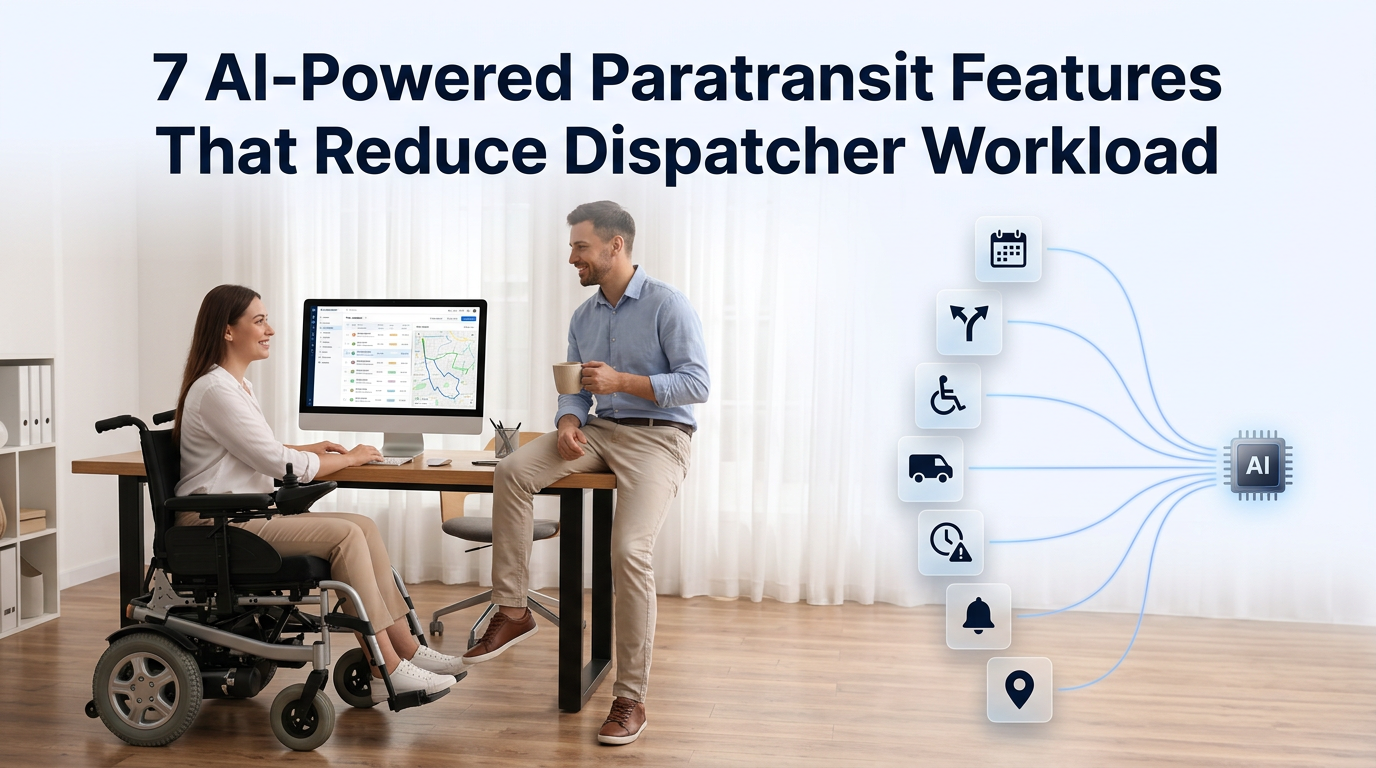
7 AI-Powered Paratransit Software Features That Reduce Dispatcher Workload
AI-powered paratransit software reduces dispatcher workload by automating the repetitive decisions that consume most of the day — building tomorrow’s schedule, inserting same-day bookings, reallocating cancellations, managing will-call returns, answering rider queries, triaging exceptions and handling vehicle substitutions. Platforms such as AllRide automate dispatch and assignment while keeping controller override intact.
Key takeaways
- Dispatcher workload is a staffing decision in disguise. Most agencies reach for another hire when the real constraint is how many manual decisions the job requires.
- Batch scheduling is the single largest time sink and the one automation addresses most completely.
- Inbound “where is my ride?” calls are the second largest, and they are almost entirely preventable with reliable rider information.
- Automation should change what dispatchers do, not how many you need — the goal is moving them from allocation to exception handling and rider contact.
- Three decisions must stay manual under ADA rules, and a platform that automates them is a compliance problem rather than an efficiency gain.
- Baseline your own hours before buying. Vendor time-saving claims mean nothing without a before figure from your own operation.
Your schedulers spent four hours building tomorrow’s runs. Your dispatchers spent the morning on the phone — half of it telling riders where their vehicle is, the rest rearranging trips around two cancellations, a no-show, a vehicle that would not start and a will-call that came in forty minutes early.
None of that is unusual. It is the standard shape of a paratransit dispatch day, and it is why agencies reach the point of hiring another dispatcher long before their trip volume would suggest they need one. The constraint is rarely the number of trips. It is the number of manual decisions each trip generates.
This guide covers seven AI-powered paratransit software capabilities that remove those decisions, what each is actually worth in dispatcher hours, and the three things automation must never touch.
Where dispatcher hours actually go
Before evaluating any feature, map your own day. Most AI-powered paratransit software dispatch operations distribute their hours across six activities, and the proportions matter more than the total.
| Activity | What it involves | Automatable? |
| Building the schedule | Converting booked trips into runs and assigning vehicles | Largely |
| Answering rider calls | Trip status, confirmations, changes, “where is my ride?” | Largely |
| Handling same-day changes | New bookings, cancellations, no-shows, delays | Substantially |
| Managing will-calls | Return legs with no fixed time | Partially |
| Resolving exceptions | Breakdowns, mobility mismatches, service failures | No — and should not be |
| Eligibility and policy decisions | Entitlement questions, denials, appeals | No — regulated |
The useful exercise is a one-week time log, even a rough one. Ask each dispatcher to tally hours against these six categories for five days. The result almost always surprises management, and it tells you which of the seven features below is worth buying first for your operation rather than in the abstract.
Without that baseline, every vendor time-saving claim is unfalsifiable.
The 7 AI-powered paratransit software features that reduce dispatcher workload
1. Automated batch scheduling
The workload it removes: building tomorrow’s runs from the booked trip set — typically the single largest block of scheduler time in the week.
What it does. Converts the day’s booked trips into vehicle runs and driver assignments against your service rules: ride-time limits, pickup windows, mobility requirements, vehicle capabilities and shift availability.
Why it matters beyond time. The quality of the batch determines how many vehicles you run. A scheduler working under time pressure produces a workable plan; an optimizer evaluating far more combinations produces a tighter one. The saving is therefore double — fewer scheduler hours and fewer vehicle hours.
What to test. Load a real day’s trip set and compare the output against what your schedulers produced: vehicle count, revenue hours, and the distribution of rider ride times, not the average. A batch that looks efficient while leaving three riders aboard for ninety minutes has not helped you.
The limit. Batch quality depends entirely on your constraints being configured correctly. An optimizer will exploit anything you leave soft, so expect to spend real time on configuration before you see the benefit.
2. Same-day booking insertion
The workload it removes: manually finding a slot for each same-day request, which interrupts whatever else the dispatcher was doing.
What it does. Evaluates whether a new request can be inserted into an existing run without breaching appointment windows, ride-time limits or capacity — and places it, rather than requiring a dispatcher to search the board.
Why it matters. Same-day requests arrive unpredictably and each one costs a context switch. Interrupted work is slower work, and dispatchers absorbing twenty insertions a day are not doing twenty short tasks — they are doing one fragmented day.
What to test. Add a same-day trip at a genuinely awkward time and location, and check both what the system does and what happens to the riders already on that run.
The limit. Capacity denials are prohibited for ADA complementary paratransit, so insertion logic must find a way to serve the trip rather than declining it when the first option does not fit.
3. Automated cancellation and no-show reallocation
The workload it removes: reworking runs when trips fall away, and spotting the capacity that has just been freed.
What it does. Detects cancellations and no-shows, releases the capacity, and either backfills it with pending demand or rebalances the affected run.
Why it matters. Paratransit cancellation rates are high enough that this happens continuously. Capacity released by a morning cancellation is free service if something fills it and pure waste if nobody notices — and nobody notices when the dispatcher is on the phone.
What to test. Cancel three trips mid-morning and see whether backfill is offered, then check what happened to the ride times of riders already aboard the affected runs.
The limit. Reallocation that reshuffles aggressively erodes driver trust in the manifest. Ask how the system balances recovered capacity against schedule stability.
4. Will-call return management
The workload it removes: holding capacity for return legs with no fixed time, and scrambling when calls arrive in clusters.
What it does. Predicts likely ready times by facility and appointment type, holds capacity accordingly, and inserts the return into a live run when the call comes.
Why it matters. Will-calls are the most dispatcher-intensive element of paratransit because they combine uncertainty with urgency. Dialysis centers release patients in waves; three calls arriving within ten minutes is a normal Tuesday, and handling them manually means three riders waiting while the dispatcher works through them sequentially.
What to test. Create a will-call return and trigger it both early and late. Watch what happens to the vehicle provisionally held, and calculate how long the rider would actually have waited.
The limit. Prediction improves planning; it does not eliminate the variability. Treat it as capacity guidance rather than a schedule.
5. Automated rider communication
The workload it removes: inbound calls — specifically trip confirmations, status checks and the perennial “where is my ride?”
What it does. Sends booking confirmations, day-before reminders, imminent-arrival notifications and delay alerts automatically, and accepts cancellations through automated voice or text without a dispatcher taking the call.
Why it matters. This is usually the second-largest workload category after scheduling, and the most preventable. A rider who can see or hear reliably when their vehicle is arriving does not call to ask. A reminder that produces an early cancellation also converts a would-be no-show into usable capacity — so the same feature reduces calls and improves utilization.
What to test. Cancel a trip by voice and by text. Then check what a rider experiences who has no smartphone, limited English or a hearing impairment.
The limit — and this one is important. Accessible fallbacks are a requirement, not a courtesy. A meaningful share of paratransit riders will use the phone, and automation that assumes app access excludes exactly the population the service exists for. Confirm that voice, text and live-agent routes all work.
6. Exception surfacing and triage
The workload it removes: scanning the board for problems, which is low-value monitoring that fills gaps between tasks.
What it does. Monitors live operations and surfaces only what needs attention — a run falling behind, a trip likely to miss its window, a vehicle stationary too long, an unassigned trip past threshold — rather than requiring a dispatcher to watch everything.
Why it matters. The difference between watching a screen and being told what is wrong is the difference between monitoring and managing. It is also what makes a higher trip-per-dispatcher ratio sustainable without degrading service.
What to test. Introduce a delay early in a run and check whether downstream trips are flagged, how quickly, and whether the alert reaches someone who can act.
The limit. Alert tuning matters enormously. Fifty alert types on day one produces alert fatigue by day ten, and a dispatcher who has learned to dismiss alerts is worse off than one who was watching the board. Start with a small set tied to your three most important service metrics.
7. Vehicle and driver substitution handling
The workload it removes: manually rebuilding affected runs when a vehicle fails or a driver is absent.
What it does. Identifies riders affected by a substitution, flags mobility mismatches where the replacement vehicle cannot carry someone, reassigns where possible, and surfaces what still needs a human decision.
Why it matters. Vehicle breakdowns and driver absences are routine rather than exceptional, and each one currently means a dispatcher working through a run rider by rider under time pressure — exactly the conditions in which a mobility mismatch gets missed.
What to test. Substitute a vehicle with fewer securement positions than the original and confirm the system identifies the riders who can no longer be carried, rather than silently reassigning them.
The limit. The system should flag and propose; a human should confirm anything affecting a rider’s mobility accommodation.
The 7 AI-powered paratransit software at a glance
| # | Feature | Workload removed | Watch for |
| 1 | Automated batch scheduling | Building tomorrow’s runs | Constraint configuration quality |
| 2 | Same-day insertion | Finding slots manually | Capacity denials are prohibited |
| 3 | Cancellation reallocation | Reworking runs continuously | Manifest stability for drivers |
| 4 | Will-call management | Holding and placing returns | Prediction is guidance, not certainty |
| 5 | Automated rider communication | Inbound call volume | Accessible fallbacks required |
| 6 | Exception triage | Board monitoring | Alert fatigue |
| 7 | Substitution handling | Rebuilding affected runs | Mobility mismatches need human confirmation |
If you can only implement three, the usual highest-return order is batch scheduling (1), rider communication (5) and exception triage (6) — because they address the two largest time blocks and the one that fills every gap between them.
What dispatchers should do with the time
This matters more than the hours saved, and it is where most automation projects underdeliver.
Automation that simply makes a dispatcher idle has achieved very little. The return comes from redirecting the time toward work that genuinely needs a person:
Exception management. The trips at risk, the service recoveries, the cases where judgement beats a rule. These are the situations where a good dispatcher adds the most value and where they currently have the least time.
Rider relationships. Calling riders whose trips are at risk before they call you. Checking in on riders whose boarding pattern has changed. This is service quality that no algorithm produces.
Facility coordination. Talking to dialysis centers and clinics about release-time patterns, which improves will-call prediction and reduces wait times on both sides.
Schedule quality review. Looking at why particular runs consistently fail, which is the work that prevents tomorrow’s problems rather than solving today’s.
The honest framing for your team matters here. Automation presented as headcount reduction gets resisted, often quietly and effectively. Presented as “you will stop spending four hours a day on the board and start doing the work you were hired for,” it gets adopted. Both can be true; only one produces cooperation.
Three things automation must not do
These are not preferences. They are compliance boundaries in ADA complementary paratransit, and a vendor who is vague about them should be treated with caution.
Eligibility determination. Whether a person is eligible, and under what conditions, is a regulated determination with documentation and appeal rights attached. Software should support the process — applications, records, conditions, expiry, correspondence — and must not make the decision.
Trip denial. Capacity denials are prohibited for ADA complementary paratransit. An optimizer that improves its metrics by declining trips is creating exposure rather than efficiency, and a scheduling tool that can refuse a trip when the board is full is solving the wrong problem.
Service reduction based on prediction. Using no-show history to deprioritize a rider — later pickups, longer rides, lower scheduling priority — raises access and discrimination concerns. Prediction should drive confirmation calls and capacity planning, never differential service.
A useful procurement question: ask the vendor to state in writing which decisions their system makes autonomously and which require human confirmation. The clarity of the answer tells you how well they understand this sector.
Measuring dispatcher workload properly
Five numbers, baselined before you buy and compared at 30 and 90 days.
| Metric | What it reveals |
| Hours per activity category | Where the time actually goes — from your one-week log |
| Trips per dispatcher per day | The headline productivity figure |
| Inbound calls per 100 trips | How much rider communication is still manual |
| Same-day changes handled per dispatcher | Interruption load, which drives fragmentation |
| Post-publication schedule change rate | Whether the batch is holding or being reworked daily |
That last metric is the most diagnostic and the least used. If a high proportion of runs change between publication and operation, you have a planning problem rather than a workload problem — the batch was built on optimistic constraints, and automating the rework will not fix the cause. Operators who track it weekly find the pattern and fix the constraints instead of adding dispatcher capacity.
Resist vendor claims expressed as percentages of time saved. Those figures come from someone else’s operation with someone else’s constraints. Your own before-and-after from a one-week log is the only number that means anything.
What this does not fix
Being clear about the limits makes the case for the rest.
It will not fix bad constraint configuration. An optimizer applies the rules you give it. If your ride-time limits, buffers or vehicle capabilities are wrong in the system, automation will produce wrong schedules faster.
It will not fix inaccurate data. Mobility levels recorded incorrectly, vehicles not configured with their actual securement positions, stale rider records — automation acts on all of this with confidence.
It will not replace scheduler judgement about riders. Experienced schedulers know which riders need extra time, which facilities run late, and which pairings do not work. That knowledge belongs in the constraints, and getting it there takes deliberate effort.
It will not reduce demand. If your trip volume genuinely exceeds your capacity, automation improves how efficiently you serve it and does not change the arithmetic.
How to implement without disrupting service
- Run the one-week time log first. Without it you cannot prioritize or prove anything.
- Configure constraints before anything else, and have your schedulers verify them rather than only review them.
- Automate one category at a time, starting with the largest from your log. Sequential adoption makes attribution possible.
- Run parallel scheduling for at least a week before relying on the batch.
- Start with a small alert set — three to five types tied to your key service metrics — and expand only once they are being acted on.
- Brief riders before any change they will notice, particularly to communication channels or booking methods.
- Review at 30 and 90 days against your baseline, and reallocate dispatcher time deliberately rather than letting it fill itself.
How AllRide fits
A scope note first. AllRide is a transport operations platform rather than an ADA paratransit specialist. Eligibility determination workflows, capacity-denial rules, negotiated pickup window management and federal reporting are the domain of dedicated paratransit vendors, and an agency procuring ADA complementary paratransit should shortlist those.
Where AllRide is directly relevant is the operational layer several of these features sit on. Automated dispatch and driver assignment, route optimization and real-time GPS tracking are confirmed capabilities, alongside multi-channel booking including phone entry, driver and vehicle management, branded rider and driver apps, and reporting — which is the machinery behind automated assignment, same-day handling, live visibility and rider-facing information.
That makes it a genuine fit for the substantial adjacent market: community and senior transport outside ADA complementary service, private contractors delivering agency trips, non-emergency medical and facility transport, campus demand-response, and accessible transport operating outside the US regulatory framework — settings where dispatcher workload is the constraint and federal compliance reporting is not.
What to confirm for your operation, as with any vendor: batch scheduling depth, will-call handling, accessible rider communication channels for riders without smartphones, and how mobility levels are enforced during vehicle substitution. These vary by platform and configuration, and they are the capabilities this article recommends testing.
Test it against your own hardest day — book a free AllRide demo and bring a real trip set, a will-call return and a mid-day vehicle withdrawal.
Frequently asked questions
How does AI-powered paratransit software reduce dispatcher workload?
By automating the repetitive decisions that consume most of the day: building the schedule, inserting same-day bookings, reallocating cancellations and no-shows, managing will-call returns, handling rider communication, triaging exceptions and processing vehicle substitutions. The aim is to move dispatchers from routine allocation toward exception handling and rider contact.
Which AI-powered paratransit software tasks take up the most dispatcher time?
For most operations, building the schedule and answering inbound rider calls are the two largest blocks, followed by handling same-day changes. The proportions vary by operation, which is why a one-week time log across six activity categories is worth running before evaluating any platform — it tells you which capability to buy first.
Does paratransit dispatch automation mean fewer dispatchers?
Not necessarily, and framing it that way usually causes resistance that undermines adoption. The stronger outcome is changing what dispatchers do — moving them from building runs and answering status calls toward exception management, proactive rider contact, facility coordination and schedule quality review, which is work that genuinely needs a person.
What should automated paratransit dispatch never do?
Three things, all compliance boundaries. It must not determine eligibility, which is a regulated decision with appeal rights. It must not deny trips for capacity reasons, which is prohibited for ADA complementary paratransit. And it must not reduce service to individual riders based on predicted behaviour such as no-show history.
How does AI handle will-call returns in paratransit?
By predicting likely ready times from historical patterns by facility and appointment type, holding capacity accordingly, and inserting the return into a live run when the call arrives. Dialysis centers in particular release patients in waves, so prediction converts a reactive scramble into planned capacity — though it remains guidance rather than certainty.
Can automation reduce “where is my ride?” calls?
Substantially. Automated confirmations, day-before reminders, imminent-arrival notifications and delay alerts remove most of the reason riders call. A reminder that prompts an early cancellation also converts a would-be no-show into usable capacity. Accessible fallbacks for riders without smartphones are a requirement, not an optional extra.
How do we measure whether automation has actually helped?
Baseline five numbers before implementing and compare at 30 and 90 days: hours per activity category from a time log, trips per dispatcher per day, inbound calls per 100 trips, same-day changes handled per dispatcher, and post-publication schedule change rate. Vendor percentage claims from other operations are not a substitute.
What is post-publication schedule change rate and why does it matter?
It is the proportion of runs altered between publication and operation. A high rate usually indicates a planning problem rather than a workload problem — the batch was built on optimistic constraints, so automating the rework treats the symptom. Tracking it weekly surfaces which constraint is wrong.
Will automation fix a badly configured schedule?
No. An optimizer applies the rules it is given, so incorrect ride-time limits, buffers, mobility levels or vehicle capabilities will produce wrong schedules faster rather than better ones. Configuration quality determines output quality, and verifying it with your schedulers is the highest-value step in implementation.
What is the difference between paratransit scheduling and dispatch automation?
Scheduling automation builds the plan — converting booked trips into runs and assignments before the service day. Dispatch automation manages the plan in operation, handling same-day insertions, cancellations, will-calls, exceptions and substitutions. Both reduce dispatcher workload, but they address different parts of the day and are sometimes separate capabilities.