


 Fleet Management
 Route optimization
 Shuttle Transportation
 Delivery Management
 School Bus Transportation
 Ride Sharing Management
 Airport Transfer Booking
  Vehicle inspection
 Car Rental Management
 Trucking & Logistics
 Food & Beverage
 E-Commerce
 Passenger Transit
 Delivery
 School & Corporate
Best Automated Billing Software for Transportation Companies in 2026
Automated billing software generates invoices, charges customers, and reconciles payments without manual data entry — pulling trip, fare, and account data straight from your operations. For transportation companies, the best systems handle recurring contract billing, per-trip invoicing, corporate accounts, multiple currencies, and integration with dispatch, because transport billing is far messier than standard subscription billing. Getting it right cuts admin hours, ends revenue leakage, and gets you paid faster.
Key takeaways
- Transport billing mixes per-trip, contract, and corporate invoicing.
- Recurring billing software handles the contracts; per-trip needs trip data.
- Integration with dispatch is what makes automation actually work.
- Revenue leakage from manual billing is often invisible until audited.
- Match the tool to your billing model, not to a generic feature list.
Why billing is harder for transport companies
Most billing software is built for predictable subscriptions: same customer, same amount, same day each month. Transport rarely works that way. A single operator might bill a corporate client monthly for hundreds of individual trips, charge a retail passenger instantly at drop-off, invoice a school district against a term contract, and settle with franchise operators on a revenue share — all in the same week.
That mix is why manual billing survives longer in transport than it should, and why it quietly costs so much. Trips get missed off invoices, waiting time and tolls go unbilled, disputes take hours to resolve because nobody can reconstruct the trip, and finance teams spend the first week of every month rebuilding data that the dispatch system already had.
Automated billing software fixes that by taking the trip and fare records your operation already produces and turning them into invoices and payments automatically. This guide covers what to look for, how billing needs differ by transport type, what it costs, and — the part most buyers underestimate — how billing connects to the platform running your trips.
What is automated billing software?
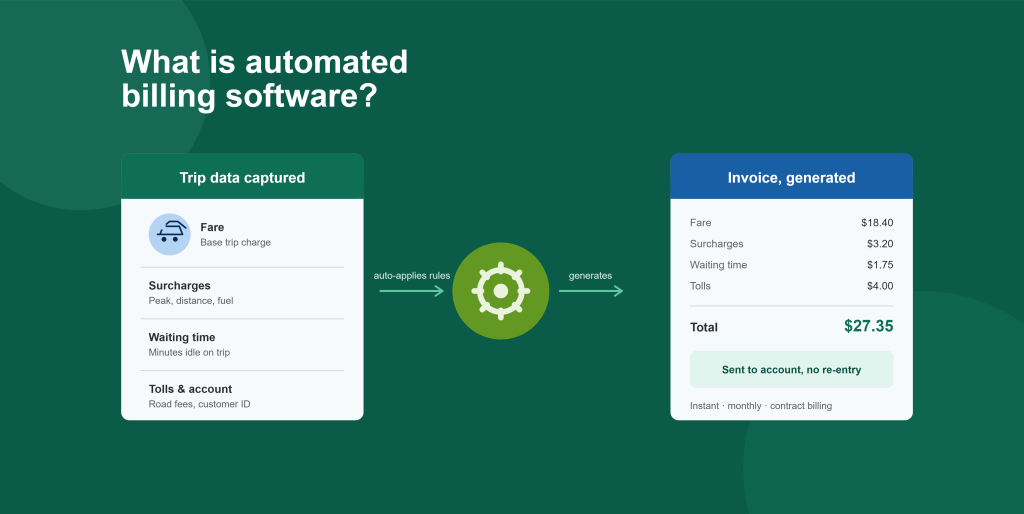
Automated billing software is a system that creates invoices, applies pricing rules, charges customers, and tracks payments automatically, without staff re-entering data. Billing automation software, invoice automation software, and automated invoicing software all describe the same core idea from different angles.
In transport specifically, it means the fare, surcharges, waiting time, tolls, and account details captured during the trip flow directly into a customer’s invoice — whether that invoice goes out immediately, at the end of the month, or against a standing contract.
The 6 features transport billing software needs
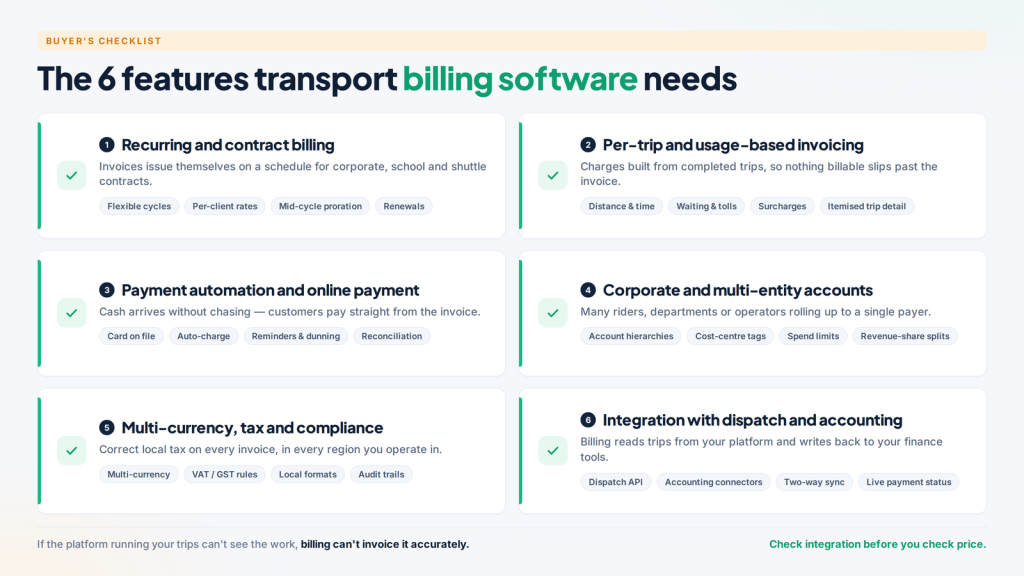
1. Recurring and contract billing
Recurring billing software issues invoices automatically on a schedule — monthly, weekly, or per contract term — which is essential for corporate, school, and shuttle work. Contract revenue is the most predictable part of most transport businesses and the most tedious to invoice by hand.
Look for flexible billing cycles, contract-based rates that differ per client, automatic proration when service changes mid-cycle, and the ability to combine a fixed contract fee with variable extras. The best recurring billing software also handles renewals and rate changes without someone rebuilding the invoice template each time.
2. Per-trip and usage-based invoicing
Trip billing software calculates charges from actual completed trips — distance, time, waiting, tolls, surcharges — and rolls them into an invoice or charges them immediately. This is where transport diverges most sharply from standard billing tools.
The critical requirement is a clean data feed from operations. If the system can’t see the trip, it can’t bill it accurately, and that gap is exactly where revenue leaks. Check that it supports itemized trip detail on invoices, since corporate clients almost always want to see the trips behind the total before they pay.
3. Payment automation and online payment
Automated payment software charges cards, processes online payments, and retries failed transactions automatically, so cash arrives without chasing. Online billing software should let customers pay from the invoice itself.
Check supported payment methods and gateways, card-on-file and auto-charge, automated payment reminders and dunning for failures, and reconciliation against your accounting system. For consumer-facing trips, instant in-app payment matters; for corporate accounts, terms-based invoicing with online settlement usually does.
4. Corporate accounts and multi-entity billing
Transportation invoicing software should handle corporate accounts where many riders, departments, or cost centers roll up to one payer. This is a standard transport requirement that generic billing tools often miss.
Look for hierarchical account structures, department or cost-center tagging, per-account rate cards, spending limits or approvals, and consolidated statements. For franchise and multi-operator businesses, add revenue-share splits and operator-level settlement to the list.
5. Multi-currency, tax, and compliance
Operators working across regions need multi-currency billing plus correct local tax handling on every invoice. Tax errors are expensive in a way that billing errors usually aren’t.
Confirm multi-currency invoicing and settlement, region-specific tax rules such as VAT or GST, compliant invoice formats and numbering for each jurisdiction, and audit trails. If you’re expanding internationally, verify this before signing rather than discovering it during a market launch.
6. Integration with dispatch and accounting
The feature that determines whether billing automation actually works is integration — billing must read trip data from your transport platform and write to your accounting system. Without it, you’ve automated the invoice but kept the manual data entry.
Check for an API or native connector to your dispatch and booking platform, integrations with accounting tools your finance team already uses, and two-way sync so payment status is visible in both systems. A transport management software with automated billing built in, or cleanly integrated, removes the reconciliation work that manual billing creates.
Billing needs by transport type
| Operation | Primary billing model | What to prioritize |
| Taxi / private hire | Per-trip, instant payment | Fast in-app payment, card on file |
| Corporate / employee shuttle | Monthly account invoicing | Corporate accounts, cost centers, itemized trips |
| School and contract transport | Recurring contract billing | Contract terms, scheduled invoicing, proration |
| Airport transfer / chauffeur | Mixed per-trip and account | Quotes, itemized extras, corporate terms |
| Delivery and logistics | Per-task or volume-based | Usage-based rules, bulk invoicing |
| Franchise / multi-operator | Revenue share and settlement | Multi-entity billing, operator payouts |
How much does automated billing software cost?
Billing software cost is usually a monthly subscription per user or per invoice volume, sometimes with a percentage of processed payments, and enterprise deployments are typically quote-based. Transaction fees often matter more than the subscription for high-volume operators.
When comparing automated billing software cost, check the pricing basis (users, invoices, revenue processed, or a blend), payment processing fees on top of the platform fee, setup and data migration, integration development if a connector doesn’t exist, and support tier. Model it at your current invoice volume and at double it — percentage-based pricing that looks cheap at low volume can become the largest line item as you scale. (For published price comparisons, insert verified vendor pricing rather than estimates.)
How to choose billing software for a transport company
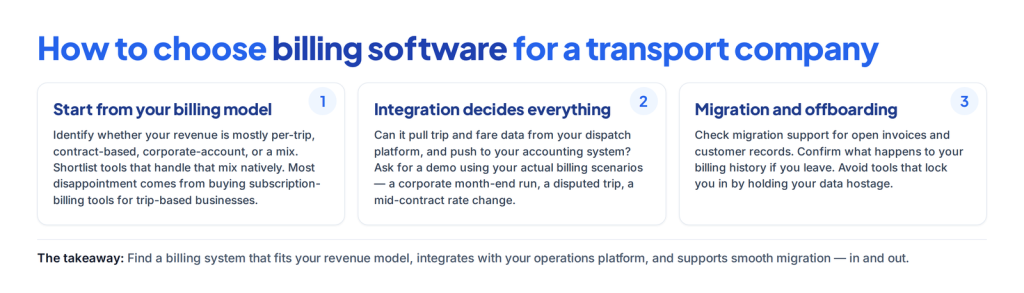
Start from your billing model, not the vendor’s feature list: identify whether your revenue is mostly per-trip, contract-based, corporate-account, or a mix, then shortlist tools that handle that mix natively. Most disappointment comes from buying subscription-billing tools for trip-based businesses.
Then work through integration, because it decides everything: can it pull trip and fare data from your dispatch platform, and push to your accounting system? Ask for a demo using your actual billing scenarios — a corporate month-end run, a disputed trip, a mid-contract rate change — rather than a generic walkthrough. Finally, check migration support for open invoices and customer records, and confirm what happens to your billing history if you leave.
How AllRide fits into transport billing
A clear scoping note, because it matters for this decision: AllRide is a transport operations platform, not a standalone billing and invoicing suite. What it provides is the layer billing depends on — and, for many operators, that’s the harder half of the problem.
AllRide Apps is an AI-powered, white-label transportation platform built and maintained by Innofied Solutions and used by 300+ global transport businesses. On the billing side, it captures the operational data that accurate invoicing requires: complete trip records with fares and trip detail across taxi, airport transfer, limo, shuttle, school, delivery, and logistics work; payment gateway integration so passengers can pay for trips online; multi-currency support across 50+ languages for operators working in several markets; and reporting and analytics dashboards covering trips and revenue. With 100+ API integrations, that trip and fare data can flow into the dedicated billing, invoicing, or accounting platform your finance team already uses.
The practical takeaway: if your billing pain is really a data problem — trips missing from invoices, disputes you can’t reconstruct, month-end spent rebuilding records — fixing the operations layer solves more than a new billing tool will. If you need full recurring invoicing, dunning, and ledger management, pair a specialist billing platform with a transport system that can feed it clean data automatically.
See how AllRide captures the trip and fare data your billing depends on — book a free demo.
Frequently asked questions
What is automated billing software?
Automated billing software creates invoices, applies pricing rules, charges customers, and tracks payments automatically, without staff re-entering data. In transportation, it turns completed trip and fare records into invoices or immediate charges, covering per-trip billing, recurring contracts, and corporate accounts, and reduces both admin time and the revenue leakage that manual billing causes.
What is the best billing software for transportation companies?
The best billing software for transportation companies is the one matching your billing mix. Per-trip operators need usage-based invoicing and instant payment; contract operators need recurring billing; corporate-heavy businesses need account hierarchies and itemized statements. Above all, it must integrate with the platform running your trips, since accurate billing depends on clean operational data.
What is recurring billing software?
Recurring billing software issues invoices automatically on a set schedule, such as monthly or per contract term, applying agreed rates without manual work. For transport, it suits corporate shuttle contracts, school transport agreements, and retainer-based services, and the best recurring billing software also handles proration, renewals, and rate changes without rebuilding the invoice each cycle.
How does invoice automation software work?
Invoice automation software pulls data from operational systems — trips, fares, contracts, accounts — applies your pricing and tax rules, generates the invoice, sends it, and tracks payment, retrying or reminding when payment fails. The automation depends entirely on data quality, which is why integration with dispatch and booking systems is the critical requirement.
Does transport management software include automated billing?
Some transport management software includes billing modules; many focus on operations and integrate with dedicated billing platforms instead. Both approaches work. What matters is that trip and fare data flows automatically into whichever system issues invoices, because manual re-entry between the two is precisely the cost automation is supposed to remove.
How much does automated billing software cost?
Pricing is typically a monthly subscription based on users or invoice volume, sometimes plus a percentage of payments processed, with enterprise deployments quote-based. Also factor in payment processing fees, setup and data migration, integration work, and support tier. Model costs at double your current invoice volume, since percentage-based pricing scales faster than flat subscriptions.
How do I reduce billing errors in a taxi or fleet business?
Remove manual data entry. Errors and revenue leakage almost always come from re-keying trip details into invoices, or from trips never reaching billing at all. Connect your dispatch and booking platform directly to your billing system so fares, waiting time, tolls, and surcharges flow through automatically, and keep itemized trip records so disputes can be resolved from evidence.
Conclusion
Transport billing is complicated because transport revenue is complicated — per-trip, contract, corporate, and franchise models running simultaneously. Automated billing software earns its cost when it handles that mix natively and, crucially, when it draws its data straight from the system running your trips rather than from a spreadsheet someone rebuilds each month.
Start by naming your billing model, then test candidates against your real month-end scenarios. And if the deeper problem is that trip data never reaches billing cleanly in the first place, see how AllRide captures complete trip, fare, and payment records across every service you run — book a free demo.