


 Fleet Management
 Route optimization
 Shuttle Transportation
 Delivery Management
 School Bus Transportation
 Ride Sharing Management
 Airport Transfer Booking
  Vehicle inspection
 Car Rental Management
 Trucking & Logistics
 Food & Beverage
 E-Commerce
 Passenger Transit
 Delivery
 School & Corporate
Taxi Dispatch Software Reviews: How to Compare Platforms Before Switching
Taxi dispatch software reviews are useful for spotting patterns and red flags, but they can’t tell you whether a platform fits your specific operation — so use them to build a shortlist, then verify everything that matters with a demo and references. Reviews are a starting point, not a decision. This guide shows how to read them critically, what they routinely leave out, and how to run a real comparison before you switch platforms.
Key takeaways
- Reviews reveal patterns and red flags, not fit for your fleet.
- Filter reviews by fleet size and service type similar to yours.
- Recency matters — platforms change; old reviews mislead.
- Reviews rarely cover pricing, migration, or support honestly.
- Verify the shortlist with a demo and same-size references.
Why reviews only get you halfway
When you’re thinking about switching dispatch platforms, reviews feel like the obvious place to start, and they’re worth reading. Across enough of them, patterns emerge: a recurring complaint about support response, praise for a driver app that drivers actually like, repeated mentions of hidden fees. Those signals are genuinely useful.
But reviews have real limits. A five-star review from a two-vehicle operator tells you little if you run forty. A glowing review from 2023 may describe a product that’s since changed hands or direction. And reviews almost never cover the things that decide a switch — what it actually costs at your volume, whether migration goes smoothly, how support behaves when dispatch is down at peak. So treat taxi dispatch software reviews as the tool that builds your shortlist, not the one that makes your choice.
This guide covers how to read reviews well, what they hide, and how to run the real comparison that follows.
How to read taxi dispatch software reviews critically
Read reviews for patterns, not individual opinions — and always filter for reviewers whose fleet size and service type resemble yours. One review is an anecdote; ten reviews saying the same thing is a signal.
- Match the reviewer to you. A review from a small phone-booking taxi firm and one from a large app-based ride-hailing operator describe different products in practice. Weight the ones that look like your business.
- Check the date. Dispatch platforms change fast, and ownership changes happen. Prioritize reviews from the last year and discount anything older than two or three.
- Look for specifics. “Great software!” tells you nothing. “Dispatch handled our Friday-night volume without lag” tells you something. Trust detailed reviews over vague ones.
- Read the negative reviews first. They’re where the real trade-offs live. Look at whether the vendor responded, and how.
- Weigh the source. Independent review platforms, operator forums, and peer recommendations carry more weight than testimonials curated on a vendor’s own site.
- Watch for pattern breaks. A wall of five-star reviews posted in the same week is a flag, not a reassurance.
What reviews rarely tell you
Reviews consistently under-cover four things that decide a switch: real pricing at your volume, migration difficulty, support quality under pressure, and how the product performs at peak load. These are exactly the areas you have to verify yourself.
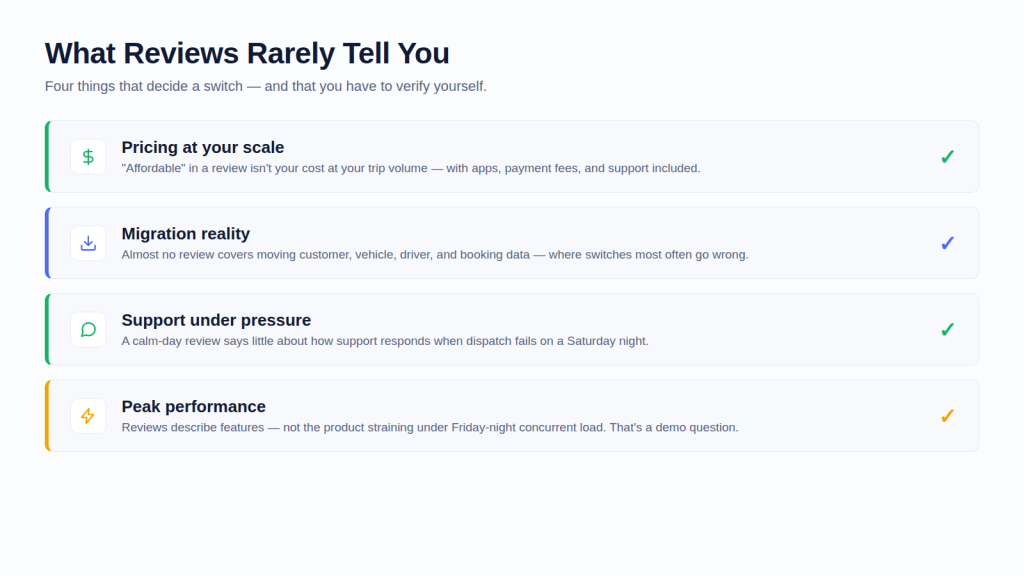
Pricing at your scale. Reviews mention “affordable” or “expensive,” but rarely your actual taxi dispatch software cost at your trip volume, with apps, payment fees, and support included. Pricing is too specific to your operation to outsource to a stranger’s review.
Migration reality. Almost no review covers what it was like to move customer, vehicle, driver, and booking data across, or how long the cutover took. Yet migration is where switches most often go wrong.
Support under pressure. A review written during calm operations says little about how support responds when dispatch fails on a Saturday night. Ask references about this directly.
Peak performance. Reviews describe features; they rarely describe the product straining under real concurrent load. That’s a demo-and-reference question, not a review one.
Build a real comparison, not just a review scan
A proper taxi dispatch software comparison scores each shortlisted platform on the same criteria against your operation — features, pricing model, migration, support, and fit — rather than tallying star ratings. Reviews narrow the field; a structured comparison chooses the winner.
| Compare on | What to actually check |
| Core fit | Does it handle your booking channels and service types? |
| Dispatch | Configurable assignment, peak-load performance |
| Driver app | Will your drivers adopt it without workarounds? |
| Pricing | Total monthly cost at your volume, all fees included |
| Migration | Data export/import and cutover support |
| Support | Hours, response times, live-operations cover |
| Growth | Does it scale to the fleet you’ll run in two years? |
| Exit | Data ownership and app-store account ownership |
Score each shortlisted platform on the same rows. A cheaper option that fails on migration or support isn’t cheaper; a well-reviewed option that can’t handle your peak isn’t a fit. This is also where taxi dispatch software alternatives you hadn’t considered earn their place — the best-reviewed platform isn’t automatically the best for you.
Pricing: the part reviews get least right
Compare taxi dispatch software pricing on total monthly cost at your real booking volume — subscription, setup, branded apps, payment and map fees, and support — because the headline rate and the star rating both hide it. This is the single most common gap between a review and reality.
Watch the pricing basis especially. A per-trip model can look cheap in a review from a low-volume operator and become your largest cost as bookings grow, while a flat plan is predictable but may bundle capacity you don’t need yet. When weighing a cheap taxi dispatch software against a pricier one, the real question is what each replaces and what it adds in fees — the cost of a taxi dispatch software is the operating total, not the sticker. (For the full breakdown of models, see our guide to transport software pricing models; insert verified vendor figures where you need published numbers.)
From reviews to decision: the switching checklist
Once reviews have built your shortlist, verify each platform in a demo using your own workflow, get pricing and migration in writing, and check references from operators like you before you switch. Reviews end here; due diligence takes over.
- Shortlist from reviews — three to five platforms that fit your size and service type.
- Demo on your workflow — book a trip the way your customers do and follow it through dispatch, the driver app, and payment. (Our taxi dispatch software demo checklist covers the twelve tests worth running.)
- Get total cost in writing — all fees, at your volume and at double it.
- Pressure-test migration — how your data moves and how long cutover takes.
- Call references — operators of your size and service type, on support and reliability specifically.
- Confirm exit terms — who owns your data and your branded app-store listings.
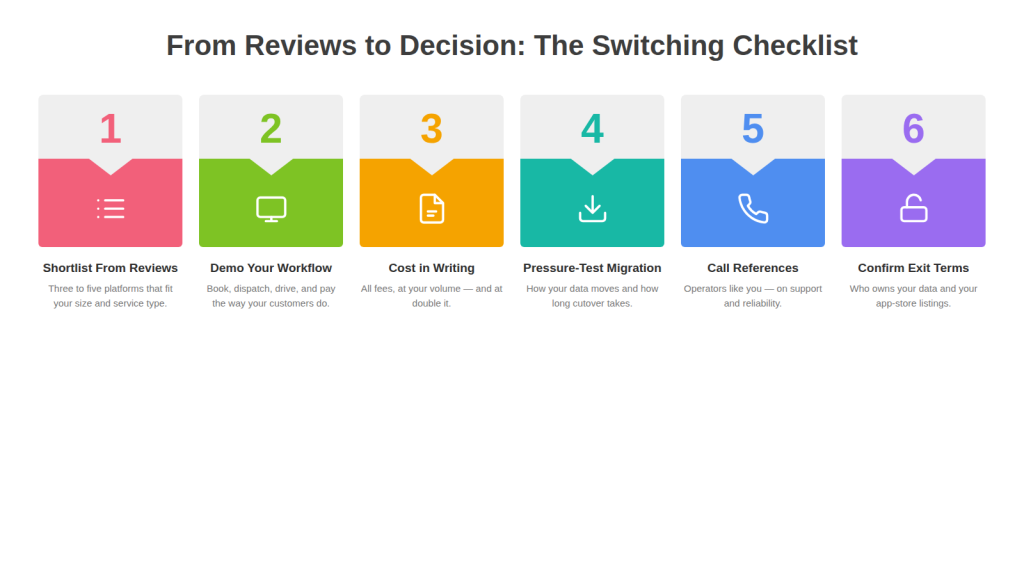
A platform that survives all six is a safer switch than the one with the most stars.
How AllRide Cab approaches evaluation
AllRide Cab is the taxi and ride-hailing product in the AllRide Apps suite — an AI-powered, white-label, all-in-one taxi booking software.
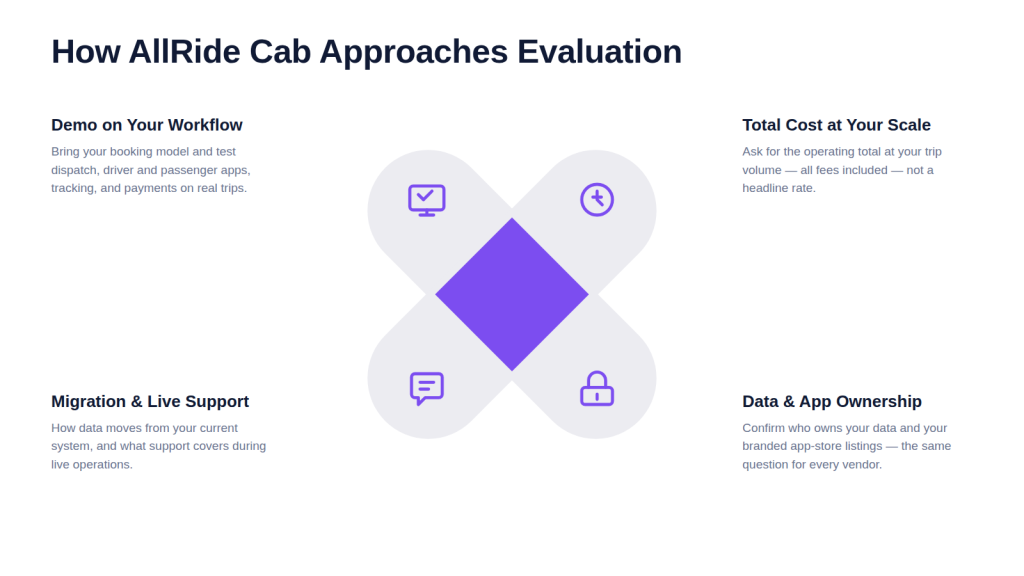
Rather than pointing you to curated testimonials, the more useful thing is to run the comparison above against it directly: bring your booking model, your trip volume, and your migration requirements to a demo and test the platform’s automated dispatch, driver and passenger apps, real-time tracking, payment integration, and reporting on your actual workflow. Ask about total cost at your scale, how migration from your current system works, what support covers during live operations, and who owns your data and apps — the same questions this guide recommends for every platform on your shortlist.
The honest position: don’t switch to AllRide, or anyone, on the strength of reviews alone. Shortlist from reviews, then make the platform prove it fits.
See how AllRide Cab holds up against your comparison — book a free demo.
Frequently asked questions
Are taxi dispatch software reviews reliable?
Taxi dispatch software reviews are reliable for spotting patterns and red flags across many reviewers, but not for judging fit with your specific operation. Filter for reviewers of similar fleet size and service type, prioritize recent and detailed reviews, read the negatives, and treat independent sources as more trustworthy than testimonials on a vendor’s own site. Verify anything decisive with a demo.
How do I compare taxi dispatch software before switching?
Build a shortlist from reviews, then score each platform on the same criteria against your operation: core fit, dispatch capability, driver app, total pricing at your volume, migration support, support quality, scalability, and exit terms. Confirm the top options with a demo run on your own workflow and references from operators of similar size before committing.
What do taxi dispatch software reviews leave out?
Reviews rarely cover the things that decide a switch: real pricing at your trip volume with all fees, how difficult migration was, how support performs under pressure, and how the product handles peak load. These are too specific to your operation for a stranger’s review, so verify them through demos, written quotes, and reference calls.
How much does taxi dispatch software cost?
Taxi dispatch software pricing is usually a monthly subscription per driver, vehicle, or trip, or custom white-label pricing. Total cost also includes setup, branded app fees, payment and map usage, and support tier. Compare the operating total at your real booking volume rather than the headline rate, and watch per-trip pricing, which can outgrow a flat plan as bookings rise.
Should I switch taxi dispatch platforms based on reviews?
No. Use reviews to build a shortlist, but base the switch on a demo run against your own workflow, pricing and migration terms in writing, and references from operators like you. Reviews reveal patterns; they can’t confirm the platform fits your booking model, handles your peak, or migrates your data cleanly, which are the things that actually determine a successful switch.
What’s the best way to trial taxi dispatch software?
Ask for a demo or free trial using your real workflow rather than a generic tour: create a booking the way your customers do, dispatch it, follow it in the driver app, take payment, and pull a report. Test peak-load and failure scenarios, and involve a dispatcher and a driver in the trial, since they’ll surface issues a sales walkthrough won’t.
Conclusion
Reviews are a good place to start a platform switch and a bad place to end one. Read them for patterns, filter them for operators like you, and let them narrow your shortlist — then do the work reviews can’t: demo each option on your own workflow, get pricing and migration in writing, and talk to references who run a fleet like yours.
The best switch isn’t to the highest-rated platform; it’s to the one that proves it fits. To put a platform through exactly that test, book a free AllRide Cab demo and run your own comparison against it.