


 Fleet Management
 Route optimization
 Shuttle Transportation
 Delivery Management
 School Bus Transportation
 Ride Sharing Management
 Airport Transfer Booking
  Vehicle inspection
 Car Rental Management
 Trucking & Logistics
 Food & Beverage
 E-Commerce
 Passenger Transit
 Delivery
 School & Corporate
White Label Taxi App Software: What Fleet Operators Should Compare Before Buying
A white label taxi app is a ready-made passenger and driver app platform that a fleet operator rebrands as their own, launching an app-based service in weeks instead of building from scratch. Before buying, compare the features, who owns the app-store listings, the full cost (not just the headline price), what any “free trial” or “free” version actually includes, and whether the platform scales — because a white-label app is a long-term operational dependency, not a one-off purchase.
Key takeaways
- A white label taxi app rebrands a ready-made platform as your own.
- App-store account ownership is the single most overlooked buying question.
- “Free” and “free trial” white-label offers almost always carry limits or hidden cost.
- Compare total cost of ownership, not the launch price alone.
- White-label is faster and cheaper than custom for most operators.
Why the white-label decision is bigger than it looks
For an operator launching an app-based taxi or ride-hailing service, a white label taxi app is appealing for obvious reasons: your brand, your apps, live in weeks, without a multi-month development project. But the appeal hides a set of decisions that determine whether you actually control your own service or quietly depend on your vendor for it.
The apps carry your logo — but who owns the app-store accounts they’re published under? The price looks reasonable — but what’s the cost once branded apps, per-trip fees, and support are added? The demo looks polished — but does the platform scale when you add vehicles or cities? These are the questions that separate a white-label purchase you’re happy with in two years from one you’re trapped in.
This guide covers what fleet operators should compare before buying a white label taxi app — features, ownership, pricing, the “free” question, and build-versus-buy — so the decision is deliberate rather than driven by the demo.
What is a white label taxi app?
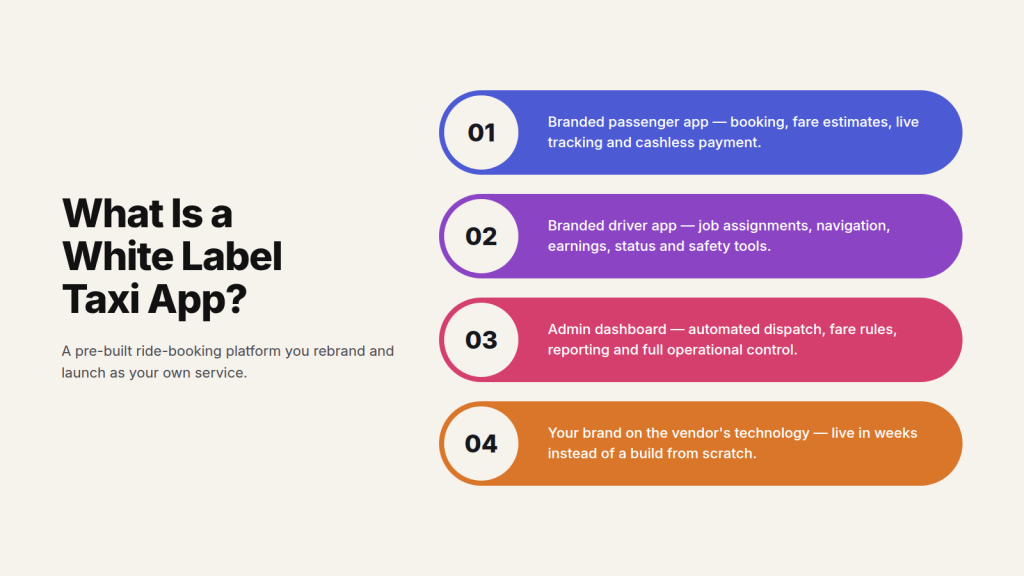
A white label taxi app is a pre-built ride-booking platform — passenger app, driver app, and admin dashboard — that a vendor lets an operator brand and launch as their own. The technology is the vendor’s; the brand, and ideally the customer relationship, is yours.
The category is also searched as white label taxi booking software, white label ride hailing app, white label transportation software, and white label taxi dispatch software. The labels vary, but the core promise is the same: launch an app-based service under your own identity without building the apps from scratch. What differs — sharply — is how much you actually own and control, which is exactly what the comparison below is about.
What fleet operators should compare before buying
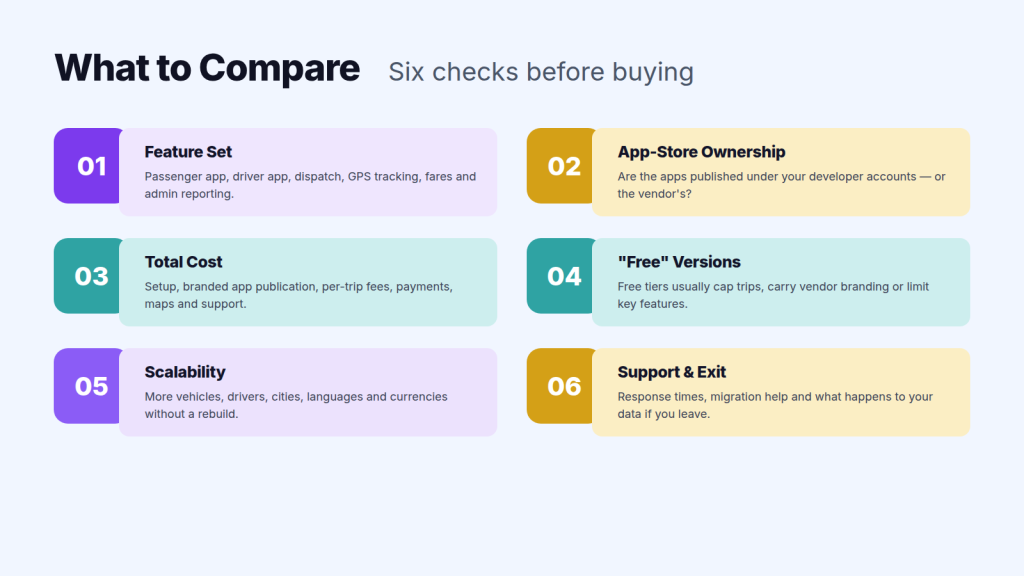
Compare six things before buying a white label taxi app: the feature set, app-store and brand ownership, total cost, what “free” versions include, scalability, and support and exit terms. Feature lists are easy to match; these are where vendors genuinely differ.
1. Features passengers and drivers actually judge you on
Confirm the platform includes a branded passenger app (booking, fare estimates, live tracking, cashless payment, ratings), a driver app (assignments, navigation, earnings, status, safety), automated dispatch, real-time GPS tracking, configurable fares with surge pricing, payments, and an admin dashboard with reporting. The test isn’t feature count — it’s whether the apps feel as polished as the ride-hailing apps your passengers already use.
2. Who owns the app-store listings and the brand
This is the most overlooked question in white-label buying. Ask directly: are the passenger and driver apps published under your Apple and Google developer accounts, or the vendor’s? If the vendor owns the listings, they effectively own your app presence and your reviews, and leaving them can mean losing both. Also confirm what’s brandable (apps, portal, notifications), whether you can change branding later, and whether the white-label extends to the customer relationship or just the logo.
3. Total cost, not the launch price
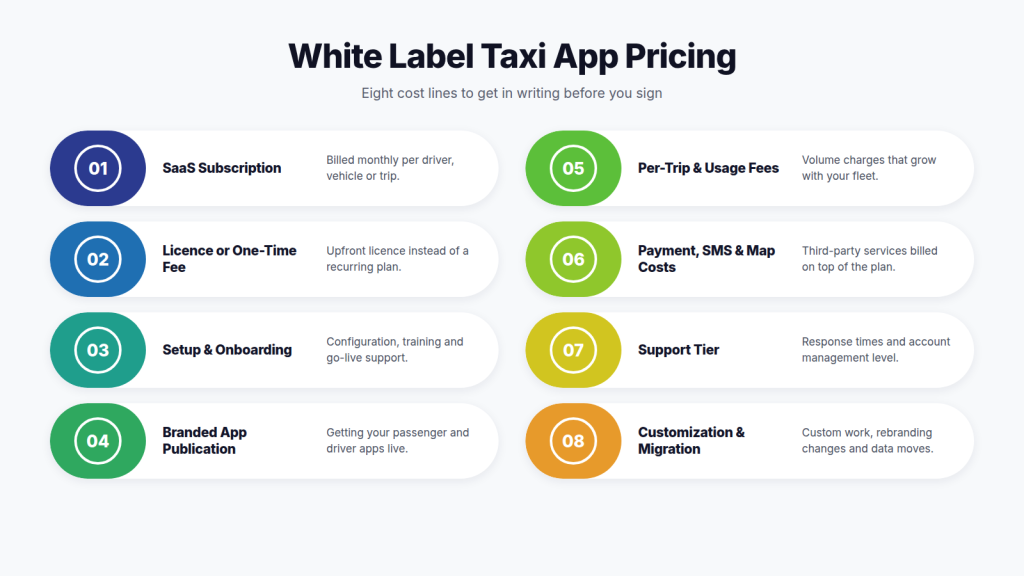
The headline figure rarely reflects the real white label app cost. Get every line in writing: setup and onboarding, branded app publication, per-trip or usage fees, payment and map costs, support tier, customization, and migration. A low monthly price with per-trip fees can cost more at volume than a higher flat plan. Model the total at your expected volume and at double it. (See our guide to transport software pricing models for the full breakdown.)
4. What “free” and “free trial” versions actually include
Searches for white label software free trial, free white label taxi dispatch, and white label apps for sale are common, and free or trial offers do exist — but treat them cautiously. A “free” white-label app usually means limits: capped drivers or trips, the vendor’s branding rather than yours, restricted features, ads, or minimal support. A genuine white-label app (your brand, your app-store presence) almost always involves setup or licensing cost. Use a free trial to test the workflow, but confirm exactly what triggers a paywall before relying on it, and be sceptical of “free white-label,” which is often a contradiction in terms.
5. Scalability
A white label taxi app has to handle growth, not just launch. Confirm it’s cloud-based and scales on demand, supports adding vehicles, drivers, and cities without a rebuild, and offers multi-language and multi-currency if you’ll operate across regions. Check whether you can extend into adjacent services — airport transfers, scheduled rides, delivery — on the same platform rather than buying another.
6. Support, migration, and exit
The vendor becomes an operational dependency. Confirm support hours and response times, what migration help you get, and — critically — what happens to your data and your branded apps if you leave. A vendor who answers exit questions clearly is showing you how the partnership will run.
Build vs buy: white-label, app builder, or custom?
Operators launching an app-based service choose between a ready-made white-label platform, a taxi app builder, or fully custom development — and for most, white-label is the fastest, lowest-risk route to a branded app.
| Route | What it is | Time to launch | Cost profile | Best for |
| White label taxi app | Ready-made platform, rebranded as yours | Weeks | Subscription or licence | Most operators launching a branded app fast |
| Taxi app builder | DIY or low-code assembly | Varies | Low to moderate | Very simple needs or technical teams |
| Custom development | Build apps from scratch | Months | High upfront + maintenance | Genuinely unique models with big budgets |
A quick clarification, since the terms get mixed up: a taxi app builder (or “best white label app builder”) usually implies a DIY or low-code tool you assemble yourself, which suits simple cases but often hits limits as you grow. A white label taxi app platform is a fully built product you rebrand and configure — more capability, less assembly. Custom development gives total control at the highest cost and longest timeline, plus ongoing maintenance you own. For most operators who want a polished branded app without a multi-month build, the ready-made white-label platform is the pragmatic choice — the point of white-label is to skip the build, not to hand you a construction kit.
White label taxi app pricing: what operators pay
White label taxi app pricing is usually a monthly SaaS subscription (per driver, vehicle, or trip), a one-time or licensed fee, or custom pricing — far less than custom app development, but the branded-app and usage fees are where the real cost sits.
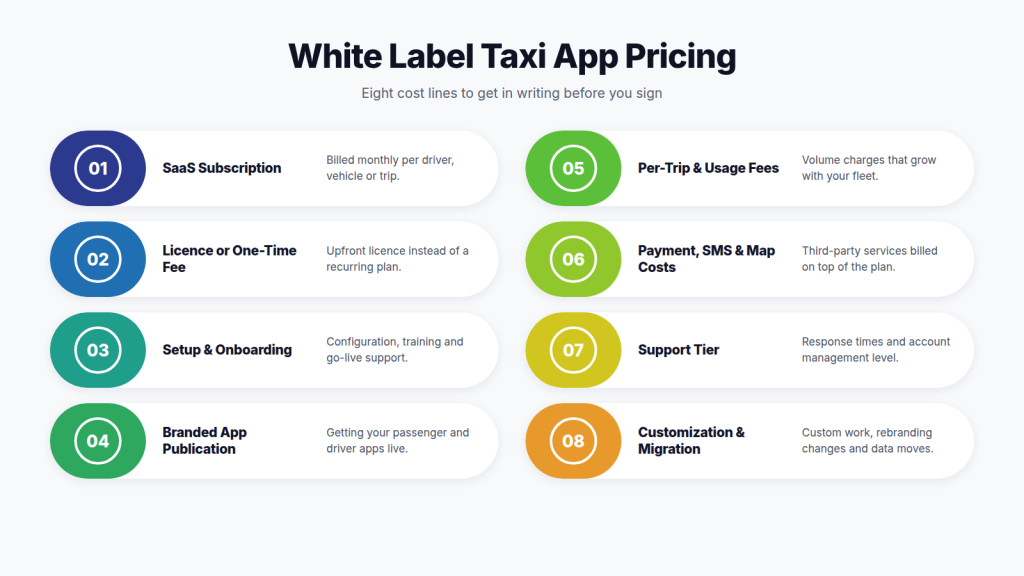
When comparing white label app cost, look past the subscription at app-store publication fees, per-trip or usage charges, payment and SMS/map costs, support tier, and any charge for future branding changes. The cost of launching a white label app is lower and faster than custom mobile app development, which carries a high upfront build plus maintenance — but “white-label” doesn’t mean “cheap,” and the total depends heavily on your volume and how much customization you need. Ask for a written breakdown at your real fleet size.
How AllRide Cab fits white-label operators
AllRide Cab is the taxi and ride-hailing product in the AllRide Apps suite — an AI-powered, white-label platform built and used by several transport businesses globally.
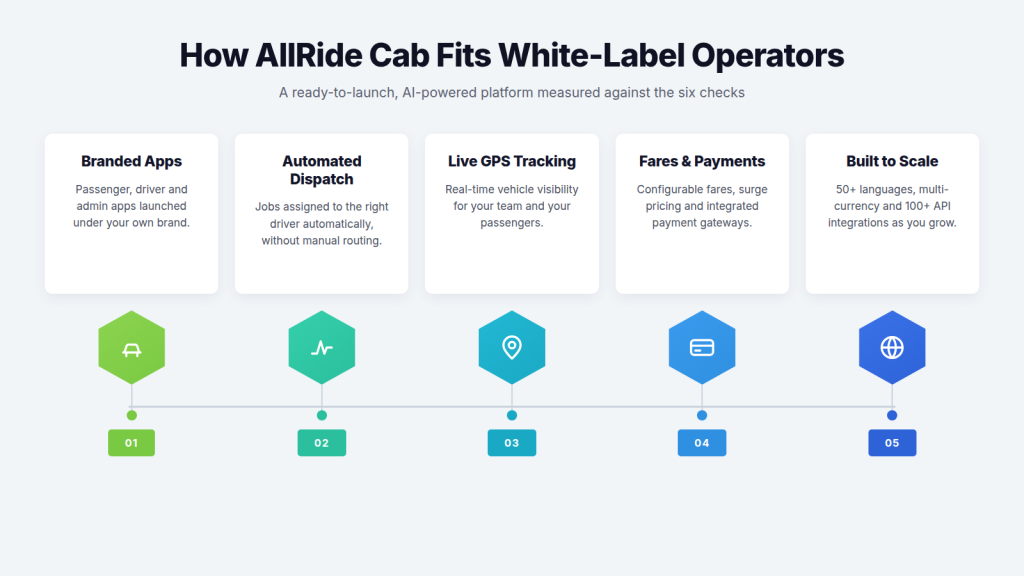
Measured against the comparison above: it provides branded passenger, driver, and admin apps; automated dispatch and driver assignment; real-time GPS tracking; configurable fares with surge pricing; and payment gateway integration. It’s a ready-to-launch white-label platform — so operators avoid the cost and timeline of custom app development — and it’s built to scale, with multi-language and multi-currency support and a wide range of API integrations.
The honest framing: AllRide is a paid platform, not a free tool or a DIY app builder, and the specifics that matter most in white-label buying — app-store account ownership, exact branded-app costs, and what’s included in your package — should be confirmed directly for your configuration rather than assumed. Bring the six comparison points above to the demo and make the platform answer each one.
See how AllRide Cab works as your branded taxi app — book a free demo.
Frequently asked questions
What is a white label taxi app?
A white label taxi app is a ready-made passenger and driver app platform that a fleet operator rebrands and launches as their own, without building the apps from scratch. The vendor provides the technology; the operator provides the brand. It lets a business launch an app-based ride service in weeks under its own identity, at a fraction of custom development cost.
How much does a white label taxi app cost?
White label taxi app pricing is usually a monthly SaaS subscription (per driver, vehicle, or trip), a licensed fee, or custom pricing — far less than building custom apps. Beyond the base rate, factor in app-store publication, per-trip or usage fees, payment and map costs, support, and customization. Get a written breakdown at your real fleet size, since the total varies widely by volume and configuration.
Is there a free white label taxi app?
Genuinely free, fully branded white-label taxi apps are rare. Free or freemium offers usually cap drivers or trips, carry the vendor’s branding rather than yours, limit features, or offer minimal support — and true white-label (your brand, your app-store presence) almost always involves setup or licensing cost. Treat “free white-label” cautiously and confirm exactly what’s included before relying on it.
Who owns the apps in a white label taxi app?
It depends on the vendor, and it’s the most important question to ask. In some arrangements the apps are published under the operator’s own Apple and Google developer accounts; in others, the vendor owns the listings. Vendor-owned listings mean the vendor effectively controls your app presence and reviews, so confirm ownership before buying.
What’s the difference between a white label taxi app and a taxi app builder?
A white label taxi app is a fully built platform you rebrand and configure. A taxi app builder is usually a DIY or low-code tool you assemble yourself, which suits simple cases but often hits limits as you grow. White-label gives more capability with less assembly; an app builder gives more control but more work. Most operators launching a branded service choose white-label.
Is a white label taxi app better than building a custom app?
For most operators, yes. A white label taxi app launches in weeks under your brand at a fraction of custom cost, with maintenance handled by the vendor. Custom development gives total control but costs more, takes months, and adds ongoing maintenance you own. Build custom only if your model is genuinely unique and you have the budget and technical team.
Can I get a demo or free trial of a white label taxi app?
Many vendors offer a demo or free trial. Use it to test your real launch scenario rather than a generic tour: book a ride in the passenger app, dispatch it, follow it in the driver app, take a payment, and check the admin dashboard. Confirm what a free trial includes and what triggers paid features before committing.
Conclusion
A white label taxi app is one of the fastest ways to launch a branded, app-based ride service — but “fast” shouldn’t mean “unexamined.” The operators who buy well compare the features, nail down who owns the app-store listings, model the true total cost, see through “free” offers, and confirm the platform scales and lets them leave. Those six points turn a polished demo into a decision you can live with.
Bring them to every vendor conversation. To see how a white-label platform handles your branding, dispatch, apps, payments, and growth, book a free AllRide Cab demo and run it against your plan.