


 Fleet Management
 Route optimization
 Shuttle Transportation
 Delivery Management
 School Bus Transportation
 Ride Sharing Management
 Airport Transfer Booking
  Vehicle inspection
 Car Rental Management
 Trucking & Logistics
 Food & Beverage
 E-Commerce
 Passenger Transit
 Delivery
 School & Corporate
Best Taxi Dispatch Software for Small Businesses in 2026: A Practical Buyer Comparison
Small fleet taxi dispatch software is dispatch and booking software sized and priced for operators running roughly 5 to 50 vehicles, where the priority is fast setup, low predictable cost, and a system one or two people can run without an IT team. The best choice for a small business is rarely the most powerful platform or the cheapest — it’s the one that automates booking and dispatch, comes with a driver and passenger app, and won’t cost more than the admin time it saves. This guide compares paid, free, and open-source options honestly, including what “free” really costs.
Key takeaways
- Small fleets need simplicity and predictable cost, not enterprise features.
- Free and open-source tools exist but carry real hidden costs.
- An all-in-one platform (booking, dispatch, apps) beats stitching tools.
- Per-trip pricing can outgrow flat plans as bookings rise — model it.
- Buy for the fleet you’ll run in two years, not just today.
What small taxi businesses actually need
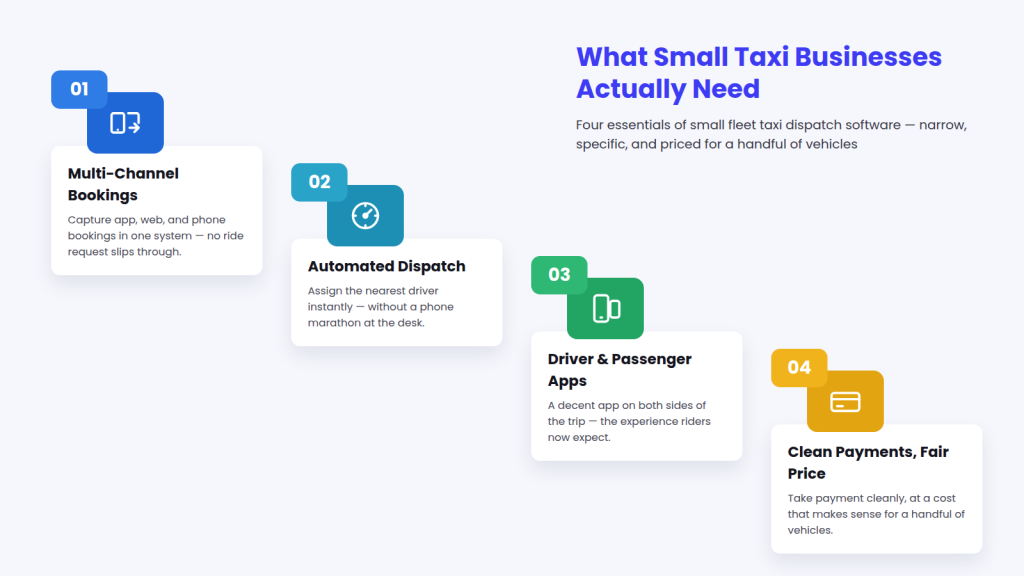
A small taxi operator has different problems from a national fleet. You’re likely running dispatch with one or two people, competing against ride-hailing apps on service, and watching every recurring cost. What you need from software is narrow and specific: capture bookings from every channel, assign the nearest driver without a phone marathon, give drivers and passengers a decent app, take payment cleanly, and do it all at a price that makes sense for a handful of vehicles.
What you don’t need is an enterprise platform built for multi-region operators, priced and configured for a scale you’re years from reaching. Overbuying is as costly a mistake as underbuying — you pay for complexity you can’t use and spend weeks configuring features you’ll never switch on.
So the real question isn’t “what’s the best taxi dispatch software?” in the abstract. It’s “what’s the best small fleet taxi dispatch software for my booking model, my budget, and my growth plan?” This comparison works through the paid, free, and open-source routes, what each genuinely costs, and how to choose.
What to look for in small fleet taxi dispatch software
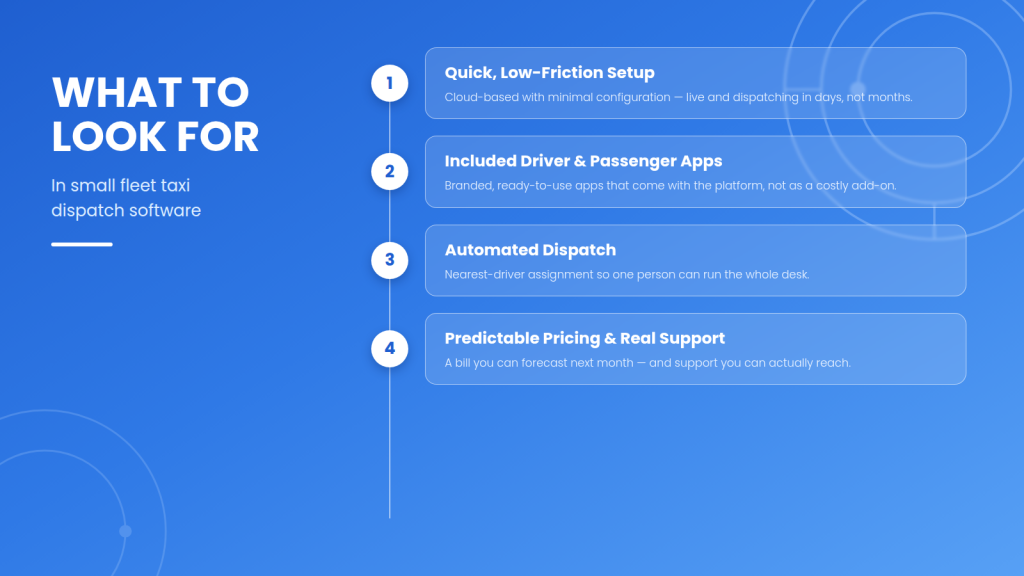
For a small fleet, prioritize fast setup, an included driver and passenger app, automated dispatch, transparent pricing, and reliable support — in that order. Depth of features matters far less than whether you can be live and dispatching within days.
- Quick, low-friction setup — cloud-based, minimal configuration, live in days not months
- Included apps — a branded or ready passenger app and driver app, not a costly add-on
- Automated dispatch — nearest-driver assignment so one person can run the desk
- Multi-channel booking — app, web, and phone feeding one system
- Transparent, predictable pricing — you can forecast next month’s bill
- Payments — integrated, with clean reconciliation
- Support you can reach — small teams can’t afford long outages
- Room to grow — the platform scales if you add vehicles or services
Notice what’s not at the top: advanced analytics, telematics, multi-region tools. Those matter at scale; for a small fleet they’re noise that adds cost and setup time.
Paid, free, or open-source: the three routes for small operators
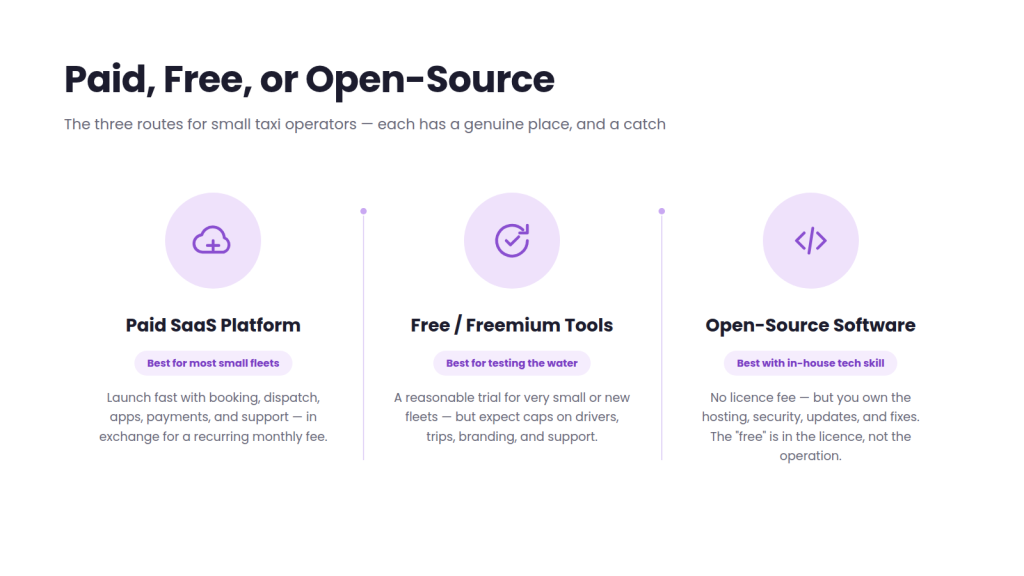
Small operators generally choose between paid SaaS platforms, free or freemium tools, and open-source software — and the right route depends on your budget, technical skill, and tolerance for maintenance. Each has a genuine place, and each has a catch.
| Route | Best for | The real trade-off |
| Paid SaaS platform | Most small fleets wanting to launch fast | Recurring subscription cost |
| Free / freemium tools | Testing the water, very small or new fleets | Feature limits, branding, and scaling caps |
| Open-source software | Operators with in-house technical skill | You own hosting, security, and maintenance |
Paid SaaS taxi dispatch software
This is the default for most small operators. A cloud subscription gets you booking, automated dispatch, driver and passenger apps, payments, and support without buying servers or hiring developers. You trade a monthly fee for speed, reliability, and someone else handling updates and security. The main task is matching the pricing model to your volume so it stays economical at a small scale.
Free and freemium taxi dispatch software
Searches for free taxi dispatch software and free taxi booking dispatch software are common, and free or freemium tools do exist. They can be a reasonable way to test a workflow or run a very small operation. But “free” almost always has limits: a capped number of drivers or trips, no white-label branding (the app carries the vendor’s name, not yours), restricted features, ads, or limited support. As soon as you grow or need your own brand, you hit a paywall — so treat free tools as a trial, not a foundation.
Open-source taxi dispatch software
Open-source taxi dispatch software (and free open-source options) appeals to operators who want control and no licence fee. The software itself is free, but running it is not: you own the hosting, security patching, updates, integrations, and fixes, which usually means paying a developer or having the skills in-house. For a technically capable operator it can work well; for a typical small taxi business without IT staff, the total cost and risk of self-hosting often exceed a paid subscription. The “free” is in the licence, not the operation.
What does small fleet taxi dispatch software really cost ?
For a small fleet, taxi dispatch software typically runs as a monthly SaaS subscription priced per driver, per vehicle, or per trip, and the smartest comparison is total monthly cost at your real booking volume — not the headline rate. The cost of a taxi dispatch software is rarely just the sticker price.
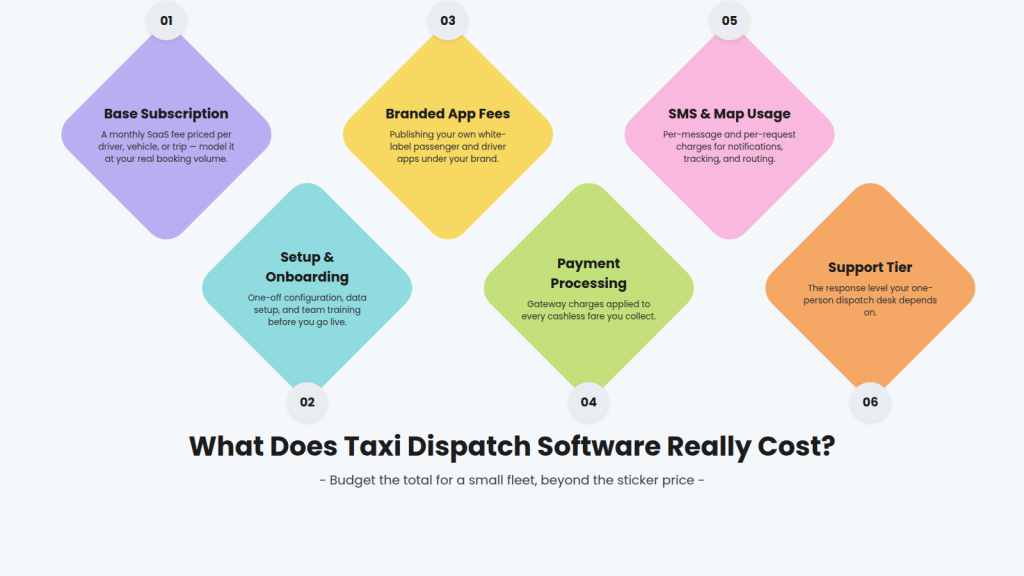
Watch the pricing basis closely. A per-trip model can look cheap at low volume and become your biggest cost as bookings rise; a flat plan is predictable but may include capacity you don’t use yet. Beyond the subscription, budget for setup and onboarding, branded app fees, payment-processing charges, SMS and map usage, and support tier. When comparing a cheap taxi dispatch software against a slightly pricier one, the deciding question is what each replaces — if the “expensive” option ends the manual admin two staff spend hours on, it’s often the cheaper choice overall. (For a full breakdown, see our guide to transport software pricing models; for published price ranges, insert verified vendor figures.)
How to choose: a small-business decision path
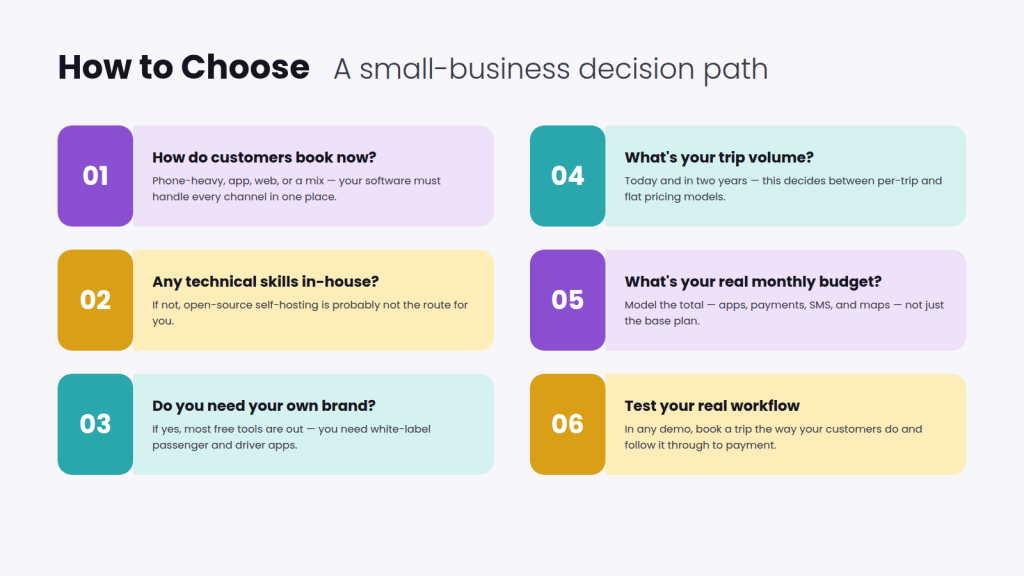
Start from your booking model and budget, then rule routes out fast: no technical team rules out open-source, need for your own brand rules out most free tools, and per-trip volume tells you which pricing model fits. A short, honest process beats a long feature comparison.
- How do customers book now? Phone-heavy, app, web, or a mix — your software must handle all your channels in one place.
- Do you have technical skills in-house? If not, open-source self-hosting is probably not for you.
- Do you need your own brand? If yes, most free tools are out, and you need white-label apps.
- What’s your trip volume, and where will it be in two years? This decides between per-trip and flat pricing.
- What’s your realistic monthly budget? Model the total, including apps and payment fees, not just the base plan.
- Test it on your real workflow. In any demo, book a trip the way your customers do and follow it through dispatch, the driver app, and payment.
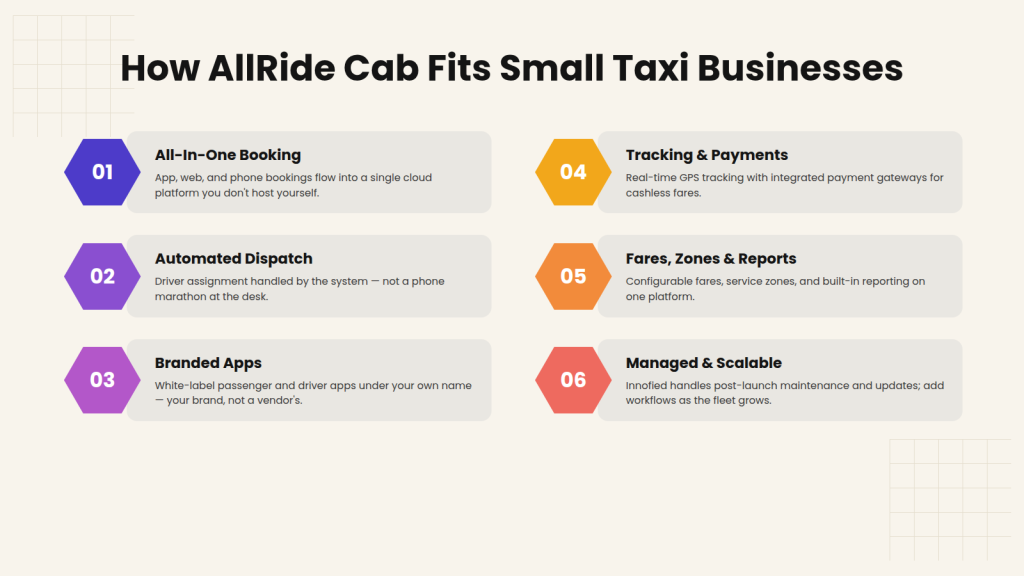
How AllRide Cab fits small taxi businesses
AllRide Cab is the taxi and ride-hailing product in the AllRide Apps suite — an AI-powered, white-label platform used by several transport businesses globally, from small operators to large fleets.
For a small business specifically, the relevant point is that it’s an all-in-one taxi booking software rather than a set of tools to assemble: booking across app, web, and phone; automated dispatch and driver assignment; branded passenger and driver apps; real-time GPS tracking; payment gateway integration; configurable fares and service zones; and reporting — on one cloud platform you don’t host or maintain yourself. Because it’s ready-to-launch and scalable, a small fleet can start with the functionality it needs now and add workflows as it grows, without migrating to a different system later.
See how AllRide Cab works for a fleet your size — book a free demo.
Frequently asked questions
What is the best taxi dispatch software for small businesses?
The best taxi dispatch software for a small business is the one that launches fast, includes driver and passenger apps, automates dispatch, and stays affordable at low trip volume — not the most feature-heavy platform. For most small fleets that means a managed, all-in-one SaaS platform; for technically capable operators, open-source is an option, though self-hosting costs offset the free licence.
Is there free taxi dispatch software?
Yes, free and freemium taxi dispatch software exists, but it comes with limits: capped drivers or trips, no custom branding, restricted features, or minimal support. It’s useful for testing or a very small operation, but most fleets outgrow it quickly. Treat free tools as a trial rather than a long-term foundation, and check what triggers a paywall before relying on one.
Is open-source taxi dispatch software a good idea?
Open-source taxi dispatch software is free to licence but not free to run — you own the hosting, security, updates, and fixes, which usually requires developer skills or budget. For a technically capable operator it offers control and no licence fee; for a typical small taxi business without IT staff, the total cost and risk of self-hosting often exceed a managed paid platform.
How much does taxi dispatch software cost for a small fleet?
Small fleet taxi dispatch software is usually a monthly SaaS subscription priced per driver, vehicle, or trip. Beyond the base rate, budget for setup, branded app fees, payment processing, SMS and map usage, and support. Compare total monthly cost at your real booking volume, and watch per-trip pricing, which can rise faster than a flat plan as bookings grow.
What is all-in-one taxi booking software?
All-in-one taxi booking software combines booking, dispatch, driver and passenger apps, tracking, payments, and reporting in a single platform, rather than requiring separate tools that you integrate yourself. For small operators it’s usually the simpler and cheaper route, because it avoids the setup, cost, and reconciliation work of stitching multiple systems together.
Can a small taxi company compete with ride-hailing apps?
Yes. With modern small fleet taxi dispatch software, a small operator can offer app booking, live tracking, accurate ETAs, and cashless payment — the same core experience passengers expect from ride-hailing — while keeping local service and relationships that big platforms can’t match. The software closes the technology gap; local service is the competitive edge.
What’s the difference between taxi booking and taxi dispatch software?
Taxi booking software focuses on capturing and managing reservations. Taxi dispatch software adds the operational step of assigning drivers and vehicles to those bookings, plus tracking and workflow. Most modern platforms, including all-in-one taxi company management software, combine both, which is what a small operator generally wants rather than two separate tools.
Conclusion
For a small taxi business, the best software isn’t the most powerful or the cheapest — it’s the one that fits. A managed, all-in-one platform gets most small fleets live fast with their own brand and predictable costs; free tools suit testing; open-source suits the technically capable who can absorb the maintenance. Name your booking model, your budget, and your growth plan first, then choose the route that matches.
Whatever you shortlist, test it on your real workflow before committing. To see how an all-in-one platform handles a small fleet’s booking, dispatch, apps, and payments, book a free AllRide Cab demo and run it against your own operation.