


 Fleet Management
 Route optimization
 Shuttle Transportation
 Delivery Management
 School Bus Transportation
 Ride Sharing Management
 Airport Transfer Booking
  Vehicle inspection
 Car Rental Management
 Trucking & Logistics
 Food & Beverage
 E-Commerce
 Passenger Transit
 Delivery
 School & Corporate
Best Ride Hailing Software for Operators in 2026: Features, Pricing & Scalability
Ride hailing software is the platform an operator uses to run an app-based, on-demand taxi service — passenger and driver apps, automated dispatch, GPS tracking, fares and payments in one system. For most operators the fastest way to launch is a white-label ride hailing platform (often searched as “Uber clone software”) rather than building an app from scratch. The right choice comes down to features, total pricing, and how well the platform scales as your fleet and bookings grow.
Key takeaways
- Ride hailing software runs app-based, on-demand taxi services end to end.
- Building from scratch is slow and costly; white-label launches fast.
- “Uber clone” is simply the common search term for white-label ride-hailing platforms.
- Compare features, total cost, and scalability — not how the app looks in a demo.
- White-label lets operators launch under their own brand quickly.
Why ride hailing software is a launch decision, not just a purchase
Starting an app-based taxi or ride-hailing service is a different problem from running a traditional fleet. You’re not just dispatching cars — you’re launching a two-sided product, with a passenger app people will compare to the ride-hailing apps they already use and a driver app your drivers have to adopt. Get the technology right and you can compete locally against the big platforms; get it wrong and you’ve spent months and a large budget on an app nobody wants to open.
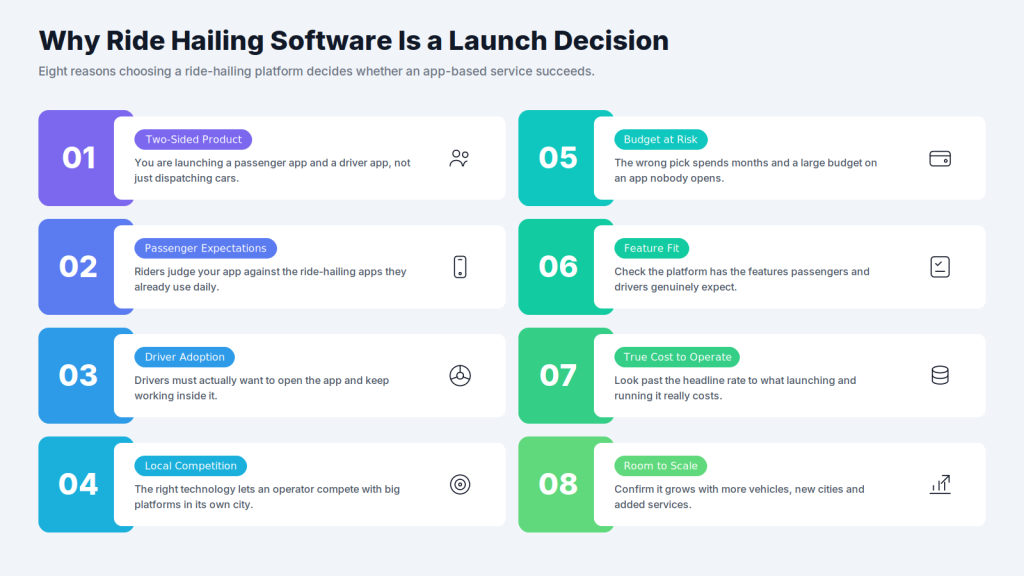
That’s why choosing ride hailing software is really about three things: whether it has the features passengers and drivers expect, what it truly costs to launch and operate, and whether it can scale as you add vehicles, cities, or services. This guide works through all three, plus the central build-versus-buy decision every operator faces first.
What is ride hailing software?
Ride hailing software is an integrated platform that lets a business offer on-demand and scheduled rides through branded mobile apps, connecting passengers, drivers, dispatch, tracking, and payments. It’s what turns a fleet of vehicles into an app-based service.
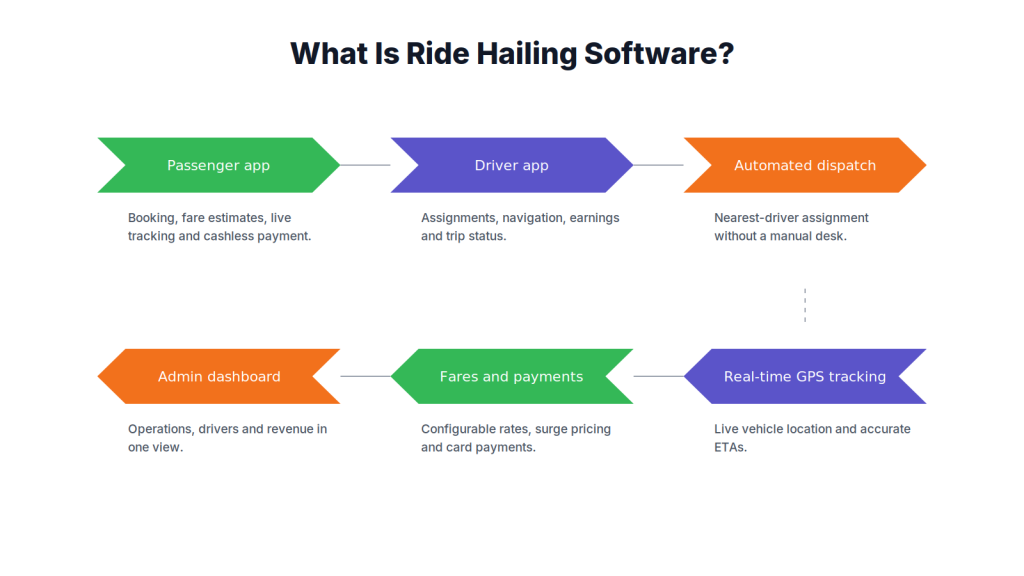
A complete ride hailing platform typically includes a passenger app for booking and payment, a driver app for assignments and navigation, an admin dashboard for operations, automated dispatch, real-time GPS tracking, fare and surge pricing, and payment processing. The term overlaps with on demand taxi software and passenger transportation software — the labels differ, but the core job is the same: run an app-based ride service end to end.
Build vs buy: custom, Uber clone, or white-label platform?
Operators launching a ride-hailing service generally choose between building custom apps from scratch, buying a ready-made white-label platform (often marketed as “Uber clone software”), or assembling one with an app builder — and for most, white-label is the fastest, lowest-risk route.
A quick note on terminology: many searches use “Uber clone app,” “Uber clone script,” or “Uber clone software.” In practice these refer to ready-made, white-label ride-hailing platforms that let an operator launch an app-based service with the features people expect from major ride-hailing apps — booking, tracking, cashless payment — under the operator’s own brand. They aren’t literal copies of Uber’s proprietary product; they’re pre-built platforms for the same category of service.
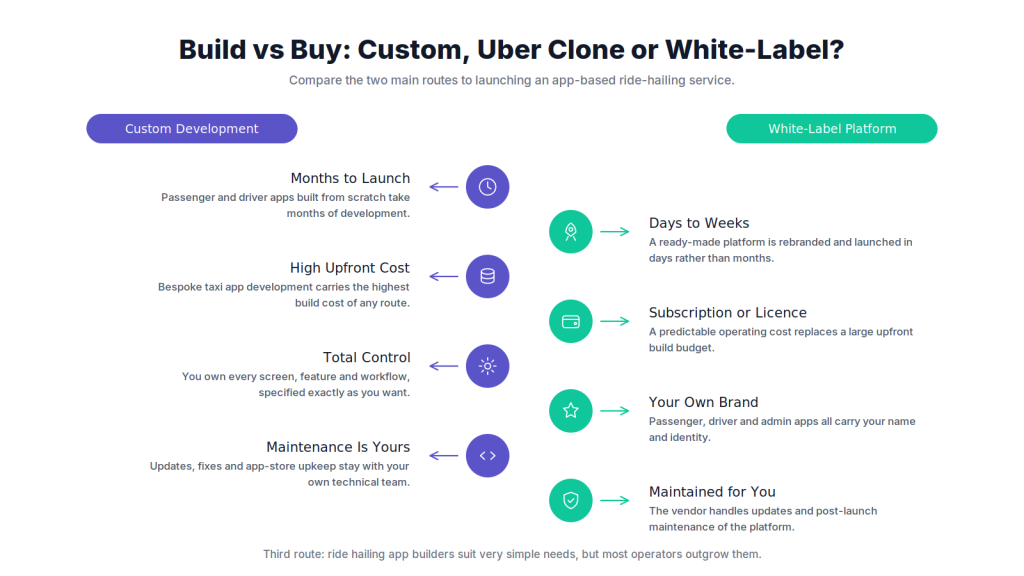
| Route | What it is | Time to launch | Cost profile | Best for |
| Custom development | Build passenger and driver apps from scratch | Months | High upfront (see taxi app development cost) | Unique models with large budgets and dev teams |
| White-label / “Uber clone” platform | Ready-made platform, rebranded as yours | Days to weeks | Subscription or licence | Most operators launching fast under their own brand |
| Ride hailing app builder | DIY or low-code assembly | Varies | Low to moderate | Very simple needs or technically capable teams |
Custom development gives total control but costs the most and takes longest — taxi app development cost for bespoke passenger and driver apps runs high, and you own all the maintenance. White-label platforms (the “Uber clone” category, and terms like white label ride hailing app) let you launch quickly under your own brand at a fraction of custom cost, which is why most operators choose this route. App builders and taxi app builder tools suit very simple cases but often hit limits as the operation grows. For the majority of operators, a ready-to-launch white-label ride hailing platform is the pragmatic middle: your brand, most of the features, none of the multi-month build.
Must-have ride hailing software features
The features that matter most are the ones passengers and drivers judge you on — easy booking, live tracking, transparent fares, cashless payment, and reliable dispatch — plus the admin tools to run it all.
- Branded passenger app — booking, fare estimates, live tracking, cashless payment, ratings, and trip history.
- Driver app — assignments, navigation, earnings, status updates, and safety features.
- Automated dispatch — nearest-driver assignment so wait times stay low without a manual desk.
- Real-time GPS tracking — live vehicle location and accurate ETAs for passengers and operators.
- Fare management and surge pricing — configurable rates, zones, and demand-based pricing to protect margin.
- Payment processing — integrated gateways, multiple methods, and clean reconciliation.
- Admin dashboard and analytics — operations, drivers, revenue, and demand in one view.
- White-label branding — your name, logo, and identity on every app and touchpoint.
- Multi-service support — the option to add airport transfers, scheduled rides, or shared trips later.
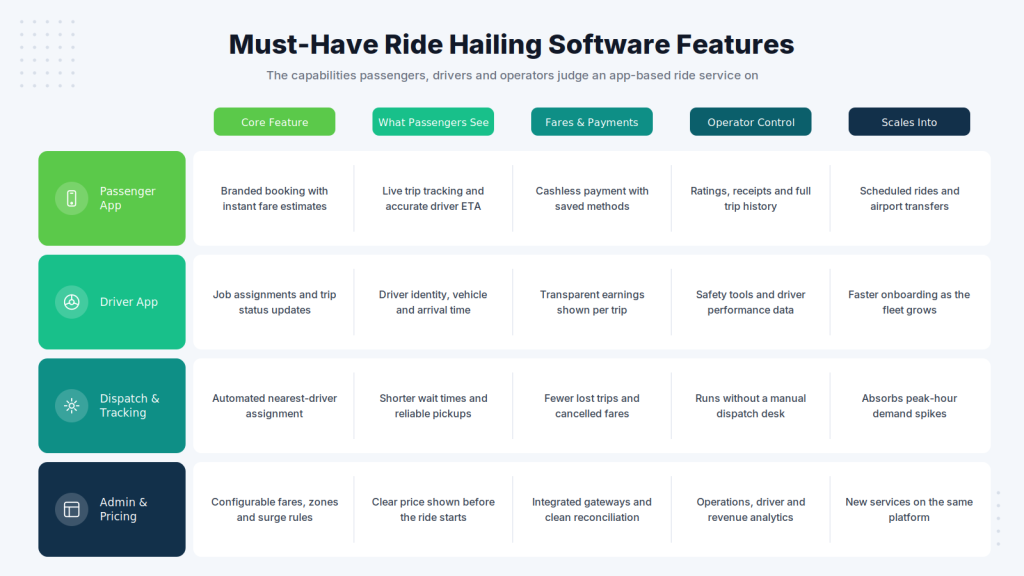
The test isn’t feature count — it’s whether these work together smoothly enough that your app feels as polished as the ride-hailing apps passengers already use.
Ride hailing software pricing: what operators actually pay
Ride hailing software is usually priced as a monthly SaaS subscription (per driver, vehicle, or trip), a one-time or licensed fee, or custom white-label pricing — and it costs far less than building custom apps, but the headline rate isn’t the whole bill.
When comparing ride hailing software pricing, look past the subscription at the full picture: setup and onboarding, branded app publication to the app stores, payment-processing and SMS/map usage fees, support tier, customization, and migration. Custom development carries a high upfront taxi app development cost plus ongoing maintenance; white-label shifts that to a predictable operating cost. Model the total at your expected trip volume and at double it, since per-trip pricing can scale faster than a flat plan. The right question isn’t “what’s cheapest to buy?” but “what will this cost to launch and operate, and how fast can it earn?”
Scalability: can the platform grow with you?
A ride-hailing platform has to handle not just today’s launch but tomorrow’s growth — more drivers, more trips, demand spikes, new cities, and new services — without a rebuild.
Check that the platform is cloud-based and scales on demand, so a Friday-night surge or a new market doesn’t overload it. Confirm it can add vehicles, drivers, and locations without a new procurement cycle, and that it supports multiple languages, currencies, and payment methods if you’ll operate across regions. Ask whether you can extend into adjacent services — airport transfers, scheduled rides, corporate accounts, or delivery — on the same platform rather than buying another. Scalability is what separates software you launch on from software you’ll outgrow in a year.
How AllRide Cab fits ride-hailing operators
AllRide Cab is the taxi, cab, and ride-hailing product in the AllRide Apps suite — an AI-powered, white-label ride hailing platform.
For operators launching or scaling an app-based service, it covers the three areas this guide is about. On features: branded passenger, driver, and admin apps; automated dispatch and driver assignment; real-time GPS tracking; configurable fares with surge pricing; and payment gateway integration. On pricing: it’s a ready-to-launch white-label platform, so operators avoid the high upfront cost and long timeline of custom app development and start on a configuration sized to their needs. On scalability: the cloud-based, customizable architecture supports growth across vehicles and services, with multi-language and multi-currency support and several API integrations.
The honest framing: if you need a genuinely unique product no platform can express, custom development may be worth its cost and timeline. But for most operators who want to launch an app-based ride service quickly, under their own brand, and scale it, a white-label ride hailing platform is the lower-risk, faster route — which is exactly the need people are searching for when they look up “Uber clone software.”
See how AllRide Cab works for your ride-hailing service — book a free demo.
Frequently asked questions
What is ride hailing software?
Ride hailing software is an integrated platform that lets a business run an app-based, on-demand taxi service through branded passenger and driver apps, with automated dispatch, GPS tracking, fare management, and payments. It connects passengers, drivers, and operators in one system, and is what turns a fleet into a ride-hailing service that competes with app-based platforms.
What is Uber clone software?
“Uber clone software” is the common search term for a ready-made, white-label ride-hailing platform that lets an operator launch an app-based service with the features passengers expect — booking, live tracking, cashless payment — under their own brand. It isn’t a literal copy of Uber’s product; it’s a pre-built platform for the same category of on-demand ride service, chosen to avoid building apps from scratch.
Is it better to build a ride hailing app or buy white-label software?
For most operators, buying a white-label platform is faster, cheaper, and lower-risk than building from scratch. Custom development gives full control but costs more and takes months, plus ongoing maintenance. A white-label ride hailing app launches in days to weeks under your own brand. Build custom only if your model is genuinely unique and you have the budget and technical team.
How much does ride hailing software cost?
Ride hailing software is usually a monthly SaaS subscription (per driver, vehicle, or trip), a licensed fee, or custom white-label pricing — far less than custom app development. Factor in setup, app-store publication, payment and map fees, support, and migration beyond the base rate. Custom taxi app development costs much more upfront and adds ongoing maintenance, which is why most operators choose white-label.
Does ride hailing software include passenger and driver apps?
Most complete ride hailing platforms include both a passenger app and a driver app, plus an admin dashboard. White-label platforms let you brand these as your own. Confirm whether the apps are included in the plan or charged separately, and who owns the app-store listings, before choosing a vendor.
Can I get a demo or free trial of ride hailing software?
Many vendors offer a demo or free trial. Use it to test your real launch scenario rather than a generic tour: book a ride in the passenger app, dispatch it, follow it in the driver app, take a payment, and check the admin dashboard. Involve a driver and a dispatcher, since they’ll surface issues a sales walkthrough won’t.
Can ride hailing software scale to multiple cities or services?
A good platform can. Look for cloud-based architecture that scales on demand, multi-language and multi-currency support, and the ability to add vehicles, cities, and services — airport transfers, scheduled rides, delivery — on the same system. Scalability is what lets you launch small and grow without migrating to a different platform later.
Conclusion
Launching a ride-hailing service is a technology decision as much as a fleet one. The best ride hailing software gives passengers and drivers an experience that rivals the big apps, at a cost that makes the business work, on a platform that scales as you grow. For most operators, a ready-to-launch white-label platform — the category people search for as “Uber clone software” — beats a slow, expensive custom build.
Decide on features, total cost, and scalability, then test your top option on a real launch scenario. To see how a white-label platform handles booking, dispatch, apps, payments, and growth, book a free AllRide Cab demo and run it against your plan.