


 Fleet Management
 Route optimization
 Shuttle Transportation
 Delivery Management
 School Bus Transportation
 Ride Sharing Management
 Airport Transfer Booking
  Vehicle inspection
 Car Rental Management
 Trucking & Logistics
 Food & Beverage
 E-Commerce
 Passenger Transit
 Delivery
 School & Corporate
Everything You Need To Know About Taxi Dispatch Software
Taxi businesses no longer compete only on the number of vehicles they operate. They compete on how quickly they can accept a booking, assign the right driver, provide an accurate ETA, complete the trip, collect payment and turn the resulting data into better operational decisions.
That is where modern taxi dispatch software comes in.
Quick answer: Taxi dispatch software is a digital platform that connects ride bookings, drivers, vehicles, dispatching, GPS tracking, routing, fares, payments and operational reporting in one system. Modern platforms can automatically match trips with suitable drivers, track vehicles in real time and help operators manage more bookings without relying entirely on phone calls, radio communication or manual spreadsheets.
Key takeaways
- Taxi dispatch software connects passenger bookings, drivers, vehicles and dispatch operations.
- Automated dispatch can assign trips according to factors such as driver availability, proximity and operating rules.
- Modern systems increasingly combine booking, GPS tracking, routing, payments, analytics and driver management.
- Cloud-based deployment, APIs, automation and real-time fleet visibility have become important considerations for taxi operators in 2026.
- The best platform is not necessarily the one with the longest feature list. It is the one that fits your fleet, booking model, operating geography, integrations and growth plans.
What is taxi dispatch software?
Taxi dispatch software is the operational system a taxi or private-hire company uses to receive bookings and coordinate trips between passengers, dispatchers, drivers and vehicles.
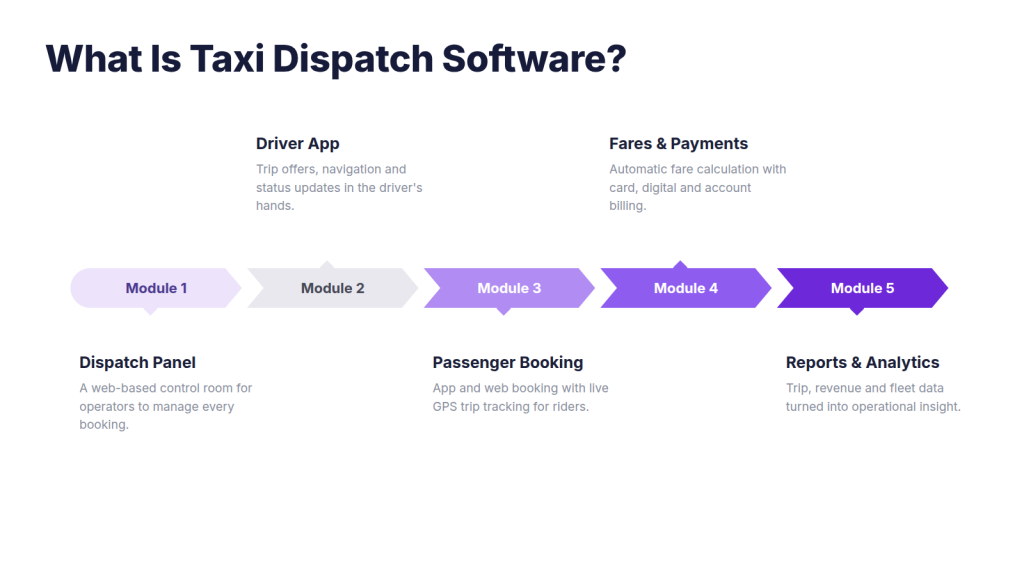
A typical system includes several connected components:
- a web-based dispatch panel for operators;
- a driver application;
- a passenger booking application or web booking form;
- real-time GPS and trip tracking;
- fare calculation and payment functionality;
- driver and vehicle management;
- notifications and passenger communication;
- reporting and analytics.
Instead of a dispatcher manually checking which driver is available for every incoming request, the system can use live operational information to recommend or automatically make an assignment.
For smaller operators, this can reduce administrative work. For larger fleets, it creates the structure needed to manage hundreds or thousands of bookings without multiplying manual processes.
How does taxi dispatch software work?
Although every platform is different, most modern taxi dispatch systems follow a similar workflow.
1. A passenger creates a booking
A booking may arrive through a passenger app, website booking form, dispatcher, call centre, corporate account or scheduled reservation.
The system records information such as:
- pickup and destination;
- requested time;
- passenger details;
- vehicle requirements;
- estimated fare;
- special instructions.
2. The dispatch system checks available resources
The platform reviews drivers and vehicles that meet the requirements of the trip.
Depending on the software, assignment rules may consider location, driver status, availability, service zones, vehicle type, scheduled commitments or trip priority.
3. A driver receives the trip
The booking is offered or assigned to a suitable driver through the driver app.
The driver can receive pickup information, passenger details, navigation assistance and trip instructions without relying on repeated calls from a dispatcher.
4. The trip is tracked
Once the driver is en route, real-time GPS information allows the dispatch team to monitor the trip.
Passengers can also receive status updates and estimated arrival information where those capabilities are enabled.
5. Fare and payment are processed
The system can calculate the fare according to configured rates, distance, time, zones or other pricing rules.
Depending on the business model, payment may be completed by card, digital payment method, account billing or another supported method.
6. Trip data becomes operational data
After the ride is completed, information such as trip volume, revenue, driver activity and fleet utilisation can feed into reporting and analytics.
That turns the dispatch system from a booking tool into an operational intelligence platform.
What changed in taxi dispatch software in 2026?
Taxi dispatch software is not new. What has changed is the breadth of the system. Operators increasingly expect their dispatch software to coordinate the full ride lifecycle rather than perform one isolated function.
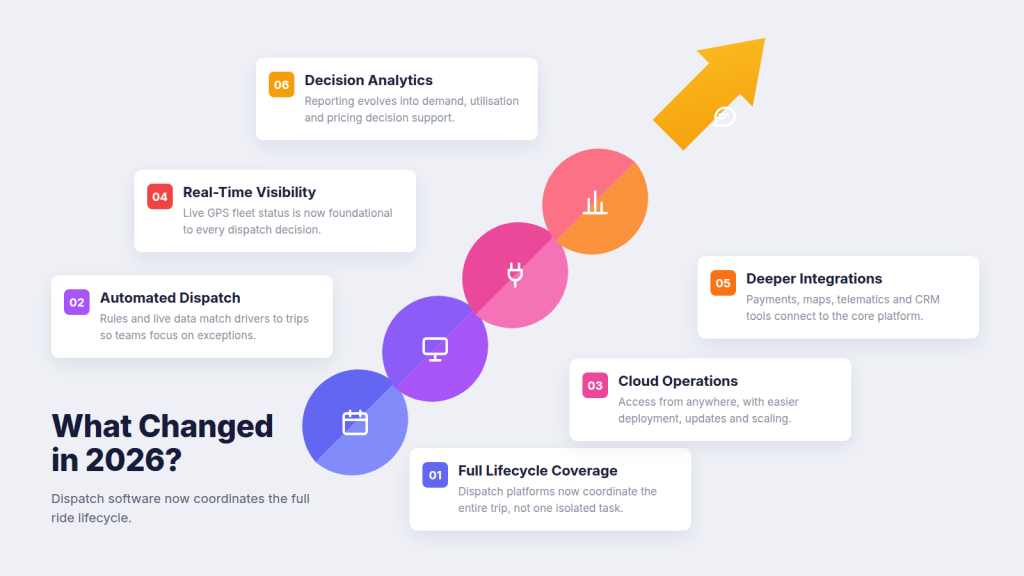
Automated dispatch is becoming more important
Manual dispatch can work when booking volume is low. As a fleet grows, however, manually comparing every driver, vehicle and ride becomes difficult to scale.
Automated dispatch uses predefined rules and live operational information to match suitable drivers with trips.
The goal is not simply to remove the dispatcher. It is to automate repetitive matching decisions so dispatch teams can focus on exceptions, customer issues and higher-value operational decisions.
Cloud-based operations are becoming the standard expectation
Cloud dispatch software gives authorised teams access to operational information without depending on one computer inside a dispatch office.
For multi-location or growing businesses, this can make deployment, updates and remote access easier. (For a deeper look at how cloud deployment reduces downtime, and how cloud compares with on-premise, see our companion guides on cloud dispatch and downtime and SaaS vs on-premise dispatch.)
When evaluating a cloud platform, operators should also ask vendors about availability, backups, security and incident-recovery procedures instead of assuming that every cloud product offers the same level of resilience.
Real-time fleet visibility is becoming foundational
Dispatch decisions are more useful when they are based on the current location and status of the fleet.
Real-time GPS tracking can help dispatch teams see available vehicles, monitor active trips and provide more useful arrival information.
Combined with routing capabilities, that information can also help operators reduce unnecessary mileage and respond more effectively when traffic or schedules change.
Integrations now matter almost as much as core features
A taxi company rarely operates one technology system.
Payments, communication, analytics, mapping, accounting, telematics and customer-management tools may all be part of the operating environment.
A dispatch platform therefore needs to be evaluated not only for what it does internally, but also for how easily it connects with the rest of the technology stack.
Analytics is moving from reporting to decision support
Basic reporting tells an operator what happened.
More useful systems help teams identify patterns in demand, vehicle utilisation, revenue, driver activity and operating performance.
That can support decisions about staffing, fleet allocation, service areas, pricing and expansion.
What features should taxi dispatch software have in 2026?
The right feature set depends on the business, but these capabilities should be considered during most evaluations. (For a focused breakdown of the features that most affect day-to-day operations, see our guide to the top taxi management software features.)
|
Feature |
Why it matters |
|
Online and app booking |
Gives customers convenient ways to request or schedule rides |
|
Automated dispatch |
Reduces repetitive manual trip assignment |
|
Driver management |
Centralises driver profiles, availability and operational information |
|
Vehicle management |
Helps manage vehicles and their assignment to trips |
|
Real-time GPS tracking |
Gives dispatchers live fleet visibility |
|
Route optimisation |
Helps drivers and operators make more efficient routing decisions |
|
Fare management |
Applies configured rates consistently |
|
Digital payments |
Simplifies passenger payment and reconciliation |
|
Notifications |
Keeps passengers and drivers informed during the trip |
|
Geofencing and zones |
Helps operators manage different service areas and pricing rules |
|
Reporting and analytics |
Turns trip information into business insight |
|
Role-based access |
Limits system functions according to user responsibilities |
|
API integrations |
Connects the platform with other business systems |
|
White-label options |
Allows operators to provide a branded passenger and driver experience |
A vendor evaluation should go beyond asking whether a feature exists.
Ask how the feature works in a real dispatch environment.
For example, two systems may both advertise “automated dispatch”, but one may only select the nearest vehicle while another allows operators to configure service zones, priorities, driver availability and other rules.
That difference can have a much larger operational impact than the feature name suggests. (When you reach the shortlisting stage, our guide to the fleet dispatch software features to compare covers how to test this properly.)
What are the benefits of taxi dispatch software?
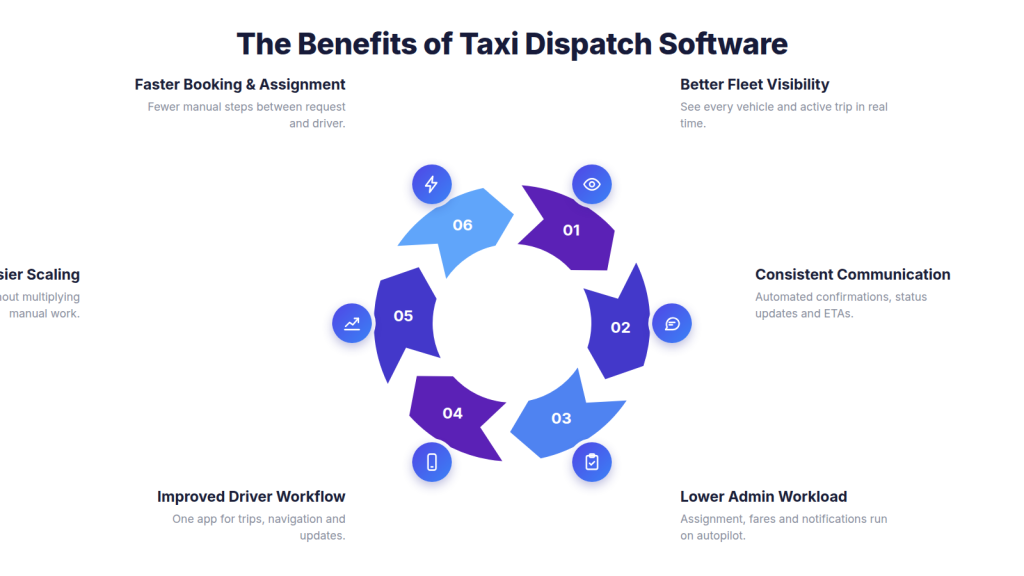
Faster booking and assignment
A connected booking and dispatch process reduces the number of manual steps between receiving a customer request and assigning a driver.
Better fleet visibility
Dispatchers can see where vehicles are and what trips they are completing instead of relying entirely on phone or radio updates.
More consistent customer communication
Automated status notifications, booking confirmations and ETAs can give passengers better visibility into their trip.
Lower administrative workload
Automating repetitive work such as assignment, fare calculation and notifications can allow staff to concentrate on exceptions and customer service.
Improved driver workflow
A dedicated driver application can centralise trip assignments, navigation, booking information and status updates. (The driver app is often what determines whether a system succeeds in the field.)
Better operational decisions
Trip and fleet data can reveal demand patterns, service bottlenecks, utilisation trends and other information that is difficult to identify through spreadsheets alone.
Easier scaling
Without software, an increase in bookings often creates an almost proportional increase in administrative work.
A well-designed dispatch platform makes it possible to handle additional trips, drivers and vehicles with a more structured operating model.
How much does taxi dispatch software cost?
There is no universal price for taxi dispatch software.
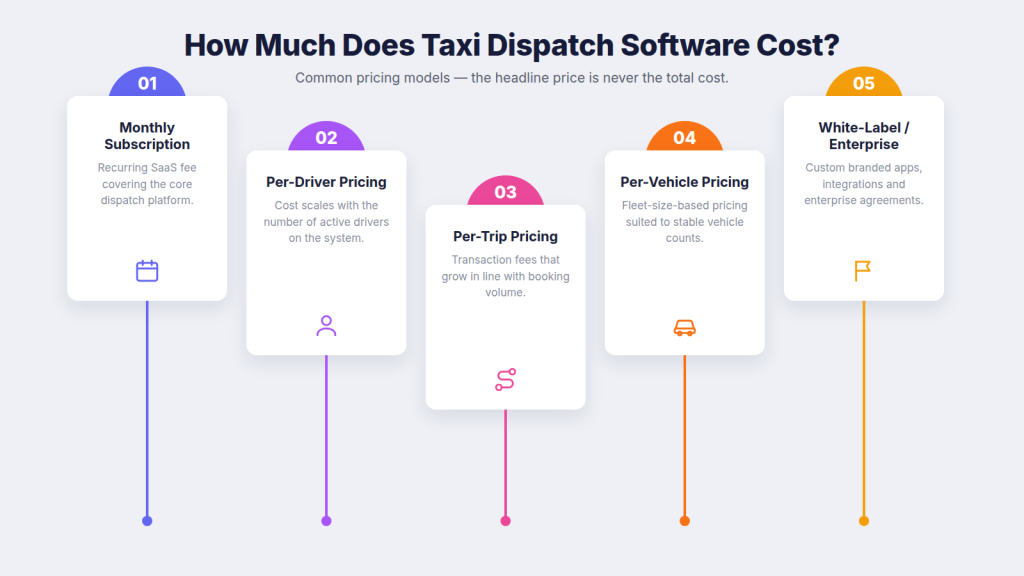
Providers use several pricing models, including:
- monthly subscriptions;
- annual subscriptions;
- per-driver pricing;
- per-vehicle pricing;
- per-trip or transaction pricing;
- enterprise agreements;
- custom white-label implementations.
The headline subscription price also does not always represent the total cost. (Our guide to transport software pricing models breaks down SaaS, licensed and white-label options in detail.)
When comparing vendors, ask about:
- onboarding;
- data migration;
- branded passenger applications;
- branded driver applications;
- payment-processing charges;
- SMS or communication charges;
- map and routing usage;
- custom integrations;
- training;
- technical support;
- additional users;
- additional service regions;
- customisation.
The better question is therefore not simply:
“What is the cheapest taxi dispatch software?”
It is:
“What will this system cost us to operate at our expected trip volume, and what manual systems or additional tools will it replace?”
Cloud taxi dispatch software vs on-premise software
Cloud software is generally hosted and maintained by the software provider or its infrastructure partners, while traditional on-premise systems rely more heavily on infrastructure controlled by the operator.
Cloud systems can provide advantages such as easier remote access, simpler updates and reduced responsibility for local server management.
However, buyers should still evaluate:
- service availability;
- data security;
- backup policies;
- system recovery;
- data portability;
- support response;
- integration availability.
The word “cloud” alone is not a guarantee of quality.
How should you choose taxi dispatch software?
Start with your operating model rather than a vendor’s feature list.
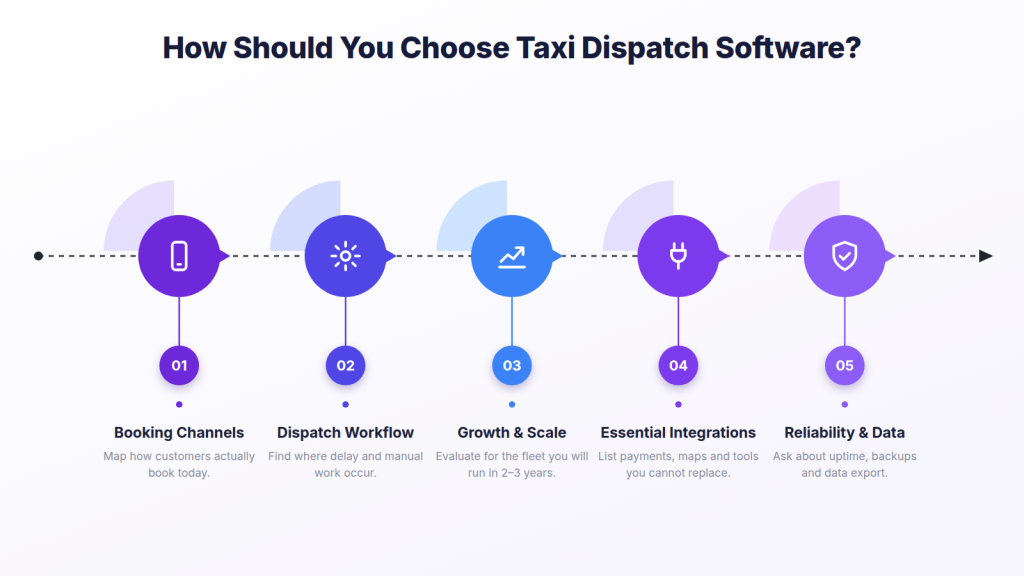
Ask these questions before purchasing:
How do customers currently book?
Do most requests come through phone calls, an app, a website, corporate clients or pre-booked reservations?
How are drivers currently assigned?
Identify which part of your current workflow creates the most delay or manual work.
What type of services do you run?
On-demand taxi trips, airport transfers, chauffeur services and scheduled transportation can require different workflows.
How large could the fleet become?
Evaluate the software for the business you expect to operate in two or three years, not only the fleet you have today.
Which integrations are essential?
List payment gateways, communication systems, maps, accounting tools, telematics or other platforms that cannot be replaced.
How much control do you need over your brand?
Determine whether a generic customer application is sufficient or whether you need fully branded passenger and driver apps.
What happens when the system fails?
Ask vendors directly about uptime, backups, support and incident recovery.
Can your data be exported?
Avoid creating unnecessary dependency on a provider that makes operational data difficult to retrieve.
How is pricing affected by growth?
Model the cost at your current trip volume and at the volume you expect after expansion.
When you reach the demo stage, take a structured test plan into every vendor call — our taxi dispatch software demo checklist covers the twelve things worth testing before you buy, and if you’re weighing named vendors, the transportation reservation software alternatives guide helps you build the shortlist.
How AllRide Cab approaches taxi dispatch
AllRide Cab brings booking, dispatch, drivers, vehicles and passenger-facing functionality into one connected platform.
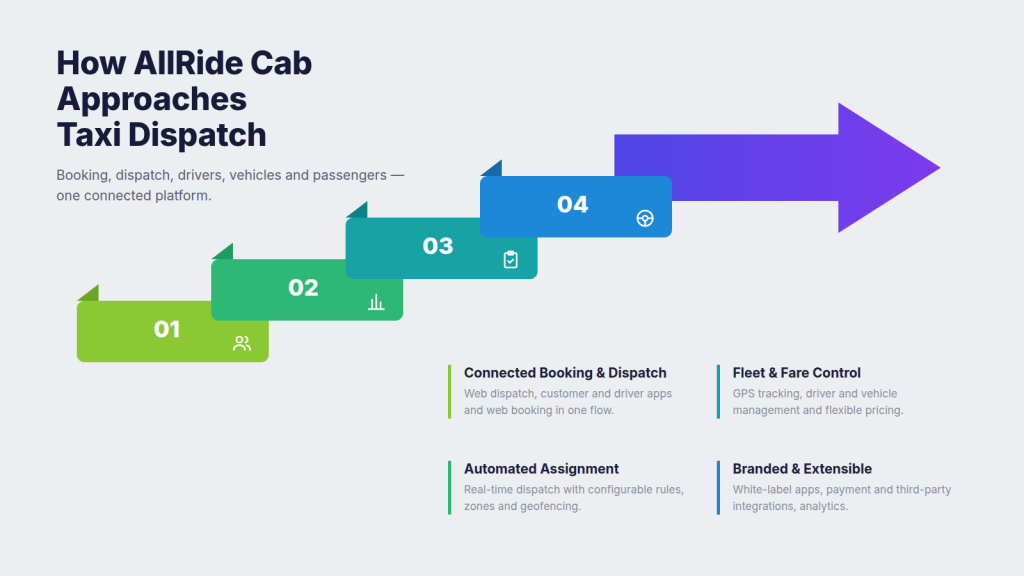
Depending on the selected configuration, operators can use capabilities including:
- web-based dispatch;
- customer and driver applications;
- web booking;
- real-time booking and dispatch;
- automated driver assignment;
- GPS tracking and navigation;
- driver and vehicle management;
- fare calculation;
- payment integrations;
- notifications;
- service zones and geofencing;
- reporting and analytics;
- configurable pricing;
- third-party integrations;
- branded applications.
The platform is designed for businesses that want to begin with the functionality they need today while retaining the ability to configure additional workflows as operations expand.
Rather than evaluating these features in isolation, the important question is how they work together inside your actual dispatch process.
Evaluating taxi dispatch software for your fleet?
Book a personalized AllRide Cab demonstration to walk through your booking model, fleet structure and dispatch requirements with the solution team — book a free demo.
Frequently asked questions
What is the main purpose of taxi dispatch software?
The main purpose of taxi dispatch software is to coordinate ride bookings with available drivers and vehicles. Modern platforms also manage tracking, fares, customer communication, payments, drivers, vehicles and reporting.
Can small taxi companies use dispatch software?
Yes. Small fleets can use taxi dispatch software to reduce manual administration and create more consistent booking and dispatch processes. The important consideration is choosing a pricing model that remains economical at lower trip volumes.
What is automated taxi dispatch?
Automated dispatch is a system that automatically recommends or assigns a driver to a booking according to configured rules and live information such as availability and location.
Is taxi dispatch software the same as taxi booking software?
The terms overlap but are not always identical. Taxi booking software focuses primarily on receiving and managing reservations. Taxi dispatch software additionally coordinates the operational process of assigning drivers and vehicles to those bookings. Many modern platforms provide both capabilities in one system.
Does taxi dispatch software include GPS tracking?
Most modern platforms provide real-time vehicle tracking directly or through integrated mapping and GPS services. Buyers should confirm exactly what tracking information is available to dispatchers, drivers and passengers.
Can taxi dispatch software handle scheduled trips?
Many modern systems support both on-demand and advance bookings. Operators running airport transfers, chauffeur services or other scheduled transportation should specifically test recurring, pre-booked and time-sensitive trip workflows during vendor demonstrations.
Does taxi dispatch software support online payments?
Many systems integrate with payment gateways to support card or digital payments. Available payment methods vary by vendor, country and payment provider.
What should I ask during a taxi software demo?
Ask the vendor to demonstrate your real workflow rather than a generic product tour. Provide an example booking and ask them to show how it is created, dispatched, tracked, modified, paid for and reported.
Final thoughts
Taxi dispatch software in 2026 is no longer just a digital replacement for the dispatcher radio.
It is increasingly the operating layer connecting bookings, drivers, vehicles, passengers, routing, payments and business data.
That makes choosing a platform a strategic decision.
Look beyond feature checklists and evaluate how well the system fits your real booking process, how it integrates with the tools you already use, how its pricing changes as you grow and how much operational control it gives your team.
The right platform should make running a larger taxi operation simpler rather than simply adding another piece of software to manage.
See how AllRide Cab could work for your fleet — book a personalised demo with the AllRide solution team.