


 Fleet Management
 Route optimization
 Shuttle Transportation
 Delivery Management
 School Bus Transportation
 Ride Sharing Management
 Airport Transfer Booking
  Vehicle inspection
 Car Rental Management
 Trucking & Logistics
 Food & Beverage
 E-Commerce
 Passenger Transit
 Delivery
 School & Corporate
How a Ride Hailing Software Helps You Manage Peak-Hour Demand?
Ride sharing software is a transportation platform that matches passengers with compatible journeys so they can share part or all of a vehicle trip — managing bookings, rider compatibility, vehicle capacity, driver assignment, shared-route sequencing, fares, real-time tracking, payments and reporting. The hard part is not putting two passengers in one vehicle. It is determining whether two journeys are genuinely compatible, and what to do when one of them changes.
Key takeaways
- Ride sharing and ride hailing are related but not identical product categories.
- A good shared-ride match considers destination, time, capacity and acceptable detour — not simply passenger proximity.
- Shared rides need different routing logic from private point-to-point trips.
- Operators should track match rate, occupancy, wait time and detour time alongside normal fleet metrics.
- AI can support matching, routing and demand prediction, but operating rules and human oversight remain essential.
- The complete platform matters more than the customer mobile interface alone.
Ride sharing is more complicated than putting two passengers in the same vehicle. A successful shared ride requires the software to determine whether several journeys are actually compatible: are the riders travelling in the same general direction? Can both pickups happen within acceptable time windows? Are enough seats available? How much extra travel will the first passenger experience? What happens if one rider cancels?
That is the real job of ride sharing software — connecting booking, rider matching, driver and vehicle assignment, capacity, shared-route planning, fares, tracking, payments and reporting through one operating workflow.
What is ride sharing software?
Ride sharing software manages journeys where more than one passenger or passenger group shares vehicle capacity.
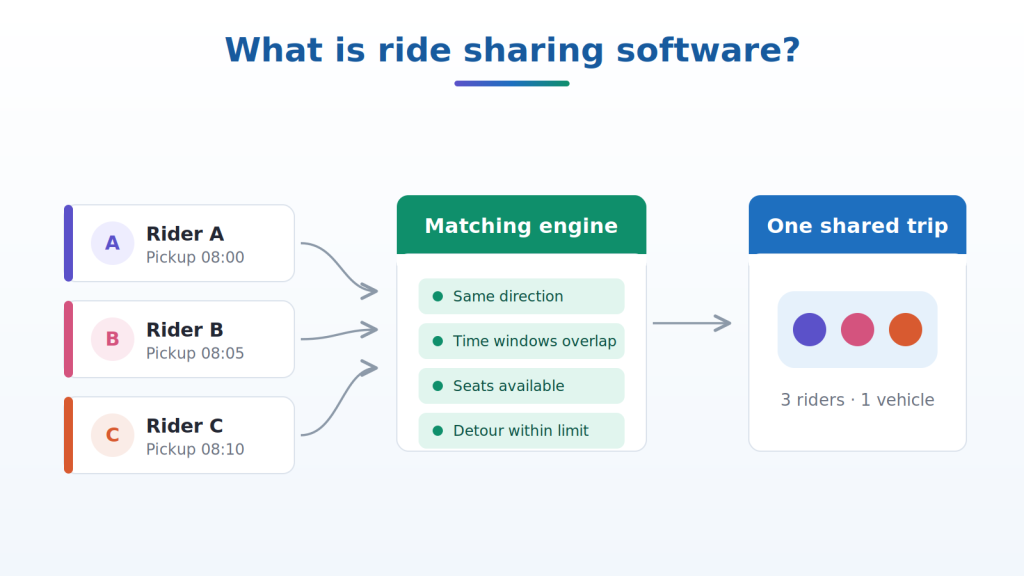
That may mean two commuters who work in the same district share a car for most of their journeys. It may mean a corporate transport operator combines employees travelling from nearby neighbourhoods. Or it may mean an on-demand operator adds another passenger to a trip when their pickup and destination can be served without creating an excessive detour.
The Federal Transit Administration defines ridesharing around passengers sharing a destination or filling otherwise unused seats, while separately identifying ride-splitting and transportation-network-company services.
This distinction matters because ordinary ride-hailing software mainly asks which driver should perform this passenger’s trip? Ride-sharing software has another problem to solve: which passenger trips can be combined without making the service unacceptable for the riders already on board?
Ride sharing vs ride hailing: what is the difference?
The terms are frequently used interchangeably, but operators should distinguish them.
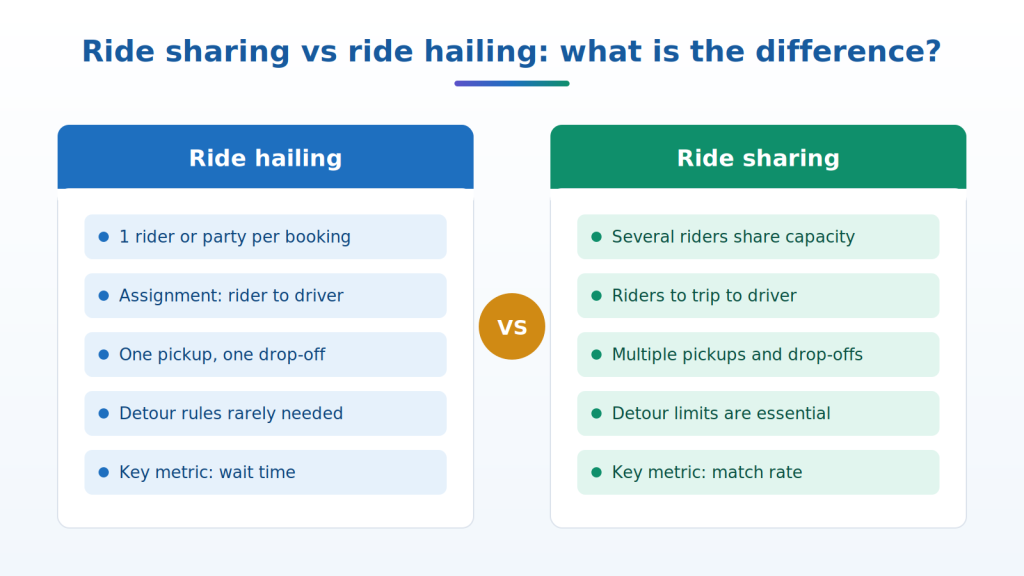
Federal Highway Administration research likewise distinguishes general ride-hailing from ridesharing products where several rider parties can be paired on overlapping trips. The two software categories should not be treated as identical.
What does ride sharing software include?
A complete shared-ride system normally requires several connected components — and the customer and driver mobile interfaces are components of the software, not the software’s entire definition.
| Software component | Purpose |
| Customer booking | Capture passenger journey requests |
| Ride-matching engine | Determine which journeys are compatible |
| Dispatch panel | Manage vehicles, drivers and active trips |
| Driver software | Receive shared-trip assignments and stop sequence |
| Capacity management | Track available seats |
| Route engine | Sequence pickups and drop-offs |
| Fare engine | Calculate per-trip, per-seat or shared fares |
| GPS tracking | Monitor trip progress |
| Notifications | Inform passengers about pickup and changes |
| Payment | Process trip payment |
| Reporting | Measure utilisation and service quality |
| APIs | Connect external systems |
AllRide’s Ride Sharing software describes matching, tracking, route optimisation, driver management, demand forecasting, capacity utilisation, fare calculation and external integrations as connected capabilities.
How does ride sharing software match riders?
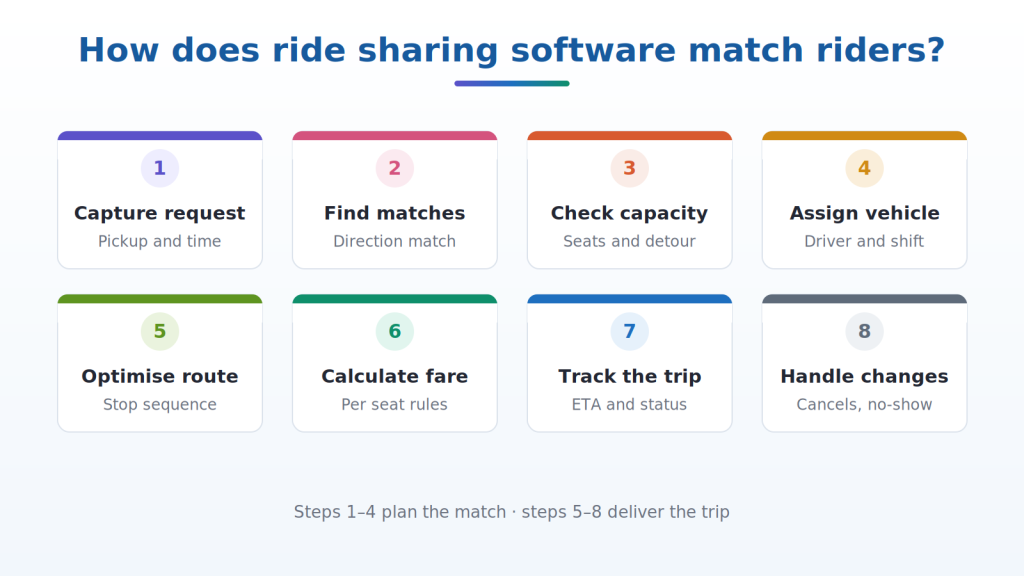
1. Capture the ride request
Every shared journey begins with a request. The software may collect pickup location; destination; desired pickup time; acceptable pickup window; passenger count; seat requirements; service type; accessibility requirements; and payment method. For scheduled services, the passenger may also provide a recurring pattern — for example, Monday to Friday, pickup between 8:00 and 8:15, destination the central business district.
Those details become matching constraints.
2. Find compatible journeys
The system then looks for other passenger requests that could reasonably share the same vehicle. Two passengers are not compatible simply because their homes are close. The software should consider direction of travel; pickup proximity; destination proximity; pickup windows; arrival requirements; remaining seat capacity; and service rules.
Consider two passengers. Passenger A wants pickup between 8:00 and 8:10, destination downtown. Passenger B wants pickup between 8:05 and 8:15, destination three blocks from A’s. These trips may be compatible.
Now consider Passenger C, travelling in the opposite direction. The fact that C is only a kilometre from A’s pickup does not make the journeys a good match.
3. Check capacity and detour limits
This is where shared-ride software differs substantially from normal dispatch. The platform needs to know vehicle seating capacity; seats already committed; accessibility requirements; luggage or other capacity requirements; additional travel time; and maximum acceptable detour.
Suppose a trip takes 20 minutes privately. Adding another rider might turn it into a 24-minute trip, which may be acceptable. If another match increases it to 42 minutes, the software should normally reject that combination as exceeding the operator’s configured service rules.
A useful matching principle. A shared trip should satisfy compatible direction + compatible time + available capacity + acceptable detour — not simply nearest passenger + nearest driver.
4. Match rider, driver and vehicle
Once the passenger combination is feasible, the system still needs an eligible vehicle and driver. Selection may consider availability; current location; shift; vehicle capacity; service zone; existing commitments; and operating rules.
The platform may perform assignment automatically or allow dispatchers to intervene. Automation should make repeatable decisions faster — not remove human control from unusual situations.
5. Optimise the shared route
A private trip might be simply Pickup A → Drop-off A. A shared trip could require Pickup A → Pickup B → Drop-off A → Drop-off B. But another sequence may work better: Pickup A → Pickup B → Drop-off B → Drop-off A.
The route engine therefore evaluates more than the shortest path. It has to balance total vehicle time; individual passenger delay; pickup windows; drop-off commitments; traffic; capacity; and operating rules. This is genuinely harder than private-trip routing, because improving one passenger’s experience usually worsens another’s.
6. Calculate the shared fare
There is no universal fare model for shared rides. Operators may use fixed per-seat fares; zone pricing; mileage-based fares; subscriptions; commuter passes; discounted shared fares; percentage sharing; or configurable rules.
A shared fare does not have to mean dividing one fare equally between every passenger. If Passenger A travels 12 km and Passenger B joins for the final 7 km, an operator may reasonably use a different rule than a 50/50 split. Whatever the model, the pricing should be transparent before passengers confirm the ride.
7. Inform passengers and track the trip
Passengers need enough information to understand the shared journey: confirmed pickup; estimated arrival; vehicle details; driver information; expected trip duration; fare; trip status; and changes in ETA.
Real-time tracking is particularly useful when several pickups are involved, because the passenger needs to understand where the vehicle is in the shared-trip sequence rather than simply how far away it is.
8. Handle cancellations and exceptions
The initial match is not necessarily the final trip, and the real strength of shared-ride software is usually visible when the original plan changes.
If Passenger B cancels after the route has been created, the system may need to remove B, recalculate the route, update Passenger A’s ETA, update the driver, and recalculate the fare if business rules require it. Other exceptions include passenger no-show; driver cancellation; vehicle breakdown; changed destination; late pickup; added passenger; and payment failure.
Shared ride vs private ride workflows
Private and shared transportation can use the same underlying fleet, but the software requirements differ.
Private ride: passenger request → eligible driver → assignment → pickup → direct journey → completion.
Shared ride: passenger request → compatibility search → passenger grouping → capacity check → detour check → driver and vehicle assignment → pickup and drop-off sequencing → shared route → trip completion.
That additional matching layer is the core of shared-ride management, and it is what a general dispatch platform typically lacks.
What features should ride sharing management software have?
Rider matching. Matching journeys using location, direction, schedule, available seats, trip overlap and detour rules. AllRide’s ride-sharing product describes ride matching using passenger location and schedule.
Capacity management. Capacity should be dynamic — the system needs to know how many seats remain after every pickup and drop-off. Starting with four available: pick up A and B, two remain; drop A, three remain; pick up C, two remain. Capacity becomes part of every dispatch decision.
Scheduled and real-time matching. Scheduled matching builds shared trips before the service day; dynamic matching inserts passengers into active or upcoming trips. Corporate commuting leans toward scheduled; urban shared rides usually require dynamic.
Driver and vehicle management. Driver availability, vehicle status and capacity, service eligibility and active assignments.
Route optimisation. Routing that accounts for multiple passenger constraints rather than producing the shortest driver route.
Fare and billing. Configurable fare logic across subscriptions, shared rides, corporate accounts, per-seat trips, zones and distance.
Real-time tracking. Supporting passengers estimating arrival, dispatchers monitoring shared trips, and drivers following stop sequences.
Notifications. Match confirmation, ride confirmation, ETA, driver arrival, changed pickup time, cancellation and payment confirmation.
Reporting. Operators need to measure whether sharing is actually working, which requires metrics beyond total bookings.
Where can ride sharing software be used?
Corporate commuting. Employees travelling toward the same workplace grouped by route and schedule — especially useful for recurring shift patterns.
Carpool networks. Drivers with unused seats matched with compatible riders. The FTA’s definition of traditional ridesharing includes carpooling and vanpooling.
Shared taxi services. A taxi operator offering a lower-cost shared service where passengers travelling along compatible routes share one vehicle.
First- and last-mile transportation. Connecting passengers with transport hubs where fixed-route transit does not serve every origin directly. FTA guidance recognises shared and ride-splitting services as a possible first and last-mile model under certain public-transport arrangements.
Campus and employee networks. Universities, campuses and business parks connecting recurring origins, parking areas, buildings and stations.
Subscription transportation. Some shared models use weekly, monthly or distance-based subscriptions rather than per-trip pricing. [VERIFY — the source draft cited a named customer implementation here; see EXTRAS before publishing.]
How is AI used in ride sharing software?
AI is worth discussing only where the operational task it assists with can be named — otherwise it is a label rather than a capability.
AI ride matching software. Evaluating far more possible rider and route combinations than a dispatcher could compare manually, using origins, destinations, pickup windows, historical demand, route overlap, capacity and detour tolerance. The goal is not simply to find a match — it is to find one that fits the operator’s rules without creating an unacceptable experience for passengers already on board.
Route optimisation. AI and optimisation methods can evaluate complex route choices and re-evaluate when conditions change mid-trip. The route engine should still treat explicit business constraints as hard limits rather than preferences.
Demand prediction. Historical ride data and current signals can estimate when and where demand is likely to rise, helping operators decide where to position supply, how many vehicles to make available, and where shared capacity is likely to be needed. AllRide’s Ride Sharing product lists demand forecasting as a software capability.
AI carpool matching in recurring commuter and campus programmes is a narrower case worth noting: matching is done once against stable patterns rather than continuously, so the emphasis shifts from speed to match quality and stability. Riders in a recurring carpool notice a changed group far more than an on-demand passenger notices a changed driver.
Across all of these, AI works best as decision support layered on clear operating rules. Two questions worth asking any vendor: what data does the matching learn from, and can a dispatcher override a match and see why it was made? In shared rides, an unexplainable match is one your support team cannot defend to the passenger who received a 40-minute detour.
Which ride-sharing KPIs should operators track?
A shared service needs different KPIs from an ordinary one-passenger-per-trip operation.
| KPI | What it shows |
| Match rate | Percentage of ride requests successfully combined |
| Average occupancy | Passengers carried per vehicle or trip |
| Seat utilisation | How much available capacity is used |
| Average pickup wait | Passenger service quality |
| Average additional detour | Cost of sharing to passenger experience |
| On-time pickup rate | Reliability |
| Cancellation rate | Match and service quality |
| No-show rate | Operational loss |
| Vehicle utilisation | Fleet productivity |
| Empty mileage | Unproductive fleet movement |
| Shared-trip completion rate | Operational effectiveness |
| Cost per passenger trip | Unit economics |
| Revenue per vehicle hour | Financial utilisation |
| Repeat shared-ride usage | Customer acceptance |
A high match rate is not automatically good if passengers experience excessive delays. Equally, minimum detour is not automatically best if vehicles remain mostly empty. Operators have to balance service quality against utilisation, and the pair of numbers to watch together is average occupancy and average additional detour.
Privacy, safety and passenger data
Ride sharing puts strangers in a vehicle together and creates detailed records of where people live, work and travel — so data handling deserves deliberate design rather than default settings.
Operators should define which users can see passenger information; which information drivers actually need; how long trip data is retained; who can export data; how customer deletion requests are handled; how payment information is processed; and how live location visibility is limited to appropriate trip periods. The system should display only the information necessary for the transport workflow — a driver needs a first name and a pickup point, not a rider’s full profile.
Safety tools may include driver verification processes, trip tracking, emergency contact workflows, trip histories, ratings and incident records. These support safety operations; they do not guarantee passenger safety by themselves, and shared rides carry considerations that private rides do not, including who is matched with whom and what riders can see about each other.
How AllRide supports shared-ride operations
AllRide’s Ride Sharing software connects several functions required to manage shared passenger transportation: rider matching; booking and reservation management; driver management; real-time tracking; route optimisation; fare calculation and billing; capacity utilisation; demand forecasting; payments; and third-party integrations.
The platform also describes multi-service support covering standard, shared and premium rides. That matters for operators who do not want every booking to follow the same model — one fleet could offer private on-demand rides, scheduled trips, shared rides and premium service, with different operating rules applied to each service type.
The right configuration depends on service area; passenger volume; fleet size; vehicle capacity; matching model; pickup windows; fare policy; scheduled versus dynamic matching; payment method; and integrations.
Want to test your shared-ride workflow? Bring your real origins, destinations, pickup windows, seating rules and fare model to an AllRide demonstration and see how the software can be configured around the operation. Book a 20-minute demo.
Frequently asked questions
What is ride sharing software?
Ride sharing software manages journeys where compatible passengers share vehicle capacity. It can match riders, assign drivers and vehicles, manage seats, optimise shared routes, calculate fares, track trips and handle payments and reporting.
Is ride sharing the same as ride hailing?
No. Ride hailing broadly refers to requesting a for-hire ride through a digital platform. Ride sharing specifically involves multiple passengers or groups sharing compatible portions of the same vehicle journey, which requires capacity management, detour limits and multi-stop sequencing that ride hailing does not.
What is dynamic ride sharing?
Dynamic ride sharing matches riders in real time or close to departure based on compatible routes, schedules and available capacity, rather than building shared trips in advance. Urban on-demand services usually need dynamic matching, while corporate commuting often works better with scheduled matching.
How does ride sharing software match passengers?
The software compares origins, destinations, pickup times, route overlap, available seats and configured detour limits to determine whether several requests can share one trip. All of those constraints have to be satisfied together — a match that meets three of them and breaches the fourth is not a match.
Does shared ride software always choose the nearest passenger?
No. Proximity is only one factor. Two nearby passengers travelling in opposite directions are poor matches, while two passengers further apart but travelling the same corridor at compatible times may share efficiently.
Can ride sharing software support recurring commuters?
Yes, where scheduling is supported. Recurring matching suits employees, campuses and regular commute routes, and it usually produces better matches than on-demand because the patterns are stable and known in advance.
How does shared-ride pricing work?
Operators can use per-seat, fixed, zone, distance, subscription or configured shared-fare structures. Equal splitting is only one possible approach — a passenger travelling the full route and one joining for the final third may reasonably be charged differently. What matters is that the model is transparent before the passenger confirms.
Can passengers track shared rides?
Modern systems generally provide live tracking and ETA information. Visibility should be controlled appropriately, since a shared ride involves several passengers and the information each can see about the trip and about each other should be limited to what the journey requires.
What happens when a shared passenger cancels?
The software should remove the passenger, recalculate capacity and route where necessary, and update affected passengers and the driver. How gracefully a platform handles this is one of the better tests of shared-ride software, because the initial match is rarely the final trip.
How is AI used in ride sharing?
AI may assist with passenger matching, route optimisation, demand prediction and exception detection. The most useful implementations solve a defined operational decision rather than adding an AI-powered label, and they keep operating rules as hard constraints with dispatcher override available.
Is ride-sharing software suitable for corporate commuting?
Yes. Corporate rides can be grouped by employee origin, shift time, workplace destination, capacity and pickup rules. Recurring patterns make matching more reliable, and subscription or employer-funded fare models are common in this segment.
Does AllRide provide software or app development for ride sharing?
AllRide is positioned as a transportation software platform. Customer and driver mobile applications are components of the ride-sharing software, alongside booking, matching, dispatch, tracking, fares, payments and management tools.
Conclusion
The most important job of ride sharing software is not displaying a map or accepting a booking. It is making a series of connected decisions: can these passengers share? Which vehicle has capacity? What pickup sequence works? How much detour is acceptable? What should each passenger pay? And what changes if one rider cancels?
When those decisions are handled well, ride sharing stops being a feature inside a ride-hailing service and becomes an operational model in its own right — one where the platform manages shared passenger journeys end to end, from matching and capacity through routes, drivers, fares and live trip execution.
To see how that works against your own origins, pickup windows, seating rules and fare model, book a free AllRide demo.