


 Car rental and Dispatch
 Ride sharing
 Fleet and Transportation Logistics
 Electric Vehicle
 Bus and Shuttle
 Courier Delivery
 Power of IoT in Transport and Logistics
 Fleet Management
 Route optimization
 Shuttle Transportation
 Delivery Management
 School Bus Transportation
 Ride Sharing Management
 Airport Transfer Booking
  Vehicle inspection
 Car Rental Management
 Trucking & Logistics
 Food & Beverage
 E-Commerce
 Passenger Transit
 Delivery
 School & Corporate
Cheapest vs Best Taxi Software: How to Save Money Without Sacrificing What Keeps Your Fleet Running
What is the cheapest vs best taxi software — and is the cheapest option ever the right call? The honest answer is that “best” and “cheapest” are rarely the same product, but they are not opposites either. The right choice comes down to a handful of levers: total cost of ownership rather than sticker price, how closely the feature set matches the way you actually book and dispatch work, whether the platform scales across your booking modes and fleet size, the strength of the support behind it, and the hidden cost of everything that breaks when a bargain tool cannot keep up. A cheap license that forces manual workarounds, double-bookings, and missed pickups quietly costs far more than it ever saves. The key insight: the real comparison is not cheap versus expensive — it is the price on the invoice versus the price of the work the software fails to do.
Demand for organized, app-based transport is climbing, and so is the pressure on operators to digitize. Straits Research valued the global ride-hailing and taxi market at $270.81 billion in 2024 and projects it to grow at 11.34% a year through 2033. That kind of growth invites competitors, and competitors compete on reliability as much as on fare — which puts the software running your operation at the center of whether you win or lose the next contract.
When the platform behind your bookings, dispatch, and fleet records cannot keep pace, the damage is not abstract. Idle vehicles, refunded transfers, and a reputation for missed pickups follow you into every renewal conversation. In practice, the software you choose becomes the operating system of your business.
This guide breaks down where buying purely on price goes wrong, then lays out five practical strategies for choosing the cheapest vs best taxi software for your operation — each one designed to protect your margins and your service quality at the same time, rather than trading one for the other.
The Cheap-Software Trap
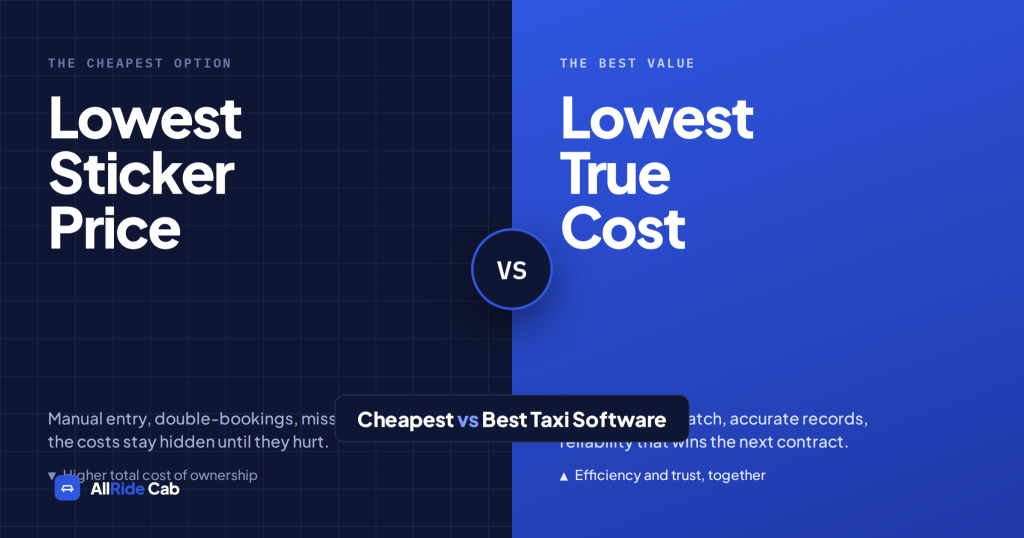
Buying on sticker price feels prudent. It usually is not. The cost that matters shows up later, in the gap between what a low-end tool promises and what your operation actually demands. A few numbers put that gap in perspective:
- Statista projects worldwide ride-hailing revenue will reach roughly $188.6 billion by 2026 and climb to about $230 billion by 2030. Demand is not the constraint; the ability to capture it cleanly is.
- Grand View Research estimates the ride-hailing services market at $47.6 billion in 2025, on track to hit $181.5 billion by 2033 at an 18.6% compound annual growth rate — every point of that growth is a competitor sharpening their service.
- Straits Research values the global ride-hailing and taxi market at $270.81 billion (2024), so the operators you compete against are scaling fast and setting rising expectations for on-time, trackable rides.
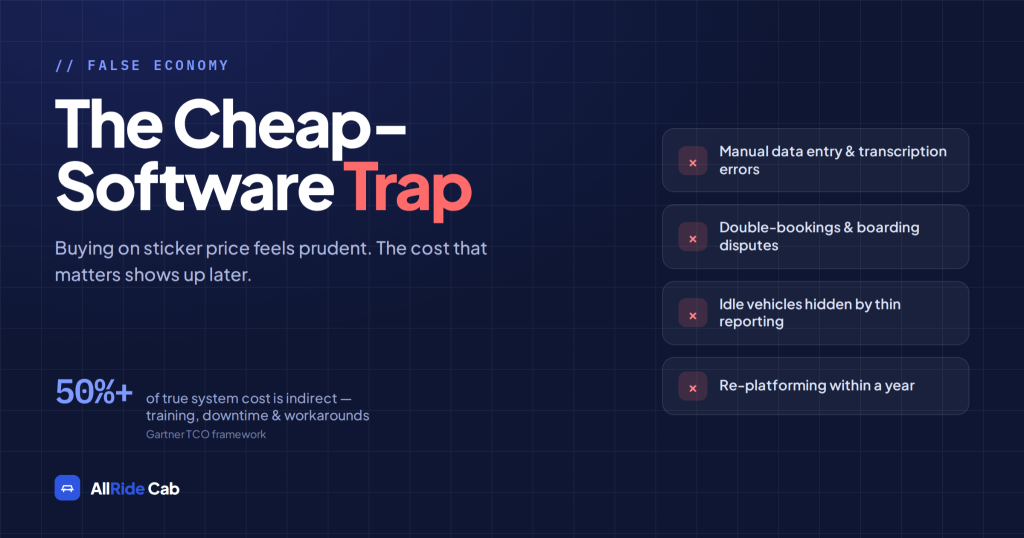
- The Gartner Group total-cost-of-ownership framework shows that indirect costs — training, downtime, lost productivity, and manual workarounds — can account for more than half of what a system truly costs over its lifetime. The license is the small number.
Put together, the picture is clear: the market rewards reliability, and the cheapest software is usually the one that quietly erodes it. Several forces push operators toward the low-price trap:
- Thinning margins from fuel, labor, and competitive fares, which make a low monthly fee look irresistible.
- Rising rider expectations for real-time tracking, accurate ETAs, and professional, trackable bookings.
- Fragmented operations — one-way, round-trip, hourly, shared, and recurring work — that a single-purpose tool cannot cover.
- Pressure to go digital quickly, which favors whatever is fastest and cheapest to switch on.
- Underestimated switching costs, where re-platforming later wipes out the early savings.
Why the Cheapest Option Is a False Economy
Picture an airport and hotel transfer operator that picks a bare-bones tool to save a few hundred dollars a month. It works fine — until a 30-passenger conference booking lands. There is no bulk reservation upload, so a coordinator keys in every passenger by hand. There is no seating-layout builder, so two riders are assigned the same seat. Without per-passenger and luggage records, a driver shows up for a multi-stop pickup with the wrong vehicle. The result is refunds, a frustrated corporate client, and a one-star story that follows the operator into the next bid.
That is the false economy of the cheapest vs best taxi software: the savings are visible and the costs are hidden until the moment they hurt most. The trade-off usually looks like this:
- Manual data entry replaces automation — cheaper to license, far more expensive in staff hours and transcription errors.
- Missing booking modes force riders into the wrong flow, so detail-heavy transfer work gets lost or mishandled.
- No seating layouts or per-passenger records mean double-bookings and boarding disputes that erode trust.
- Thin reporting hides utilization gaps, so vehicles you already pay for sit idle.
- Weak support and a hard ceiling on scale mean you re-platform within a year — paying twice for what the cheapest vs best taxi software would have delivered once.
How to Choose the Best Taxi Software Without Overpaying
Run a proper taxi software pricing comparison and you will notice the real gap between tools is not the monthly fee — it is the capability behind it. Best-value software earns its price by removing manual work and protecting service quality at the same time. These five strategies show how to spot it.
1. Match the cheapest vs best taxi software to how you actually book work
The best taxi software fits your operation instead of forcing your operation to fit the tool. If you run pre-scheduled, detail-heavy transfers, you need the booking modes that capture that work in one clean flow.
- One-way, round-trip, and hourly modes with multi-stop routing capture complex transfer jobs in a single booking — fewer manual edits (efficiency) and accurate per-passenger and luggage records that prevent boarding mix-ups (quality).
- Branded PDF tickets give every guest a clear boarding document — less back-and-forth for your team (efficiency) and a professional, traceable record for each rider (quality). See how this works in AllRide Cab.
2. Automate dispatch and driver assignment
The cheapest software leaves dispatch to a person and a phone. The best taxi software automates it, which is where cost and safety wins stack on top of each other.
- Auto-assigning the nearest available driver trims idle time and dead mileage (efficiency) while keeping every job matched to an available, vetted driver (safety).
- Driver assignment with approval gates stops the wrong vehicle going out — fewer reassignments (efficiency) and a controlled, accountable chain for every trip (safety). This is the core of AllRide’s taxi dispatch software.
3. Standardize recurring and shared transfers
For corporate shuttles, school routes, and fixed loops, repeatability is the whole game. A capable platform lets you set the pattern once and trust it to run.
- Trip templates with weekly-repeat rules, excluded dates, and buffer days let you set a daily office or campus route once and let it run (efficiency) while enforcing consistent, safety-conscious scheduling every day (quality).
- The seating-layout builder maps fixed seat assignments per vehicle — maximizing paid capacity (efficiency) and keeping per-passenger records for managed, repeating transport (safety). Explore this in AllRide’s ride sharing software.
4. Consolidate fleet records and analytics
A taxi tool that ignores the vehicle is only doing half the job. Deep records and real reporting are where best-value platforms separate from bargain ones.
- Detailed vehicle records (registration, ownership, VIN, insurance, warranty, and tags) keep compliance documentation in one place — less admin scramble (efficiency) and audit-ready proof when it matters (compliance and safety).
- A fleet analytics dashboard surfaces utilization, mileage, and availability — so you sweat the assets you already own (efficiency) and service or retire vehicles before they fail (safety). See AllRide’s fleet management software.
5. Handle bulk and event bookings without manual entry
The best taxi software absorbs a sudden 200-passenger event the same way it handles a single airport pickup — without a coordinator typing through the night.
- CSV and Excel bulk reservation upload with a field-override toggle ingests large one-time batches — conferences, weddings, corporate events — without per-booking entry (efficiency) and without the transcription errors that cause double-bookings (quality).
- Pair bulk uploads with seating layouts and branded PDF tickets for capacity-controlled boarding (efficiency) and a clean, verifiable passenger manifest for every trip (safety). The full platform is at AllRide Apps.
What Good Looks Like
Read those five strategies as a checklist and they look like separate wins. They are not. They are outputs of one well-run system. Booking modes feed dispatch; dispatch draws on the same driver and vehicle records that power your analytics; recurring templates and bulk uploads write into the same seating layouts and ticketing. When all of it lives in one integrated platform, the cost win and the quality win stop competing — because the thing that makes you efficient (no duplicate data, no manual hand-offs) is the same thing that makes you reliable (accurate records, controlled assignment, verifiable manifests).
That is the throughline of integrated SaaS, and it is exactly why a single connected platform beats a patchwork of cheap point tools. With a patchwork, every seam is a place for data to fall through and for cost to leak. With one system, every feature reinforces the next. The operators who get this right are not choosing between saving money and serving riders well — they have built an operation where doing one automatically does the other.
The Bottom Line
“Cheapest” and “best” only look like opposites when you measure a single number on an invoice. Measure total cost of ownership — the staff hours, the refunds, the idle vehicles, the lost contracts — and the cheapest vs best taxi software almost always turns out to be the better-value one too. The goal was never to spend the least; it was to spend in a way that compounds, where every dollar buys both efficiency and trust.
The companies that win the next decade of transport will be the ones that stopped treating price and quality as a trade-off and started running both from the same platform — lean, dependable, and ready to scale the day a bigger contract walks in the door.
Want operating insights like these in your inbox? Subscribe to the Operator Insights Newsletter for practical guidance on running a leaner, more reliable fleet — and explore AllRide Cab to see how an integrated platform brings booking, dispatch, fleet records, and bulk handling together in one place.
Frequently Asked Questions
What is the best taxi software, and is the cheapest option ever the right call?
The best taxi software is the one that fits how you book and dispatch work while keeping your total cost of ownership low — not simply the one with the lowest monthly fee. A low-price tool can be the right call for a tiny, single-mode operation, but for most operators the savings disappear into manual workarounds, double-bookings, and missed pickups. Measure value by the work the software does for you, not just the line item on the invoice.
Is a low-cost taxi tool ever worth it?
Yes, if your operation is genuinely simple and unlikely to grow — a handful of vehicles running one booking mode with no recurring or bulk work. The moment you add transfers, shared rides, event bookings, or a real fleet to track, a bargain tool starts costing you in staff time and service failures. Match the tool to your real and near-future needs, not just today’s.
What features separate best-value taxi software from bare-bones tools?
The dividing lines are automated dispatch and driver assignment, multiple booking modes, recurring trip templates, a seating-layout builder, deep vehicle records with fleet analytics, and bulk reservation upload. Bare-bones tools usually offer one or two of these and lean on manual work for the rest. Best-value platforms combine them so efficiency and reliability rise together.
How does dispatch automation reduce costs without hurting safety?
Automated dispatch assigns the nearest available driver, which cuts idle time and dead mileage, while approval gates keep every trip matched to a vetted, available vehicle. You save on fuel and coordination time and tighten accountability at the same time. The cost win and the safety win come from the same feature.
How do I compare taxi software options on value rather than price?
Look past the monthly fee and weigh total cost of ownership: staff hours saved, errors avoided, vehicles kept utilized, and the cost of re-platforming if you outgrow the tool. Score each option against the booking, dispatch, fleet, and bulk-handling capabilities your operation actually uses. The cheapest sticker price and the lowest true cost are rarely the same product.