

 Car rental and Dispatch
 Ride sharing
 Fleet and Transportation Logistics
 Electric Vehicle
 Bus and Shuttle
 Courier Delivery
 Power of IoT in Transport and Logistics
 Fleet Management
 Route optimization
 Shuttle Transportation
 Delivery Management
 School Bus Transportation
 Ride Sharing Management
 Airport Transfer Booking
  Vehicle inspection
 Car Rental Management
 Trucking & Logistics
 Food & Beverage
 E-Commerce
 Passenger Transit
 Delivery
 School & Corporate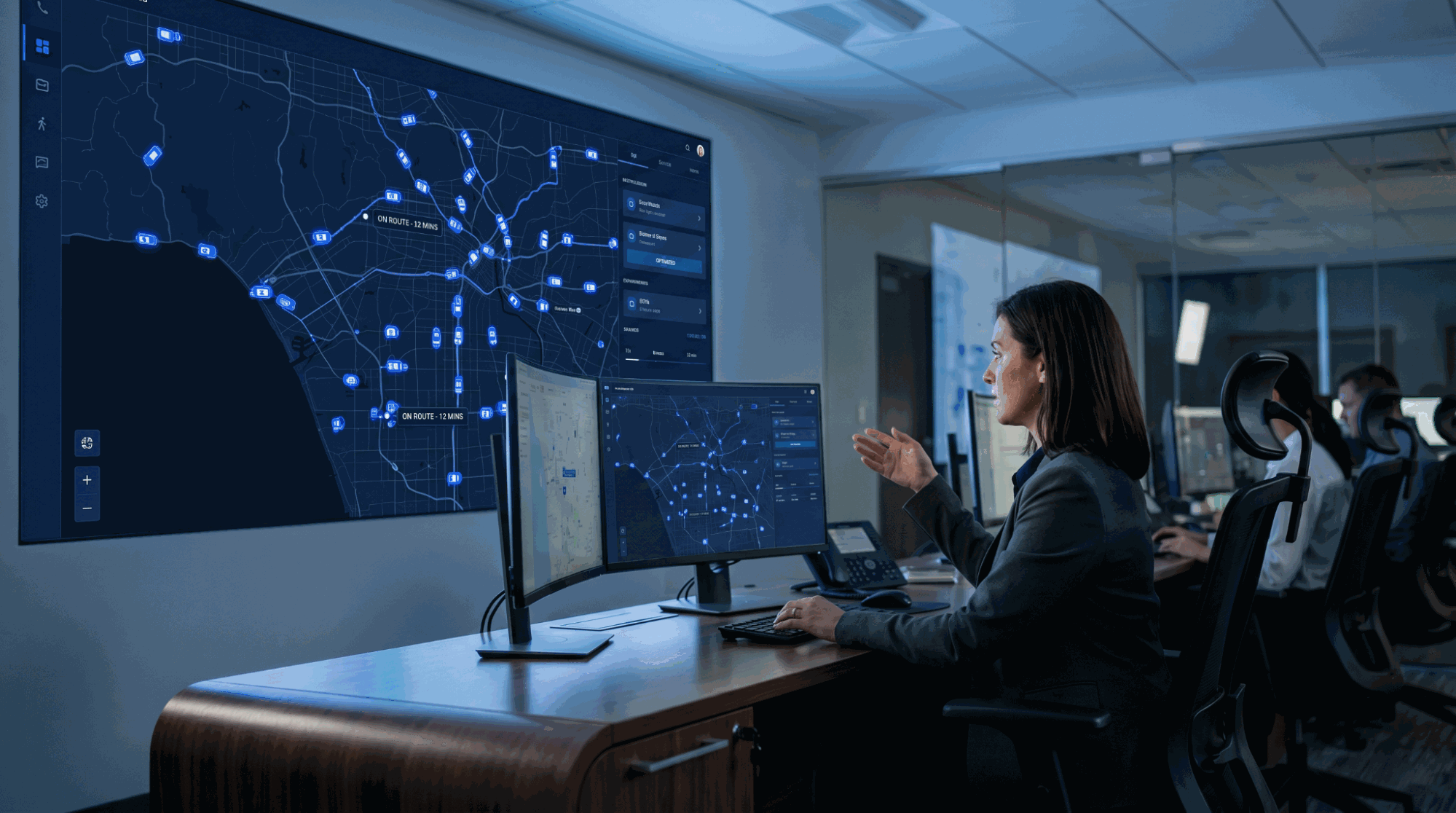
Best Dispatch Management Software: The 2026 Comprehensive Guide To Automated Operations
What is the best dispatch management software — and can it really cut costs without putting safety or service quality at risk?
The best dispatch software cuts costs and wait times by pulling five levers at once: it automates trip assignment so vehicles move on rules instead of phone calls, optimizes routes to kill dead mileage and fuel waste, streams real-time GPS and ETAs so no one is guessing, runs in the cloud so you scale without buying servers, and ties everything to reporting that exposes idle assets and compliance gaps. The crucial part is that the same engine making you faster also makes you safer — rules-based assignment refuses to send a fatigued or unqualified driver, live tracking removes the pressure to speed, and audit trails protect you when something goes wrong. Operators who feel forced to choose between “cheap and fast” and “safe and reliable” are almost always running fragmented, manual tools that make those two goals compete. The best dispatch management software collapse that competition into a single workflow.
The key insight: the trade-off between efficiency and safety isn’t a law of transport operations — it’s a symptom of disconnected tooling, and the right cloud-based dispatch software erases it.
Demand is rising and patience is falling. Congestion keeps climbing: in 2025 the typical U.S. driver lost 49 hours to traffic and about $894 in wasted time, with the national bill reaching at least $85.8 billion, according to the INRIX Global Traffic Scorecard. Add a persistent driver shortage, volatile fuel prices, tightening compliance, and customers who now expect Uber-grade live ETAs from every operator, and the margin for sloppy dispatch is gone. A single missed school run or airport pickup no longer costs you a tank of fuel — it costs you the contract.
The market is responding by moving to the cloud. The global fleet management market is projected to grow from roughly $27 billion in 2025 to more than $122 billion by 2035, and cloud-based deployments already hold about 70% of the market, according to Global Market Insights. The operators winning contracts treat dispatch software as core infrastructure, not an afterthought.
This guide quantifies the real cost of inefficient dispatch, explains why the cheapest tool is usually the most expensive, and lays out five strategies for choosing the best dispatch management software — each one delivering a cost win and a safety or quality win at the same time.
The Dispatch Inefficiency Problem
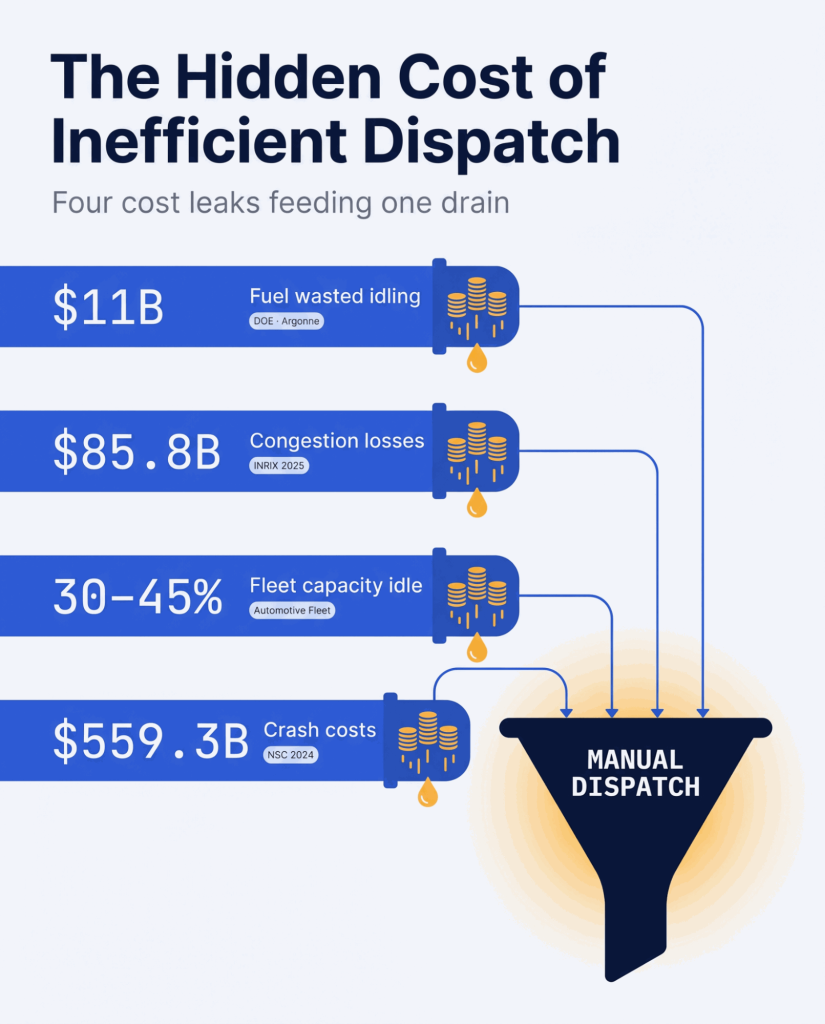
Inefficient dispatch doesn’t announce itself; it leaks. A few minutes of idling here, a backtrack there, an overtime shift to cover a double-booking — individually trivial, collectively brutal. The numbers are stark:
- Idling burns billions for nothing. U.S. road vehicles waste more than 6 billion gallons of fuel a year just idling — over $11 billion even at $2 a gallon, per the U.S. Department of Energy’s Argonne National Laboratory.
- Congestion taxes every late trip. The INRIX 2025 Global Traffic Scorecard puts U.S. congestion losses at least $85.8 billion, with the average driver losing 49 hours. Every late arrival on a jammed corridor cascades into the next job.
- Half your capacity may be sitting still. Industry benchmarks reported by Automotive Fleet place average fleet utilization at just 55–70%, meaning 30–45% of capacity is idle at any given moment — paid-for vehicles earning nothing.
- Safety is a cost line, not a separate topic. Motor-vehicle injuries cost an estimated $559.3 billion in 2024 , and crashes remain a leading cause of workplace death, according to the National Safety Council. For a transport operator, one serious incident can erase a year of efficiency gains.
The forces intensifying the problem:
- E-commerce and last-mile delivery pushing trip volumes up.
- A persistent driver shortage and rising labor costs.
- Volatile fuel prices that punish every wasted mile.
- Tightening compliance — hours-of-service, emissions, ELD, and ADA/paratransit rules.
- Customer expectations for real-time ETAs and proactive notifications.
- Fragmented tooling — spreadsheets, phone calls, and a separate “dot on a map” GPS that don’t talk to each other.
Why the Cheapest Dispatch Software Is a False Economy
The tempting shortcut is to keep costs down by sticking with spreadsheets and phone-call dispatch, or by buying the cheapest tracker that just shows dots on a map. It looks frugal. It rarely is.
Picture a 40-vehicle operator running mixed work — morning school runs, daytime corporate shuttles, evening airport transfers. Dispatch lives in a shared spreadsheet and the dispatcher’s memory. On a Tuesday, two bookings land on the same vehicle; the dispatcher catches it at 7:10 a.m. and scrambles, pulling a driver who’s already near the end of his legal hours. The school run goes out late, a parent calls the district, and that evening’s airport pickup is assigned to a driver who never learns the flight landed early — the passenger waits 35 minutes and leaves a one-star review. To claw back time, another driver speeds across town. Nothing in that day was caused by the cheap tool — and everything in it was.
That’s the false economy:
- You save on licenses and pay it back in overtime, dead mileage, and fuel.
- You “own your data” in spreadsheets that no one can act on in real time.
- A dots-on-a-map tracker shows where vehicles are, but not whether a driver is overdue for rest or a trip is about to be missed.
- Every manual handoff is a fresh chance for a double-booking, a missed pickup, or an unqualified driver on a sensitive run.
- When an incident or dispute happens, there’s no audit trail — so you carry the liability.
Cheap dispatch optimizes the one line item you can see and inflates the five you can’t.
How to Choose the Best Dispatch Management Software That Cuts Costs Without Cutting Corners
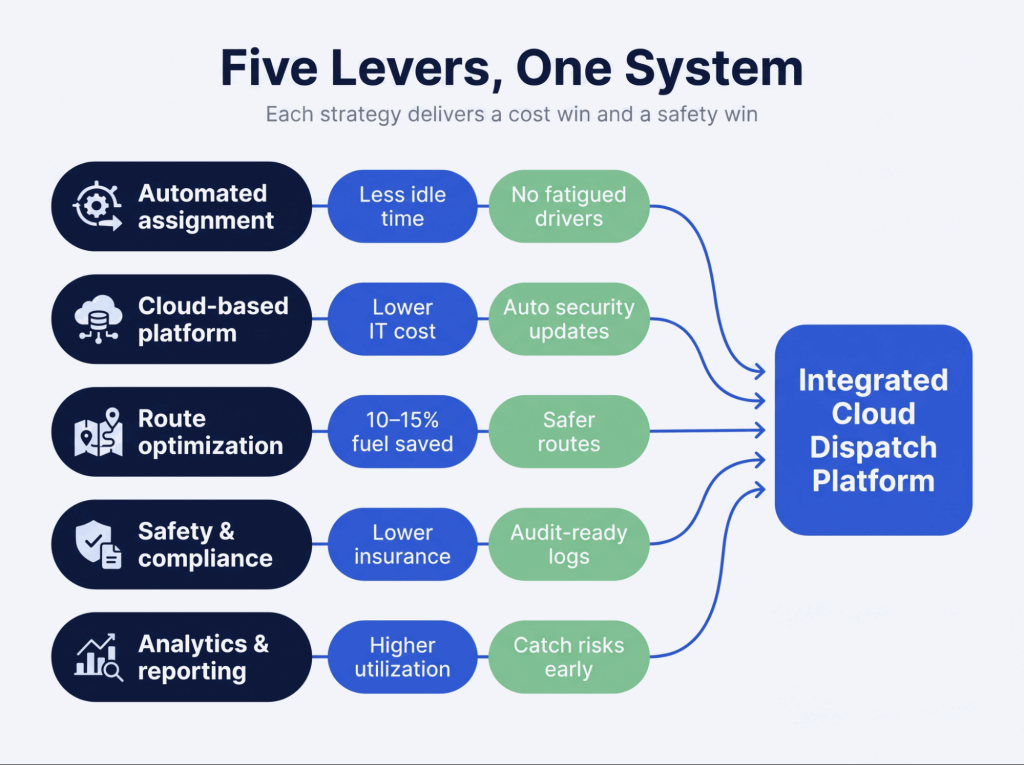
Each strategy below pairs a cost or efficiency win with a safety or quality win — because in a well-built system they come from the same place.
1. Automate trip assignment instead of dispatching by hand
The best dispatch software replaces phone-call dispatching with rules-based, automated assignment that reacts in seconds and never forgets a constraint.
- Auto-assignment matches the nearest suitable vehicle instantly, cutting idle time and dispatcher overhead — and the same rules refuse to assign a driver who is out of hours or unqualified for the run.
- Trip templates and recurring schedules eliminate re-keying for daily routes — and approval gates ensure a human signs off before a school or NEMT trip ever goes out.
- Automated reassignment absorbs no-shows and breakdowns without a frantic scramble, protecting your SLAs — and keeping fatigued drivers off improvised “rescue” runs.
See how AllRide’s automated dispatch handles rules-based assignment across mixed fleets.
2. Choose cloud-based dispatch software, not a server in a closet
For most operators, cloud based dispatch software is the difference between scaling smoothly and hitting a wall.
- No servers to buy or maintain means lower upfront cost and a bill that scales with your fleet — and automatic updates close security gaps you’d otherwise miss.
- Dispatchers, drivers, and managers see the same live data from any device — and a schedule change reaches the driver before it becomes a missed pickup.
- Built-in redundancy and uptime keep operations running — and protect the passengers depending on a confirmed ride, not just your revenue.
- Multi-tenant architecture lets franchises and depots run independently under one roof — and standardize safety rules without slowing anyone down.
Explore AllRide’s cloud-based, multi-tenant platform built for distributed transport operations.
3. Optimize routes and surface live ETAs
The best dispatch software treats every route as something to optimize, not merely record.
- Multi-stop route optimization trims dead mileage and fuel — fleets using GPS tracking and optimized routing typically report 10–15% fuel savings (Geotab) — and keeps drivers on planned, safer paths instead of improvising shortcuts.
- Real-time ETAs and passenger notifications cut “where’s my ride?” calls and no-shows — and remove the pressure on drivers to speed to recover a late arrival.
- Flight-aware airport transfers adjust pickups to actual landing times — saving wait-time cost — and sparing drivers risky last-minute dashes to the terminal.
Learn how AllRide’s route optimization and real-time tracking keep trips lean and predictable.
4. Build safety and compliance into the workflow, not on top of it
The best dispatch software makes compliance a by-product of normal operation rather than a separate scramble at audit time.
- Driver-hours and qualification rules baked into assignment prevent fatigued or unlicensed dispatch — lowering incident risk and insurance exposure together.
- Per-passenger records, seating layouts, and approval gates protect vulnerable riders on school and NEMT routes — and standardize the documentation auditors ask for.
- Automatic trip logs and audit trails turn every job into evidence — cutting dispute-handling time and shielding you from liability.
See the safety and compliance controls built into AllRide’s school and campus transport workflows.
5. Unify everything under analytics and reporting
The best dispatch management software closes the loop with reporting that turns operations into decisions.
- A fleet analytics dashboard exposes idle assets and dead mileage — so you can lift utilization from the 55–70% norm toward best-in-class without buying a single extra vehicle.
- Utilization, mileage, and on-time metrics make SLAs measurable — rewarding the safe, efficient drivers, not just the fast ones.
- Operator- and route-level reports give oversight across a distributed operation — catching safety and cost problems before they compound.
Dig into AllRide’s fleet analytics and reporting for utilization, mileage, and compliance visibility.
What Good Looks Like
Read those five strategies again and notice something: they aren’t five products you bolt together. They’re five outputs of one well-run system. Automated assignment only protects driver hours because it shares data with your compliance rules. Route optimization only produces honest ETAs because it’s wired to live GPS. Analytics only lifts utilization because every trip, every mile, and every exception flows into the same database.
Pull those pieces apart into separate tools and the trade-off comes back — the spreadsheet doesn’t know what the tracker knows, and safety becomes a manual afterthought. Keep them inside one integrated, cloud-based platform and efficiency and safety stop being opposing forces; they become two readings off the same instrument. That’s why “best dispatch management software” is less about a feature checklist and more about whether the pieces share a single source of truth.
The Bottom Line
The operators who win the next contract won’t be the ones who bought the cheapest dispatch tool, or the ones who spent the most. They’ll be the ones who stopped treating cost and safety as a trade-off. The best dispatch management software — cloud-based, automated, and integrated — lets you cut wait times, dead mileage, and fuel while tightening safety and compliance, because all of it runs off the same data. Get that right, and you become the kind of company clients trust with their employees, their students, and their reputation: efficient because it’s disciplined, and safe because it’s efficient.
Keep Going
If you want more breakdowns like this, subscribe to the Operator Insights Newsletter for practical guidance on running leaner, safer transport operations. And when you’re ready to see how an integrated, cloud-based platform handles dispatch, routing, compliance, and analytics in one place, explore the AllRide solution.
Frequently Asked Questions
What is the best dispatch software, and can it cut costs without sacrificing safety?
The best dispatch software automates trip assignment, optimizes routes, streams real-time ETAs, runs in the cloud, and unifies reporting — so vehicles move efficiently while built-in rules stop unsafe or unqualified dispatches before they happen. Because efficiency and safety draw on the same live data, the right platform improves both at once instead of trading one for the other. The trade-off most operators feel comes from fragmented, manual tools, not from the work itself.
What is cloud based dispatch software, and is it better than on-premise?
Cloud based dispatch software runs on the provider’s servers and is accessed through a browser or app, so there’s no hardware to buy or maintain and updates are automatic. For most operators it’s more cost-effective and scalable than on-premise systems — cloud deployments now account for roughly 70% of the fleet management market, according to Global Market Insights. On-premise can still suit organizations with strict data-residency rules, but it carries higher upfront and maintenance costs.
How does dispatch software actually reduce operating costs?
It attacks the costs you can’t easily see: idle time, dead mileage, overtime from manual scheduling, and fuel waste. Operators using GPS tracking and route optimization typically report 10–15% fuel savings, according to Geotab, and better utilization lets you serve more demand without adding vehicles. Removing manual handoffs also cuts the dispatcher hours spent fixing avoidable mistakes.
Does automated dispatch improve safety, or does speed come at safety’s expense?
Automation improves safety when the rules are built in. Rules-based assignment can refuse to dispatch a driver who is out of hours or unqualified, and approval gates add a human check for sensitive runs like school or NEMT transport. The speed comes from removing manual handoffs — not from cutting corners.
What should the best dispatch software include for a mixed fleet?
Look for automated assignment, cloud-based access, multi-stop route optimization, real-time tracking and ETAs, driver and compliance controls, and a unified analytics dashboard. Mixed operators — taxi, shuttle, airport transfer, and rental — also need multi-tenant support and flexible booking modes (one-way, round-trip, hourly, and recurring) so a single platform covers every service line.