


 Car rental and Dispatch
 Ride sharing
 Fleet and Transportation Logistics
 Electric Vehicle
 Bus and Shuttle
 Courier Delivery
 Power of IoT in Transport and Logistics
 Fleet Management
 Route optimization
 Shuttle Transportation
 Delivery Management
 School Bus Transportation
 Ride Sharing Management
 Airport Transfer Booking
  Vehicle inspection
 Car Rental Management
 Trucking & Logistics
 Food & Beverage
 E-Commerce
 Passenger Transit
 Delivery
 School & Corporate
Top 5 Ways Cloud Dispatch Software Reduces Downtime for Modern Taxi Fleets
Cloud dispatch is taxi dispatch software hosted on remote, redundant servers instead of an on-premise machine, so operations keep running even when local hardware or internet fails. It reduces downtime by removing single points of failure and adding automatic failover, real-time data syncing, remote access, continuous updates, and on-demand scaling — so bookings, drivers, and dispatchers stay connected through the outages that would stall a traditional system.
Key takeaways
- Cloud dispatch removes the office-server single point of failure.
- Automatic failover keeps dispatch running during outages and hardware crashes.
- Real-time syncing means no lost bookings when a device drops off.
- Remote access lets dispatchers keep working from anywhere.
- Automatic updates, backups, and scaling cut maintenance and overload downtime.
Table of contents
- Why Downtime Is the Hidden Cost in Taxi Operations
- What Is a Cloud Taxi Dispatch System?
- The 5 Ways Cloud Dispatch Software Reduces Downtime
- Cloud Dispatch vs On-Premise Dispatch
- What Downtime Actually Costs a Taxi Fleet
- What to Look for in a Cloud Dispatch Platform
- How AllRide Cab Delivers Resilient Cloud Dispatch
- Conclusion
- FAQs
Running a taxi fleet today involves much more than managing vehicles and drivers. As booking volumes grow, operators depend on one system to keep everything moving: dispatch.
That dependence has a cost. Every minute the dispatch system is down, bookings go unanswered, drivers sit idle, and customers open a competitor’s app instead. A single office server crash, a power cut, or a dropped internet line can freeze an entire operation.
This is why modern fleets are moving to cloud dispatch software. By running dispatch on managed, redundant infrastructure instead of a machine in the office, operators remove the single points of failure that turn small technical faults into lost revenue days.
In this guide, you will learn what a cloud taxi dispatch system is, the five specific ways it reduces downtime, how it compares to on-premise software, and what to look for when evaluating a platform.
Why downtime is the hidden cost in taxi operations
Before looking at the solution, it helps to understand why downtime hits taxi fleets harder than most businesses.
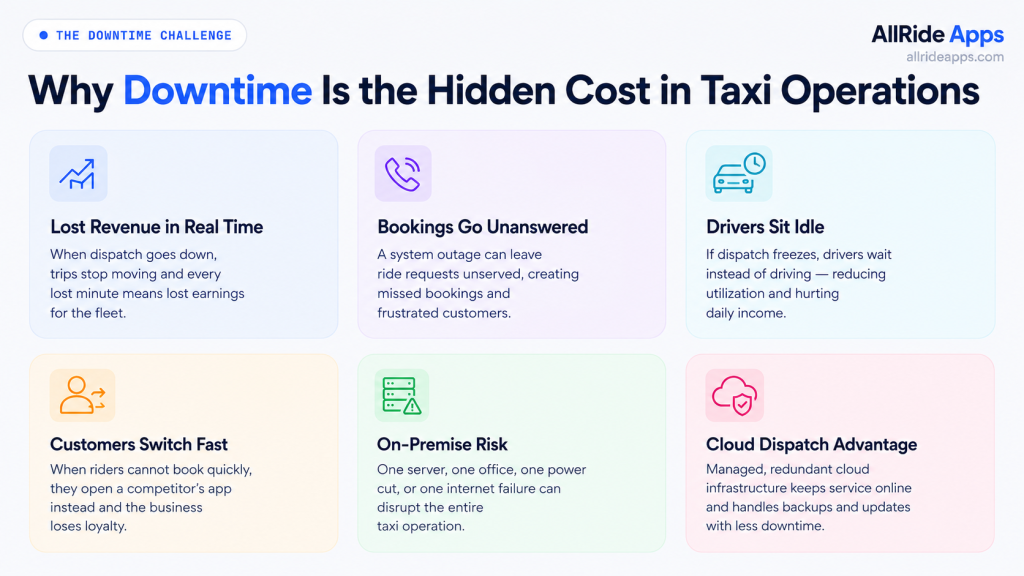
Dispatch Is the Revenue Engine
For a taxi fleet, downtime is not an IT footnote — it is lost revenue in real time.
Bookings, driver assignment, tracking, and payments all flow through one system. When that system stops, the business stops with it.
On-Premise Concentrates the Risk
Traditional on-premise dispatch puts everything in one place: one server, one machine, one building.
A hardware fault, a power cut, or a local internet outage at that one location can take the whole operation offline — often for hours.
Cloud Spreads the Risk Out
Cloud dispatch runs the system on managed, redundant infrastructure in professional data centers.
When local conditions fail, the platform keeps running — and it quietly handles the updates and backups that used to mean scheduled outages.
Expert Tip: Track how many hours of dispatch downtime your fleet logged in the past 12 months, including maintenance windows. That number is the clearest business case for or against your current setup.
What is a cloud taxi dispatch system?
A cloud taxi dispatch system is dispatch software delivered over the internet from managed data centers, rather than installed on a computer in your office.
How It Works
Dispatchers, drivers, and customers connect through apps and a web dashboard. The platform, data, and backups live in the cloud, maintained and replicated by the provider.
Why the Architecture Matters
Because the infrastructure is redundant by design, a cloud-based system does not rise and fall with one piece of local hardware.
That architecture is what makes cloud dispatch inherently more resilient than a server humming under someone’s desk — and it is what makes the five downtime reductions below possible.
The 5 ways cloud dispatch software reduces downtime
Each of these advantages targets a specific failure mode that regularly takes on-premise systems offline.
1. It Removes the Single Point of Failure
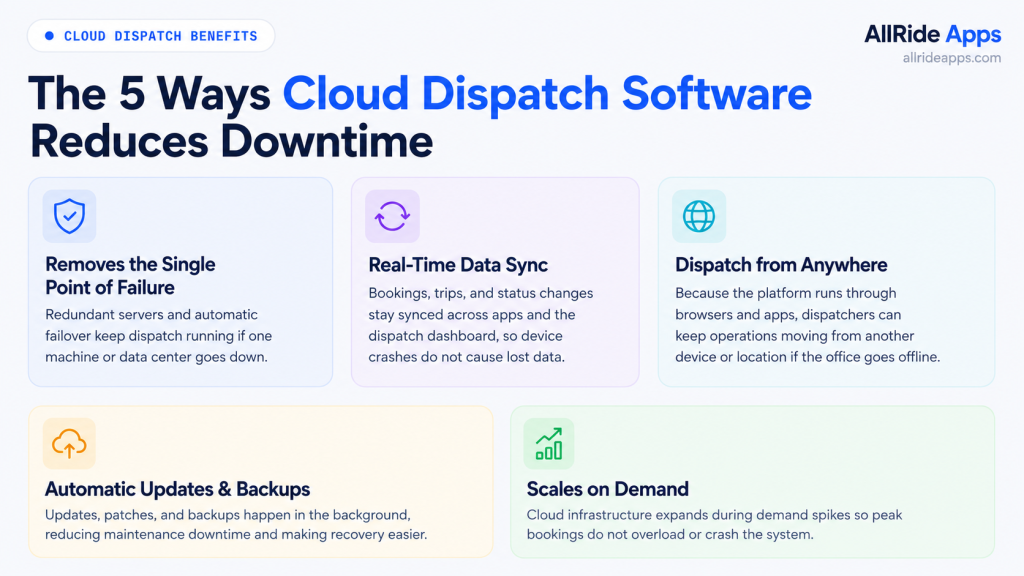
Cloud dispatch runs on redundant servers with automatic failover. If one machine or data center has a problem, another takes over without stopping dispatch.
On-premise systems have no backup: when the office server dies, everything dies with it.
With redundancy built in, a hardware fault becomes a non-event rather than a crisis. The system reroutes to healthy infrastructure automatically, and your dispatchers usually never notice. For a fleet whose revenue depends on staying reachable minute to minute, eliminating that one fragile box is the biggest single downtime win.
2. It Syncs Data in Real Time, So Nothing Is Lost
A cloud taxi dispatch system keeps every booking, trip, and status change synced in real time across the customer app, driver app, and dispatch dashboard.
If a driver’s phone crashes or a dispatcher’s browser closes, the live state is safe in the cloud. Work resumes exactly where it stopped:
- No re-keying a booking that vanished
- No trip lost because two screens disagreed
- One accurate, shared source of truth across the operation
That continuous sync is what keeps small interruptions from becoming lost rides.
3. It Keeps Dispatch Running From Anywhere
Because cloud dispatch is accessed through a browser and apps, dispatchers can keep the fleet moving from a phone, a laptop, or a second location if the office goes offline.
This is business continuity in practice. During a flood, a power cut, or a building-level outage, a dispatcher can pick up on any connected device and keep assigning trips.
For fleets that once lost whole shifts to a local problem, remote access turns a hard stop into a minor inconvenience.
4. It Updates and Backs Up Without a Maintenance Window
Cloud dispatch software updates, patches, and backs up automatically in the background.
That removes the scheduled downtime and manual maintenance on-premise systems require. New features and security fixes arrive continuously — no “system down for upgrades” evening, no admin patching a server after hours.
Automatic, regular backups also mean data loss is recoverable rather than catastrophic. Less maintenance downtime, fewer security gaps, no upgrade weekends.
5. It Scales on Demand So Peaks Don’t Crash the System
Cloud infrastructure scales capacity up automatically during demand spikes — airport rushes, bad weather, event nights — so a surge in bookings does not overload the system.
Fixed on-premise hardware has a hard ceiling; the cloud flexes past it.
This matters most exactly when downtime hurts most: the busiest, highest-revenue moments. Elastic capacity absorbs the load, keeps booking and dispatch responsive under pressure, and scales back down afterward — so you never lose the peak to a frozen screen.
Expert Tip: Ask any dispatch vendor how their system behaved during their clients’ last major demand spike. A platform that has proven it stays responsive at peak load is worth more than one that only performs on a quiet Tuesday.
Cloud dispatch vs on-premise dispatch
The downtime difference comes down to architecture. Here is the side-by-side view.
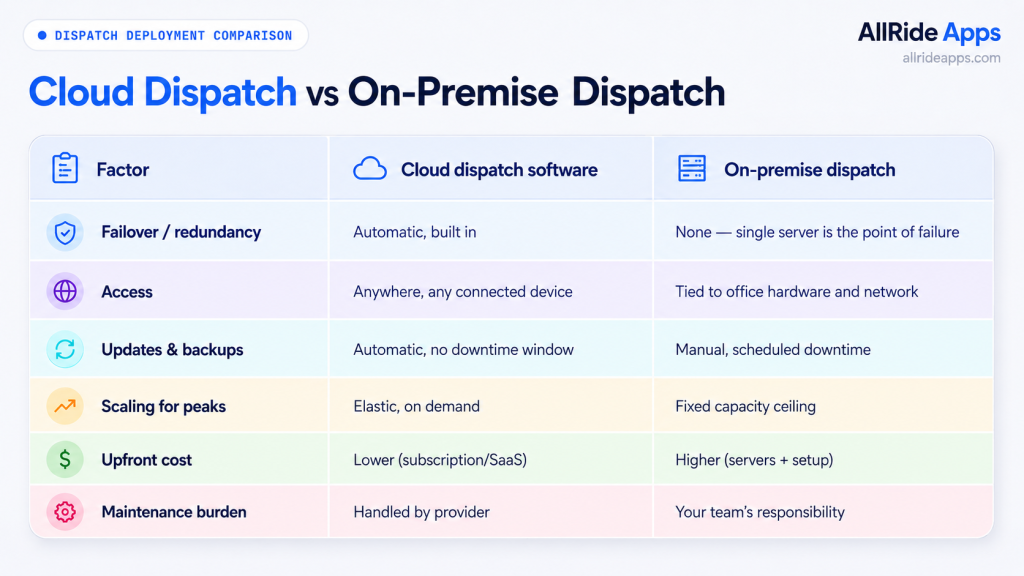
On-premise may still suit operators with strict internal data-control mandates and dedicated IT teams. For most taxi fleets, though, cloud-based dispatch software removes far more risk than it adds.
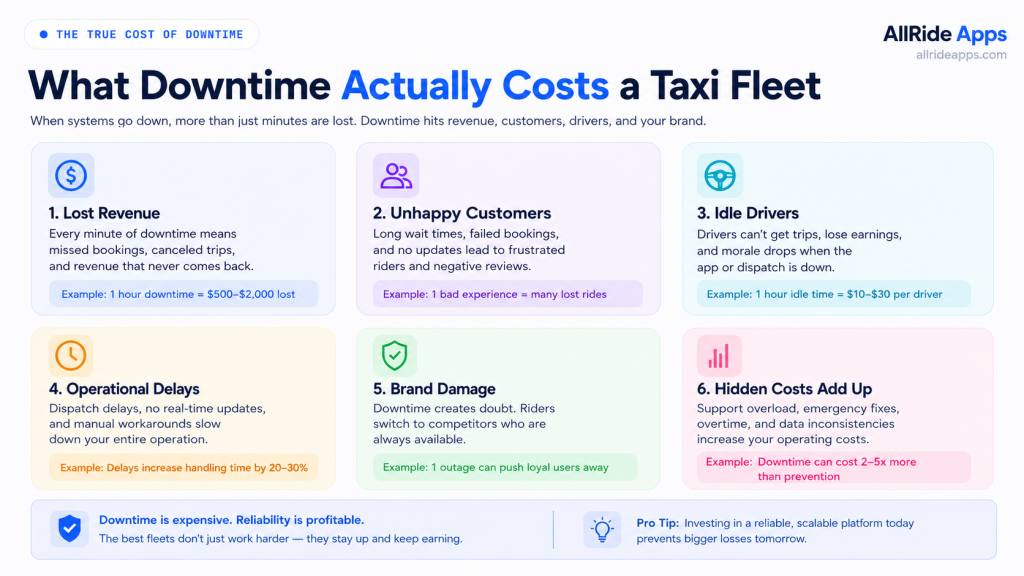
What downtime actually costs a taxi fleet
Downtime is not only the rides you miss during the outage — it is the customers who switch apps and do not come back.
An Illustrative Scenario
Consider a fleet that handles 200 trips on a normal day and loses its system for two peak hours.
It loses not just those hours of bookings, but repeat business from riders who found an alternative. Multiply that across a few incidents a year, and the cost of “cheap” on-premise reliability adds up fast.
The Real Case for Cloud
Moving dispatch to the cloud is not about chasing technology for its own sake.
It is about protecting revenue on the days something goes wrong — which, over a long enough timeline, is every fleet.
How AllRide Cab delivers resilient cloud dispatch
AllRide Cab is the taxi, cab, and ride-hailing product in the AllRide Apps suite — an AI-powered, cloud-delivered platformF trusted by several businesses worldwide. It is designed so the resilience above is the default, not an add-on.
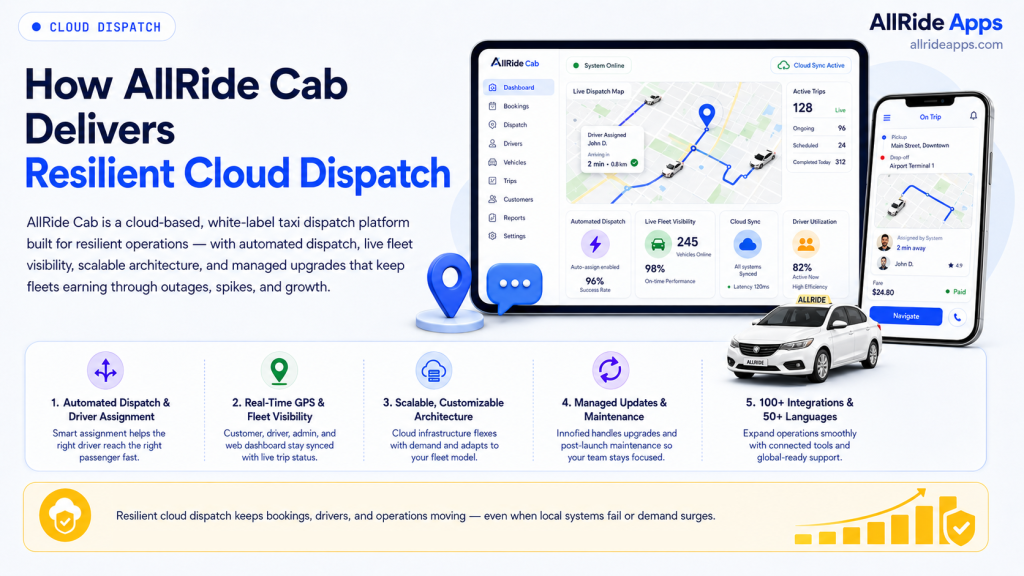
In practice, that means:
- Automated dispatching and driver assignment based on proximity and availability
- Real-time GPS tracking and fleet visibility, synced across customer, driver, and admin apps plus a web dashboard
- A customizable, scalable architecture that flexes with demand
- API integrations to connect payments, maps, and other stakeholders
- Multiple language support for fleets operating across markets
Operators managing broader mixed fleets can extend the same cloud-based approach across AllRide’s wider suite.
The point is not cloud for its own sake. It is a cloud dispatch platform engineered so a hardware fault, a local outage, or a demand spike does not stop your fleet from earning.
See how AllRide Cab keeps your dispatch running — [book a free demo].
Frequently asked questions
What is cloud dispatch software?
Cloud dispatch software is a dispatch platform hosted on remote, managed servers and accessed over the internet through apps and a web dashboard, rather than installed on an office computer. It centralizes bookings, driver assignment, tracking, and data in the cloud, so the system stays available and backed up even when local hardware or internet fails.
What is a cloud taxi dispatch system?
A cloud taxi dispatch system is dispatch software for taxi and cab fleets delivered from the cloud instead of on-premise hardware. Dispatchers, drivers, and riders connect through synced apps and a browser dashboard, while data, updates, and backups are managed by the provider — making the operation more resilient, remotely accessible, and easier to scale.
How does cloud dispatch reduce downtime?
Cloud dispatch reduces downtime by removing single points of failure. Redundant servers with automatic failover keep it running through hardware faults, real-time syncing prevents data loss, remote access maintains dispatch during local outages, automatic updates and backups eliminate maintenance windows, and elastic scaling stops demand spikes from crashing the system.
Is cloud-based dispatch software better than on-premise?
For most taxi fleets, yes. Cloud-based dispatch software offers built-in redundancy, remote access, automatic updates, and on-demand scaling that on-premise systems can’t match, usually at a lower upfront cost. On-premise may suit operators with strict internal data-control mandates and dedicated IT teams, but it concentrates downtime risk in local hardware.
Is cloud dispatch software secure?
Reputable cloud dispatch providers run encryption, access controls, automatic backups, and continuously patched infrastructure that often exceeds what a small operator can maintain in-house. Security depends on the provider, so confirm data handling, backup practices, and compliance before buying — but managed cloud platforms typically reduce, not increase, both security and downtime risk.
Can cloud dispatch handle trucking or mixed fleets?
Yes. The same cloud model powers dispatch software for trucking and cloud based fleet management software across logistics and delivery fleets, not just taxis. The core benefits — failover, real-time sync, remote access, scaling — apply wherever a fleet depends on dispatch, which is why cloud-based platforms increasingly span multiple transport types.
How much does cloud dispatch software cost?
Cloud dispatch software is usually priced as a monthly SaaS subscription (per driver, vehicle, or trip) or as custom white-label pricing, typically with lower upfront cost than on-premise servers and setup. Total cost depends on fleet size, branded apps, integrations, and support tier, so request a tailored quote rather than relying on a headline figure.
Conclusion
Every taxi fleet will eventually face the moment when something breaks — a server, a connection, a surge of bookings. What separates the fleets that keep earning from the ones that go dark is where the dispatch system lives. Cloud dispatch removes the single points of failure, keeps data synced and accessible, updates and backs up itself, and scales through the peaks — so downtime stops being an existential risk and becomes a manageable blip.
If reliability is what your operation runs on, that’s the case for moving dispatch to the cloud. See how AllRide Cab delivers resilient cloud dispatch built to keep modern taxi fleets moving — book a free demo.