

 Car rental and Dispatch
 Ride sharing
 Fleet and Transportation Logistics
 Electric Vehicle
 Bus and Shuttle
 Courier Delivery
 Power of IoT in Transport and Logistics
 Fleet Management
 Route optimization
 Shuttle Transportation
 Delivery Management
 School Bus Transportation
 Ride Sharing Management
 Airport Transfer Booking
  Vehicle inspection
 Car Rental Management
 Trucking & Logistics
 Food & Beverage
 E-Commerce
 Passenger Transit
 Delivery
 School & Corporate
Top 5 Transportation Software Solutions for Booking, Scheduling, and Fleet Dispatch
Transportation reservation software is one of five distinct solution categories passenger fleets buy from — alongside scheduling software, dispatch software, dispatch fleet management software, and unified transportation management platforms. Most operators overspend or under-buy because these categories get marketed with the same language. Knowing which one solves your actual bottleneck is what separates a system that lasts five years from one you replace in two.
Key takeaways
- Five distinct categories are marketed under near-identical names.
- Reservation software captures bookings; dispatch software assigns them.
- Scheduling software handles recurring routes, shifts, and contracts.
- Fleet management adds vehicle and driver oversight on top of dispatch.
- Unified platforms suit operators running two or more services.
Why operators buy the wrong transportation software
An operator searching for new software will see the same promises from very different products. A booking tool, a dispatch engine, a scheduling system, and a full fleet platform all describe themselves as “transportation software” — so buyers compare feature lists across categories that were never meant to be compared, and end up with a tool that solves someone else’s problem.
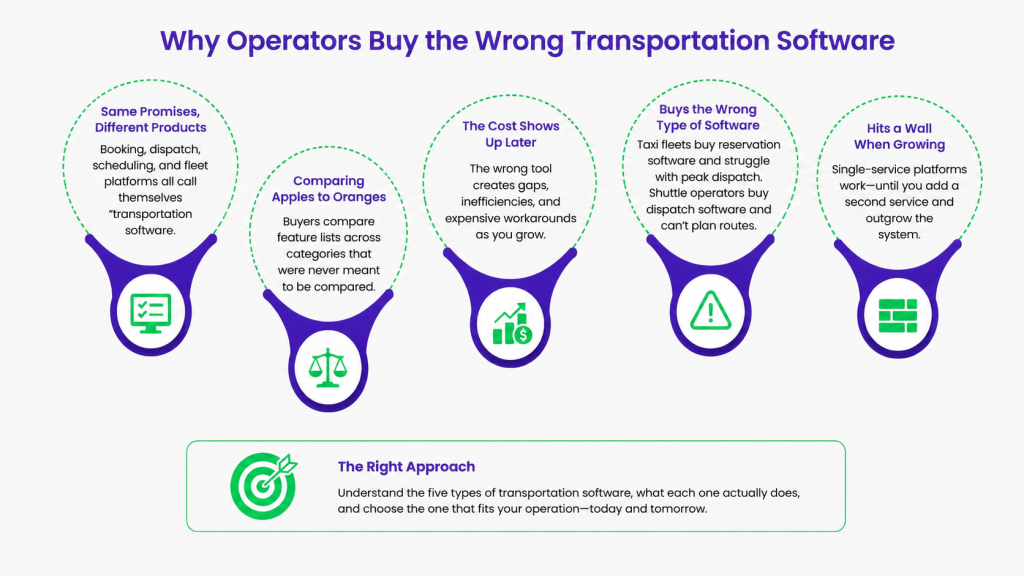
The cost shows up later. A taxi fleet buys reservation software and finds it can’t handle peak dispatch. A shuttle contractor buys dispatch software and discovers it can’t plan recurring routes. A growing operator buys a single-service platform and hits a wall the moment they win a contract in a second service.
This guide separates the five transportation software solutions that matter for passenger fleets, explains what each actually does, and shows which one fits which operation — so you buy for the bottleneck you have, and the one you’ll have next.
What is transportation reservation software?
Transportation reservation software is a system that captures, schedules, and manages passenger ride bookings, then connects each booking to a driver, vehicle, and payment. It’s the front door of the operation: the record of who booked what, when, and for how much.
It’s also the category most often confused with the other four, because nearly every platform includes some booking capability. The difference is where a product’s real strength sits — and that’s what the next five sections make explicit.
The 5 transportation software solutions compared
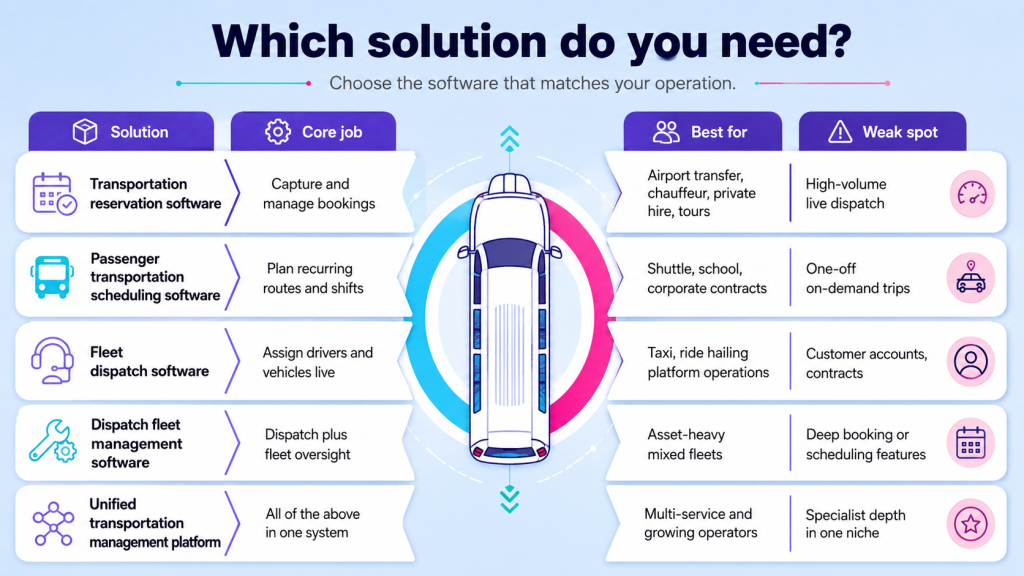
1. Transportation reservation and booking software
Reservation software captures bookings across app, web, and phone, and manages the trip record from request through completion. Its strength is the customer side: quotes, confirmations, trip details, customer accounts, and payment.
Choose it when pre-booked work is the core of your business — airport transfers, chauffeur trips, private hire, tours, and corporate accounts, where most trips are arranged in advance and customer detail matters more than split-second assignment. Its weakness is the opposite case: reservation-first tools often struggle when hundreds of on-demand trips need assigning at once.
2. Passenger transportation scheduling software
Passenger transportation scheduling software plans recurring routes, stops, shifts, and capacity in advance, rather than handling one-off trips. It answers “who is driving which route, when, all month” instead of “who takes this ride now.”
This is the category shuttle operators, school transport providers, and contract carriers actually need. Look for recurring route and stop management, driver scheduling and shift planning, capacity and seat management, and contract-based service handling. Fleet scheduling software overlaps here, adding vehicle availability to the same planning picture. If your work repeats on a timetable, scheduling depth matters far more than dispatch speed.
3. Fleet dispatch software
Fleet dispatch software assigns each booking to the best available driver and vehicle in real time, and is the engine behind on-demand transport. Where reservation software captures demand, dispatch software matches it to supply.
Strong transportation dispatch software offers automated driver assignment, configurable assignment rules, dispatcher override, and stability at peak load. This is what a busy taxi or ride-hailing operation lives on: driver dispatch software and vehicle dispatch software are the same category described from different angles. Its limitation is scope — a dispatch engine alone won’t manage customer accounts, recurring contracts, or vehicle records.
4. Dispatch fleet management software
Dispatch fleet management software combines live dispatch with vehicle, driver, and fleet oversight — records, availability, utilization, and reporting in one system. It’s dispatch plus the asset layer above it.
Choose this when you’re managing a fleet, not just a flow of trips: vehicle records and availability, driver onboarding and documents, utilization and performance reporting, and operational dashboards. Note the boundary — full fleet management suites may extend into telematics, diagnostics, and compliance, which are a genuinely separate product category from booking and dispatch, and usually a separate purchase.
5. Unified transportation management platform
A unified transportation management platform combines reservation, scheduling, dispatch, and fleet oversight in one system, so multi-service operators don’t stitch four tools together. It’s the category that exists because most growing fleets outgrow the other four.
This is where mobility software platform and ground transportation software terminology usually points: one platform running taxi, private hire, limousine, airport transfer, shuttle, and school work with a single customer experience and one source of truth. The trade-off is honest — a unified platform may not match a specialist tool’s depth in one narrow area, so it wins on breadth, consistency, and fewer handoffs rather than on being the deepest at any single function.
Which solution do you need?
Matching the solution to your operation
The right category is determined by the shape of your work, not the size of your fleet. Here’s the honest mapping.
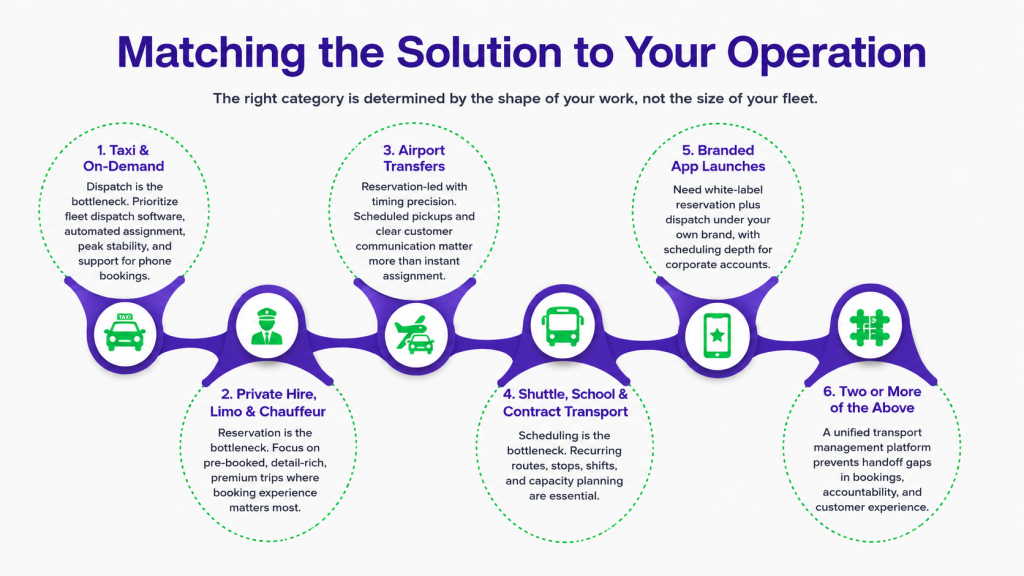
Taxi and on-demand. Dispatch is the bottleneck. Prioritize fleet dispatch software with automated assignment and peak stability, and confirm it handles the phone bookings you still take.
Private hire, limo, and chauffeur. Reservation is the bottleneck. Private hire booking software and limousine dispatch software are built around pre-booked, detail-rich, premium trips — dispatch matters, but it’s secondary to the booking experience.
Airport transfers. Reservation-led, with timing precision. Scheduled pickups and clear customer communication matter more than instant assignment.
Shuttle, school, and contract transport. Scheduling is the bottleneck. Recurring routes, stops, shifts, and capacity planning are the job — a dispatch-first tool will leave gaps.
Branded app launches. If you’re building a ride hailing platform under your own brand, white-label reservation plus dispatch is the requirement, with scheduling depth if you’ll also serve corporate accounts.
Two or more of the above. This is where a unified transport management platform stops being a nice-to-have. Every handoff between separate systems is a place bookings, accountability, and customer experience get lost.
Should you consolidate or combine tools?
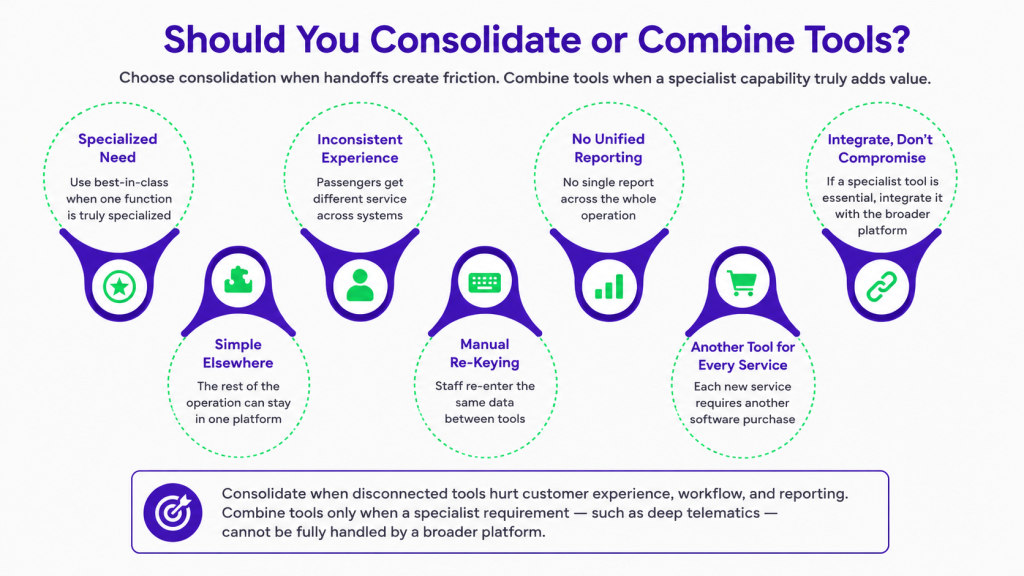
Combining best-in-class tools makes sense when one function is genuinely specialized and the rest are simple; consolidating makes sense when you run multiple services or the handoffs are costing you. There’s no universal answer, but there are clear signals.
Consolidate when passengers get an inconsistent experience across your services, when staff re-key data between systems, when nobody can produce one report across the whole operation, or when adding a new service means buying another tool. Combine when a specialist requirement — deep telematics, for instance — genuinely can’t be met by a broader platform, and integrate the two rather than compromising on both.
Where AllRide fits among these solutions
AllRide Apps sits in the fifth category: a unified, AI-powered, white-label transportation platform built and maintained by Innofied Solutions and used by 300+ global transport businesses, with AllRide Cab covering taxi, airport transfer, limo, and car rental and AllRide Bus covering shuttle, corporate, and school transport.
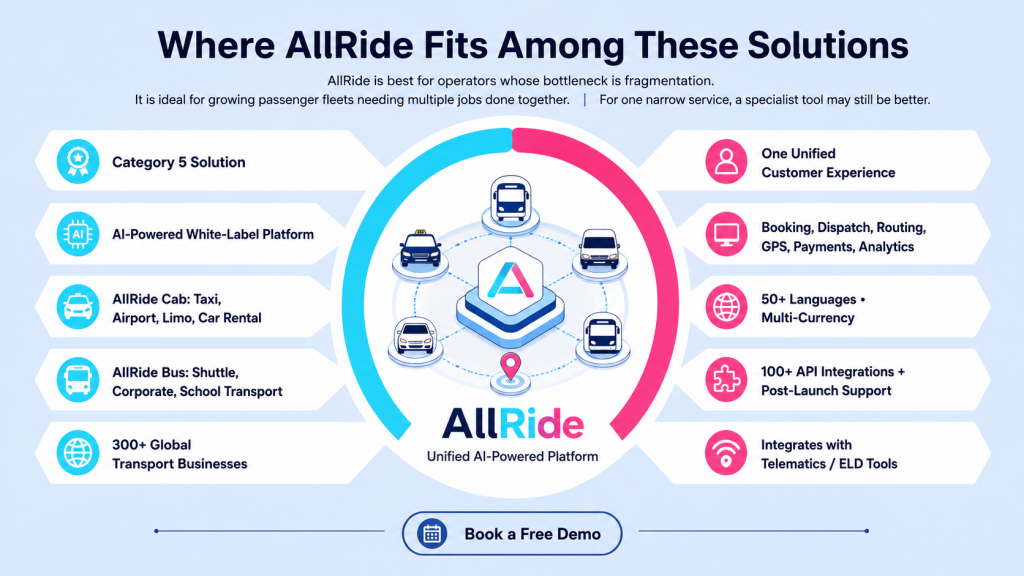
It’s built for operators whose bottleneck is fragmentation rather than any single function. Reservation and multi-channel booking, automated dispatch and driver assignment, route optimization, real-time GPS tracking, payment gateway integration, and analytics run on one multi-tenant platform, with 50+ language and multi-currency support, 100+ API integrations, and post-launch maintenance handled by Innofied. For a fleet running taxis and airport transfers, or shuttles and school routes, that means one customer experience and one source of truth instead of four systems and manual reconciliation.
Where it isn’t the right answer, plainly: if you run one narrow service with no plans to expand, a specialist tool in categories one to four may serve you better and cheaper. And if telematics, ELD/HOS compliance, or vehicle diagnostics are core requirements, that’s a separate product category — AllRide integrates with those tools rather than replacing them.
The strongest case for AllRide isn’t that it wins every category. It’s that most growing passenger fleets eventually need all five jobs done together, and that’s the problem it’s built for.
Compare AllRide against your current setup — book a free demo.
Frequently asked questions
What is transportation reservation software?
Transportation reservation software captures, schedules, and manages passenger ride bookings, then connects each booking to a driver, vehicle, and payment. It covers taxi, private hire, airport transfer, shuttle, and other passenger services, and its strength is the customer side of the trip: quotes, confirmations, trip details, customer accounts, and payment records.
What’s the difference between reservation, dispatch, and scheduling software?
Reservation software captures and manages bookings. Fleet dispatch software assigns those bookings to drivers and vehicles in real time. Passenger transportation scheduling software plans recurring routes, shifts, and capacity in advance. Many platforms include all three, but most are genuinely strong in only one, so identify your real bottleneck before comparing products.
What is dispatch fleet management software?
Dispatch fleet management software combines live dispatch with fleet oversight: vehicle records and availability, driver onboarding and documents, utilization reporting, and operational dashboards. It suits operators managing assets as well as trips. Full fleet management suites may extend into telematics and compliance, which are a separate product category from booking and dispatch.
Do I need one platform or several transportation software solutions?
Consolidate onto one platform if you run multiple services, staff re-key data between systems, passengers get an inconsistent experience, or you can’t report across the whole operation. Combine specialist tools when one requirement — such as deep telematics — genuinely can’t be met by a broader platform, and integrate them rather than compromising on both.
What software do shuttle and school transport operators need?
Scheduling, primarily. Passenger transportation scheduling software handles recurring routes and stops, driver shifts, and capacity planning, which is the real work in shuttle, school, and contract transport. Dispatch matters, but a dispatch-first tool typically can’t plan a repeating timetable, so scheduling depth should drive the shortlist.
What is a mobility software platform?
A mobility software platform is a unified system covering booking, dispatch, scheduling, tracking, and payments across multiple transport services, rather than one service type. The terms transportation management platform and ground transportation software describe much the same thing: one platform running taxi, private hire, airport, shuttle, and other passenger operations together.
How do I choose between transportation software solutions?
Start with your bottleneck, not the feature list. Identify whether bookings, assignment, or recurring planning is what actually breaks in your operation, then shortlist the matching category. Next, check the service mix you’ll run in two years, the pricing model as you scale, branding needs, integrations, and migration support before committing.
Conclusion
Most bad software purchases in passenger transport aren’t bad products — they’re the right product in the wrong category. Reservation, scheduling, dispatch, dispatch fleet management, and unified platforms solve different problems, and the operators who buy well are the ones who name their bottleneck before they compare vendors.
Work out which of the five you actually need, then check it against the services you’ll be running in two years. If that answer is “more than one service,” see how AllRide brings booking, scheduling, dispatch, and fleet visibility onto a single white-label platform — book a free demo.