


 Car rental and Dispatch
 Ride sharing
 Fleet and Transportation Logistics
 Electric Vehicle
 Bus and Shuttle
 Courier Delivery
 Power of IoT in Transport and Logistics
 Fleet Management
 Route optimization
 Shuttle Transportation
 Delivery Management
 School Bus Transportation
 Ride Sharing Management
 Airport Transfer Booking
  Vehicle inspection
 Car Rental Management
 Trucking & Logistics
 Food & Beverage
 E-Commerce
 Passenger Transit
 Delivery
 School & Corporate
Top 5 Fleet Dispatch Software Features to Compare Before Choosing a Dispatch Partner
Fleet dispatch software assigns bookings to the right driver and vehicle in real time, and the five features worth comparing before you buy are assignment logic, live tracking and dispatcher control, the driver app and scheduling, integrations and scalability, and white-label branding. But features are only half the decision. The vendor becomes your operational partner, so support quality, migration help, uptime, and contract terms deserve the same scrutiny as the product demo.
Key takeaways
- Configurable assignment logic matters more than raw automation.
- Dispatchers need override control, not just a live map.
- The driver app determines whether the system gets adopted.
- Integrations and scalability decide if the tool survives growth.
- Support, migration, and contract terms are part of the product.
Why the dispatch decision is bigger than the software
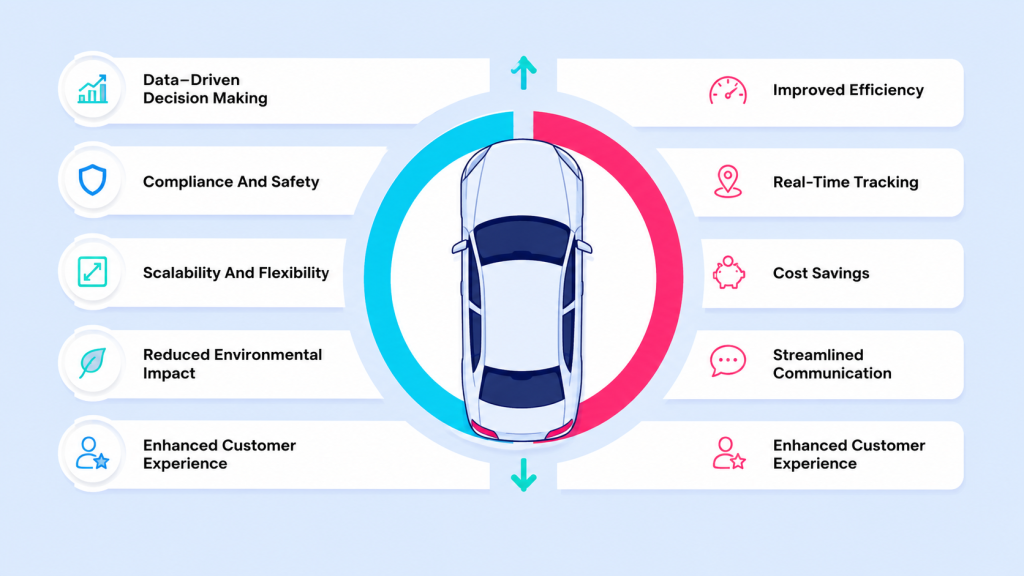
Dispatch sits at the center of a transport operation. It decides how long passengers wait, how many trips each driver completes, and how well the business absorbs a busy Friday night. Get it right and the fleet runs itself; get it wrong and dispatchers spend the day firefighting.
That’s why choosing fleet dispatch software is really two decisions at once. You’re choosing a product — the assignment logic, the driver app, the dashboard — and you’re choosing a partner who will host it, support it, fix it at 2am, and migrate your data when things change. Operators who only evaluate the first decision tend to regret the second.
This guide covers the five features to compare, the partner qualities that matter just as much, and a checklist to take into vendor calls — so you can tell a strong dispatch software for transportation from a good demo.
What is fleet dispatch software?
Fleet dispatch software is a system that receives bookings and assigns each one to the most suitable available driver and vehicle, then tracks the trip to completion. It’s the layer that turns demand into movement.
The category goes by several names — transportation dispatch software, dispatch management software, transport dispatch software, transportation dispatcher software — and vendors use them interchangeably. What separates products isn’t the label; it’s how much control you get over the assignment decision and how well the system holds up under load.
The 5 fleet dispatch software features to compare
1. Assignment logic you can configure
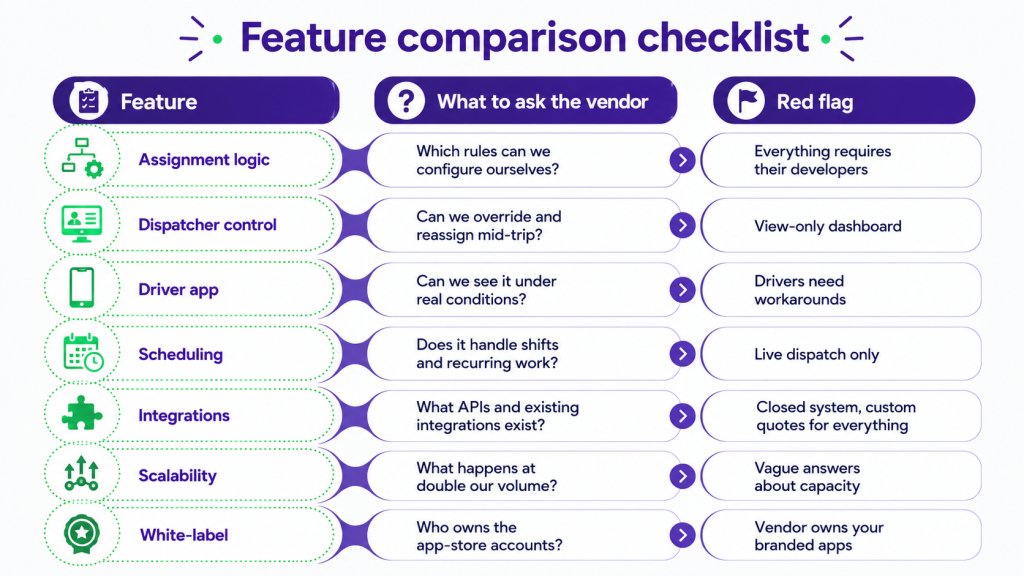
The most important feature is control over how trips are assigned — nearest driver, rotation, vehicle type, priority rules — not simply that assignment is automated. Every fleet dispatches differently, and rigid logic is the fastest way to outgrow a system.
Ask vendors what rules you can change yourself versus what requires their developers. Look for nearest-available matching, vehicle and service-type filtering, driver rotation for fairness, priority handling for premium or corporate trips, and automatic reassignment when a driver declines or drops offline. A good vehicle dispatch software should adapt to your policy; a weak one makes you adapt to its defaults.
2. Real-time tracking with genuine dispatcher control
Live tracking is table stakes, so compare what dispatchers can actually do from the dashboard — reassign, reroute, contact drivers, and intervene mid-trip. A map you can only watch is a monitor, not a dispatch tool.
Strong dispatch management software gives one screen showing every active trip, driver status, and vehicle location, plus the ability to override automated decisions instantly. Ask to see the dispatcher view under load during the demo, not a clean five-vehicle mockup. Peak-hour usability is where dispatch products separate, and it’s the hardest thing to assess from a feature list.
3. Driver app and driver scheduling
The driver app decides whether the whole system succeeds, because dispatch only works if drivers accept, follow, and update trips reliably. Poor driver experience quietly sabotages good dispatch logic.
Compare clarity of assignments and trip details, navigation quality, one-tap status updates, earnings visibility, and offline resilience when signal drops. On the management side, transportation dispatch software with driver scheduling built in lets you plan shifts and availability alongside live assignment, so dispatch works with a roster rather than against it. If you run recurring or contract work, that scheduling layer is not optional — and good driver dispatch software treats it as core, not an add-on.
4. Integrations and scalability
Compare how the platform connects to what you already run — payments, maps, accounting, CRM — and how it behaves when your fleet doubles. Integration gaps and capacity ceilings are the two most common reasons operators replace dispatch software within two years.
Ask about available APIs, existing integrations, whether the architecture is cloud-based and multi-tenant, and what happens at peak load or when you add a branch or a second service. Dispatch fleet management software that also handles vehicle records, driver documents, and utilization reporting saves you buying a second system later. And if you might add private hire booking software or shuttle work to a taxi operation, confirm the platform covers it before you commit rather than after.
5. White-label branding and customization
If your brand is part of how you compete, compare how far the customer and driver apps can carry your identity — and who owns the app-store listings. Branding limits are easy to miss in a demo and expensive to discover later.
Check what’s brandable (apps, portal, notifications), what customization is included versus chargeable, whether you can change branding later, and critically, whose developer accounts the apps are published under. For ground transportation software serving premium or franchise operators, brand ownership can matter as much as any dispatch feature.
Feature comparison checklist
Beyond features: how to evaluate the dispatch partner
The vendor you choose becomes an operational dependency, so evaluate support, migration, uptime, roadmap, and exit terms with the same rigor as the feature list. This is the part most buyers skip, and the part they later wish they hadn’t.
Support. What hours, what channels, what response times, and is live-operations support included or a paid tier? Dispatch fails at inconvenient times.
Migration. Will they export and import your customer, vehicle, driver, and booking history? Can you run both systems briefly during cutover? Is training included?
Reliability. What’s the uptime record, what redundancy exists, and what happens during an outage? Ask for specifics, not adjectives.
Roadmap and stability. Is the product actively developed? How often do updates ship? Is the company financially stable enough to still be here in three years?
Contract and exit. What’s the term, what does it cost to leave, and what happens to your data and branded apps if you do? A vendor who answers this cleanly is showing you how the partnership will work.
Proof. Ask for references from operators of your size and service type — not just the flagship logos on the homepage.
Where AllRide fits
AllRide Apps is an AI-powered, white-label transportation platform used by 300+ global transport businesses, spanning taxi, airport transfer, limo, and car rental through AllRide Cab and shuttle, corporate, and school transport through AllRide Bus.
Measured against the five features above: dispatch is automated with configurable driver and vehicle assignment plus route optimization; real-time GPS tracking feeds a live operational view across trips and vehicles; drivers get a dedicated app with assignments, navigation, and two-way ratings, backed by driver onboarding and background checks; the platform is cloud-based and multi-tenant with multiple API integrations, payment gateway support, and multi-language and multi-currency coverage; and the apps are white-label, so the customer-facing experience carries your brand.
Where it’s not the right fit, plainly: if you need telematics, ELD/HOS compliance, or vehicle diagnostics as core capability, that’s a separate product category and AllRide is better integrated with a dedicated tool than used in place of one.
Put AllRide against your checklist — book a free demo.
Frequently asked questions
What is fleet dispatch software?
Fleet dispatch software is a system that receives bookings and assigns each to the most suitable available driver and vehicle, then tracks the trip through completion. It typically includes automated assignment rules, a live dispatcher dashboard, a driver app, and reporting, and is the operational core of taxi, private hire, shuttle, and delivery fleets.
What features should I compare in dispatch software?
Compare five things: how configurable the assignment logic is, whether dispatchers can override and intervene in real time, the quality of the driver app and whether scheduling is included, integrations and how the platform scales, and white-label branding including who owns the app-store listings. Beyond features, compare support, migration help, uptime, and contract terms.
What’s the difference between dispatch software and dispatch fleet management software?
Dispatch software focuses on assigning trips to drivers and vehicles in real time. Dispatch fleet management software adds the asset layer on top: vehicle records and availability, driver documents and onboarding, utilization, and reporting. If you’re managing a fleet rather than only a flow of trips, the broader category usually saves buying a second system later.
Does fleet dispatch software include driver scheduling?
Some do, some don’t, and it matters. Transportation dispatch software with driver scheduling lets you plan shifts, availability, and recurring routes alongside live assignment, which is essential for shuttle, school, and contract work. Dispatch-only tools handle the live decision but can’t plan a roster, so confirm scheduling depth if repeating work is part of your business.
How do I choose a dispatch software partner?
Evaluate the vendor, not just the product. Ask about support hours and response times, migration and training, uptime and redundancy, development roadmap and company stability, and contract length, exit costs, and data and app ownership. Request references from operators of similar size and service type. A vendor who answers these clearly is signalling how the partnership will actually run.
Can dispatch software handle multiple transport services?
Broader platforms can. If you run taxi plus airport transfers, or shuttles plus school routes, look for a transportation management platform covering all your services rather than separate tools, since every handoff between systems is a place bookings and accountability get lost. Confirm coverage for the services you’ll add next, not only the ones you run today.
How much does fleet dispatch software cost?
Pricing is usually a monthly subscription per vehicle, driver, or trip, or custom white-label pricing, with quote-based enterprise tiers common. Look past the headline figure at setup and onboarding, branded app fees, payment and map usage costs, support tier, and migration, since these frequently affect total cost more than the base subscription does.
Conclusion
The best fleet dispatch software isn’t the one with the longest feature list — it’s the one whose assignment logic matches how you dispatch, whose driver app your drivers will actually use, whose integrations fit what you already run, and whose vendor answers hard questions clearly.
Take the five features and the partner questions into every vendor call, and ask to see the dispatcher view under real load rather than a clean demo. If a unified, white-label platform fits your operation, see how AllRide handles dispatch across taxi, airport, limo, shuttle, and school transport — book a free demo.