


 Car rental and Dispatch
 Ride sharing
 Fleet and Transportation Logistics
 Electric Vehicle
 Bus and Shuttle
 Courier Delivery
 Power of IoT in Transport and Logistics
 Fleet Management
 Route optimization
 Shuttle Transportation
 Delivery Management
 School Bus Transportation
 Ride Sharing Management
 Airport Transfer Booking
  Vehicle inspection
 Car Rental Management
 Trucking & Logistics
 Food & Beverage
 E-Commerce
 Passenger Transit
 Delivery
 School & Corporate
Top 5 Reasons SaaS Dispatch Software Beats On-Premise for Modern Operators
Quick answer: SaaS dispatch software is dispatch software delivered as a cloud subscription and maintained by the vendor, instead of installed and run on your own servers. For most modern operators it beats on-premise on five fronts. Lower upfront cost, automatic updates, effortless scaling, faster launch, and continuous innovation. This turns a heavy capital IT project into a predictable operating cost that keeps improving on its own.
Key takeaways
- SaaS dispatch replaces big upfront server costs with a predictable subscription.
- Updates, security, and backups are automatic and vendor-managed.
- Multi-tenant SaaS scales instantly as your fleet grows.
- Cloud delivery means launching in days, not months.
- On-premise still fits strict data-control mandates with in-house IT.
Table of contents
- The Real Choice Modern Operators Face
- What Is SaaS Dispatch Software?
- What Is Multi-Tenant SaaS, and Why Does It Matter for Dispatch?
- The 5 Reasons SaaS Dispatch Beats On-Premise
- SaaS Dispatch vs On-Premise: Side-by-Side
- When Does On-Premise Dispatch Still Make Sense?
- How AllRide Delivers SaaS Dispatch
- Conclusion
- FAQs
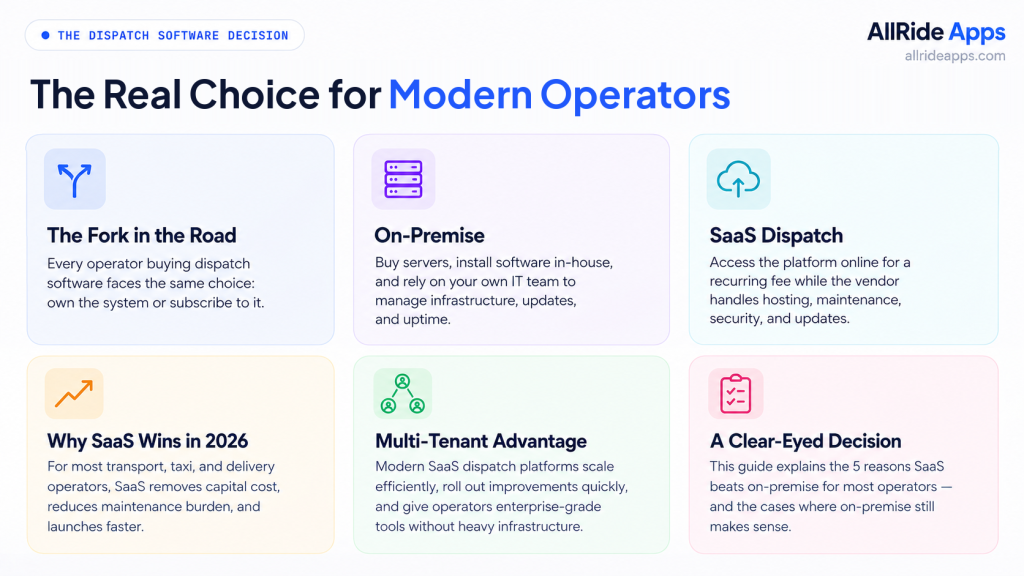
Every operator buying dispatch software hits the same fork: own it or subscribe to it.
On-premise means buying servers, installing software in your building, and running it with your own IT. SaaS means accessing the platform over the internet for a recurring fee while the vendor handles everything underneath.
For years, the assumption was that owning meant more control and lower long-term cost. In 2026, that assumption is mostly outdated. SaaS dispatch has matured into the default for transport, taxi, and delivery operators. This is because it removes the capital cost, the maintenance burden, and the slow launch that made on-premise a liability rather than an asset.
This guide explains what SaaS dispatch is, how multi-tenant SaaS works, the five reasons it beats on-premise for most operators. Further, honestly, the cases where on-premise still makes sense. The goal is a clear-eyed on premise vs SaaS decision, not a sales pitch.
The Real Choice Modern Operators Face
The decision is not really about features. Both delivery models can run bookings, driver assignment, and tracking.
The Question Underneath
The real question is who carries the infrastructure — and what that costs you in cash, time, and attention.
With on-premise, that weight sits with you: hardware, licenses, patching, backups, and the staff to manage them. However, with SaaS, it sits with the provider, folded into a subscription.
Why the Default Has Flipped
A decade ago, subscribing felt like renting. Today, the calculus has reversed for most fleets.
Cloud infrastructure has become more reliable than a single office server, vendors ship improvements continuously, and operators increasingly cannot justify an IT project standing between them and revenue.
Expert Tip: Before comparing vendors, write down what your current dispatch setup costs per year — including the hours your team spends maintaining it, not just the invoices. That number is your real baseline for the on premise vs SaaS decision.
What Is SaaS Dispatch Software?
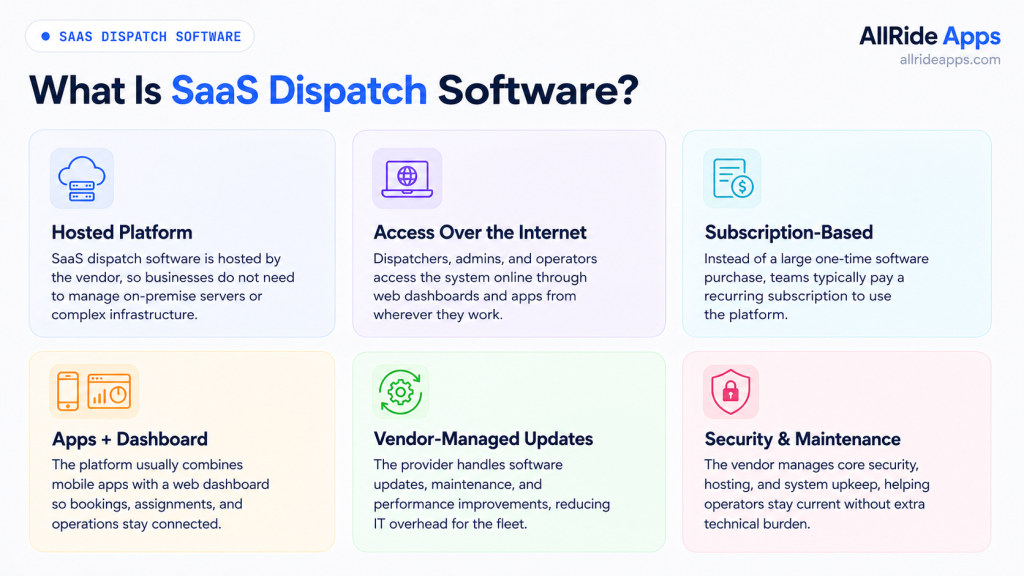
SaaS dispatch is a hosted dispatch platform you access over the internet through apps and a web dashboard, paid by subscription, with the vendor managing servers, updates, and security.
On-premise dispatch software, by contrast, is installed on hardware you own and maintain in-house.
The difference is not the features — both can run bookings, driver assignment, and tracking. The difference is who carries the infrastructure. With SaaS, that weight sits with the provider. With on-premise, it sits with you.
What Is Multi-Tenant SaaS, and Why Does It Matter for Dispatch?
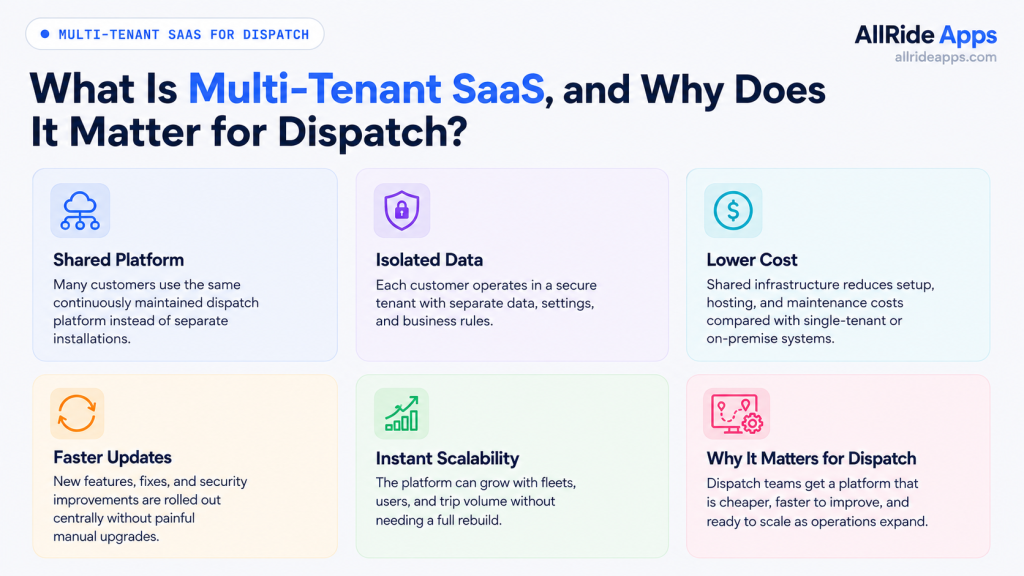
Multi-tenant SaaS is an architecture where many customers securely share the same continuously maintained platform, each with isolated data.
It is what makes SaaS dispatch cheaper, faster to update, and instantly scalable compared with a single-tenant or on-premise install.
How the Shared Model Works
Every operator runs on one well-maintained codebase. Improvements, security patches, and new features reach everyone at once.
The cost of the infrastructure is spread across the whole customer base rather than shouldered by you alone.
Private Data, Shared Efficiency
Your data stays private and separated; the efficiency is shared.
That shared-platform model is the engine behind most of the advantages below.
The 5 Reasons SaaS Dispatch Beats On-Premise
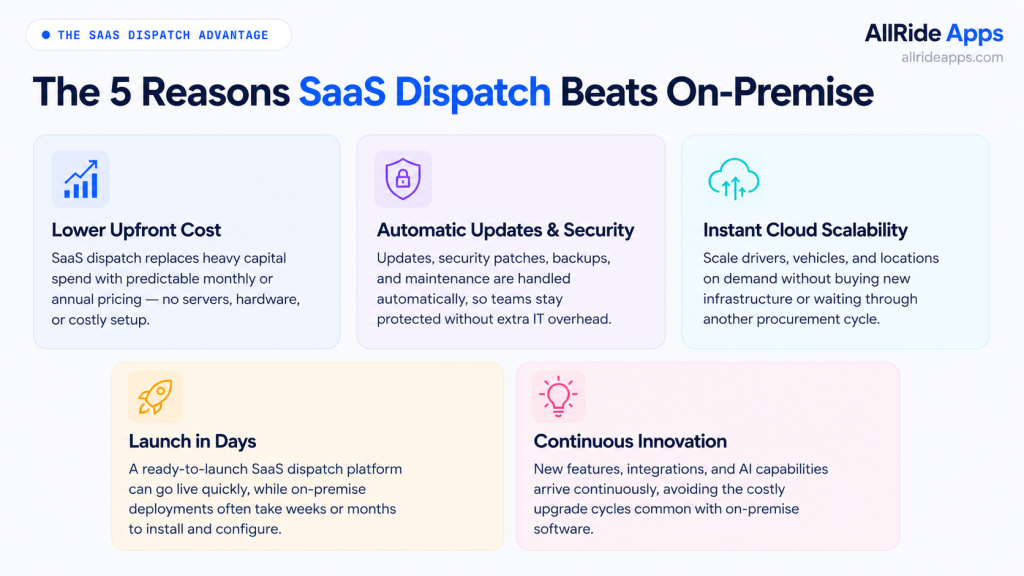
Each advantage removes a specific cost or delay that on-premise builds in by design.
1. Far Lower Upfront Cost and Predictable Pricing
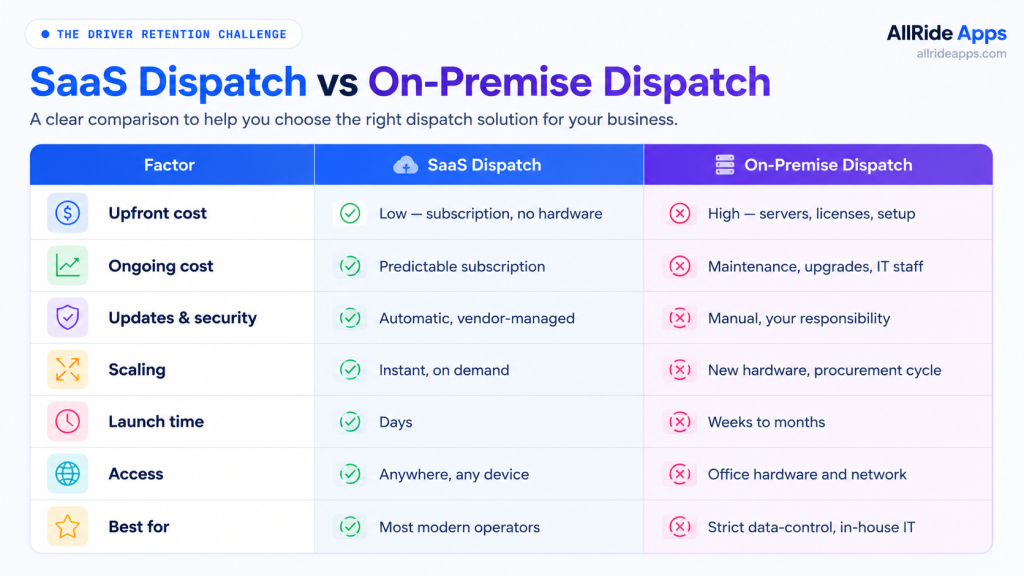
SaaS dispatch turns a large capital purchase into a predictable monthly or annual operating cost, with no servers to buy or IT infrastructure to build.
On-premise front-loads the spend: hardware, licenses, installation, and setup before you dispatch a single trip.
That shift from CapEx to OpEx matters most for small and growing operators, where tying up cash in servers is exactly what you cannot afford. SaaS pricing scales with your usage and fleet size, so you pay for what you run rather than over-provisioning hardware for a peak you might reach later.
When comparing dispatch software pricing, weigh the full three-year cost, not just the sticker — but for most operators the SaaS curve starts far lower and stays flatter.
2. Automatic Updates, Security, and Maintenance
With SaaS dispatch, the vendor handles updates, security patches, and backups automatically, so you are always on the current, protected version without an IT team.
On-premise software makes all of that your job — and stale, unpatched on-premise systems are where security and reliability problems accumulate.
The practical difference:
- No maintenance windows or upgrade weekends
- No manual patching or after-hours server fixes
- No internal IT cost just to keep dispatch running
For operators without a dedicated tech team, this alone often justifies the move.
3. It Scales Instantly With the Cloud
SaaS dispatch scales up or down on demand — more drivers, more vehicles, more locations — without buying or provisioning new hardware.
On-premise capacity is fixed at whatever you installed, so growth means another procurement cycle and a wait.
Multi-tenant cloud infrastructure flexes with you: add a branch, a hundred cars, or a seasonal surge, and the platform absorbs it. Your software never becomes the bottleneck that caps your growth, and you are not paying for idle capacity in the quiet months.
4. You Launch in Days, Not Months
Because there is nothing to install, a ready-to-launch SaaS dispatch platform can go live in days, while on-premise deployments often take weeks or months of hardware setup and configuration.
Speed-to-launch is revenue you capture sooner.
For an operator starting up or switching systems, that gap is decisive. SaaS gets you booking and dispatching quickly, then lets you configure and expand from a running system, instead of waiting on an infrastructure project before the business can earn.
5. Continuous Innovation, No Obsolescence
SaaS dispatch improves continuously — new features, integrations, and AI capabilities arrive automatically — while on-premise software ages between expensive upgrade cycles.
You stay current by default rather than falling behind.
On-premise systems tend to freeze at the version you installed until a costly, disruptive upgrade. SaaS platforms evolve underneath you, so the dispatch tool you buy today keeps pace with rider expectations, payment methods, and integrations without a rip-and-replace project down the line.
Expert Tip: Ask any SaaS vendor for their release history over the past 12 months. A platform that shipped meaningful improvements every month is demonstrating the innovation advantage; one that has not is just on-premise software hosted somewhere else.
SaaS Dispatch vs On-Premise: Side-by-Side
When Does On-Premise Dispatch Still Make Sense?
On-premise dispatch software still fits operators with strict data-residency or regulatory mandates, air-gapped security requirements, or an established in-house IT team that needs full control of the stack.
It is not obsolete — it is specialized.
The Honest Cases for On-Premise
Consider on-premise (or a licensed, self-hosted deployment) if:
- Your contracts or jurisdiction require data to physically stay on hardware you own
- You operate under air-gapped or high-security mandates
- You already run a capable IT department and value complete control over every layer
The Honest Test
The question is whether that control is worth the capital outlay, maintenance burden, and slower innovation.
For a minority of operators it genuinely is. For most, it is not.
Expert Tip: If you are unsure which side you fall on, check your actual contractual obligations rather than your instincts. Many operators assume they have a data-residency mandate when their contracts only require data protection standards — which reputable SaaS providers can meet.
How AllRide Delivers SaaS Dispatch
AllRide Apps is an AI-powered, fully branded dispatch and mobility platform. It is delivered as subscription-based SaaS, with a licensed deployment option available — so operators can choose the subscription model most will want, without being locked out if a genuine data-control mandate calls for something else.
On the SaaS side, that means:
- Automated dispatch and driver assignment
- Real-time GPS tracking and fleet visibility
- Customer, driver, and admin apps plus a web dashboard
- A scalable architecture that flexes with demand
Updates, security, and post-launch maintenance are handled by AllRide team, and the ready-to-launch platform keeps improving continuously — which is exactly the SaaS advantage this comparison is about.
The takeaway is not “SaaS always, everywhere.” It is that for the modern operator weighing on premise vs SaaS, a SaaS dispatch platform removes the cost, delay, and maintenance that make on-premise hard to justify.
See how AllRide’s SaaS dispatch works for your fleet — [book a free demo].
Conclusion
The on premise vs SaaS decision used to be about control versus convenience. Today it is mostly about whether you want to run an IT project or run a fleet.
SaaS dispatch software beats on-premise for most modern operators on cost, maintenance, scale, launch speed, and continuous innovation — while on-premise stays the right fit for the specific minority with strict data-control needs and the IT muscle to back it.
If you want dispatch that launches fast, scales cleanly, and keeps improving without a server room, SaaS is the model to choose. See how AllRide delivers SaaS dispatch built for modern operators — [book a free demo].
FAQs
1. What is SaaS dispatch software?
SaaS dispatch software is a hosted dispatch platform accessed over the internet through apps and a web dashboard, paid by subscription, with the vendor managing servers, updates, security, and backups. It centralizes bookings, driver assignment, and tracking in the cloud, so operators run dispatch without buying or maintaining their own hardware.
2. What is the difference between on-premise and SaaS dispatch?
On-premise dispatch is installed on hardware you own and maintain in-house, with high upfront cost and full self-management. SaaS dispatch is delivered as a cloud subscription, with the vendor handling infrastructure, updates, and security. On-premise offers maximum control; SaaS offers lower cost, faster launch, automatic maintenance, and easier scaling.
3. What is multi-tenant SaaS?
Multi-tenant SaaS is an architecture where many customers securely share one continuously maintained platform, each with isolated, private data. Sharing the underlying infrastructure spreads its cost across all users and lets updates and new features reach everyone at once, which is why multi-tenant SaaS dispatch is cheaper to run and faster to improve than single-tenant or on-premise software.
4. Is SaaS dispatch cheaper than on-premise?
For most operators, yes — especially upfront. SaaS dispatch replaces servers, licenses, and setup with a predictable subscription, and folds maintenance and updates into that fee. On-premise can look competitive over many years for large operators with existing IT, but when you count hardware, staff, upgrades, and downtime, SaaS is usually the lower total cost.
5. Is on-premise dispatch software more secure?
Not inherently. On-premise gives you physical control, but security then depends entirely on your team keeping servers patched and protected — and unpatched on-premise systems are a common weak point. Reputable SaaS providers run encryption, access controls, continuous patching, and automatic backups that often exceed what a small operator can maintain in-house. Verify the provider’s practices either way.
6. What happens to SaaS dispatch if the internet goes down?
SaaS dispatch needs connectivity, which is a fair concern, but modern platforms mitigate it: driver and customer apps cache data and resync when the connection returns, and business-grade or redundant internet keeps the dispatch desk online. In practice, the reliability of managed cloud infrastructure usually outweighs the risk of a local server failing with no failover.
7. Can I switch from on-premise to SaaS dispatch?
Yes. Most operators migrate by exporting existing customer, vehicle, driver, and booking data and importing it into the SaaS platform, then running a short parallel period before cutover. A good vendor provides migration support to make the switch low-risk, and because SaaS launches quickly, the transition is usually far faster than the original on-premise install was.