


 Fleet Management
 Route optimization
 Shuttle Transportation
 Delivery Management
 School Bus Transportation
 Ride Sharing Management
 Airport Transfer Booking
  Vehicle inspection
 Car Rental Management
 Trucking & Logistics
 Food & Beverage
 E-Commerce
 Passenger Transit
 Delivery
 School & Corporate
12 AI Features Transit Agencies Should Look for in Paratransit Software
AI in paratransit software is worth buying where it increases schedule density, protects on-time performance and reduces manual dispatcher work — and worth refusing where it makes decisions that belong to a human under the ADA. This guide covers the twelve AI capabilities transit agencies should evaluate, what each is genuinely worth, what to test in a demo, and the compliance limits that apply to all of them.
Key takeaways
- Paratransit is a civil-rights service before it is a transport service. Several efficiencies available in commercial transport are not lawful here.
- Schedule density is where AI pays. Grouping compatible trips without breaching ride-time or window commitments is the highest-value application.
- No-show and late-trip prediction protect both cost and OTP — the two numbers your board and the FTA actually look at.
- AI must never determine eligibility. That is a regulated human decision with appeal rights attached.
- Capacity denials are prohibited for ADA complementary paratransit, so any tool that “optimises” by declining trips is a compliance problem, not a feature.
- Explainability is procurement-grade, not academic. You will need to explain a scheduling decision to a rider, an advocate, or an FTA reviewer.
- Microtransit convergence is real — evaluate whether one platform can run both, because that is where most agency roadmaps are heading.
What is paratransit software?
Paratransit software schedules, routes and dispatches demand-response trips for riders who cannot use fixed-route transit, managing eligibility records, trip booking and negotiation, vehicle and driver assignment by mobility need, real-time execution, and the reporting agencies are required to produce.
The category is searched as paratransit scheduling software, paratransit dispatch software, paratransit routing software and paratransit management software. Those describe different emphases in one workflow, and platforms genuinely differ in which part they do well.
A note on adjacent terms: transit scheduling software more often refers to fixed-route service planning, run-cutting and crew scheduling — a different product category with different vendors. If your requirement is demand-response service for ADA-eligible riders, paratransit-specific platforms are what you are shopping for.
Why paratransit is not general fleet software
This is the distinction that determines whether a platform will survive your operation.
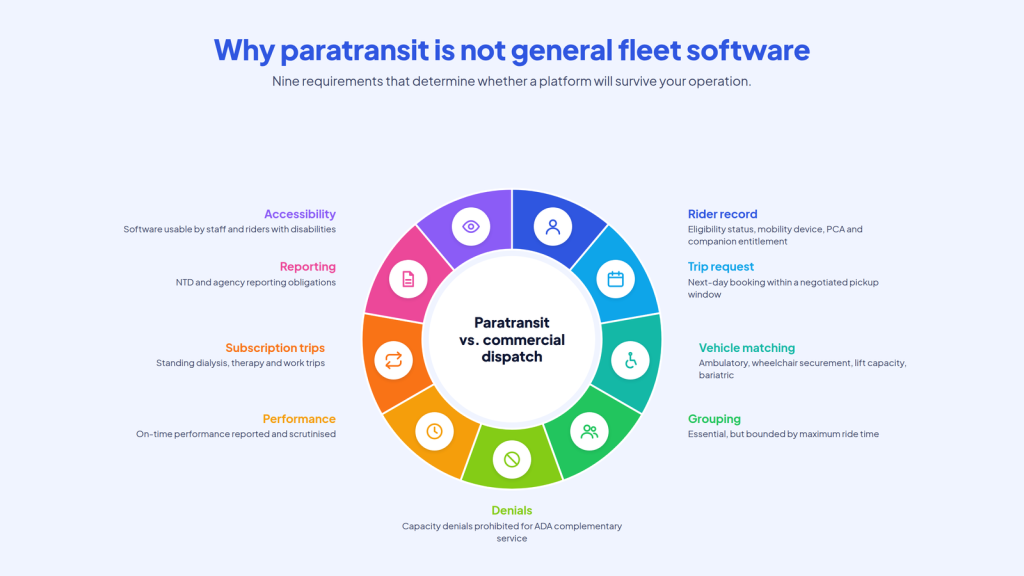
Two rows deserve emphasis. Capacity denials are prohibited for ADA complementary paratransit, so any AI that improves efficiency by turning trips away is not an efficiency at all. And maximum ride time bounds every grouping decision — an algorithm that fills a vehicle perfectly while leaving a rider on board for two hours has produced a complaint, not an optimisation.
The 12 AI features to evaluate
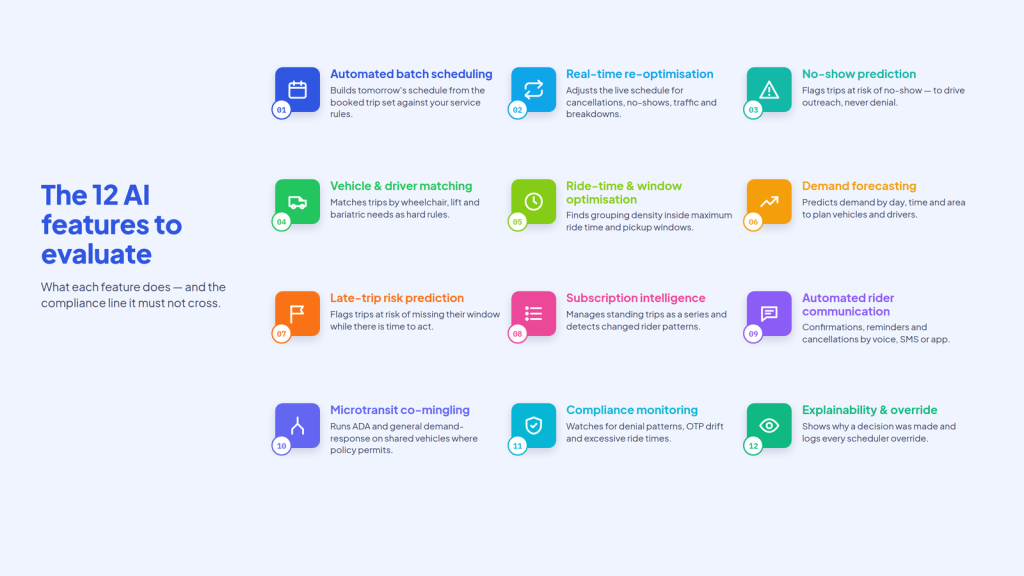
1. Automated batch scheduling
What it does. Builds tomorrow’s schedule from the booked trip set, assigning trips to runs and vehicles against your service rules rather than requiring schedulers to place them manually.
Why it matters. This is the single largest consumer of scheduler time in most agencies, and the quality of the batch determines the cost of the entire service day.
What to test. Load a real day’s trip set — including your hardest one — and run the batch. Compare the result against what your schedulers actually produced, on vehicle count, total revenue hours and rider ride times.
Red flag. A batch that looks efficient but breaches ride-time limits or drops trips into windows your riders never agreed to.
2. Real-time re-optimisation
What it does. Adjusts the live schedule as the day changes — same-day cancellations, no-shows, traffic, a vehicle breakdown — rather than leaving dispatchers to rebuild manually.
Why it matters. Paratransit days rarely survive contact with reality. Recovering capacity released by a cancellation is free service.
What to test. Cancel three trips mid-morning and see whether the system offers to backfill. Break a vehicle and watch how its remaining trips are redistributed.
Red flag. Re-optimisation that reshuffles so aggressively that drivers and riders lose confidence in the manifest they were given.
3. Predictive no-show and cancellation modelling
What it does. Flags trips at elevated risk of no-show or late cancellation, based on historical patterns by rider, trip type, time and destination.
Why it matters. A no-show costs a vehicle slot and a driver’s time with no service delivered. Even modest predictive accuracy funds itself.
What to test. Ask what data the model uses and how it performed on the vendor’s existing customers. Then ask what the system does with a prediction — confirmation call, schedule adjustment, or just a flag.
Red flag — and this one is important. Prediction must never become a reason to deny or deprioritise a rider’s trip. Using no-show history to refuse service raises discrimination and ADA problems. Confirm the prediction drives outreach, not exclusion.
4. Intelligent vehicle and driver matching
What it does. Matches trips to vehicles and drivers by mobility requirement — wheelchair securement positions, lift capacity, bariatric equipment — alongside location and availability.
Why it matters. A trip assigned to a vehicle that cannot carry the rider is a failed trip and a serious service failure.
What to test. Create a mobility mismatch deliberately and confirm the system prevents it rather than warning after assignment. Add a PCA and a companion and check the capacity maths.
Red flag. Mobility requirements treated as preferences the optimiser can trade away for efficiency.
5. Ride-time and window optimisation
What it does. Balances grouping efficiency against maximum ride time and negotiated pickup windows, finding density that stays inside your service commitments.
Why it matters. This is where paratransit economics actually live. Every additional compatible trip on a run reduces cost per trip — up to the point where rider experience breaks.
What to test. Set your real ride-time policy and see whether the optimiser respects it as a hard constraint. Then look at the distribution of ride times, not just the average.
Red flag. Ride-time limits configured as soft targets the algorithm can exceed to improve a metric.
6. Demand forecasting and capacity planning
What it does. Predicts trip demand by day, time and area, so vehicle and driver resources can be planned rather than reacted to.
Why it matters. Paratransit demand is more predictable than it feels — dialysis, therapy and work trips recur. Forecasting turns that into staffing decisions.
What to test. Ask the system to forecast a month you already have data for, and compare against what actually happened.
Red flag. Forecasting that only reports historical averages under a predictive label.
7. Late-trip risk prediction
What it does. Identifies trips at risk of missing their window while there is still time to intervene, rather than reporting lateness afterwards.
Why it matters. On-time performance is the number your board, your riders and your oversight body all watch. Preventing three late trips is worth more than reporting on thirty.
What to test. Introduce a delay early in a run and see whether downstream trips are flagged, and what action the system proposes.
Red flag. Alerts that fire once the trip is already late.
8. Subscription and standing-trip intelligence
What it does. Manages recurring trips as a series, detects when a rider’s pattern has changed, and identifies subscription trips that are consistently cancelled or no-showed.
Why it matters. Standing trips are the backbone of paratransit demand and a common source of waste when a rider’s circumstances change without the agency being told.
What to test. Build a three-times-weekly dialysis subscription, change one occurrence, suspend it for two weeks, and end it from a date forward.
Red flag. Subscriptions stored as copied individual trips rather than an editable series.
9. Automated rider communication
What it does. Handles confirmations, reminders, imminent-arrival notifications and cancellation intake through automated voice, SMS or app, including conversational systems that understand a spoken cancellation.
Why it matters. Call volume is a major agency cost, and a reminder that produces an early cancellation converts a no-show into a usable slot.
What to test. Cancel a trip by voice and by text. Then check what happens with a rider who has no smartphone, limited English, or a hearing impairment.
Red flag. Automation that assumes app access. A meaningful share of paratransit riders will use the phone, and accessible fallbacks are a requirement rather than a courtesy.
10. Microtransit and co-mingled service optimisation
What it does. Runs paratransit alongside microtransit or general demand-response service on shared vehicles where policy permits, optimising across both.
Why it matters. Many agencies are moving this way, and co-mingling can improve utilisation substantially — but only if the software can hold both service rules simultaneously.
What to test. Ask whether ADA trips and general microtransit trips can share a vehicle under your fare and service policy, and how the optimiser prioritises when they conflict.
Red flag. Co-mingling that lets general-public demand crowd out ADA trips, which inverts your legal obligation.
11. Compliance and anomaly monitoring
What it does. Watches operational data for patterns that indicate a compliance problem: trip denial patterns, on-time performance drift, excessive ride times, or trips clustering outside the service area.
Why it matters. Compliance issues are far cheaper to find in your own data than in a review or complaint.
What to test. Ask what the system flags automatically, and whether reporting maps to your NTD and agency requirements without manual rebuilding.
Red flag. Reporting that requires exporting to a spreadsheet to answer a basic oversight question.
12. Explainability and human override
What it does. Shows why a scheduling or assignment decision was made, and lets a scheduler or dispatcher override it, with the override recorded.
Why it matters. You will have to explain a decision — to a rider, an advocate, a board member or a reviewer. “The algorithm decided” is not an answer any of them will accept. Override is equally essential, because schedulers hold context the model does not.
What to test. Ask the system why a specific trip was placed on a specific run. Then override it and confirm the override is logged and does not get silently reversed by the next optimisation pass.
Red flag. A system that cannot explain a decision, or that resists correction. Your schedulers will work around it within a fortnight, and you will have paid for automation you cannot use.
What AI must not do in paratransit
Three decisions must stay with humans, and any vendor suggesting otherwise should be disqualified rather than negotiated with.
Eligibility determination. Whether a person is eligible for ADA complementary paratransit, and under what conditions, is a regulated determination with documentation and appeal rights attached. Software can support the process — managing applications, records, expiry dates and correspondence — but the determination itself is a human decision. Treat any “AI eligibility screening” claim with considerable caution.
Trip denial. Capacity denials are prohibited for ADA complementary paratransit. An optimiser that improves its metrics by declining trips is creating a compliance exposure, not delivering efficiency.
Service reduction for individual riders based on prediction. Using no-show history or predicted behaviour to deprioritise a rider raises discrimination concerns. Prediction should drive outreach and confirmation, never exclusion.
A useful procurement question: ask each vendor to state plainly, in writing, which decisions their system makes autonomously and which require human confirmation. The answer tells you a great deal about whether they understand this sector.
How much does paratransit software cost?
Paratransit platforms are typically priced per vehicle, per trip, or as an agency licence, often on multi-year contracts aligned to procurement cycles.
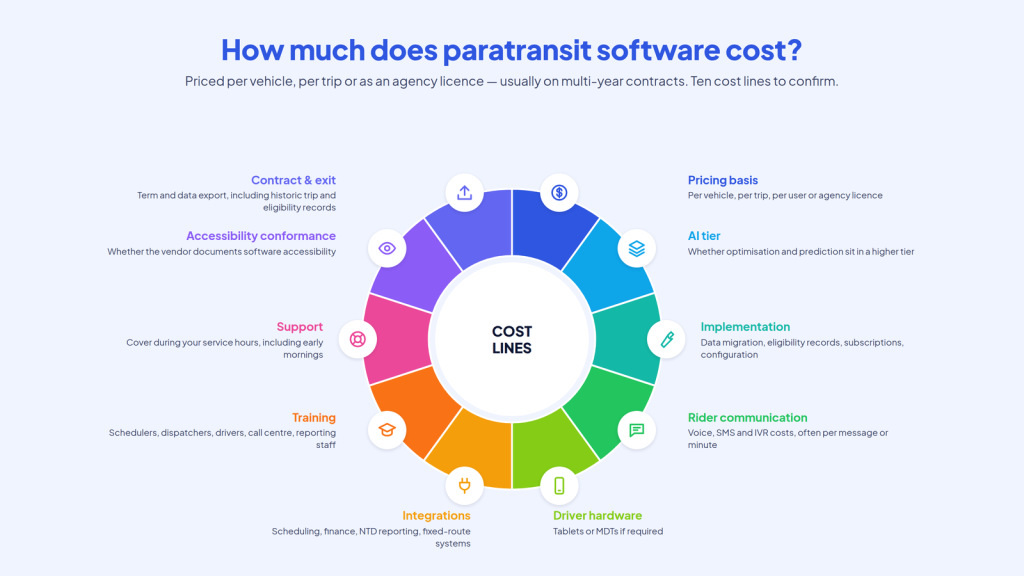
Two sector-specific points. Per-trip pricing rises with ridership, which is awkward when demand growth is a legal obligation rather than a commercial choice — model it at projected demand, not current. And implementation is heavier than commercial transport, because eligibility records and subscription trips must migrate accurately; a lost standing dialysis trip is a serious failure, not an inconvenience.
Procurement notes for agency buyers
Public procurement shapes this purchase as much as the software does, and building the right requirements into the RFP is more effective than negotiating afterwards.
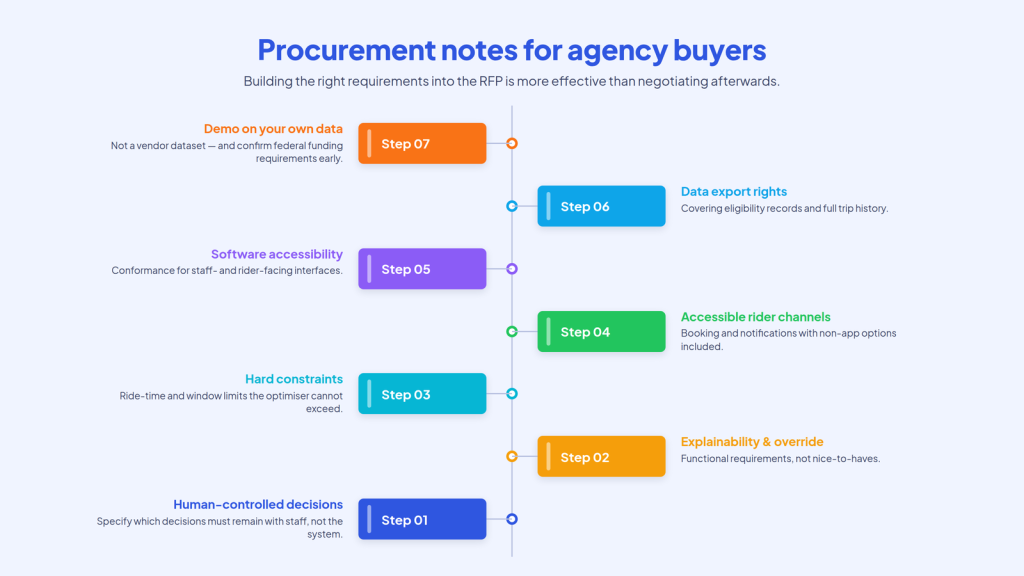
Consider specifying: which decisions must remain human-controlled; explainability and override as functional requirements rather than nice-to-haves; ride-time and window limits as hard constraints; accessible rider communication channels including non-app options; software accessibility conformance for staff and rider-facing interfaces; data export rights covering eligibility and trip history; and demonstration on the agency’s own data rather than a vendor dataset.
Where federal funding applies, confirm any programme-specific requirements with your funding administrator early — those obligations shape eligible vendors and contract terms, and are far cheaper to address before an award than after.
Common mistakes agencies make
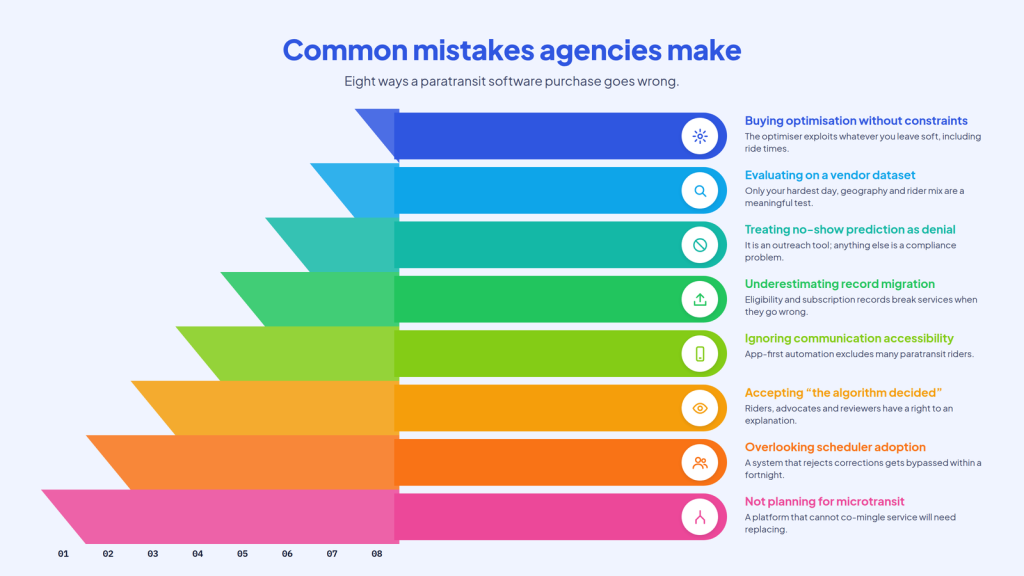
- Buying optimisation without setting constraints properly. An optimiser will exploit whatever you leave soft, including ride times.
- Evaluating on a vendor dataset. Your hardest day, your geography and your rider mix are the only meaningful test.
- Treating no-show prediction as a denial tool. It is an outreach tool. Using it otherwise creates a compliance problem.
- Underestimating eligibility and subscription migration. These are the records that break services when they go wrong.
- Ignoring rider communication accessibility. App-first automation excludes a meaningful share of paratransit riders.
- Accepting “the algorithm decided” as an answer. You will need to explain decisions to people with a right to an explanation.
- Overlooking scheduler adoption. Experienced schedulers hold enormous contextual knowledge; a system that cannot accept their corrections gets bypassed.
- Not planning for microtransit. If co-mingled service is on your roadmap, buying a platform that cannot support it means replacing it.
Implementation without disrupting service
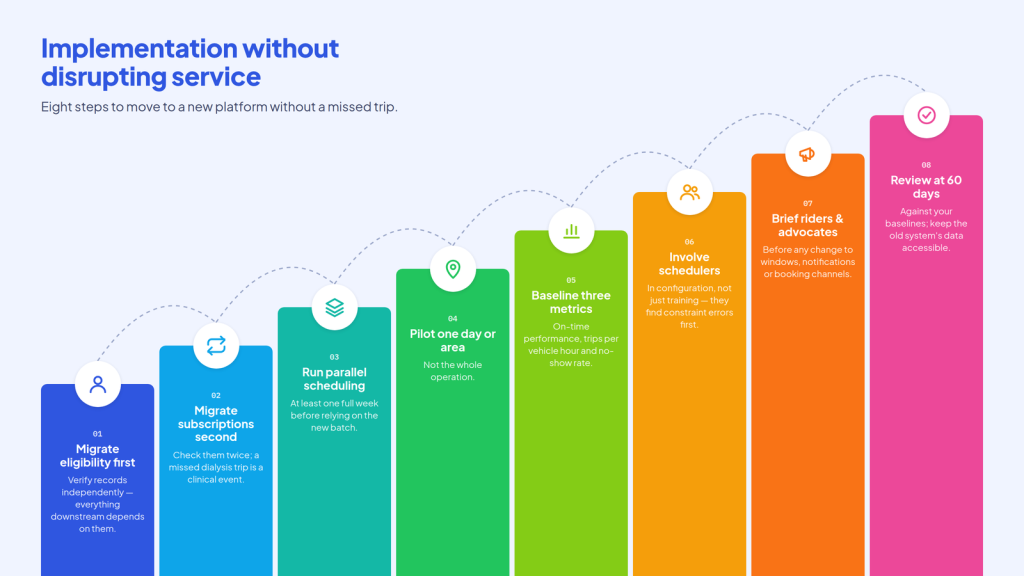
- Migrate eligibility records first and verify them independently. Everything downstream depends on them.
- Migrate subscription trips second, and check them twice. A missed dialysis trip is a clinical event.
- Run parallel scheduling for at least one full week before relying on the new batch.
- Pilot on one service day or area, not the whole operation.
- Baseline three metrics first: on-time performance, trips per vehicle hour, and no-show rate.
- Involve schedulers in configuration, not just training. They will find the constraint errors before your riders do.
- Brief riders and advocacy groups before any change they will notice — particularly to windows, notifications or booking channels.
- Review at 60 days against your baselines, and keep the previous system’s data accessible until you are confident.
How AllRide fits paratransit and community transport
A scope note first, because it matters in this sector. AllRide Apps is a transport operations platform — its strengths are automated dispatch and driver assignment, route optimisation, real-time tracking and branded rider and driver apps, delivered as configurable white-label software. It is not a specialist ADA paratransit system: eligibility determination workflows, NTD reporting, ADA-specific compliance monitoring and demand-response window negotiation are the domain of dedicated paratransit vendors, and an agency procuring ADA complementary paratransit should shortlist those.
Where AllRide is genuinely relevant is the adjacent work many agencies and their contractors also run: community and senior transport that sits outside ADA complementary service, private contractor operations delivering agency trips, non-emergency medical and facility transport, employee and campus shuttles, and demand-response services outside the US regulatory framework. Operators running several of these alongside each other can do so on one configurable platform with automated assignment and their own branding, rather than separate tools per service.
For agencies, the practical question is which part of your service mix you are actually buying for. If it is ADA complementary paratransit, evaluate specialist vendors against the twelve features above. If it is the wider community, contracted or non-ADA transport around it, book a free AllRide demo and test it against those workflows.
Frequently asked questions
What is paratransit scheduling software?
Paratransit scheduling software builds and manages demand-response trip schedules for riders who cannot use fixed-route transit. It handles eligibility records, trip booking within negotiated pickup windows, grouping compatible trips within maximum ride times, assigning vehicles by mobility requirement, and producing the operational and compliance reporting agencies need.
How is paratransit software different from general dispatch software?
Paratransit software has to model things commercial dispatch does not: rider eligibility and conditions, mobility devices and securement positions, personal care attendants and companions, negotiated pickup windows, maximum ride times, subscription trips, and the prohibition on capacity denials for ADA complementary service. General dispatch software handles the middle of the workflow and typically fails at both ends.
What AI features actually matter in paratransit software?
The highest-value are automated batch scheduling, real-time re-optimisation, ride-time and window optimisation, no-show and late-trip prediction, and intelligent vehicle matching by mobility requirement. Explainability and human override matter as much as any of them, because agencies must be able to explain scheduling decisions to riders, advocates and oversight bodies.
Can AI determine paratransit eligibility?
No, and agencies should be cautious about any vendor implying otherwise. ADA paratransit eligibility is a regulated determination with documentation and appeal rights attached, and it must remain a human decision. Software can properly support the process by managing applications, records, conditions, expiry dates and correspondence, but the determination itself should not be automated.
Can paratransit software deny trips to improve efficiency?
Capacity denials are prohibited for ADA complementary paratransit, so a system that improves its metrics by declining trips creates a compliance exposure rather than an efficiency. Similarly, no-show prediction should drive confirmation calls and outreach, never the refusal or deprioritisation of a rider’s trip.
What is microtransit software, and does it overlap with paratransit?
Microtransit software manages flexible, demand-response shared service for the general public, typically booked by app within a zone. It overlaps with paratransit because both are demand-response and can share vehicles where policy permits. Many agencies now want one platform for both, so if co-mingled service is on your roadmap, evaluate whether a platform can hold both service rule sets simultaneously.
How much does paratransit dispatch software cost?
Typically priced per vehicle, per trip, or as an agency licence, often on multi-year contracts. Beyond the base cost, confirm whether AI optimisation sits in a higher tier, plus implementation and data migration, rider communication costs for voice and SMS, driver hardware, integrations, training and support hours. Per-trip pricing is worth modelling at projected demand rather than current volume.
Is there free paratransit software?
Genuinely free platforms capable of ADA-compliant demand-response scheduling, eligibility management and required reporting are rare, and general-purpose free scheduling tools will not meet agency obligations. Small community transport operations sometimes start with basic tools, but agencies delivering ADA complementary service should expect to procure a specialist system.
What should we test in a paratransit software demo?
Use your own data and your hardest service day. Run a full batch schedule and compare it to your schedulers’ result; create a mobility mismatch and confirm it is prevented; build and then amend a dialysis subscription; introduce a mid-morning delay and check late-trip flagging; cancel trips and see whether capacity is recovered; and ask the system to explain one specific scheduling decision, then override it.
How long does paratransit software implementation take?
It varies with agency size, but the schedule is usually driven by data migration rather than software configuration. Eligibility records and subscription trips must transfer accurately and be independently verified, parallel scheduling should run for at least a week, and schedulers need involvement in configuration rather than only training. Plan the go-live outside peak demand periods.
Conclusion
Paratransit is one of the few places in transport where the efficiency case and the compliance case can pull in opposite directions — and where getting that balance wrong affects people’s access to dialysis, work and daily life rather than a delivery window.
The twelve features above are worth buying because they make schedulers faster, vehicles fuller and lateness rarer, all within limits the agency sets. What makes them safe is the last one: a system that explains its decisions and accepts correction from the people who know the riders. Evaluate the first eleven on your own hardest day, and treat the twelfth as non-negotiable.
If your service mix includes community, contracted or non-ADA transport alongside your paratransit programme, book a free AllRide demo and test it against those specific workflows.