


 Fleet Management
 Route optimization
 Shuttle Transportation
 Delivery Management
 School Bus Transportation
 Ride Sharing Management
 Airport Transfer Booking
  Vehicle inspection
 Car Rental Management
 Trucking & Logistics
 Food & Beverage
 E-Commerce
 Passenger Transit
 Delivery
 School & Corporate
10 Best AI-Powered NEMT Software Platforms for 2026
NEMT software is judged on three things before anyone looks at the AI: can it schedule and route wheelchair and stretcher trips correctly, can it submit clean claims to Medicaid, and can it connect to your broker. Platforms that fail any of those cannot run a Medicaid NEMT operation, however sophisticated their algorithms. This guide compares ten platforms against that reality, then against what their AI genuinely does.
Key takeaways
- NEMT software is not general fleet software. Trip legs, mobility levels, will-calls, no-shows, standing orders and claims are structural requirements, not add-ons.
- Billing is the business. A platform that schedules beautifully but produces rejected claims will bankrupt an operation faster than one with a clumsy interface.
- Broker integration determines your revenue. If your trips come from Modivcare, MTM, Access2Care or a state broker, confirm the integration exists before anything else.
- HIPAA is a gate, not a feature. Patient data handling, BAAs and access controls belong in procurement, not the wish list.
- AI in NEMT is most valuable in scheduling density and no-show prediction — the two things that most directly determine whether a route is profitable.
- Pricing is usually per trip or per vehicle, and the per-trip model rewards you for growing while punishing you for it at the same time. Model it carefully.
- The evaluation order that works: compliance and billing first, scheduling depth second, AI third, interface last.
What is NEMT software?
NEMT software manages non-emergency medical transportation: scheduling patient trips, routing and dispatching appropriate vehicles and drivers, tracking trip legs, capturing signatures and attestations, and submitting claims to Medicaid, brokers or private payers.
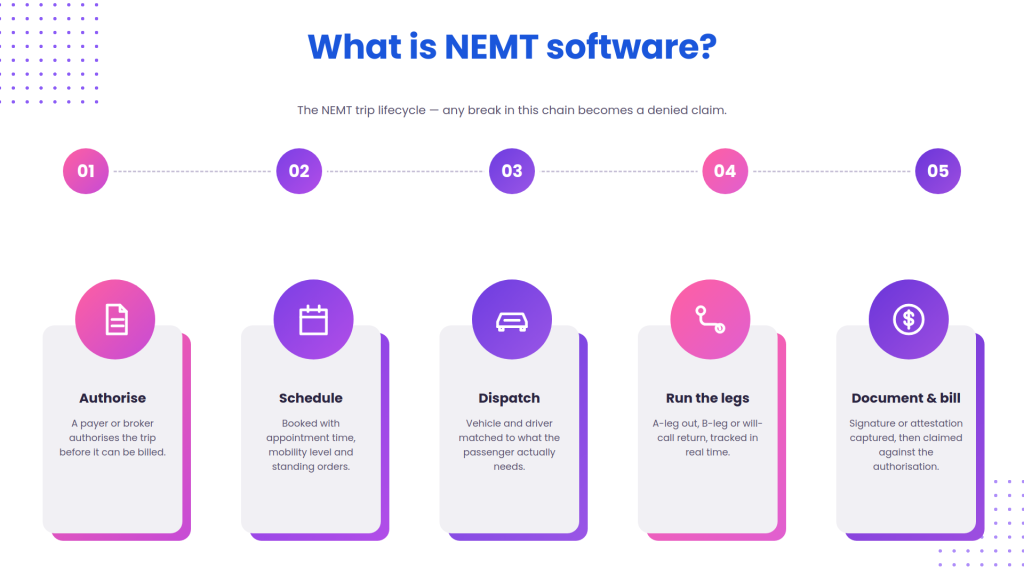
The category is searched as NEMT dispatch software, NEMT scheduling software, NEMT routing software, NEMT transportation software and NEMT dispatch and billing software. Those labels describe different emphases within one workflow — and the platforms genuinely differ in which part they do well.
The workflow itself is distinctive: a trip is authorised by a payer, scheduled with a mobility level and appointment time, assigned to a vehicle capable of carrying that passenger, executed as an A-leg and usually a B-leg return, documented with signatures or electronic attestation, and then billed against the authorisation. Any break in that chain becomes a denied claim.
What makes NEMT different from general fleet software?
This is where most software disappointment in this sector originates. A general dispatch platform handles the middle of the workflow well and the ends badly.
| Requirement | General fleet software | NEMT software |
| Trip structure | Point to point | A-leg and B-leg, will-call returns |
| Passenger detail | Name and phone | Mobility level, oxygen, escort, weight capacity |
| Vehicle matching | Class or capacity | Ambulatory, wheelchair, stretcher, bariatric |
| Recurrence | Occasional | Standing orders, dialysis three times weekly |
| Authorisation | Not applicable | Trip must be authorised before it is billable |
| Documentation | Optional POD | Signature or attestation required for payment |
| Billing | Invoice | Claims to Medicaid, brokers, private pay |
| Compliance | General | HIPAA, state Medicaid rules, driver credentialing |
| No-shows | Inconvenience | Unbillable trip plus a wasted vehicle slot |
The two rows that decide viability are authorisation and billing. A NEMT provider is effectively a healthcare claims business that happens to own vehicles, and software that treats billing as an afterthought will produce a denial rate the operation cannot absorb.
How we compared the platforms
These ten were reviewed using publicly available vendor information current in August 2026, selected to span NEMT specialists, broker-connected platforms and adjacent transport platforms serving parts of this market.
We assessed each on scheduling depth including standing orders and will-calls; mobility-level and vehicle matching; routing and multi-loading capability; dispatch and driver workflow; documentation and attestation capture; billing and claims; broker connectivity; the specific AI capability offered; and operating-model fit.
AllRide Apps’ transport software is included, scoped to the segment it genuinely serves. This is not an invented ranking — each platform is identified by the NEMT operation it suits, and every compliance, billing and broker-integration claim should be verified directly with the vendor, including ours.
The 10 best NEMT software platforms: at a glance
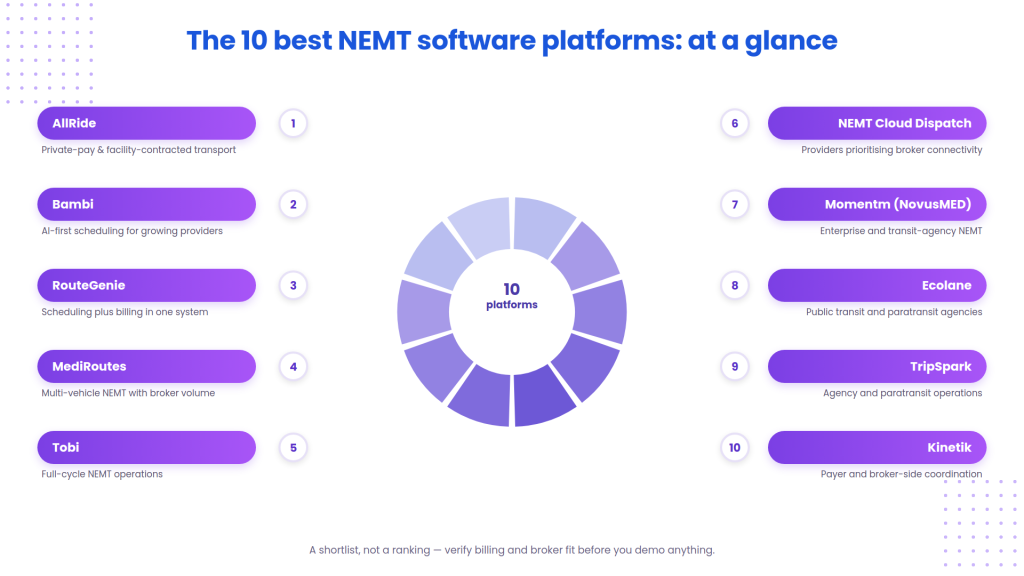
1. AllRide — best for private-pay and facility-contracted medical transport
Scope note up front: AllRide is a transport operations platform, not a Medicaid claims system. If your revenue comes through Medicaid brokers, you need a NEMT specialist from this list or AllRide paired with a billing platform. Where AllRide fits is the growing segment of medical transport that does not run on Medicaid claims — private-pay patient transport, hospital and clinic contracts, senior living and care-home transport, and international medical transport where US Medicaid does not apply.
Where its AI is applied. Automated dispatch and driver assignment, and route optimisation — the operational layer. For a private-pay or facility-contracted operation, that is where the margin actually sits: filling vehicles efficiently, assigning the right driver, and keeping appointment times without a dispatcher working the phone.
How it works in practice. Trips arrive from a facility portal, phone booking or app into one queue. Automated assignment matches them to drivers and vehicles on configured rules, with dispatcher override for exceptions — which matters when a patient’s needs change. Route optimisation and real-time tracking handle the timing, and branded apps mean the facility and patient see your organisation rather than a vendor’s.
Key capabilities: multi-channel booking; automated dispatch and driver assignment; manual dispatcher control; route optimisation; real-time GPS tracking; configurable fares and service zones; payment gateway integration; branded customer and driver apps; reporting dashboards; multi-language support; third-party API integrations.
Pros
- Strong operational automation without NEMT-specific implementation weight.
- Fully white-label — the facility and patient experience carries your brand.
- No hardware dependency, so faster and cheaper deployment than telematics-led options.
- Same platform can run non-medical work if you also operate shuttles, transfers or general transport.
Cons
- Not a Medicaid claims or broker-integrated platform. Medicaid-funded providers should shortlist NEMT specialists instead, or plan an integration.
- NEMT-specific structures — mobility levels, standing orders, will-call returns, attestation capture — must be confirmed rather than assumed.
- HIPAA posture and data handling need to be established directly before any patient data is involved.
Key differentiator: operational automation plus full white-label branding for medical transport that is not claims-driven.
Who it’s best for: private-pay patient transport, hospital and clinic contract transport, senior living and care-home fleets, and international medical transport operations — particularly those also running other passenger services.
2. Bambi — best for AI-first NEMT scheduling

Bambi positions itself around automated assignment for NEMT providers, aiming to replace manual scheduling with algorithmic trip allocation.
Where its AI is applied. Automated trip assignment and route building — reducing the hours dispatchers spend building tomorrow’s schedule by hand.
Key capabilities: automated scheduling and assignment; routing; driver app; trip management; reporting.
Pros: AI-first positioning aimed squarely at the scheduling bottleneck; modern interface; built for NEMT rather than adapted to it. Cons: confirm billing and broker depth relative to established full-cycle platforms; newer entrant than several competitors.
Key differentiator: automation of the scheduling task that consumes most NEMT dispatcher time.
Who it’s best for: growing NEMT providers whose dispatchers are the bottleneck.
3. RouteGenie — best for scheduling plus billing in one system

RouteGenie targets NEMT providers wanting scheduling, routing and billing in a single platform rather than stitched tools.
Where its AI is applied. Route optimisation and schedule density — fitting more trips into available vehicles.
Key capabilities: trip scheduling; route optimisation; dispatch; driver app; billing and claims; broker imports; reporting.
Pros: covers the full trip-to-claim cycle; routing depth aimed at profitability per vehicle. Cons: confirm which broker integrations are live in your state; billing depth varies by payer mix.
Key differentiator: trip-to-claim coverage in one system.
Who it’s best for: Medicaid providers wanting to avoid separate scheduling and billing tools.
4. MediRoutes — best for multi-vehicle broker-volume operations

MediRoutes serves NEMT providers managing significant broker trip volume across multiple vehicles.
Where its AI is applied. Routing and dispatch automation across larger daily trip counts.
Key capabilities: scheduling; routing and multi-loading; dispatch; driver app; broker trip import; billing support; reporting.
Pros: built for volume; multi-loading capability directly affects revenue per vehicle; established in the sector. Cons: confirm fit at smaller scale.
Key differentiator: handling high broker volume without proportional dispatcher headcount.
Who it’s best for: established providers with meaningful daily broker volume.
5. Tobi — best for full-cycle NEMT operations

Tobi covers the NEMT operating cycle from trip intake through scheduling, dispatch and billing.
Where its AI is applied. Scheduling and billing automation across the trip lifecycle.
Key capabilities: intake; scheduling; dispatch; driver app; attestation capture; billing and claims; reporting.
Pros: breadth across the full cycle; established NEMT focus. Cons: breadth can mean configuration effort.
Key differentiator: end-to-end NEMT cycle coverage.
Who it’s best for: providers wanting one system across intake, operations and billing.
6. NEMT Cloud Dispatch — best for broker connectivity

Positioned around connecting providers to broker trip sources and managing the resulting operations.
Where its AI is applied. Automated scheduling from imported broker trips.
Key capabilities: broker trip import; scheduling; dispatch; driver app; billing; reporting.
Pros: broker connectivity as the organizing principle; relevant where broker trips are most of your revenue. Cons: brokers and states are supported; assess depth outside broker workflows.
Key differentiator: broker integration as the core rather than an add-on.
Who it’s best for: providers whose volume is predominantly broker-assigned.
7. Momentm (NovusMED) — best for enterprise and agency NEMT

Momentm’s NovusMED serves larger NEMT operations, healthcare systems and transit agencies.
Where its AI is applied. Demand and capacity optimisation across large trip volumes and mixed service types.
Key capabilities: scheduling; demand-response routing; dispatch; call centre tooling; reporting and analytics; enterprise integrations.
Pros: enterprise depth; suits mixed NEMT and paratransit operations; strong reporting. Cons: implementation weight; disproportionate for small providers.
Key differentiator: enterprise and agency-scale capability.
Who it’s best for: healthcare systems, large providers and transit agencies.
8. Ecolane — best for paratransit and public agencies

Ecolane focuses on demand-response and paratransit operations for public agencies and their contractors.
Where its AI is applied. Real-time optimization of demand-response trips, including same-day changes.
Key capabilities: demand-response scheduling; real-time optimisation; dispatch; driver app; rider tools; agency reporting.
Pros: strong real-time paratransit optimisation; agency-oriented reporting and compliance. Cons: agency orientation may exceed a commercial provider’s needs; Medicaid billing depth.
Key differentiator: real-time demand-response optimisation.
Who it’s best for: public transit agencies and paratransit contractors.
9. TripSpark — best for agency scheduling depth

TripSpark serves paratransit, community and agency transport with scheduling and demand-response tooling.
Where its AI is applied. Scheduling optimisation and demand-response routing.
Key capabilities: scheduling; routing; dispatch; driver tools; rider communication; agency reporting.
Pros: established agency presence; scheduling depth for complex service rules. Cons: agency-focused; confirm commercial NEMT billing fit.
Key differentiator: depth in agency and community transport scheduling.
Who it’s best for: paratransit and community transport operations.
10. Kinetik — best for payer and network-side coordination

Kinetik operates on the connectivity layer between payers, brokers and transportation providers.
Where its AI is applied. Network and claims intelligence across the NEMT ecosystem rather than a single provider’s fleet.
Key capabilities: payer and broker connectivity; trip data exchange; claims workflows; network analytics.
Pros: addresses the data and claims layer many providers struggle with; relevant to payers and larger networks. Cons: not a provider-side dispatch platform in the same sense as others here; it replaces versus complements.
Key differentiator: ecosystem connectivity rather than fleet operations.
Who it’s best for: payers, brokers and provider networks rather than single small operators.
Which NEMT platform fits your operation?
| Your operation | Shortlist |
| Medicaid provider, broker-assigned volume | MediRoutes, NEMT Cloud Dispatch, RouteGenie |
| Growing provider, scheduling is the bottleneck | Bambi, RouteGenie |
| Want scheduling and billing in one system | RouteGenie, Tobi |
| Large provider or healthcare system | Momentm, Kinetik |
| Public transit or paratransit agency | Ecolane, TripSpark, Momentm |
| Private-pay patient transport | AllRide, Bambi |
| Hospital, clinic or care-home contract fleet | AllRide, Momentm |
| Medical transport outside the US Medicaid system | AllRide |
| Also running shuttles or general passenger transport | AllRide |
| Payer, broker or network operator | Kinetik |
What features should NEMT software have?
Evaluate in this order: compliance and billing, scheduling depth, routing, driver workflow, then AI and interface. Reversing that order is the most common and most expensive mistake in this category.
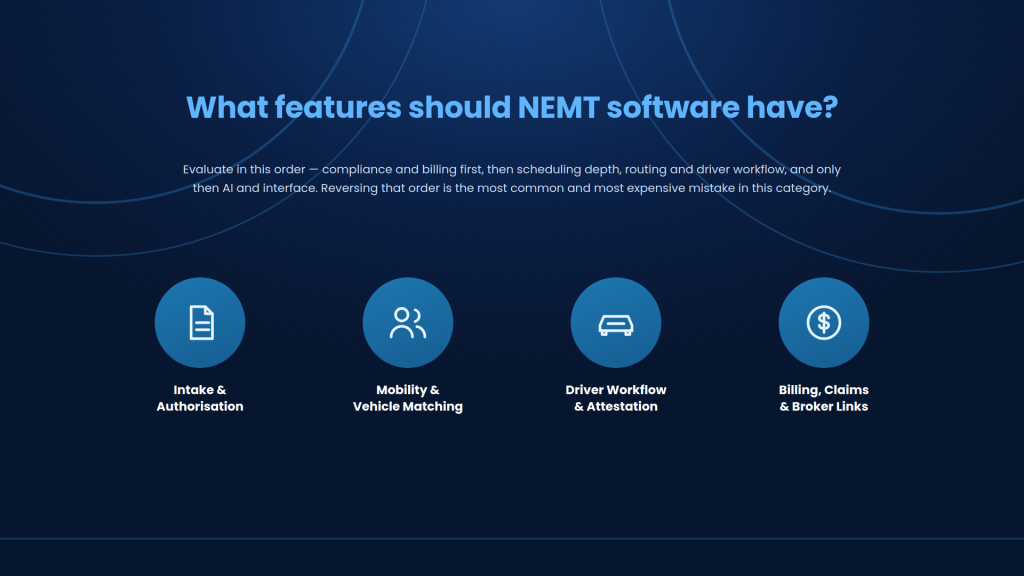
Trip intake and authorisation. Manual entry, broker import, facility portal and standing orders, with the authorisation attached to the trip so it cannot be billed without one.
Mobility levels and vehicle matching. Ambulatory, wheelchair, stretcher, bariatric and oxygen requirements matched to vehicles that can actually carry them — including escort and companion rules.
Standing orders and recurring trips. Dialysis three times a week, weekly therapy, ongoing treatment cycles. These should exist as an editable series, not copied trips.
Will-call and return-leg handling. The B-leg where the patient calls when ready is a defining NEMT workflow and a common weak point. Test it specifically.
Multi-loading and route density. Sharing a vehicle across compatible trips is where NEMT profitability lives. Confirm the system does it within your service and mobility constraints.
Driver workflow and attestation. Trip details, navigation, mobility requirements, and signature or electronic attestation capture — the evidence a claim depends on.
No-show and cancellation handling. Documented procedure, evidence capture, and correct billing treatment, since these directly affect revenue.
Billing and claims. Claim generation, payer rules, denial management, resubmission, and reconciliation. Ask about denial rates from existing customers, not just feature presence.
Broker integration. Which brokers, which states, and whether the connection is live or roadmap.
HIPAA and patient data. Storage, access controls, audit trails, business associate agreements and retention.
Reporting. On-time performance, trips per vehicle, denial rate, no-show rate, revenue per trip and cost per trip — the numbers that determine whether the operation works.
Where AI genuinely helps in NEMT
The two highest-value AI applications in NEMT are schedule density and no-show prediction, because both translate directly into revenue per vehicle.
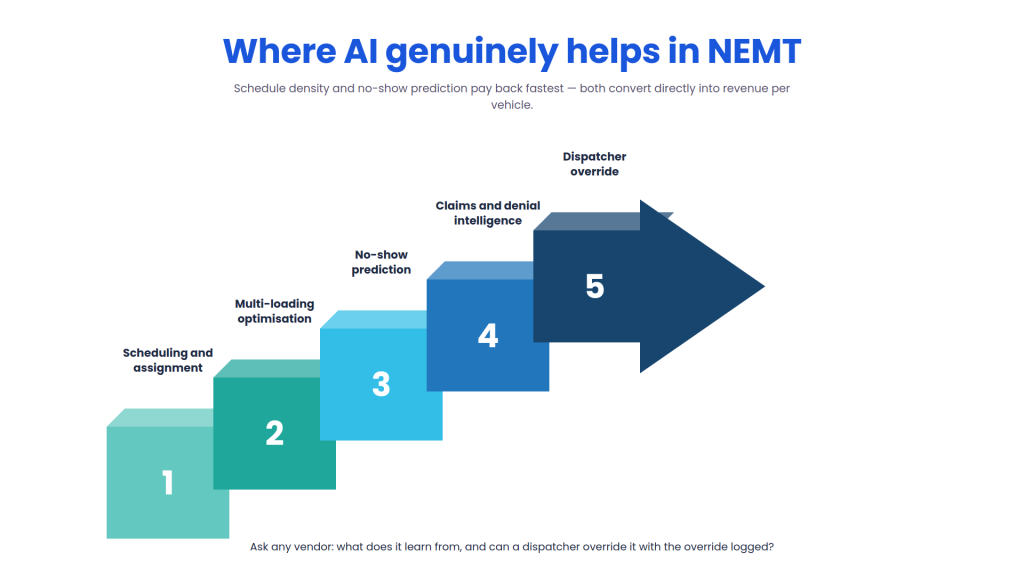
AI NEMT scheduling and assignment. Building tomorrow’s schedule is the single biggest consumer of dispatcher time. Automated assignment that respects mobility levels, appointment windows, vehicle capability and driver hours can compress hours of manual work — but only if the constraints are modelled correctly. A schedule that is efficient but puts a wheelchair passenger in an ambulatory vehicle is worse than a manual one.
Multi-loading optimisation. Deciding which trips can share a vehicle without breaching appointment times is a genuine optimisation problem, and small gains compound across every route every day.
No-show prediction. Patterns in patient history, appointment type and time of day can flag likely no-shows, letting dispatchers confirm ahead or schedule differently. This is where machine learning has the clearest payoff in NEMT, because a no-show is an unbillable trip and a wasted slot simultaneously.
Claims and denial intelligence. Flagging trips likely to be denied before submission, based on missing documentation or authorisation mismatches.
Two questions for any vendor: what does it learn from — your trip history, or generic assumptions? And can a dispatcher override it, with the override logged? In patient transport, an automated decision that ignores a mobility requirement is a safety issue, not an efficiency one. Human oversight is not optional here.
How much does NEMT software cost?
NEMT software is usually priced per trip, per vehicle or per user per month, sometimes with a percentage of billed claims — and the model you choose interacts with your growth in ways worth modelling before signing.
| Cost line | What to confirm |
| Pricing basis | Per trip, per vehicle, per user, or a share of claims |
| Minimum commitment | Whether there is a floor above your current volume |
| Billing module | Included, tiered, or a percentage of collections |
| Broker integrations | Included, per-broker fee, or custom development |
| Implementation | Data migration, configuration, standing-order setup |
| Driver app | Per driver or included |
| Attestation hardware | Signature devices or tablets if required |
| Training | Dispatchers, drivers, billing staff |
| Support | Cover during your service hours, especially early mornings |
| Exit | Trip history, claims records and data export terms |
The per-trip trap. Per-trip pricing looks attractive at low volume and scales linearly with success — precisely when your margin per trip is under pressure from broker rates. Model it at double your current volume before committing, and compare against per-vehicle pricing at the same scale.
How to evaluate NEMT vendors
| Criterion | Weight | Questions that expose the truth |
| Billing and claims | 25% | What is the denial rate among current customers? Show a denied claim being corrected and resubmitted. |
| Broker and payer connectivity | 20% | Which brokers, which states, live or roadmap? Show a broker trip importing. |
| Scheduling depth | 20% | Build a standing order. Add a will-call return. Change one occurrence. |
| Compliance and data | 15% | HIPAA posture, BAA, access controls, audit trail, retention. |
| AI and automation | 10% | What does it learn from? Can a dispatcher override, and is it logged? |
| Total cost at scale | 10% | Full cost at double current trip volume, all modules included. |
Billing and broker connectivity carry nearly half the weight deliberately. In NEMT, the platform with the better interface and the worse denial rate is the more expensive platform.
Common mistakes NEMT buyers make
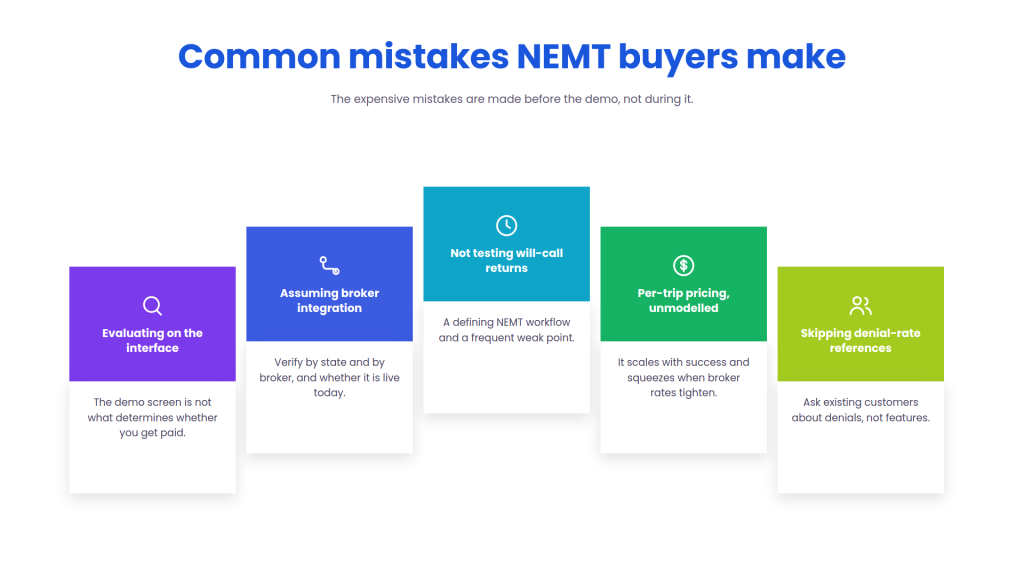
- Evaluating on the interface. The demo screen is not what determines whether you get paid.
- Not testing will-call returns. It is a defining NEMT workflow and a frequent weak point.
- Ignoring multi-loading constraints. Efficiency that breaches appointment windows or mobility requirements is not efficiency.
- Treating HIPAA as a checkbox. Get the BAA and the data handling terms in writing during procurement.
- Choosing per-trip pricing without modelling growth. It scales with success and squeezes exactly when broker rates tighten.
- Skipping denial-rate references. Ask existing customers about denials, not features.
- Underestimating standing-order migration. Recurring dialysis and treatment schedules are laborious to rebuild and easy to get wrong.
How to implement without disrupting service
- Migrate standing orders first and them twice. A missed dialysis trip is a clinical problem, not an operational one.
- Run parallel billing for at least one full cycle. Compare claim outcomes before switching off the old system.
- Pilot on one service area or vehicle group, not the whole fleet.
- Train billing staff before dispatchers. Denials surface later and cost more than scheduling mistakes.
- Baseline three metrics first: on-time performance, denial rate and trips per vehicle.
- Brief drivers on attestation capture specifically — it is the step most likely to break a claim.
- Review at 60 days against those metrics, and keep the old system’s data accessible until you are certain.
The bottom line: which should you choose?
If your revenue comes through Medicaid brokers, shortlist the NEMT specialists — RouteGenie, MediRoutes, Tobi, NEMT Cloud Dispatch or Bambi depending on whether billing depth, volume handling or scheduling automation is your bottleneck. Verify broker connectivity in your state first.
If you are a healthcare system, large provider or transit agency, look at Momentm, Ecolane or TripSpark, where scale and demand-response depth matter more than per-seat cost.
If you sit on the payer or network side, Kinetik operates on that layer rather than the provider’s.
Go with AllRide if your medical transport is private-pay, facility-contracted, care-home based, or operating outside the US Medicaid system — particularly if you also run shuttles, transfers or other passenger services and want one branded platform with automated dispatch across all of it. If Medicaid claims are your revenue, pair it with a billing specialist or choose one of the NEMT platforms above.
Whichever you shortlist, run the demo on your own hardest day: a standing order, a will-call return, a mobility mismatch, a no-show, and a denied claim being corrected.
Frequently asked questions
What is the best NEMT software?
There is no universal best — it depends on your payer mix. Medicaid providers with broker volume should evaluate NEMT specialists such as RouteGenie, MediRoutes, Tobi, NEMT Cloud Dispatch and Bambi. Agencies and healthcare systems should look at Momentm, Ecolane or TripSpark. Providers running private-pay or facility-contracted medical transport, especially alongside other passenger services, can consider operations platforms such as AllRide.
What is NEMT dispatch software?
NEMT dispatch software assigns authorised patient trips to appropriate vehicles and drivers, accounting for mobility level, appointment time, vehicle capability and driver availability, then tracks execution through pickup, drop-off and return leg. It differs from general dispatch software because trips carry clinical and payer requirements that determine both vehicle suitability and whether the trip can be billed.
How much does NEMT software cost?
NEMT software is typically priced per trip, per vehicle or per user per month, and sometimes as a percentage of billed claims. Beyond the base rate, confirm whether the billing module, broker integrations, driver app, implementation and training are included. Model the total at double your current trip volume, since per-trip pricing scales directly with growth.
Does NEMT software handle Medicaid billing?
Dedicated NEMT platforms generally do, including claim generation, payer rules and denial management. General transport and fleet platforms usually do not, and providers using them typically pair them with a billing system. Since claims are how a Medicaid NEMT provider gets paid, billing capability should be verified before anything else in the evaluation.
What broker integrations should NEMT software have?
That depends entirely on your state and payer mix — common brokers include Modivcare, MTM and Access2Care, alongside state-specific programmes. Ask vendors which brokers they connect to, in which states, and whether the integration is live rather than planned. A platform without your broker means manual trip entry, which erodes most of the efficiency you are buying.
Is NEMT software HIPAA compliant?
Compliance depends on the vendor and on how the system is configured and used, so treat it as a procurement requirement rather than a feature claim. Ask where patient data is stored, who can access it, what audit trails exist, what the retention policy is, and whether the vendor will sign a business associate agreement. Involve whoever owns compliance in your organisation early.
What is AI-powered NEMT software?
AI-powered NEMT software applies machine learning to specific NEMT problems: building schedules that respect mobility levels and appointment windows, optimising multi-loading so vehicles carry more compatible trips, predicting no-shows from historical patterns, and flagging claims likely to be denied before submission. Ask what the system learns from and whether dispatchers can override it, since automated decisions here affect patient safety.
Can AI reduce NEMT no-shows?
It can help. Patterns in patient history, appointment type and time of day can identify trips at higher risk of a no-show, letting dispatchers confirm in advance or schedule differently. Since a no-show is both an unbillable trip and a wasted vehicle slot, even modest prediction accuracy has a direct revenue effect — but it supplements confirmation calls rather than replacing them.
What is the difference between NEMT scheduling and NEMT routing software?
Scheduling determines which trips happen when and which vehicle and driver are assigned, including standing orders and appointment windows. Routing determines the sequence and path those trips take, including multi-loading compatible passengers. Most platforms include both, but they differ in depth — providers whose problem is dispatcher workload need scheduling depth, while those whose problem is empty seats need routing depth.
What should we test in a NEMT software demo?
Build a standing order for a dialysis patient, add a will-call return leg, create a mobility mismatch and confirm the system prevents it, record a no-show, and take a denied claim through correction and resubmission. Then check what the driver sees, how attestation is captured, and what reporting you can pull on denial rate and trips per vehicle.
Conclusion
NEMT software is bought under a constraint most transport software is not: your customer is a payer, and the trip only counts if the paperwork is right. That makes billing accuracy and broker connectivity the first filter, scheduling depth the second, and AI the third — however compelling the algorithm demo.
So evaluate in that order. Verify broker integration by state before you book demos. Ask existing customers about denial rates rather than features. And test the workflows that actually break: standing orders, will-call returns, mobility mismatches and denied claims.
If your medical transport runs on private-pay or facility contracts rather than Medicaid claims — and especially if you operate other passenger services alongside it — book a free AllRide demo and run it against your own schedule.